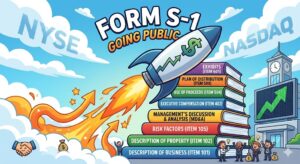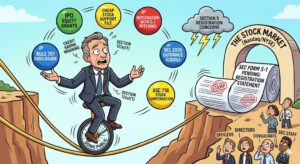


Using Form S-1 to Go Public: A Detailed Breakdown of Regulation S-K Items and SEC Expectations
Form S-1 is the primary registration statement used by issuers under the Securities Act of 1933 to register securities for public sale.…
Read MoreBlog
Insights on securities law, exchange listings, going public, SEC reporting, and market regulation. Stay updated with our latest articles on capital markets compliance, regulatory developments, and strategic guidance for public and private companies.
Form S-1 is the primary registration statement used by issuers under the Securities Act of 1933 to register securities for public sale.…
Read MoreThe Securities and Exchange Commission has rescinded its long-standing SEC no-deny settlement policy, ending a rule that for more than 50 years…
Read MoreCompanies going public using a Form S-1 registration statement often continue to issue equity to officers, directors, employees, and consultants while the…
Read MoreWhy Shareholders Need a Legal Opinion Before Selling Restricted Securities A shareholder may own stock, but that does not always mean the…
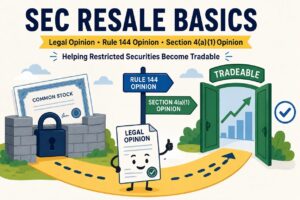
Read MoreWhy SEC Resale Opinions Matter A legal opinion can be a critical step in moving restricted or controlled securities from a blocked…
Read MoreA legal opinion is one of the most important documents filed with an SEC registration statement. For issuers conducting registered offerings, the…
Read MoreNasdaq $5 Million Minimum Offering Proceeds Rule: What IPO and OTC Uplisting Companies Need to Know Nasdaq’s initial listing liquidity rules changed…
Read MoreOverview: Nasdaq Raises the Bar for SPAC IPO Listings Nasdaq has adopted enhanced initial listing standards for special purpose acquisition companies, commonly…
Read MoreOn May 5, 2026, the Securities and Exchange Commission proposed rule and form amendments that would allow public companies to satisfy their…
Read MoreBy Securities Lawyer 101 | Securities Lawyers Gone Wild The latest SEC insider trading complaint has many familiar ingredients: confidential merger information,…
Read MoreThe Path from OTC to National Exchange Uplisting from the OTC Markets to Nasdaq or NYSE expands investor access, liquidity, and visibility.…
Read MoreEvery initial public offering (IPO) in the United States relies on a team of financial intermediaries known as underwriters. Underwriters are investment banks that…
Read MoreMany believe going public is limited to Fortune 500 giants. In reality, smaller issuers can access public capital through Direct Public Offerings (DPOs), Regulation…
Read MoreWhat Is a Super 10-K? How Delinquent SEC Filers Request Relief and the Downside of Using One Issuers that fall behind on…
Read MoreFor small and mid-size companies, the costs, dilution, and loss of control associated with a traditional underwritten Initial Public Offering (IPO) can…
Read MoreTransitioning from a private company to a public company involves more than filing a registration statement with the U.S. Securities and…
Read MoreWhen a private company decides to go public, it faces several potential pathways—each differing in structure, cost, timing, dilution, and control. This…
Read MoreForm 10 Shells occupy a unique niche in the U.S. capital markets. These corporations register a class of securities under the Securities…
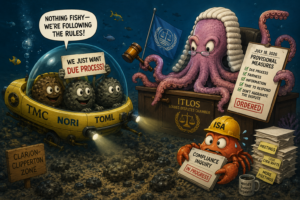
Read MoreThe Case for a U.S. Deep-Sea Mining Association The case for a U.S. deep-sea mining association is no longer theoretical; it is a…
Read MoreThis guide provides a comprehensive comparison between Free Writing Prospectuses (FWP) and Testing-the-Waters (TTW) communications. While these investor presentations often look identical,…
Read MoreWhat we help issuers accomplish on Nasdaq & NYSE Compliance We advise issuers on Nasdaq and NYSE corporate governance and continued listing…
Read MoreRecent SEC orders suggest a more practical path to relief for individuals seeking reentry after administrative bars, including penny stock bars, and…
Read MoreRegulation S-K Item 401 is an SEC requirement designed to provide investors with essential background information on the individuals leading a company.…
Read MoreA restrictive legend on a stock certificate acts as a practical trading freeze, signaling that shares cannot be sold unless registered under…
Read MoreIn the world of SEC reporting, Section 16a compliance is often viewed as a routine administrative task. However, treat it too lightly,…
Read MoreDirector independence is a core corporate governance requirement for a Nasdaq listing. It affects whether the board can satisfy the majority independent…
Read More“Testing the waters” (TTW) communications let an issuer conducting an IPO, and anyone acting on its behalf, such as its underwriters, gauge…
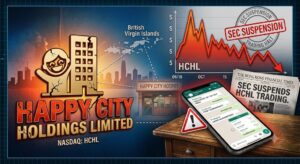
Read MoreMessage boards and social platforms can move thinly traded and microcap stocks quickly. That speed is exactly why the U.S. Securities and…
Read MoreOn September 30, 2025, we explored how deep-sea mining companies raising capital must treat regulatory uncertainty, international conflict, and expected challenges as…
Read MoreA free writing prospectus, commonly called an FWP, is a written offering communication used in a registered securities offering that is…
Read MoreExplore our curated collection of external resources and industry links that complement our blog content. These hand-picked links provide additional perspectives on securities law, market regulations, and business compliance.