


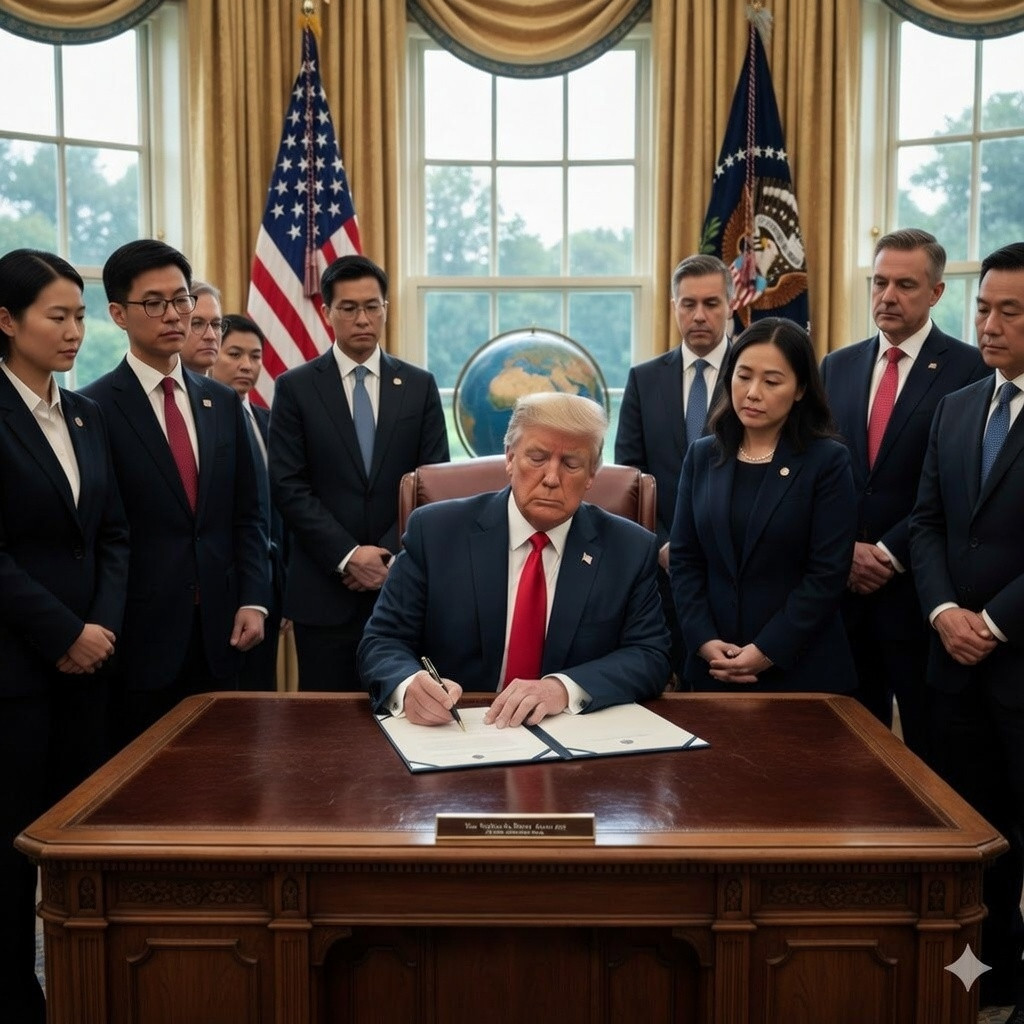
On December 18, 2025, President Trump signed the National Defense Authorization Act (NDAA) into law. While the legislation is primarily focused on national security and defense policy, it also includes a significant amendment to U.S. securities laws that will materially affect foreign private issuers (FPIs) and their senior leadership, including SEC reporting requirements. Section 8103 of the NDAA, known as the Holding Foreign Insiders Accountable Act, amends Section 16(a) of the Securities Exchange Act of 1934 to require directors and executive officers of FPIs to comply with U.S. insider reporting requirements for the first time.
This change represents a major shift in regulatory expectations for foreign companies accessing U.S. capital markets and reflects a growing emphasis on transparency and accountability for foreign issuers. The amendments become effective on March 18, 2026, leaving FPIs with a limited window to prepare for compliance.
Background: Section 16 and Foreign Private Issuers
Section 16 of the Securities Exchange Act of 1934 is designed to promote market transparency by requiring corporate insiders to disclose their ownership of, and transactions in, the issuer’s equity securities. As discussed in What Is Section 16 Reporting? (https://www.securitieslawyer101.com/2013/01/02/section-16-reporting/), Section 16(a) has historically applied to directors, executive officers, and beneficial owners of more than 10% of a registered class of equity securities of U.S. domestic issuers.
For decades, directors and officers of foreign private issuers were exempt from Section 16(a) reporting obligations. That exemption reflected a policy choice to reduce regulatory burdens on foreign companies and to recognize differences between U.S. and non-U.S. corporate governance regimes. Section 8103 of the NDAA eliminates that exemption for directors and officers, bringing FPIs closer to parity with domestic issuers with respect to insider disclosure obligations.
Although FPIs will continue to follow the foreign issuer disclosure framework under the Exchange Act, including reporting on Form 20-F and Form 6-K (https://www.securitieslawyer101.com/2025/01/08/foreign-private-issuer-periodic-reporting-on-form-20-f-and-form-6-k/), insider reporting under Section 16(a) will now apply directly to their directors and executive officers.
Who Is Now Subject to Section 16(a) SEC Reporting?
Beginning March 18, 2026, every director and executive officer of a foreign private issuer with a registered class of equity securities under the Exchange Act will be subject to Section 16(a). This includes directors of FPIs, whether executive or non-executive directors, executive officers of FPIs who perform policy-making functions, and officers and directors of FPIs that list equity securities on U.S. exchanges or otherwise register securities under the Exchange Act, including in connection with a U.S. initial public offering.
Existing directors and officers of FPIs must file an initial Form 3 on March 18, 2026. Any individual who becomes a director or executive officer after that date must file a Form 3 within 10 calendar days of assuming the position. FPIs conducting an initial public offering in the United States should ensure that their directors and officers are prepared to file initial ownership reports as part of the IPO process, consistent with Exchange Act registration requirements for foreign issuers (https://www.securitieslawyer101.com/2024/03/23/going-public-exchange-act-registration-for-foreign-issuers/).
Initial Reporting Obligations: Form 3
Form 3 is the initial ownership report required under Section 16(a). It discloses the insider’s beneficial ownership of the issuer’s equity securities as of the date the reporting obligation arises. For FPIs, March 18, 2026 will serve as the triggering date for current directors and officers.
As explained in SEC Form 3, Insider Reporting Requirements (https://www.securitieslawyer101.com/2020/06/24/sec-form-3-insider-report/), Form 3 filings must accurately reflect all reportable equity interests, including ordinary shares, ADRs, options, restricted stock units, and other equity-based awards. Errors or omissions in Form 3 filings can result in reputational risk, corrective filings, and increased SEC scrutiny.
Ongoing Reporting Obligations: Forms 4 and 5
After filing the initial Form 3, directors and executive officers of foreign private issuers will be subject to ongoing Section 16(a) reporting requirements similar to those applicable to insiders of U.S. domestic issuers.
Form 4 must generally be filed within two business days of most reportable transactions, including open market purchases and sales, option exercises, equity award grants, and certain transfers. The two-business-day deadline is strict and leaves little margin for delay, particularly for insiders located outside the United States.
Form 5 is an annual filing that may be required for certain transactions or holdings that were exempt from Form 4 reporting or inadvertently not reported during the fiscal year. If required, Form 5 must be filed within 45 days after the end of the issuer’s fiscal year. Additional detail is discussed in What Is SEC Form 5 — SEC Reporting Requirements (https://www.securitieslawyer101.com/2020/04/27/sec-form-5-when-is-it-due-sec-reporting-requirements/).
EDGAR Access and Administrative Preparation
All Section 16 filings must be submitted electronically through the SEC’s EDGAR system. For many FPI directors and officers, particularly those located outside the United States, obtaining EDGAR access credentials may be unfamiliar and time-consuming.
FPIs are strongly encouraged to begin the EDGAR enrollment process well in advance of the March 18, 2026 effective date. Early coordination can help avoid last-minute filing delays and compliance failures. Companies should also consider whether powers of attorney will be used to allow U.S. counsel or internal compliance personnel to make timely filings on behalf of insiders.
What the NDAA Does Not Change
Although Section 8103 significantly expands disclosure obligations for FPI insiders, its scope is limited. The amendments do not extend Section 16(a) reporting requirements to beneficial owners of more than 10% of an FPI’s registered equity securities. In addition, the NDAA does not impose Section 16(b) short-swing profit disgorgement liability on directors or officers of foreign private issuers.
As a result, while disclosure obligations are expanded, FPIs are not exposed to the full range of insider liability that applies to domestic issuers under Section 16.
Practical Compliance Considerations for FPIs
FPIs should treat the March 18, 2026 effective date as a firm compliance deadline and begin preparing now. Key steps include identifying covered insiders, educating directors and officers about U.S. insider reporting rules, implementing transaction pre-clearance and reporting procedures, and coordinating closely with U.S. securities counsel.
Failure to comply with Section 16 reporting requirements can result in public disclosure of delinquent filings in annual reports and other SEC filings, as well as heightened regulatory and investor scrutiny. Proactive planning remains the most effective way to mitigate these risks within the broader framework of U.S. capital markets compliance for foreign issuers (https://www.securitieslawyer101.com/foreign-issuers/).
Conclusion
The extension of Section 16(a) reporting requirements to directors and executive officers of foreign private issuers marks a significant evolution in U.S. securities regulation. With enhanced transparency now required, FPIs must adapt their compliance frameworks to align with U.S. insider reporting standards.
Foreign private issuers, their boards, and executive teams should consult experienced U.S. securities counsel to ensure timely compliance with these new obligations and to integrate Section 16 reporting into their broader governance and disclosure practices.