
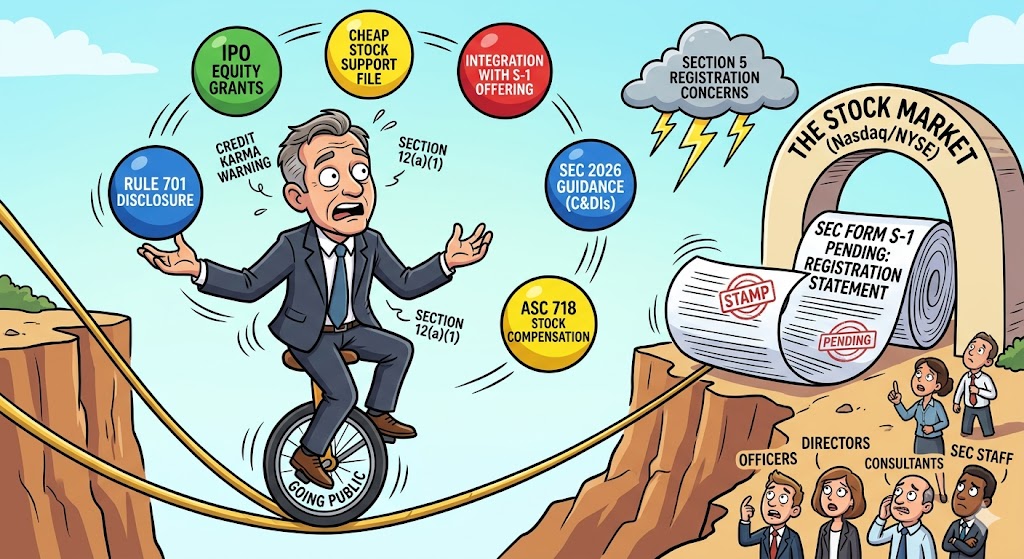
Companies going public using a Form S-1 registration statement often continue to issue equity to officers, directors, employees, and consultants while the Form S-1 is pending with the Securities and Exchange Commission. Compensating service providers with stock is common, but the timing creates two related issues that pre-IPO issuers frequently underestimate: potential Section 5 registration concerns under the Securities Act of 1933 and cheap-stock comments that the SEC Staff routinely raises during Form S-1 review.
This article explains how Rule 701 of the Securities Act operates as the principal federal exemption for compensatory stock grants during the going-public process, how Rule 152 protects qualifying Rule 701 grants from integration with a registered offering, what the SEC’s March 6, 2026 Corporation Finance Interpretations clarify, why the Credit Karma cease-and-desist order remains an important warning, and how cheap stock can delay or reprice an IPO if not addressed before the S-1 is filed.
Why Issuing Stock While an S-1 Is Pending Triggers Section 5
Section 5 of the Securities Act prohibits offers and sales of securities unless the offering is registered with the SEC or qualifies for an exemption from registration. When a private company files, or confidentially submits, a Form S-1 for an initial public offering or other going-public transaction, every additional securities issuance made during the same period must independently fit within an exemption from registration or be registered. If it does not, the offer or sale may violate Section 5.
If the SEC or a court integrates a contemporaneous private issuance with a pending registered offering, the private exemption may be unavailable. The integrated offering may then be treated as part of the registered public offering, and the unregistered issuance may create Section 5 exposure.
A failed exemption can create Section 12(a)(1) rescission or damages exposure for purchasers of the securities, subject to the one-year limitations period and three-year repose period in Section 13 of the Securities Act. For a company in registration, potential rescission or damages exposure can become a material contingent liability that must be evaluated for prospectus disclosure and underwriter diligence.
The good news for companies issuing compensatory equity is that Rule 701 and Rule 152 provide a clean integration framework when the grant is properly structured. Rule 701 itself treats compliant Rule 701 offers and sales as a single, discrete compensatory offering that is not integrated with other offers and sales. Rule 152(b)(2) separately provides that offers and sales made in compliance with Rule 701, pursuant to an employee benefit plan, or in compliance with Regulation S will not be integrated with other offerings. For companies preparing an IPO, that protection is the reason Rule 701 remains the workhorse exemption for compensatory equity issuances during the going-public process.
What Rule 701 Permits During the Going-Public Process
Rule 701 is the federal exemption from securities registration most frequently used by private companies to grant compensatory equity awards, including stock options, restricted stock, restricted stock units, and direct share issuances to eligible service providers. The exemption is unavailable to companies that are subject to Exchange Act reporting obligations, which places Rule 701 squarely in the pre-IPO and pre-reporting-company window.
To qualify for Rule 701, the issuer should confirm the following core conditions before making the grant:
Eligible issuer. The company cannot be subject to the reporting requirements of Section 13 or Section 15(d) of the Securities Exchange Act of 1934, and it cannot be an investment company registered or required to be registered under the Investment Company Act of 1940. Filing or confidentially submitting an S-1 does not, by itself, make the issuer an Exchange Act reporting company. Rule 701 generally remains available until the issuer becomes subject to Exchange Act reporting. If the issuer becomes reporting after making Rule 701-compliant offers, Rule 701 may still cover sales of securities previously offered to the persons to whom those offers were made, but the rule is not available for new post-reporting-company offers.
Eligible recipient. Employees, officers, directors, general partners, trustees, and certain former service providers are eligible. Consultants and advisors are eligible only if they are natural persons, provide bona fide services to the issuer or qualifying related entities, and do not provide services in connection with the offer or sale of securities in a capital-raising transaction and do not directly or indirectly promote or maintain a market for the issuer’s securities. The natural-person requirement excludes entity consultants. The capital-raising and market-promotion restrictions generally exclude investor-relations firms, finders, securities analysts, and persons hired to help the company go public on the financing side.
Written compensatory benefit plan or written compensation contract. The issuance must be made under a written compensatory benefit plan or written compensation contract. The recipient must receive a copy of the plan or contract. Oral promises and post-hoc documentation do not satisfy the rule.
Twelve-month aggregate cap. The aggregate sales price or amount of securities sold in reliance on Rule 701 during any consecutive 12-month period cannot exceed the greatest of three measures: $1 million, 15% of the issuer’s total assets measured at the issuer’s most recent balance sheet date, or 15% of the outstanding amount of the class of securities being offered. For options, sales of the underlying securities are counted on the option grant date for Rule 701 purposes.
Enhanced disclosure above $10 million. If aggregate sales under Rule 701 in any consecutive 12-month period exceed, or are expected to exceed, $10 million, the issuer must deliver the additional Rule 701(e) disclosure package. That package generally includes a copy or summary of the compensatory plan or contract, risk factors associated with investment in the securities, and financial statements dated not more than 180 days before the sale. The required timing depends on the award type: for direct stock grants and RSUs, disclosure generally must be delivered a reasonable period before the sale or grant; for options and other derivative securities, Rule 701(e)(6) requires delivery a reasonable period before exercise or conversion.
The Credit Karma Cease-and-Desist Order Remains the Operative Warning
The clearest example of how Rule 701 noncompliance can become a Section 5 matter remains the SEC’s 2018 cease-and-desist order against Credit Karma, Inc. Between October 1, 2014 and September 30, 2015, Credit Karma granted approximately $13.8 million in employee stock options, exceeding the then-applicable $5 million enhanced-disclosure threshold, without providing the financial statements and risk disclosures required by Rule 701(e).
The SEC concluded that, because the required disclosure had not been delivered, the Rule 701 exemption was unavailable and the company violated Section 5. Credit Karma consented to a cease-and-desist order and a $160,000 civil penalty.
The lesson for pre-IPO issuers is straightforward: when the company crosses the Rule 701(e) disclosure threshold, partial compliance is not a cure. If required disclosure is not delivered on time to the required recipients, the exemption can be lost for the Rule 701 offering in the threshold-crossing period, creating potential rescission exposure, disclosure issues, and underwriter diligence problems.
What the SEC’s March 6, 2026 Rule 701 Guidance Clarified
On March 6, 2026, the SEC’s Division of Corporation Finance issued new and revised Corporation Finance Interpretations, often still referred to by practitioners as C&DIs, addressing Rule 701 mechanics. The interpretations do not amend Rule 701, but they clarify several issues that frequently arise for companies preparing to file or amend a Form S-1.
Option repricings count as new sales. When an issuer reprices an outstanding option downward, the repriced option is treated as a new sale for Rule 701 cap and disclosure-threshold purposes and must be counted in the 12-month period that includes the repricing date. If the repricing occurs within 12 months of the original grant, the issuer may exclude the original grant and count the repriced option instead, but the repricing itself must be tracked.
Forward-looking forecasting is required for the $10 million trigger. The Staff reaffirmed that Rule 701(e) disclosure must be provided to all investors in the Rule 701 offering if the issuer believes sales will exceed the $10 million threshold in the coming 12-month period, not only to recipients who receive awards after the threshold is crossed. An issuer that waits until after the threshold is crossed may lose the exemption for the entire Rule 701 offering in the threshold-crossing period.
RSU disclosure timing is based on the grant date. For RSUs that settle upon satisfaction of service or performance conditions with no additional consideration paid at settlement, the sale date for Rule 701 purposes is the grant date. If the issuer expects to cross the $10 million threshold, the enhanced disclosure must be delivered a reasonable period before the RSU grant, not before later settlement.
Multi-period grant patterns must be tested period by period. The Staff addressed option grants across three consecutive 12-month periods and clarified that the Rule 701(e) disclosure obligation is triggered by the value of options granted in the relevant period, based on exercise price, plus other securities sold in reliance on Rule 701 during that period. It is not triggered by vesting amounts or exercise amounts alone. A failure to deliver required disclosure in the threshold-crossing period causes the Rule 701 exemption to fail for the offering in that period, but not automatically for separate offerings in non-threshold periods.
The practical consequence is that companies preparing to file or amend a Form S-1 should run a forward-looking Rule 701 forecast before each grant cycle. A backward-looking reconciliation at the end of the fiscal year is not enough.
Documenting Rule 701 Issuances for the Form S-1
Underwriters’ counsel and the SEC Staff will diligence Rule 701 compliance, grant-by-grant. A Rule 701 file that can withstand S-1 review generally includes:
- The written equity plan or compensation contract, adopted by board resolution and approved by stockholders if required by state law, the plan, or corporate governance documents.
- Board or compensation committee minutes or written consents approving each grant.
- A written award agreement signed or otherwise accepted by each recipient, with evidence that the recipient received the plan or contract.
- For consultants and advisors, a written services agreement and documentation showing that the recipient is a natural person providing bona fide services unrelated to capital raising or market promotion for the issuer’s securities.
- A rolling 12-month Rule 701 tracker showing aggregate sales price and amount of securities sold under each of the three cap measures: the $1 million floor, 15% of total assets, and 15% of the outstanding amount of the class.
- If any 12-month period exceeds, or is expected to exceed, the $10 million threshold, evidence that the Rule 701(e) disclosure package was delivered to the required recipients a reasonable period before the applicable sale, RSU grant, option exercise, or conversion, depending on the award type.
- A cheap-stock support file tying each grant date to the contemporaneous 409A valuation, board approval, valuation methodology, and any material intervening business events.
Form S-1 discloses these issuances in Part II, Item 15, “Recent Sales of Unregistered Securities,” which requires the information called for by Item 701 of Regulation S-K. Although Part II is not part of the prospectus, related changes may also be needed elsewhere in the registration statement, including capitalization, dilution, executive compensation, MD&A, and financial-statement stock-compensation disclosure.
For each unregistered issuance in the past three years, the registrant should disclose the date, title, and amount of securities sold; the persons or class of persons to whom they were sold; the nature of the consideration received, including services; the exemption from registration claimed; a brief statement of the facts relied upon to make the exemption available; and, for options, warrants, or convertible securities, the terms of conversion or exercise.
Cheap Stock: The Other Issue That Holds Up Going Public
Even when Rule 701 compliance is clean, the SEC Staff will scrutinize the price at which compensatory equity was granted during the 12 to 18 months leading up to the IPO. This is the cheap-stock issue, and it surfaces frequently in Form S-1 review for operating companies.
Cheap stock arises when the fair value of the common stock underlying an equity award at the grant date is significantly lower than the midpoint of the estimated IPO price range later disclosed in the registration statement. The gap matters because the difference between the award price and the higher fair value at grant may produce additional stock-based compensation expense under ASC 718 that the issuer must record. If the grants were not contemporaneously valued in a way that supports the grant-date fair value, the issuer may need to revise or restate financial statements, which can delay the IPO and extend SEC comment review.
The Staff’s cheap-stock comment typically asks the issuer to reconcile, on a step-by-step basis, the change in fair value between each grant date in the preceding 12 to 18 months and the midpoint of the IPO price range. The issuer is expected to identify specific value-driving events, such as a financing at a higher valuation, a regulatory milestone, a major customer contract, completed clinical results, a revenue inflection point, or other development that explains each step-up. Bare assertions that valuations rise as IPOs approach are not sufficient.
Practical steps to mitigate cheap-stock exposure include:
- Obtaining contemporaneous Section 409A valuations from an independent appraiser at least every 12 months and after events reasonably likely to change fair value materially, such as financings, new contracts, regulatory milestones, secondary transactions, or significant operating developments.
- Pricing each option grant at or above the fair value reflected in the most recent valuation and refreshing the valuation before any large grant cluster.
- Maintaining a written narrative, typically prepared with accounting advisors or the audit committee, explaining each valuation step-up by reference to identifiable business events.
- Coordinating the 409A valuation, ASC 718 accounting analysis, and S-1 disclosure before filing or publicly disclosing the anticipated IPO price range.
- Avoiding new equity grants after the company has agreed on an IPO price range with underwriters but before the offering prices, unless the company is prepared to support the grant price and related compensation accounting.
Cheap stock and Rule 701 compliance overlap, but they are not the same analysis. For Rule 701 cap purposes, options are valued based on their exercise price, measured at grant. A low exercise price may create ASC 718, Section 409A, and SEC cheap-stock comment issues, but the Rule 701 cap calculation itself looks to the option exercise price. The compliance risk is greater where the issuer fails to track option grants, repricings, cancellations, RSUs, direct share issuances, or non-option awards correctly under Rule 701’s calculation rules.
What Should Not Be Done While the S-1 Is Pending
Several patterns recur in going-public engagements and almost always create avoidable problems:
Granting equity to entities under Rule 701. Rule 701 is unavailable for an issuance to an LLC, corporation, partnership, or other entity consultant. If a consultant operates through an entity, the issuer must analyze another exemption, typically Section 4(a)(2) or Rule 506(b), and the issuance will not receive Rule 701 treatment.
Issuing Rule 701 equity to investor-relations firms, finders, securities analysts, or capital-raising consultants. Even if the recipient is a natural person, services connected with capital raising, investor solicitation, securities promotion, or maintaining a market for the issuer’s securities disqualify the grant from Rule 701.
Backdating equity plan adoption or award agreements. The written plan or written compensation contract requirement is strict. A grant that was not made under proper written documentation cannot be fixed by creating paperwork later. Underwriters’ counsel will compare execution dates, board approvals, grant dates, and valuation dates.
Treating confidential S-1 submissions as a free pass. A confidential draft submission does not eliminate the need for an exemption for securities issued during the same period. The issuer should consider when the registered offering has commenced for Rule 152 purposes, whether IPO-related communications have occurred, and whether the compensatory issuance independently satisfies Rule 701 or another exemption.
Issuing stock to settle claims or vendor invoices without a separate exemption analysis. A claim settlement paid in stock, or a vendor invoice paid with shares, is a sale of securities for consideration other than cash. These issuances often do not fit Rule 701 because the recipient is not receiving compensatory equity under a written employee benefit plan or written compensation contract. They require a stand-alone Section 4(a)(2), Rule 506(b), or other exemption analysis and may create separate S-1 disclosure issues.
How Form S-1 Going-Public Transactions Wrap Up Rule 701
Once the issuer becomes subject to Exchange Act reporting, Rule 701 is no longer available for new compensatory offers. Continuing compensatory issuances after the issuer becomes a reporting company are typically registered on Form S-8, the short-form registration statement available for eligible employee benefit plan issuances by reporting companies.
Shares previously issued under Rule 701 remain restricted securities. However, Rule 701 provides a meaningful resale benefit. Beginning 90 days after the issuer becomes subject to Exchange Act reporting, non-affiliate holders of Rule 701 securities may generally resell those shares under Rule 144 without satisfying several of the conditions that ordinarily apply to restricted securities. Affiliates remain subject to additional Rule 144 conditions.
This shortened resale path is one of the practical benefits of structuring pre-IPO compensatory grants under Rule 701 rather than relying solely on Section 4(a)(2) or Regulation D.
Putting It Together
Companies going public on Form S-1 can continue to issue equity compensation while the registration statement is pending, but only if each issuance independently satisfies an exemption from Section 5 and survives integration analysis. Rule 701 is the practical answer for compensatory grants to employees, directors, officers, and qualifying natural-person consultants, and Rule 152(b)(2) keeps compliant Rule 701 grants from being integrated with the registered IPO.
The SEC’s March 6, 2026 Rule 701 guidance adds important detail on option repricings, RSU grant timing, multi-period grant patterns, and forward-looking forecasting of the $10 million disclosure trigger. A pre-IPO issuer should integrate that guidance into every grant cycle before filing or amending the Form S-1.
Cheap stock is the parallel problem. Even a Rule 701-compliant grant can hold up the IPO if the exercise price or grant-date fair value cannot be reconciled to the midpoint of the estimated IPO price range. Contemporaneous 409A valuations, disciplined grant timing, ASC 718 support, and a clear valuation narrative are the best defenses.
The Credit Karma cease-and-desist order remains the leading enforcement warning, and the SEC Staff’s 2026 guidance makes clear that the Staff expects forward-looking compliance, not after-the-fact reconciliation. For any company in the going-public process, mapping every recent equity issuance to the correct exemption, supporting each valuation, and disclosing each issuance accurately in the S-1 should be among the first items addressed before filing.
About the Author
Brenda Hamilton is a securities lawyer with Hamilton & Associates Law Group, P.A. The firm represents companies going public on Form S-1 on the Nasdaq Stock Market, the New York Stock Exchange, and the OTC Markets, as well as foreign private issuers using Form F-1.
For more on the Form S-1 registration statement, the JOBS Act, Rule 701, cheap stock, and going-public registration statements, contact Brenda Hamilton at Hamilton & Associates Law Group, P.A., 200 East Palmetto Park Road, Suite 103, Boca Raton, Florida 33432, telephone (561) 416-8956, www.securitieslawyer101.com.
This blog post is provided as a general informational service to clients and friends of Hamilton & Associates Law Group and should not be construed as legal advice on any specific matter. This post does not create an attorney-client relationship.