
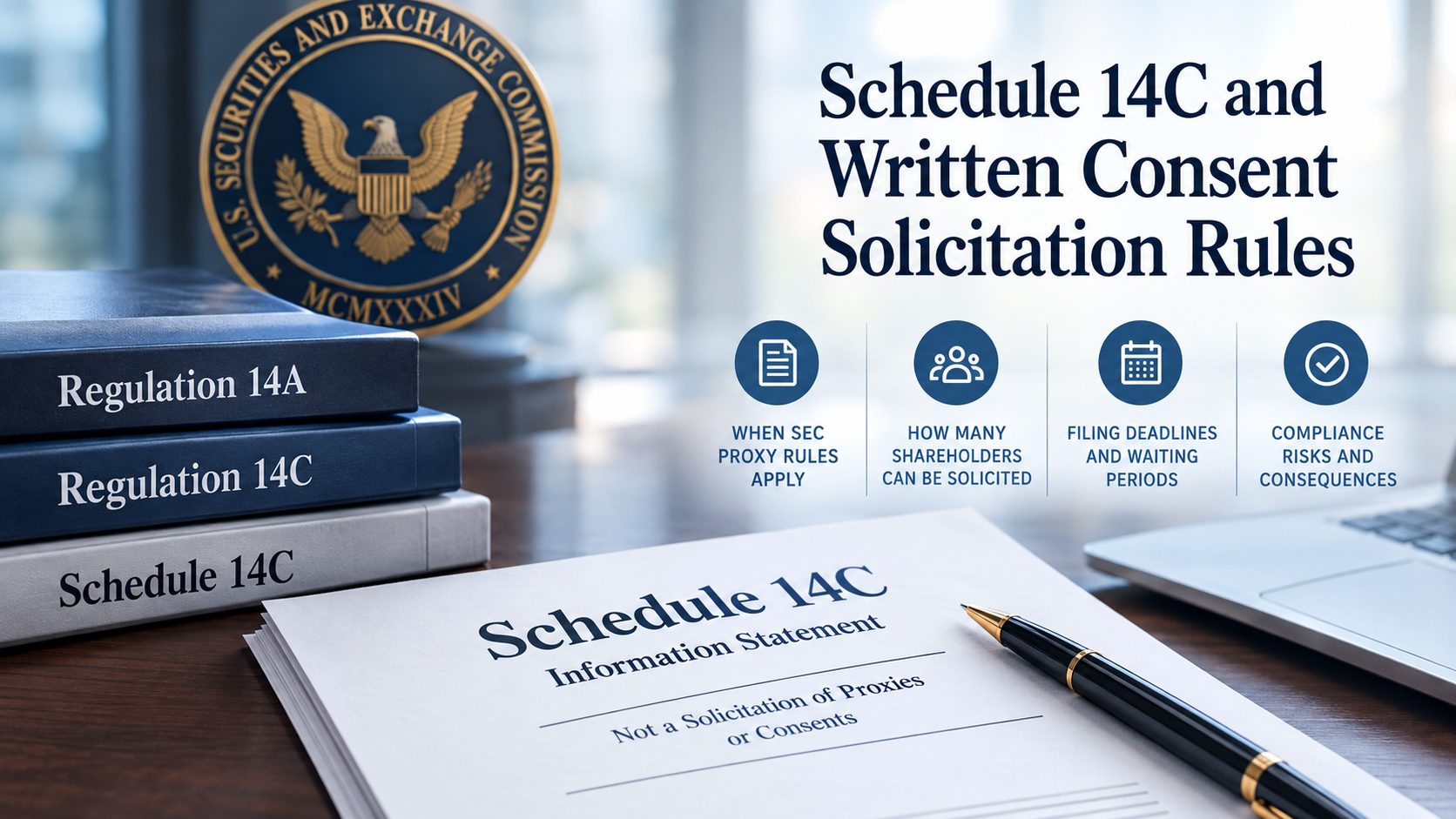
A request for a shareholder written consent can constitute a solicitation under the SEC proxy rules even when directed to only one shareholder. An issuer has no general exemption allowing it to request up to ten written consents. Rule 14a-2(b)(2), the ten-person exemption, applies only to solicitations made by someone other than the issuer. Schedule 14C provides information to shareholders whose approval the issuer is not soliciting; it does not exempt an issuer’s consent solicitation from Regulation 14A. [2, 3, 7]
Before choosing Schedule 14C, a public company must determine whether its communications solicit shareholder approval, whether an exemption applies and which disclosures shareholders must receive. Written consent is a method of corporate approval. Using it does not automatically permit the company to file a Schedule 14C information statement instead of complying with Regulation 14A.
Why SEC Proxy Rules Apply to Shareholder Written Consents
Section 14(a) of the Securities Exchange Act of 1934 expressly addresses solicitations of proxies, consents and authorizations. Rule 14a-1(f) likewise includes consents and authorizations within the term proxy. Consequently, a stockholder who signs directly, without appointing someone to vote at a meeting, can still be responding to a solicitation covered by the proxy rules. [1, 2]
This discussion concerns domestic public companies with a relevant class registered under Exchange Act Section 12. Reporting solely under Section 15(d) does not itself trigger the federal proxy rules. Securities registered by a foreign private issuer are exempt from Sections 14(a) and 14(c) under Rule 3a12-3(b). State corporate law and governing documents separately determine whether written consent is available and the approval required. [1, 12]
What Makes a Written Consent Request a Proxy Solicitation
Rule 14a-1(l) covers requests for a proxy, requests to execute, withhold or revoke one, and forms or other communications reasonably calculated to procure, withhold or revoke a proxy. Applying that definition to written consents requires examining the communication and its surrounding circumstances. [2]
Requests to Sign Withhold or Revoke a Written Consent
An issuer email asking a stockholder to sign an attached consent approving a reverse split ordinarily falls directly within the solicitation definition. The same analysis applies to a telephone request or a request to withdraw a previously delivered consent. A formal campaign or public announcement is unnecessary. [2]
Communications Designed to Influence Shareholder Approval
A communication may constitute a solicitation without expressly asking for a signature. The context may show that a presentation promoting a transaction is reasonably calculated to obtain stockholder approval. SEC Interpretation Question 101.02 explains that even a nonreporting acquisition target can solicit the public acquirer’s stockholders through communications promoting the transaction. [4]
Requests Made on the Issuer’s Behalf
Communications by an officer, counsel or another intermediary must be evaluated for their actual purpose and relationship to the issuer. A request made through an intermediary does not qualify for the ten-person exemption if it is made on the issuer’s behalf. An officer’s separate stock ownership does not automatically resolve that question. [1, 3]
Unsolicited Requests and Ministerial Assistance
Among other exclusions, Rule 14a-1(l)(2) excludes furnishing a form in response to a stockholder’s unsolicited request and performing ministerial acts on behalf of someone soliciting a proxy. These are fact-dependent exclusions. The stockholder’s request must actually be unsolicited, and the ministerial exclusion does not exempt the underlying solicitation. [2]
The determination does not depend on whether a stockholder ultimately signs. An unsuccessful request may still be a solicitation. Conversely, receipt of an independently initiated consent does not itself establish that the issuer solicited it. These conclusions follow from the rule’s focus on the request and communication rather than the eventual result. [2]
How Many Shareholders Can an Issuer Ask to Sign a Written Consent
Schedule 14C creates no numerical allowance for issuer solicitations. Asking one shareholder to sign can be a solicitation, just as asking several shareholders can. The relevant distinction is whether the issuer is soliciting approval and, if so, whether an exemption permits that solicitation. [2, 3]
Rule 14a-2(b)(2) exempts certain solicitations made otherwise than on behalf of the registrant when no more than ten persons are solicited. It is an exemption from specified requirements for a qualifying solicitation; it does not define when a communication first becomes a solicitation. Rule 14a-9’s prohibition against materially false or misleading solicitation statements continues to apply. [3]
For example, a stockholder independently seeking consents from eight other stockholders may qualify. An issuer seeking eight stockholder signatures cannot rely on the same exemption merely because the number is below ten. Having a friendly stockholder carry out the issuer’s request does not establish eligibility. [3]
Where the exemption is available, count persons solicited, including those who decline, rather than signatures obtained. SEC interpretation Question 122.01 treats one person holding through several nominee accounts as one person. Question 122.02 excludes responding to an unsolicited request for a proxy form from the count. Question 122.03 cautions that a Schedule 13D containing a broader appeal may expand the solicitation beyond ten persons. [4]
Rule 14a-2(b)(1) supplies a different exemption for certain communications that do not seek proxy authority or furnish or request a consent or authorization form. It excludes the registrant and other specified persons. It therefore does not provide an issuer with a general exemption for collecting written consents before filing Schedule 14C. [3]
Can a Company Use Schedule 14C After Asking Insiders to Sign
Assume three shareholders, including two directors, own 62% of the voting power. Management wants approval of a reverse stock split and instructs company counsel to email those holders a written consent with a request that they sign. The company plans to file Schedule 14C after receiving the signatures.
On those assumed facts, the request is an issuer solicitation even though only three people are contacted, two are insiders and public shareholders will not be asked to vote. The solicitation occurs when approval is requested. A later Schedule 14C filing does not supply an exemption for that request. The company must address Regulation 14A before seeking signatures. [2, 3, 5]
A controlling shareholder independently initiating and delivering a consent presents a different factual record. Counsel should document who initiated the action, what communications occurred, and on whose behalf each participant acted before concluding that Schedule 14C is appropriate. Share ownership or an insider title alone does not decide the solicitation question.
When to Use Schedule 14C for Shareholder Written Consent
Exchange Act Section 14(c) supplies the statutory basis for information statements when management does not solicit proxies, consents or authorizations under Section 14(a). Regulation 14C implements that requirement, and Schedule 14C specifies the information to disclose. Rule 14c-2 expressly covers corporate action by written consent and requires information for entitled holders from whom the issuer is not soliciting approval. [1, 7, 9]
For written consent transactions, there is no stockholder meeting and the information statement informs its recipients rather than requesting their approval. Regulation 14C also covers meetings where proxies are not solicited; the absence of a meeting is therefore not the legal test separating Regulations 14A and 14C. [7]
The rules address the recipients of the communication. Rule 14c-2 requires disclosure to entitled stockholders from whom the issuer is not soliciting approval. It does not excuse a separate solicitation directed to other holders. A Schedule 14C filing cannot serve as an exemption for an earlier issuer solicitation. [5, 7]
Schedule 14C Item 2 requires a prominent first-page statement that the company is not asking the recipient for a proxy and requests that none be sent. That legend describes the informational purpose of the document. Adding it to a document that actually requests consent does not change the substance of the request. Item 1 generally imports the applicable Schedule 14A disclosures, with specified exceptions. [9]
For the information statement’s item-by-item disclosure requirements, see What Is SEC Schedule 14-C. Our SEC Proxy and Information Statements resource also discusses proxy and information statements.
When Regulation 14A Requires a Consent Solicitation Statement
If the issuer plans to solicit written consents and no exemption applies, the process must comply with Regulation 14A, including the applicable Schedule 14A disclosure and delivery requirements. The disclosure may be called a consent solicitation statement even though no meeting will occur. [1, 5]
Rule 14a-3(a) establishes the baseline requirement to furnish the prescribed proxy statement to persons solicited. Rule 14a-12 conditionally permits solicitation communications before that delivery, with required legends, participant information and filing of written communications. Reliance on Rule 14a-12 requires that a definitive proxy statement be furnished before or at the same time consent forms are furnished or requested. It does not permit collecting signatures first and supplying disclosure afterward. [5, 6]
Rule 14a-6(a) generally requires filing a preliminary consent solicitation statement and consent form at least ten calendar days before definitive materials are first distributed, unless an exception or authorized shorter period applies. This preliminary filing requirement must be considered alongside the parallel Schedule 14C requirement under Rule 14c-5. [10]
For related background on soliciting shareholder approval, see Schedule 14-A Lawyers.
Schedule 14C Filing Deadlines and the Twenty-Day Waiting Period
When a preliminary information statement is required, Rule 14c-5 generally requires filing at least ten calendar days before definitive materials are first distributed, subject to its exceptions and SEC review. The definitive information statement must be filed no later than its first distribution. [8]
Rule 14c-2 generally requires furnishing the information statement at least twenty calendar days before the earliest date the corporate action may be taken. Filing on EDGAR alone should not be confused with satisfying the applicable stockholder delivery requirements. [7]
SEC Interpretation Question 182.01, issued January 23, 2026, addresses consents solicited by a dissident without the registrant’s knowledge. The staff explains that state law and governing documents determine effectiveness and that failure to satisfy Rule 14c-2’s twenty-day requirement does not invalidate the corporate action. In that fact pattern, the staff will not object if the issuer distributes the information statement as soon as practicable after learning of the consents. [4]
That limited staff position is not permission to shorten the Schedule 14C waiting period in an ordinary issuer-driven transaction. Failure to satisfy an applicable Rule 14c-2 delivery requirement remains a federal securities law violation even if the corporate action is valid under state law. Corporate effectiveness and federal compliance are separate issues. [7]
Notice and Access Delivery of Schedule 14C
Rule 14c-2(d) permits notice-and-access delivery of information statements through Rule 14a-16. Under the notice-only method, notice generally must be sent at least forty calendar days before consents may be used to effect corporate action. Full set delivery under Rule 14a-16(n) is exempt from that forty-day requirement, but Rule 14c-2’s twenty-day requirement generally still applies. Notice and access is unavailable for certain business combination transactions under Rule 14a-16(m). Select the Schedule 14C delivery method before setting the implementation date. [7, 11]
Broker Searches for Schedule 14C Distribution
In SEC interpretation Question 133.02, the staff states it will not object to a broker search fewer than twenty business days before the record date if the issuer reasonably believes materials will be distributed on time and otherwise complies with the rule. The staff expressly extends that position to Rule 14c-7(a)(3) for information statements. This timing flexibility does not shorten the Schedule 14C delivery period. [4]
State Law Notice to Shareholders Who Did Not Consent
Schedule 14C compliance does not eliminate separate state notice requirements. For Delaware corporations, DGCL Section 228(e) requires prompt notice of action taken by less than unanimous consent to nonconsenting holders entitled to the specified meeting notice. A Schedule 14C information statement may serve both purposes if its content and timing satisfy both regimes. The federal filing timetable should not be assumed to satisfy Delaware’s prompt-notice obligation. Section 228(e) also permits a qualifying notice of internet availability. [13]
Public companies listed on Nasdaq must also consider exchange meeting requirements separately. See Nasdaq Annual Meeting Rules Q and A Guide.
Consequences of Using Schedule 14C After an Issuer Solicitation
The SEC staff may ask how written consents were obtained and whether Regulation 14A applied. For example, comment 14 reproduced in World Racing Group’s May 20, 2009 SEC response letter asked whether management’s discussions with large holders about supporting a reverse split constituted a partial solicitation. The issuer’s response was its own legal position, not an SEC exemption or approval. [14]
An incorrect Schedule 14C approach can require corrective disclosure and, depending on the facts, a compliant Regulation 14A process and renewed consents, delaying implementation. Materially false or misleading solicitation statements may create Rule 14a-9 exposure; information statements are separately subject to Rule 14c-6. Private Section 14(a) claims also may arise, subject to the required elements. A technical filing error does not automatically establish a private damages claim. [5, 15, 18]
Mills v. Electric Auto-Lite Co., 396 U.S. 375, 384-385 (1970), addresses the requirement that the solicitation be an essential link in accomplishing the transaction. Virginia Bankshares, Inc. v. Sandberg, 501 U.S. 1083, 1100-1108 (1991), limits causation theories where minority votes were unnecessary. Those requirements matter when controlling holders already possess sufficient voting power. [16, 17]
Before requesting signatures, the company and its securities counsel should identify proposed communications, determine who will make them and on whose behalf, and establish whether Schedule 14C, Regulation 14A or a supported exemption governs the process.
The number of signatures needed for corporate approval and the number of persons who may be solicited under a federal exemption are separate questions.
Sources
- Exchange Act Section 14
- Rule 14a-1 Definitions
- Rule 14a-2 Exempt solicitations
- SEC Proxy Rules and Schedules 14A and 14C Interpretations, Questions 101.02, 122.01 through 122.03, 133.02 and 182.01
- Rule 14a-3 Information furnished to security holders
- Rule 14a-12 Solicitation before furnishing a proxy statement
- Rule 14c-2 Distribution of information statements
- Rule 14c-5 Filing requirements
- Schedule 14C Items 1 and 2
- Rule 14a-6 Preliminary and definitive filing requirements
- Rule 14a-16 Notice and access and full set delivery
- Rule 3a12-3 Foreign private issuer exemption
- Delaware General Corporation Law Section 228 particularly subsection e
- World Racing Group SEC correspondence dated May 20 2009 response to staff comment 14
- Rule 14a-9 False or misleading solicitation statements
- Mills v Electric Auto Lite Co 396 US 375 particularly pages 384 and 385
- Virginia Bankshares Inc v Sandberg 501 US 1083 particularly pages 1100 through 1108
- Rule 14c-6 False or misleading information statements
About the Author
Brenda Hamilton is a securities attorney with Hamilton & Associates Law Group, P.A.
Hamilton & Associates Law Group, P.A. | Securities Lawyer 101
Disclaimer: This article is provided for informational purposes only and does not constitute legal or tax advice. Securities rules change, so speak with qualified counsel about your specific situation.