
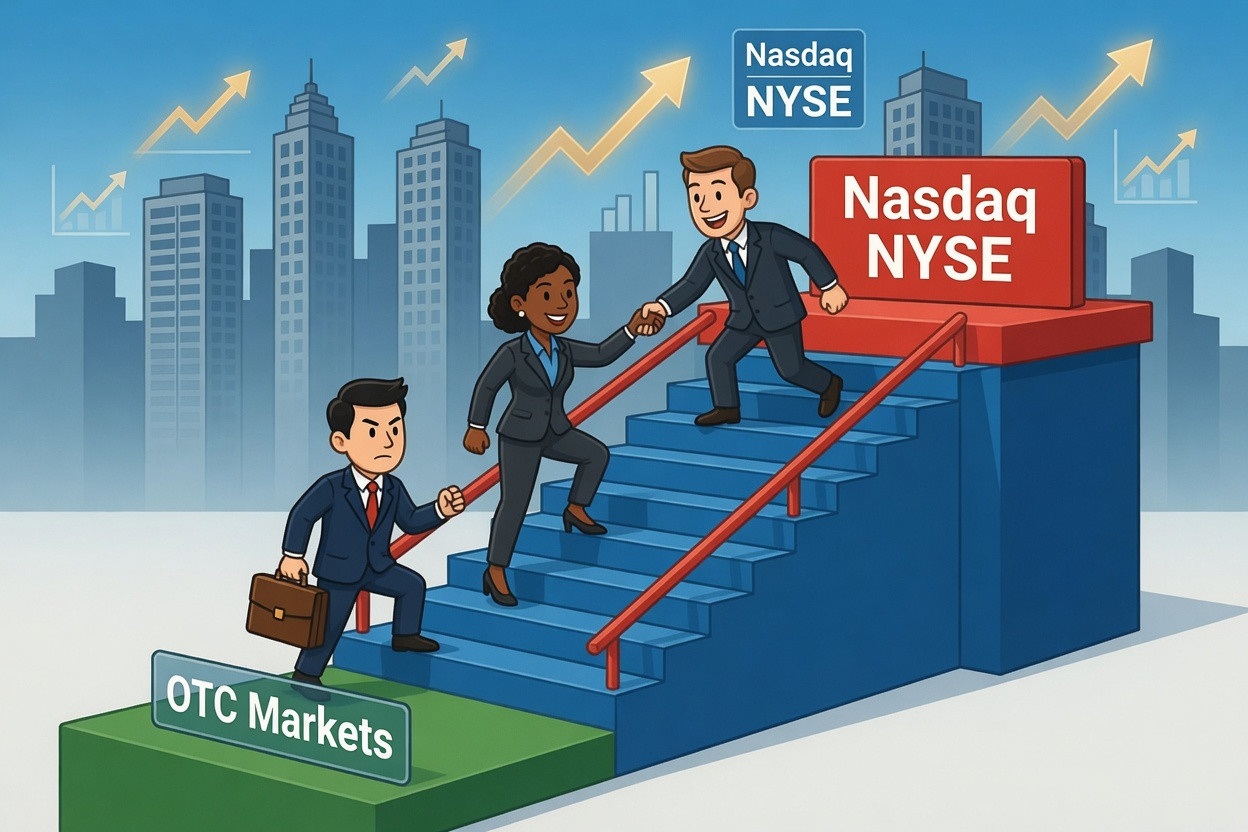
The Path from OTC to National Exchange
Uplisting from the OTC Markets to Nasdaq or NYSE expands investor access, liquidity, and visibility. It requires detailed preparation, compliance with exchange standards, and governance upgrades. Issuers who completed a DPO or registered on Form 10 often view uplisting as the next strategic milestone.
In 2026, the process is governed by stricter liquidity definitions and tighter audit timelines. Issuers must meet higher “unrestricted” share thresholds and comply with accelerated financial reporting standards.
Understanding Uplisting – What It Means
Uplisting transitions trading from OTC Markets to a national securities exchange. The process demands quantitative compliance, corporate governance readiness, and filing a formal listing application. Listed companies gain institutional exposure and often qualify for ETF and index inclusion.
Step 1 – Assess Eligibility Early
Companies must meet “Initial Listing” standards, which have been refined in 2026 to ensure immediate trading stability:
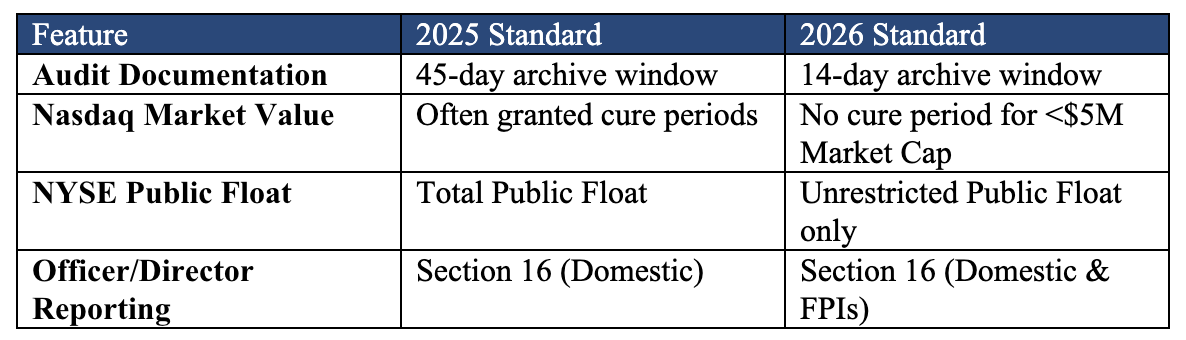
- Nasdaq Capital Market: Requires a $4 bid price and $5 million stockholders’ equity. A critical 2026 update: Nasdaq now enforces a strict $5 million “Market Value of Listed Securities” floor. If a company’s total market cap falls below this for 30 consecutive days, it faces immediate suspension with no cure period.
- NYSE American: Generally requires a $3–$4 share price and $4 million equity. As of April 2026, the NYSE American has increased scrutiny on “Publicly-held Shares.” The $15 million public float requirement must now be met exclusively by “Unrestricted Securities”—meaning shares not subject to lock-ups, Rule 144 restrictions, or held by affiliates.
Step 2 – Corporate Governance and Board Composition
Standard governance (majority-independent boards and independent audit/comp committees) remains the baseline. In 2026, exchanges require:
- Clawback Policies: Fully implemented policies for recovering erroneously awarded executive compensation.
- Cybersecurity Oversight: Disclosure of the board’s role in cybersecurity risk oversight is a mandatory component of the 2026 listing application.
Step 3 – Financial Reporting and PCAOB Audit Requirements
Uplisting applicants must provide U.S. GAAP financials audited by PCAOB-registered firms. Two years of audited financials are required (three for NYSE), and internal control reporting under Sarbanes-Oxley Section 404 must be in place. Issuers using OTC Alternative Reporting must become SEC-reporting before applying.
Requirements in 2026 now include the “14-Day” PCAOB Audit Rule.
- Under the amended PCAOB AS 1215, audit firms must now finalize and archive all audit documentation within 14 days of the report release date (down from 45 days).
- Because OTC records can often be fragmented, companies must have their books “audit-ready” well before the engagement begins. Any delay in providing records can now cause an auditor to miss this mandatory 14-day window, potentially delaying the entire uplisting.
Step 4 – Reverse Stock Split or Capital Restructuring
To meet the $3 or $4 minimum bid price, most OTC issuers perform a reverse stock split.
- You must still file with FINRA 10 business days in advance.
- 2026 updates to Nasdaq Rule 5550(a)(4) emphasize that “rounding up” fractional shareholders to whole shares during a split must be handled carefully to ensure it actually cures the 400 Round-Lot Shareholder requirement.
Step 5 – Filing the Exchange Application
The exchange application includes governance certifications, financial statements, and board documentation. A listing analyst reviews the submission and coordinates with SEC filings. Review typically takes 6–10 weeks before conditional approval and now includes a more aggressive “Liquidity Review.”
- Exchange analysts in 2026 are specifically looking for “concentrated holdings.” If 90% of your “public float” is held by only a few investors, the exchange may deny the application even if you meet the mathematical $15M threshold.
Step 6 – Publicity and Investor Relations Readiness
Post-approval, companies must comply with Regulation FD and discontinue promotional practices. Best practices include issuing accurate press releases, hosting earnings calls, and maintaining consistent SEC reporting. Paid promotions without proper disclosure risk violations under Section 17(b) and Rule 10b-5.
The “honeymoon period” for newly listed stocks has shortened:
- Immediate Suspension: Under 2026 rules, failing the $5M Market Value test results in an immediate Staff Delisting Determination. Unlike the “bid price” deficiency (which has a 180-day cure period), market value deficiencies in 2026 may lead to trading suspension while an appeal is pending.
Step 7 – Post-Uplisting Compliance and Monitoring
Listed issuers must maintain minimum bid and equity levels and file timely SEC reports. Deficiency notices are issued if requirements are breached, with a 180-day cure period available for most deficiencies.
Summary of Changes in 2026
Conclusion – Strategic Planning Drives Uplisting Success
Uplisting enhances credibility and liquidity but demands precise preparation. Governance, PCAOB audits, and proactive investor relations underpin long-term success.
For more information, contact Brenda Hamilton at (561) 416-8956 or by email at [email protected].