
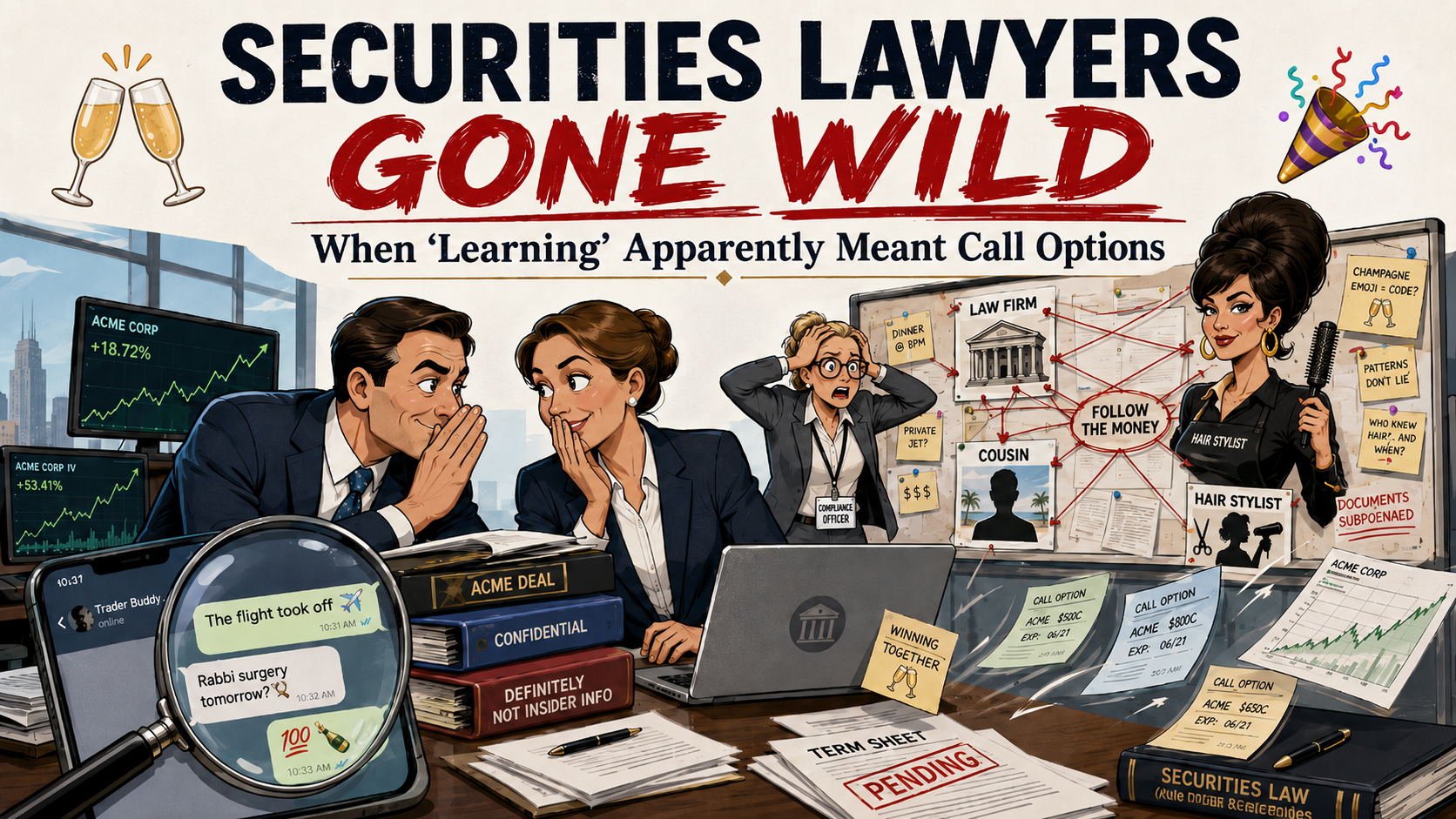
By Securities Lawyer 101 | Securities Lawyers Gone Wild
The latest SEC insider trading complaint has many familiar ingredients: confidential merger information, out-of-the-money call options, friends and relatives, alleged kickbacks, and a group chat that appears to have missed the lecture on discoverability. It also has a few less common ingredients, including coded references to flights, religious learning, a rabbi having surgery, and a tip chain that allegedly made a stop at a hair salon. Compliance departments may want tea. Strong tea.
The complaint, filed in the U.S. District Court for the District of Massachusetts, names 21 defendants and alleges a years-long insider trading scheme involving material nonpublic information about pending mergers, acquisitions, and a tender offer. The alleged sources of the information included lawyers who worked at global law firms and had access to confidential M&A files. The SEC says the scheme generated millions of dollars in illicit profits from trades in securities of companies including Momenta, SailPoint, iRobot, Momentive, Enstar, DSP Group, Citrix, Poshmark, KnowBe4, Qualtrics, Berkshire Grey, and NextGen Healthcare.
As always, these are allegations. The defendants have not been found liable. But as allegations go, the complaint is unusually well-stocked: a relationship chart, timing-heavy trading narratives, WhatsApp messages, alleged code words, and profit tables. It is less a complaint than a compliance training module with better pacing.
SEC insider trading complaint: what the agency alleges
According to the SEC, attorney Nicolo Nourafchan worked as a corporate associate at various law firms and allegedly misappropriated confidential information about impending corporate transactions. The complaint alleges that he tipped Robert Yadgarov and others, who then passed the information through a network of friends, relatives, business assochttps://www.sec.gov/iates, co-workers, and additional traders.
The SEC also alleges that Gabriel Gershowitz, another corporate lawyer and college acquaintance of Nourafchan and Yadgarov, was recruited into the alleged scheme and began providing material nonpublic information from his own law firm employers. The complaint says both lawyers were subject to law firm confidentiality policies. This will not surprise anyone who has ever worked at a law firm, where confidential deal documents are generally not treated as community bulletin board material.
The alleged mechanics were straightforward. The SEC says confidential deal information moved from lawyer sources to middlemen and then to downstream traders. Some allegedly traded in their own brokerage accounts. Some allegedly used accounts held in other names. Some allegedly tipped others. Some allegedly collected or routed kickbacks. It was, according to the SEC, not so much one tip as a distribution channel. One assumes there was no onboarding deck, although the complaint comes close.
The relationship chart nobody wants to appear in
Page 4 of the complaint includes a chart mapping the alleged flow of information. At the top sit the alleged M&A lawyer sources. From there, arrows move through friends, brothers, brothers-in-law, co-workers, business associates, and other participants. One branch allegedly runs from Nicolo Nourafchan to his brother Lorenzo Nourafchan, then to hair stylist Miakel Bishay, then to Bishay’s friend Nowel Milik.
There are many ways to describe that chart. “Strong internal controls” is not one of them. When an alleged insider trading network requires arrows from a law firm document system to a hair stylist to a friend, the structure has left the land of plausible deniability and entered the county fair of evidentiary arrows.
The alleged code words: flights, learning, and surgery
The SEC alleges that several defendants used coded language to discuss the tips and trading. “Flights” allegedly referred to deal announcements. “Learning” allegedly referred to passing inside information. Some religious references were allegedly used as cover language. In the iRobot allegations, the expected date of the Amazon-iRobot announcement was allegedly discussed as the timing of a “rabbi’s surgery.”
The dry lesson is that code words often become much less coded after the SEC lines them up next to timestamps, call records, brokerage activity, and announcement dates. A metaphor that looks clever in a chat can look quite different in paragraph 129 of a federal complaint.
For example, after Johnson & Johnson announced its acquisition of Momenta, one message in a WhatsApp trading group allegedly stated that “the flight took off this morning.” Another participant allegedly responded with a picture of LeBron James; another allegedly sent a picture of $100 bills. This is not ideal exhibit hygiene.
The deals at the center of the complaint
The SEC provides five detailed examples: Momenta, SailPoint, iRobot, Momentive, and Enstar. It also lists seven additional transactions allegedly traded by certain defendants. The complaint reads like a tour through recent M&A activity, except the tour guide is an enforcement lawyer and the souvenir is disgorgement.
Momenta: the tender offer problem
The Momenta allegations involve Johnson & Johnson’s 2020 acquisition of Momenta Pharmaceuticals through an all-cash tender offer. The SEC alleges that Nourafchan accessed confidential Law Firm A files about the transaction, despite not being assigned to the deal, and that information moved through Silverstein and others. Several defendants allegedly bought Momenta securities, including out-of-the-money call options, before the announcement.
Momenta is also legally important because the SEC brings tender offer claims under Exchange Act Section 14(e) and Rule 14e-3. Tender offer insider trading rules are their own special neighborhood, and the welcome sign is not especially warm.
SailPoint: the ship sailed, allegedly
The SEC alleges that Law Firm B represented SailPoint in its 2022 acquisition by Thoma Bravo. The complaint says Nourafchan accessed confidential SailPoint documents stored on Law Firm B servers in Massachusetts and that several defendants bought SailPoint stock or options before the deal announcement. After the announcement, one alleged message stated, “Ship just sailed!!!” Another stated, “We just arrived at the airport to watch the plane takeoff.”
One can appreciate the thematic consistency while still questioning the litigation strategy. In insider trading cases, aviation metaphors have a habit of landing in exhibits.
iRobot: the complaint’s main event
The iRobot allegations are the complaint’s centerpiece. Law Firm B represented iRobot in its proposed acquisition by Amazon. The SEC alleges that Nourafchan accessed documents, including a draft merger agreement, offer letter, and signing checklist. The agency says information then moved through multiple chains and led to trading by a large group of defendants.
The alleged profits are significant. The SEC says Nowel Milik made approximately $733,433 from iRobot trading; Daniel Kavian made approximately $276,448; Joseph Suskind made approximately $171,079; Yisroel Horowitz made approximately $136,253; and Mark Fensterszaub made approximately $111,496. The complaint also alleges that one defendant forwarded an article about insider trading charges and another responded with Google search results for “insider trading definition.” Continuing legal education is admirable. Timing remains important.
Momentive: fast trades and alleged special deliveries
The SEC alleges that Law Firm B represented an investment bank advising Momentive, the maker of SurveyMonkey, in a 2023 acquisition by a consortium led by Symphony Technology Group. The complaint says Nourafchan accessed deal documents, including a proposed merger agreement, an engagement letter, and fairness opinion materials. Multiple defendants allegedly bought Momentive stock and out-of-the-money call options before the announcement.
After the announcement, the SEC alleges that certain defendants paid kickbacks through routed transfers and in-person deliveries. One alleged message referred to a “special delivery lol.” In enforcement pleadings, “lol” is rarely a load-bearing legal defense.
Enstar: When the stock drops, but the case does not
The Enstar allegations are unusual because Enstar’s stock price declined after the July 2024 announcement. The SEC nevertheless alleges that Joseph Suskind made approximately $630,000 because he had purchased shares earlier at lower prices and later sold at a profit. The complaint alleges that Gershowitz, who was staffed on a potential Enstar transaction, provided material nonpublic information to Yadgarov, and that Yadgarov told him that he and Nourafchan had bought between $2 million and $3 million in Enstar stock.
The market does not always cooperate with the script. The SEC, however, appears willing to read the whole script anyway.
Additional alleged transactions
In addition to the five examples described in detail, the SEC lists alleged profitable trading ahead of announcements involving DSP Group, Citrix Systems, Poshmark, KnowBe4, Qualtrics, Berkshire Grey, and NextGen Healthcare. The complaint summarizes overall approximate trading profits for individual defendants, including approximately $3 million for Joseph Suskind, $1.2 million for Nowel Milik, $329,000 for David Bratslavsky, $293,000 for Daniel Kavian, and $271,000 for Yisroel Horowitz.
Why this case matters for securities lawyers and law firms
The law firm angle is what makes this SEC insider trading complaint especially relevant for securities lawyers. The complaint alleges that confidential deal information was obtained through law firm document management systems, including by searching keywords and viewing documents in preview or read-only mode to reduce the electronic trail. If true, that is not merely a trading problem. It is an information governance problem with a complaint number.
Law firms necessarily hold highly sensitive client information. M&A lawyers need access to deal documents, precedent files, diligence materials, signing checklists, board presentations, fairness materials, and closing sets. But broad access can become dangerous if access logs are not monitored, ethical walls are not tight, and unusual access patterns are not reviewed. “Trust us” is not a control environment; it is a wish with billing rates.
The complaint is also a reminder that insider trading risk does not remain politely inside the issuer, investment bank, or law firm. Once material nonpublic information leaves the building, it can move through social networks quickly. Family members, friends, co-workers, business associates, and service providers can become part of a tip chain. That is not a remote hypothetical. In this complaint, it is a diagram.
The legal claims: Rule 10b-5 and Rule 14e-3
The SEC brings claims under Exchange Act Section 10(b) and Rule 10b-5 against the alleged lawyer sources and downstream participants. The agency alleges that certain defendants traded or tipped while aware of material nonpublic information and while knowing, recklessly disregarding, or consciously avoiding knowing that the information had been obtained in breach of a duty of trust or confidence.
The SEC also brings tender offer claims under Exchange Act Section 14(e) and Rule 14e-3 in connection with Momenta. Rule 14e-3 can be especially powerful for the SEC because it applies to trading or tipping in the tender offer context after a substantial step toward the offer has been taken, where the person is in possession of material nonpublic information relating to the tender offer and knows or has reason to know the information is nonpublic and came from specified sources.
The requested relief includes permanent injunctions, disgorgement, prejudgment interest, civil monetary penalties, and other relief. The SEC also demanded a jury trial, which is a procedural way of saying the agency would like the full courtroom experience.
Compliance takeaways
The facts alleged in the complaint offer several practical lessons for law firms, public companies, investment banks, and anyone who thinks a clever nickname will outwit subpoena power.
- Audit document access around sensitive transactions. If a lawyer not staffed on a deal repeatedly accesses merger agreements, signing checklists, or board materials shortly before suspicious trades, the log may become a witness.
- Limit access where possible. M&A files, fairness materials, signing checklists, and board presentations should not be accessible on a casual curiosity basis.
- Monitor for unusual searches. Keyword searches across document systems can be useful for work product. They can also be useful for misconduct. Systems should help firms tell the difference.
- Train personnel that tipping is not safer than trading. Passing material nonpublic information to someone else can create serious liability even if the tipper never clicks the buy button.
- Treat messaging apps as discoverable. WhatsApp messages, texts, emojis, memes, and coded phrases can all become readable exhibits. The SEC has seen metaphors before.
- Do not mistake social distance for legal distance. A tip chain through relatives, friends, co-workers, or a stylist is still a tip chain.
FAQ: SEC insider trading complaint issues
What is the SEC alleging in this case?
The SEC alleges that lawyers and others participated in a tipping scheme involving material nonpublic information about pending corporate transactions. The agency says the information originated from law firm sources and moved through a network of middlemen and traders who bought securities before public announcements.
Why do M&A transactions create insider trading risk?
Pending mergers, acquisitions, and tender offers often move stock prices when announced. Because that information can be highly material and confidential, those who learn it through employment, advisory work, or a relationship of trust generally cannot trade on it or tip others to trade.
What makes law firm document access important?
Law firm document systems often contain draft merger agreements, diligence materials, board presentations, signing checklists, and transaction timelines. The SEC alleges that some of the confidential information in this case was obtained by accessing those kinds of law firm files. That makes access controls, audit logs, and matter restrictions central compliance tools.
What is Rule 14e-3?
Rule 14e-3 is an insider trading rule for tender offers. It can prohibit trading or tipping while in possession of material nonpublic information relating to a tender offer after a substantial step toward the offer has been taken. The SEC invokes Rule 14e-3 in the Momenta portion of the complaint.
Final thought
The serious lesson is simple: confidential M&A information remains one of the most sensitive categories of market-moving information, and lawyers who touch it are expected to treat it accordingly. The less serious lesson is also simple: if an alleged trading scheme involves a “Brothers in the Market” chat, out-of-the-money options, airplane metaphors, a hair stylist, champagne emojis, and someone Googling “insider trading definition,” the complaint may not need much embellishment.
The SEC has already brought the plot. Securities lawyers can bring the compliance memo.
Source note
This article is based on the SEC complaint filed in Securities and Exchange Commission v. Nicolo Nourafchan, Robert Yadgarov, Mark Alperin, Miakel Bishay, David Bratslavsky, Brian Fensterszaub, Mark Fensterszaub, Simon Fensterszaub, Gabriel Gershowitz, Fernando Grinberg, Boruch Hatanian, Yisroel Horowitz, Joseph Izsak, Daniel Kavian, Eliyahu Kavian, Nowel Milik, Lorenzo Nourafchan, David Ostrov, Gavryel Silverstein, Joseph Suskind, and Seth Winslow, Case No. 1:26-cv-12068, filed May 6, 2026 in the U.S. District Court for the District of Massachusetts. The facts described above are allegations unless otherwise stated.