
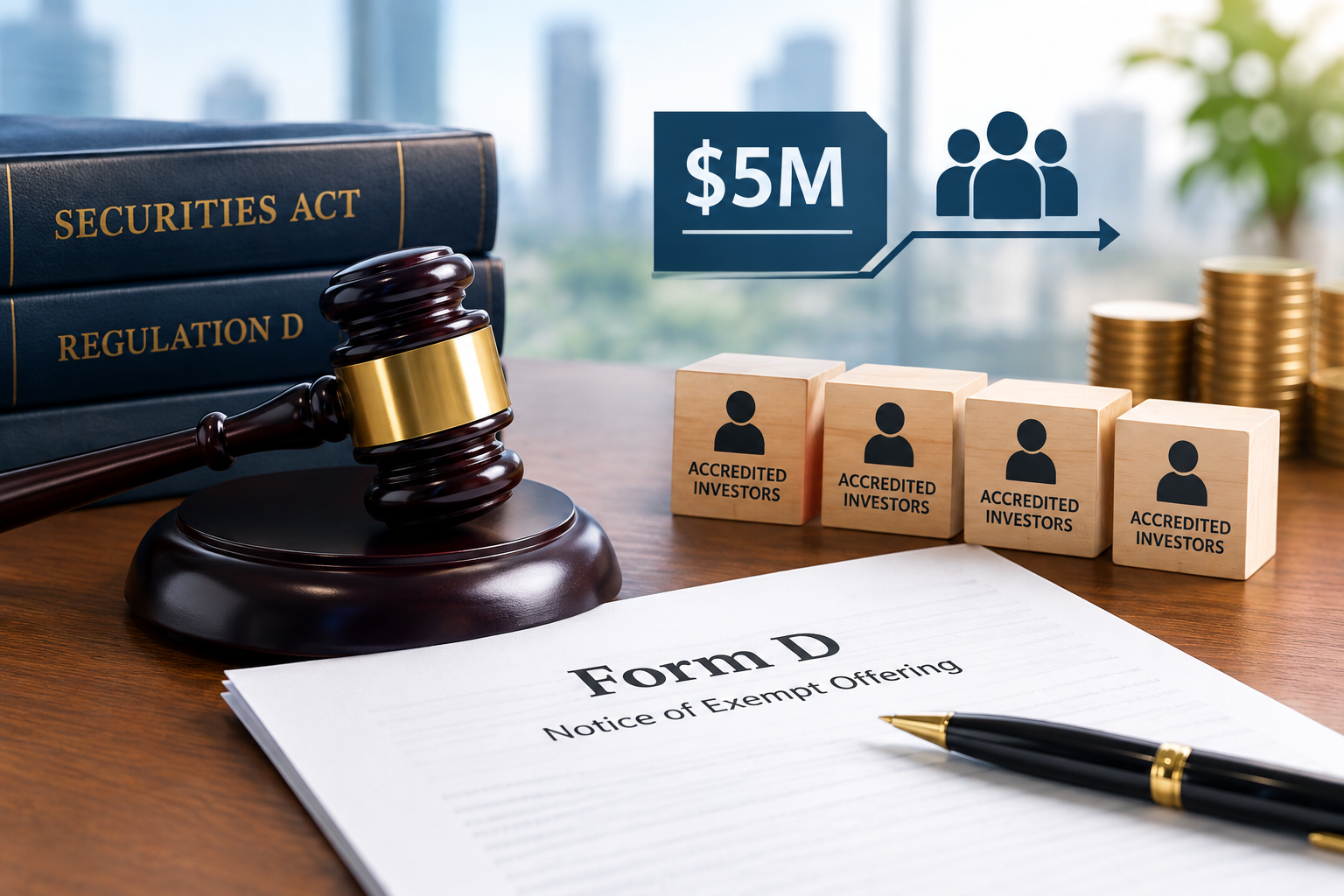
Section 4(a)(5) of the Securities Act of 1933 allows a company to offer and sell up to $5 million of securities exclusively to accredited investors without registering the offering with the Securities and Exchange Commission. The exemption prohibits advertising and public solicitation and requires a Form D filing. It may remain available when a bad actor disqualification prevents the company from using Rule 506 of Regulation D. State securities law requirements must be satisfied separately. [1, 2, 6]
What Are the Section 4(a)(5) Exemption Requirements
Section 4(a)(5) applies to offers and sales by an issuer of its own securities. It requires offers and sales solely to accredited investors, an aggregate offering price no greater than $5 million, no advertising or public solicitation by the issuer or anyone acting on its behalf, and the prescribed SEC notice filing. The exemption does not impose a numerical limit on accredited investors. [1]
Who Qualifies as an Accredited Investor
Rule 215 incorporates the accredited investor definition in Rule 501(a). Common qualifying categories include the following. [3, 4]
- Individuals with net worth exceeding $1 million, individually or jointly with a spouse or spousal equivalent, excluding their primary residence and subject to the applicable mortgage rules.
- Individuals with income exceeding $200,000 individually, or $300,000 jointly with a spouse or spousal equivalent, in each of the two preceding years, with a reasonable expectation of reaching the same level in the current year.
- Individuals holding a Series 7, Series 65, or Series 82 license in good standing.
- Certain institutions, entities, trusts, and family offices that satisfy the applicable conditions, as well as directors, executive officers, and general partners of the issuer. [4]
The definition includes persons whom the issuer reasonably believes qualify at the time of sale. An investor questionnaire and appropriate follow-up should establish and document the qualifying basis. Section 4(a)(5) does not impose Rule 506(c)’s separate verification requirement. [3, 4, 6]
How Does the $5 Million Offering Limit Apply
The $5 million limit applies to the aggregate offering price of the issue, rather than proceeds remaining after expenses. An offering of exactly $5 million may qualify. Section 4(a)(5) does not expressly provide a rolling 12-month limit or an automatic annual reset. [1]
Companies conducting multiple financings must evaluate whether offerings should be integrated and treated as one. Rule 152 supplies the federal integration framework and applicable safe harbors. Separately naming or documenting financing rounds does not, by itself, establish that each is a separate offering. [5]
Can a Company Advertise a Section 4(a)(5) Offering
Advertising and public solicitation are prohibited. Public investment solicitations through websites, social media, mass emails, or other broadly distributed communications can jeopardize the exemption. Limiting eventual purchasers to accredited investors does not eliminate this restriction. Communications and overlapping offerings should be reviewed before fundraising begins. [1, 5]
When Must Form D Be Filed
The issuer must file Form D electronically through EDGAR no later than 15 calendar days after the first sale. If the deadline falls on a Saturday, Sunday, or holiday, it moves to the next business day. Amendments are required for material errors, certain changes, and annually while the offering continues. These requirements appear in 17 C.F.R. Section 239.500. Form D is a notice of an exempt offering, not SEC approval of the investment. [2]
How Section 4(a)(5) Differs From Regulation D
Regulation D contains SEC exemptions commonly used for private placements, including Rules 504, 506(b), and 506(c). Section 4(a)(5) is an independent statutory exemption with its own requirements. Filing Form D for a Section 4(a)(5) offering does not make it a Regulation D offering. [1, 2, 6, 7]
Rule 506(b) permits unlimited fundraising without general solicitation. It allows accredited investors and, subject to additional sophistication and disclosure requirements, up to 35 non-accredited purchasers in any 90-calendar-day period. Rule 506(c) also has no dollar ceiling and permits general solicitation, but all purchasers must be accredited and the issuer must take reasonable steps to verify their status. Both are subject to Rule 506(d) bad actor disqualification. [6, 7]
Rule 504 permits eligible issuers to raise up to $10 million in a rolling 12-month period and has its own bad actor provisions. It therefore does not automatically solve a bad actor problem. Rule 506 also provides state registration preemption that Section 4(a)(5), standing alone, does not provide. [1, 7]
Can a Company With a Bad Actor Use Section 4(a)(5)
Section 4(a)(5) does not incorporate Rule 506(d)’s bad actor disqualification. A conviction, injunction, or regulatory order that disqualifies an offering under Rule 506 does not automatically prevent reliance on Section 4(a)(5). [1, 6]
The actual order must still be reviewed for restrictions on the person’s activities, and applicable state disqualification provisions must be evaluated. Material legal history must also be addressed in the offering disclosures. The absence of automatic disqualification does not excuse misleading statements or omissions. [6, 8]
How Florida Statute Section 517.061(10) Applies
For transactions subject to Florida law, Section 517.061(10) may provide the state registration exemption that accompanies Section 4(a)(5). A federal exemption alone does not establish compliance with Florida law. [1, 9]
Florida subsection (10) prohibits general solicitation and advertising in the state and requires full and fair disclosure of all material information before sale. Purchasers must receive written notice of their right to void the sale within three days after their first tender of consideration. The disclosure document must identify the issuer’s email address for a rescission notice. [9]
The subsection generally permits no more than 35 counted Florida purchasers during the offering, or in any consecutive 12-month period if the offering continues longer than 12 months. Accredited investors are excluded from that count. An offering solely to accredited investors therefore is not limited to 35 Florida purchasers under this provision. [9]
Section 517.061(10) is generally self-executing and requires no filing with the Florida Office of Financial Regulation before being claimed. The separate federal Form D obligation remains. [2, 9]
Does Florida Bad Actor Disqualification Apply
Under the current text of Section 517.0616, Florida’s statutory bad actor disqualification applies to Section 517.061(11), the Florida Limited Offering Exemption under Section 517.0611, and the Florida Invest Local Exemption under Section 517.0612. It does not apply to Section 517.061(10). [10]
A 2025 amendment removed subsections (9) and (10) from Section 517.0616. Older descriptions of Florida law may still state that those exemptions are subject to its disqualification provision. Although Section 517.061(11) also addresses accredited investor offerings, it remains subject to that restriction. [10, 11]
What Disclosures and Resale Restrictions Apply
Section 4(a)(5) does not prescribe a particular private placement memorandum format. Federal antifraud requirements still apply, and Florida subsection (10) expressly requires material disclosures and a written rescission notice. A disclosure document should explain the business, financial condition, offering terms, use of proceeds, material risks, conflicts, and material legal proceedings. The document should be tailored to the company and the applicable state exemption. [1, 8, 9]
Securities issued under Section 4(a)(5) are restricted securities under Rule 144(a)(3)(viii). Investors need registration or an available resale exemption to resell them; the original offering exemption does not make the securities freely tradable. [12]
For example, a company seeking $3 million privately from accredited investors may be able to rely on Section 4(a)(5) federally and Section 517.061(10) in Florida even when Rule 506 is unavailable because of a covered person’s disqualifying event. One disclosure document can address the applicable federal and Florida obligations. Offers and sales in other states require a separate review of those states’ securities laws. [1, 8, 9, 10]
Frequently Asked Questions
Is Section 4(a)(5) part of Regulation D
No. It is a separate statutory exemption that permits an aggregate offering price of up to $5 million exclusively to accredited investors. [1]
Does Section 4(a)(5) permit public advertising
No. Advertising and public solicitation by the issuer or anyone acting on its behalf are prohibited. [1]
Does Section 4(a)(5) require Form D
Yes. Form D must be filed within 15 calendar days after the first sale, subject to the weekend and holiday rule. [2]
Does a Rule 506 bad actor disqualification bar Section 4(a)(5)
Not automatically. Section 4(a)(5) does not incorporate Rule 506(d), but the actual order, material disclosures, and applicable state law must still be reviewed. [1, 6, 8]
Does Florida Section 517.0616 apply to Section 517.061(10)
No. The current disqualification statute does not cover subsection (10), although it does cover subsection (11) and Sections 517.0611 and 517.0612. [10]
Authoritative Sources
- Securities Act of 1933, Sections 3(b)(1), 4(a)(5), and 18
- Form D filing requirements, 17 C.F.R. Section 239.500
- Accredited investor definition, Rule 215
- Accredited investor categories, Rule 501(a)
- Integration of offerings, Rule 152
- Rule 506 offerings and bad actor disqualification
- SEC guidance on capital raising exemptions
- SEC frequently asked questions about exempt offerings
- Florida Statutes Section 517.061
- Florida Statutes Section 517.0616
- Chapter 2025-28, Laws of Florida, Section 5
- Restricted securities, Rule 144(a)(3)(viii)
About the Author
Brenda Hamilton is a securities attorney with Hamilton & Associates Law Group, P.A.
Hamilton & Associates Law Group, P.A. | Securities Lawyer 101
Disclaimer: This article is provided for informational purposes only and does not constitute legal or tax advice. Securities rules change, so speak with qualified counsel about your specific situation