



Choosing the right exchange is one of the most important strategic decisions a company makes when going public. The New York Stock Exchange (NYSE) and the Nasdaq Stock Market (Nasdaq) represent the two dominant U.S. exchanges, each with its own history, reputation, listing tiers, and trading models. The choice between NYSE and Nasdaq influences investor perception, liquidity, analyst coverage, and long-term positioning in the capital markets.
Reputation: Tech vs. Blue Chip
For decades, the NYSE has been associated with established blue-chip companies—global giants like ExxonMobil, Coca-Cola, and JPMorgan Chase. Its reputation is built on tradition, stability, and the prestige of its iconic trading floor. In contrast, Nasdaq has long been the preferred home for technology and growth companies, including Apple, Microsoft, Amazon, Google, and Meta. This reputation continues to influence where companies list. High-growth startups often gravitate toward Nasdaq for its innovative image, while industrials, financials, and consumer goods companies tend to lean toward the NYSE for its prestige and credibility.
Trading Models: Hybrid vs. Electronic
The NYSE operates a hybrid trading model, combining human oversight on its famous trading floor with modern electronic trading systems. This model is seen as providing added liquidity and reducing volatility, especially during major market events. Nasdaq, by contrast, pioneered an all-electronic trading model, which has proven efficient, scalable, and attractive to tech-savvy issuers. The difference reflects the cultural DNA of the two exchanges—NYSE rooted in tradition, Nasdaq in technology.
Listing Tiers
Nasdaq operates three distinct tiers:
- Nasdaq Capital Market – for smaller companies, lower financial thresholds.
- Nasdaq Global Market – for mid-sized companies with higher capitalization.
- Nasdaq Global Select Market – the highest tier, with the most stringent financial and governance standards.
The NYSE, by contrast, operates a single main market with rigorous listing requirements, though it allows emerging growth companies to qualify with lower thresholds in some cases.
Comparative Statistics: Number of Listed Companies
As of 2025, Nasdaq lists approximately 3,600 companies across its three tiers, while the NYSE lists around 2,300. Despite having fewer listed companies, NYSE companies tend to have significantly higher average market capitalizations, reflecting its focus on blue-chip issuers. Nasdaq companies often represent a mix of high-growth startups and mid-sized firms with rapid scaling potential.
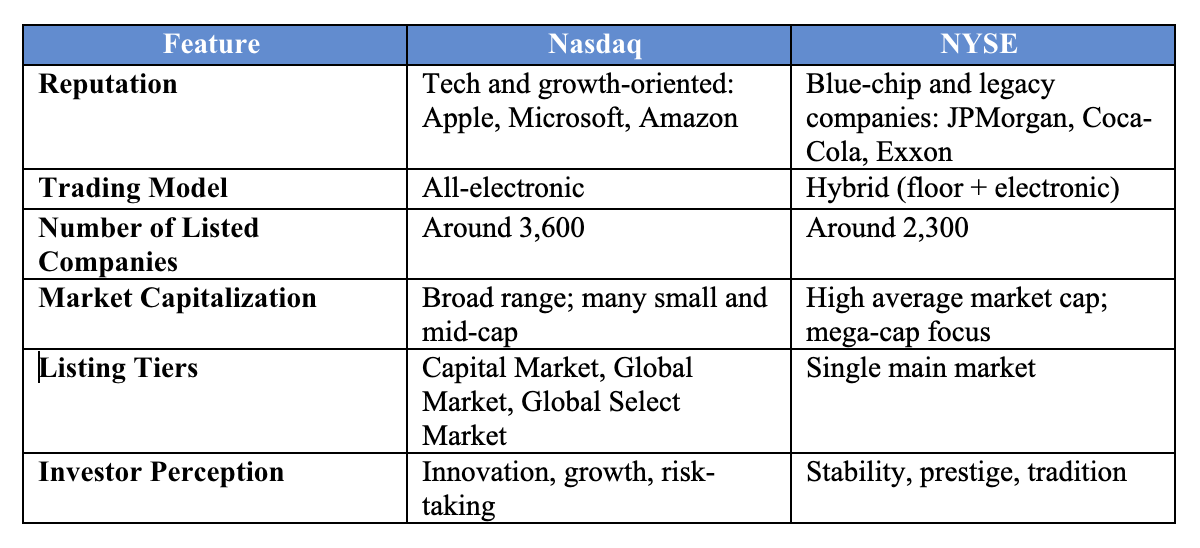
Comparative Chart: NYSE vs. Nasdaq by Listing Profile
The chart below compares the exchanges across major categories:
Which Exchange Is Better Suited for Which Companies?
The answer depends largely on the company’s industry, growth stage, and investor base. Technology firms, biotech companies, and other innovative businesses often prefer Nasdaq, where peer companies reside and investors are accustomed to volatility and rapid scaling. Meanwhile, mature companies in traditional sectors—such as finance, energy, or manufacturing—tend to prefer the NYSE, where the listing conveys stability and prestige.
Investor Base and Analyst Coverage
Another important factor is analyst coverage. Nasdaq’s strength in growth sectors often translates into more active research coverage by analysts familiar with those industries. In contrast, NYSE-listed companies may benefit from coverage by analysts focused on mature sectors, institutional investors, and dividend-paying equities. For issuers, choosing the exchange that aligns with their investor base ensures better reception in the market.
Case Examples
Nasdaq’s dominance in technology is evident in its roster of the ‘Magnificent Seven’—Apple, Microsoft, Alphabet, Amazon, Meta, Tesla, and Nvidia. Meanwhile, the NYSE remains home to global titans like Berkshire Hathaway, JPMorgan Chase, and ExxonMobil. In some cases, companies have switched exchanges for strategic reasons—for example, PepsiCo moved from NYSE to Nasdaq in 2017 to align with peers, while Kraft Heinz moved from Nasdaq to NYSE in 2015 for prestige and broader institutional appeal.
Global Context
Internationally, both exchanges compete with the London Stock Exchange, Euronext, and the Hong Kong Stock Exchange for global IPOs. The NYSE has an edge in attracting large foreign issuers, particularly in the financial and industrial sectors, while Nasdaq remains the preferred choice for cross-border tech listings.
Conclusion
Both the NYSE and the Nasdaq offer unique advantages for new listings. Nasdaq provides the innovation-driven image and electronic infrastructure suited for fast-growing companies, while the NYSE offers stability, tradition, and prestige that resonate with institutional investors. The best exchange for a company depends on its sector, growth profile, and long-term capital markets strategy.
If you are considering taking your company public or would like to speak with a Securities Attorney, Hamilton & Associates Law Group, P.A. is ready to help. Our Founder, Brenda Hamilton, is a nationally known and recognized securities attorney with over two decades of experience assisting issuers worldwide with going public on the Nasdaq, NYSE, and OTC Markets. Since 1998, Ms. Hamilton has been a leading voice in corporate and securities law, representing both domestic and international clients across diverse industries and jurisdictions. Whether you are taking your company public, raising capital, navigating regulatory challenges, or entering new markets, Brenda Hamilton and her team deliver the experience, strategic insight, and results-driven representation you need to succeed.
To speak with a Securities Attorney, please contact Brenda Hamilton at 200 E Palmetto Rd, Suite 103, Boca Raton, Florida, (561) 416-8956, or by email at [email protected].
Hamilton & Associates | Securities Attorneys
Brenda Hamilton, Securities Attorney
200 E Palmetto Rd, Suite 103
Boca Raton, Florida 33432
Telephone: (561) 416-8956
Facsimile: (561) 416-2855
www.SecuritiesLawyer101.com