
An SEC-reporting company placed on the OTC Markets Expert Market ordinarily has two distinct problems. First, it must cure its delinquent reporting obligations under the Securities Exchange Act of 1934. Second, after it becomes current, it must reestablish eligibility for broker-dealers to publish public quotations under amended Exchange Act Rule 15c2-11. These workstreams overlap, but they are not interchangeable.
The central point is that filing delinquent Forms 10-K and 10-Q does not automatically restore public quotations. If the security has lost quotation eligibility, a broker-dealer generally may not initiate or resume quotations unless the requirements of Rule 15c2-11 and FINRA Rule 6432 are satisfied. In the traditional route, a FINRA member market maker submits a new Form 211 and must receive notice from FINRA that the filing has been processed. Under the amended rule, a qualified interdealer quotation system may conduct the information review and make a publicly available determination, but it also has a FINRA filing obligation under Rule 6432.

If the SEC institutes a proceeding under Exchange Act Section 12(j) and revokes the registration of the company’s securities, the problem becomes materially more severe. A revoked issuer cannot cure the revocation merely by filing the missing reports. FINRA may delete the trading symbol from its OTC symbol directory and Daily List. To reestablish public trading, the issuer ordinarily must complete a new registration process, become fully current, obtain a new or reactivated CUSIP and trading symbol as applicable, and establish quotation eligibility through a new Rule 15c2-11 review.
Key authorities
- Exchange Act Sections 12(g), 13(a), 15(d) and 12(j).
- Exchange Act Rules 12b-25, 13a-1, 13a-13, 15d-1, 15d-13 and 15c2-11.
- FINRA Rules 6432, 6490 and 5250.
- Securities Act Rule 144(c), Form S-8 eligibility requirements and Form S-3 timeliness requirements.
- OTC Markets quotation-tier and disclosure standards applicable to the issuer’s intended market.
1. Determine Why the Security Entered the Expert Market
The Expert Market is a restricted quotation environment used for securities that are not eligible for broad public quotation. Following the September 28, 2021 compliance date for the SEC’s amendments to Rule 15c2-11, broker-dealers generally cannot publish public quotations for an issuer’s security unless specified current issuer information is publicly available, subject to the rule’s exceptions.
An SEC-reporting issuer is commonly moved to the Expert Market because it failed to file a required Form 10-K or Form 10-Q, allowed its financial statements to become stale, ceased satisfying the conditions for the piggyback exception, or became subject to a trading suspension or other regulatory event. The issuer should not assume that the missing report is the only problem.
Counsel should identify each independent impediment
- Missing Forms 10-K, Forms 10-Q, or required amendments.
- Material Forms 8-K that were never filed or contain incomplete disclosure.
- An ineffective, withdrawn or disclaimed audit report.
- Auditor resignation, dismissal or independence issue.
- An SEC trading suspension, Section 12(j) proceeding or final revocation order.
- Loss of the Rule 15c2-11 piggyback exception.
- OTC Markets compliance holds, Caveat Emptor designation or unresolved issuer-review questions.
- FINRA symbol deletion, corporate-action deficiency or unresolved Rule 6490 matter.
- A former-shell or reverse-merger history requiring enhanced diligence.
- Promotional activity, unusual trading, convertible debt, large discounted issuances or other red flags.
2. Understand the Amended Rule 15c2-11 Framework
Exchange Act Rule 15c2-11, 17 C.F.R. § 240.15c2-11, governs when a broker-dealer may publish or submit a quotation for an OTC security in a quotation medium. The 2020 amendments modernized the rule and tied quotation eligibility more closely to current, publicly available issuer information.
Before initiating or resuming quotations, the reviewing broker-dealer must obtain and review the information specified by the rule and must have a reasonable basis for believing that the information is accurate in all material respects and obtained from reliable sources. The amended rule also permits a qualified interdealer quotation system to perform an initial information review and make a publicly available determination on which broker-dealers may rely, subject to the conditions of the rule.
The amendments also narrowed reliance on the piggyback exception. Historically, quotations sometimes continued even after issuer information became stale. Under the amended framework, continued reliance on important exceptions generally depends on current and publicly available issuer information, subject to grace periods and specific exceptions.
Important 2026 development. On March 16, 2026, the SEC proposed amendments to Rule 15c2-11 (Release No. 34-105004) that would limit the rule’s scope to equity securities by replacing the term “security” with “equity security” as defined in Exchange Act Rule 3a11-1. The proposal would not change the substantive information-gathering and review requirements applicable to OTC equity securities. Comments were due May 18, 2026, which the Commission also proposed as the effective and compliance date. The proposing release additionally solicited comment on whether the Commission should revisit a conditional exemption permitting an “expert market” for certain grey-market securities — an exemption proposed in December 2020 but never adopted. Issuers of OTC equity securities must proceed under the rule currently in effect, and should confirm the current status of this rulemaking with counsel, unless and until a final amendment changes their obligations.
3. Prepare a Complete SEC Filing-Deficiency Schedule
The issuer should create a written matrix listing every report that was required, its due date, whether a Form 12b-25 was filed, whether the extension period was met, and whether an audit or interim review is required. The matrix should be updated each time another reporting deadline occurs.
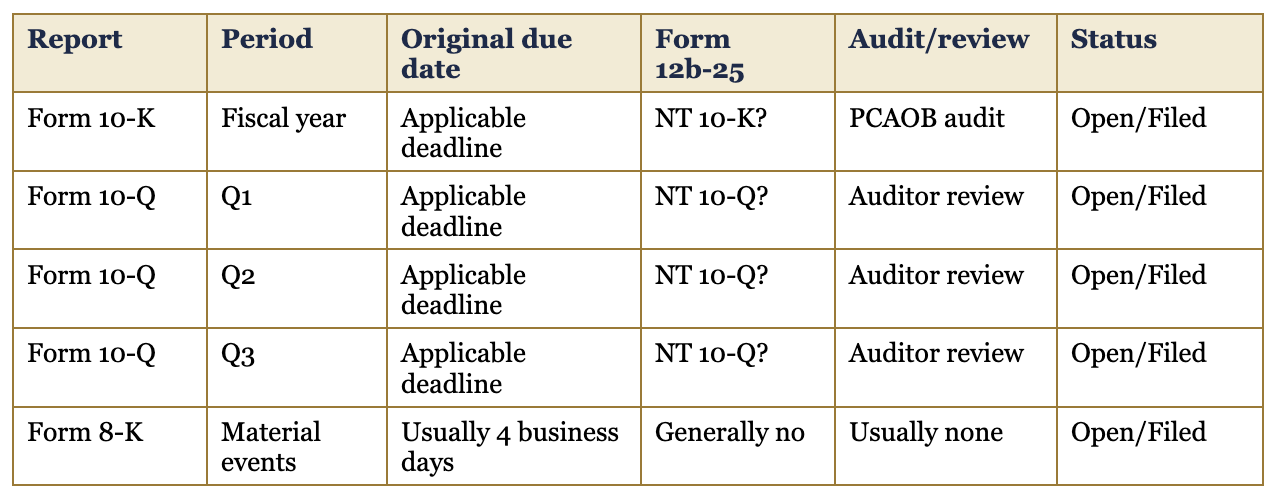
Rule 12b-25 provides only a limited extension — generally 15 calendar days for Form 10-K and five calendar days for Form 10-Q. Filing an NT 10-K or NT 10-Q does not create an indefinite extension. If the report is not filed within the applicable extension period, the issuer remains delinquent.
4. Confirm the Legal Basis for the Reporting Obligation
The issuer should determine whether its periodic reporting obligations arise under Exchange Act Section 12(b), Section 12(g), Section 15(d), or more than one provision. This affects whether reporting may be suspended or terminated and whether a Form 15 could ever be available.
- Section 12(b) applies to securities registered for listing on a national securities exchange.
- Section 12(g) applies to classes registered under the asset-and-holder thresholds or voluntarily registered on Form 10.
- Section 15(d) applies after an effective Securities Act registration statement and may be suspended only if the statutory and rule conditions are met.
A company with a class registered under Section 12 ordinarily cannot stop filing merely because its stock is illiquid, on the Expert Market or held by few active investors.
5. Stabilize the Audit and Accounting Process
The annual catch-up process cannot be completed without an independent PCAOB-registered auditor willing and able to issue an audit report. The issuer should confirm the auditor’s engagement, independence, PCAOB status, access to predecessor workpapers and ability to complete the audit.
Common audit impediments
- Unreconciled bank accounts, incomplete ledgers or unsupported journal entries.
- Missing inventory records, physical counts or valuation support.
- Inadequate revenue-recognition documentation.
- Convertible note, warrant, derivative and stock-compensation accounting.
- Unrecorded related-party transactions or advances.
- Unsupported asset valuations, impairment analyses or acquisition accounting.
- Inability to obtain confirmations from banks, customers, vendors, lenders or legal counsel.
- Insufficient funds to pay audit and review fees.
- Auditor independence or engagement-quality concerns.
If the prior auditor resigned or was dismissed, the company should determine whether Item 4.01 of Form 8-K was triggered and whether the predecessor auditor’s letter is required. A change in auditor during a delinquency often increases the time and cost because the successor must address opening balances, predecessor communications and prior-period reliance.
6. Reconstruct the Delinquent-Period Disclosure Record
Curing delinquency is not merely a financial-statement exercise. Counsel should reconstruct every material event that occurred during the delinquent period and determine whether it required a Form 8-K, financial statement treatment, MD&A discussion, risk-factor update or exhibit filing. Events commonly requiring attention include:
- Changes in control, officers or directors.
- Acquisitions, dispositions, discontinued operations and changes in business.
- Debt financings, defaults, modifications and foreclosures.
- Convertible securities, preferred stock, warrants, options and large stock issuances.
- Related-party transactions and management advances.
- Entry into or termination of material agreements.
- Litigation, investigations, judgments or regulatory proceedings.
- Bankruptcy, receivership or material liquidity events.
- Impairments, asset losses, customer concentration or loss of a major contract.
- Reverse splits, name changes, domicile changes or amendments to authorized capital.
The issuer should compare SEC filings against press releases, investor presentations, social-media statements, OTC Markets disclosures and financing materials. A statement can be literally true but misleading if it omits the reporting delinquency, going-concern uncertainty, defaults, dilution or inability to finance announced operations.
7. Decide Whether to File Each Missing Report or Seek a Comprehensive Catch-Up Approach
The default approach is to file each required Form 10-K and Form 10-Q. A severely delinquent issuer may explore whether the SEC staff would accept a comprehensive catch-up filing, sometimes called a “Super 10-K.” There is no automatic rule allowing an issuer to replace all missing reports with one filing. The company should not rely on that approach without appropriate SEC staff engagement and careful analysis.
A comprehensive filing does not erase prior violations or automatically restore Rule 144, Form S-8, Form S-3, OTC Markets or Rule 15c2-11 eligibility. It is a possible filing architecture, not a regulatory pardon.
8. File Complete and Internally Consistent Catch-Up Reports
Each catch-up report should include all required financial statements, footnotes, MD&A, controls disclosure, officer certifications, exhibits and Inline XBRL. The issuer should confirm that the audit report and interim reviews cover the correct periods and that all financial statements remain sufficiently current when filed.
Before filing, counsel and management should verify
- Outstanding shares, authorized shares and beneficial ownership reconcile to transfer-agent records.
- Debt, warrants, options and convertible securities reconcile across the financial statements and exhibits.
- Business descriptions and risk factors do not repeat stale or promotional claims.
- MD&A explains liquidity, capital resources, known obligations and the reasons for filing delays.
- Controls and procedures disclosure accurately identifies material weaknesses.
- Required CEO and CFO certifications are supportable.
- All material contracts are filed or validly omitted.
- Forms 8-K and auditor-change disclosures are complete.
- EDGAR acceptance, exhibits and Inline XBRL are confirmed after transmission.
9. Consequences That May Continue After the Company Becomes Current
Late filings can have consequences beyond Expert Market placement. Becoming current does not retroactively eliminate violations or contractual defaults.
Rule 144. Affiliates and nonaffiliates selling after a six-month holding period generally must consider the current-public-information condition in Securities Act Rule 144(c). A reporting issuer that has not filed the reports required during the preceding 12 months, other than certain Form 8-K reports, may not satisfy Rule 144(c). Nonaffiliates holding for at least one year may have a different analysis, but broker and transfer-agent restrictions may still make sales impracticable.
Form S-8 and Form S-3. Form S-8 generally requires the issuer to have filed all reports required during the preceding 12 months. Form S-3 eligibility also includes timely-filing conditions, subject to the form’s specific exceptions. The filing cure should not be represented as immediately restoring short-form eligibility without a separate analysis.
Financing defaults. Notes, registration-rights agreements and equity purchase agreements may treat late reports, loss of quotation, Rule 144 unavailability or Expert Market placement as events of default. The issuer should review default interest, acceleration, liquidated damages, share-reserve obligations and collateral remedies.
10. Restoring Public Quotations: The New Form 211 Requirement
After the issuer becomes current, it must determine whether publicly displayed proprietary quotations can resume under an existing exception or whether quotation eligibility must be reestablished. An issuer that has been relegated to the Expert Market should not assume that its former piggyback eligibility will revive automatically.
FINRA Rule 6432(a) provides that, except for identified Rule 15c2-11 provisions and exceptions, a FINRA member may not initiate or resume quotation of a non-exchange-listed security unless it has demonstrated compliance through the required FINRA filing and has received notification that the filing has been processed.
Traditional sponsoring-market-maker route
- The issuer becomes fully current and resolves material disclosure deficiencies.
- A FINRA-member broker-dealer agrees to act as sponsoring market maker.
- The broker-dealer independently obtains and reviews the Rule 15c2-11 information.
- The broker-dealer investigates red flags and determines that it has a reasonable basis to believe the information is accurate in all material respects and from reliable sources.
- The broker-dealer submits a new Form 211 under FINRA Rule 6432.
- The broker-dealer responds to FINRA questions and supplemental requests.
- The broker-dealer receives notice from FINRA that the filing has been processed before initiating or resuming quotations.
- Other market makers may later rely on the piggyback exception only when its conditions are satisfied.
The issuer cannot file Form 211 for itself, and FINRA’s processing of a Form 211 is not an endorsement of the issuer or its securities. FINRA Rule 5250 also prohibits a market maker from accepting payment or other consideration from an issuer or related person for publishing a quotation or acting as a market maker, subject to the rule’s terms and exceptions.
Qualified IDQS route under amended Rule 15c2-11
Amended Rule 15c2-11 permits a qualified interdealer quotation system to conduct the required information review and make a publicly available determination. FINRA Rule 6432(b) requires a qualified IDQS making that determination to make the required FINRA filing. This pathway may eliminate the need for a traditional market maker to perform the initial review, but it does not eliminate regulatory review or make quotation automatic upon filing delinquent reports.
The practical availability, cost, timing and tier eligibility of an OTC Markets review should be confirmed directly with OTC Markets based on the issuer’s facts. A company with a Caveat Emptor designation, shell history, promotional activity, unresolved control issues or questionable stock issuances may face additional diligence or may not be accepted.
11. Information Commonly Requested in the Rule 15c2-11 Review
- Current SEC reports and financial statements.
- Articles of incorporation, bylaws and amendments.
- Good-standing evidence and corporate minute records.
- Current capitalization and transfer-agent reports.
- Shareholder lists, issuance histories and free-trading share analyses.
- Debt, preferred stock, warrants, options and convertible-security schedules.
- Officer, director, control-person and significant-shareholder information.
- Related-party transactions and conflicts of interest.
- Material contracts and acquisition documents.
- Litigation, regulatory and disciplinary histories.
- Business operations, facilities, customers, vendors and revenue support.
- Promotional arrangements, investor-relations providers and trading anomalies.
- Former shell, reverse merger, custodianship or change-of-control documentation.
- Explanations for the reporting delinquency and remediation of internal-control weaknesses.
A current filing package can still fail a Rule 15c2-11 review if it contains unresolved inconsistencies, unsupported business claims, questionable stock issuances or other red flags. The review is substantive, not merely a check that documents appear on EDGAR.
12. OTC Markets Tier Review Is a Separate Contractual Process
Rule 15c2-11 and FINRA Rule 6432 govern broker-dealer quotation conduct. OTC Markets tiers are operated under OTC Markets’ own rules and contractual standards. An issuer seeking OTCQB, OTCQX or another public tier must satisfy both the federal quotation framework and the applicable OTC Markets standards.
- Update OTCIQ and issuer profile information.
- Confirm transfer-agent verification and share structure.
- Resolve fees, applications, certifications and management background review.
- Address any Caveat Emptor, promotional or compliance concerns.
- Satisfy the financial, bid-price, corporate-governance or disclosure standards of the intended tier.
- Coordinate the effective quotation date only after regulatory and market requirements are satisfied.
13. SEC Trading Suspensions, Section 12(j) Revocation and Symbol Deletion
A prolonged reporting delinquency can lead to consequences more severe than Expert Market placement. The SEC may suspend trading temporarily, institute an administrative proceeding under Exchange Act Section 12(j), or both, depending on the facts.
Trading suspension under Section 12(k)
Exchange Act Section 12(k) authorizes the SEC to suspend trading in a security for up to 10 business days when the Commission determines that a suspension is required in the public interest and for investor protection. An SEC trading suspension generally destroys existing quotation continuity. After the suspension ends, a broker-dealer ordinarily may not resume quotations unless Rule 15c2-11 is satisfied; a new Form 211 process is commonly required.
Administrative revocation under Section 12(j)
Exchange Act Section 12(j), 15 U.S.C. § 78l(j), authorizes the SEC, after notice and an opportunity for hearing, to suspend for up to 12 months or revoke the registration of a security if the issuer has failed to comply with the Exchange Act or its rules and the sanction is necessary or appropriate for investor protection. Chronic failure to file Forms 10-K and 10-Q is a recurring basis for Section 12(j) proceedings.
The SEC commonly considers the seriousness of the violations, whether they were isolated or recurrent, the degree of culpability, assurances against future violations and the issuer’s recognition of its obligations. Filing reports only after a proceeding begins does not guarantee that the SEC will decline revocation.
Effect of a final revocation order
- The class is no longer registered under Exchange Act Section 12.
- The issuer cannot cure the revocation merely by filing the missing periodic reports.
- EDGAR may display the notation that the company’s Exchange Act registration has been revoked, and the revocation order may appear as a “REVOKED” filing.
- Broker-dealers cannot rely on the former registration or quotation history as though it remained intact.
- FINRA may delete the OTC trading symbol, and the deletion may appear on FINRA’s Daily List.
- Shareholders may retain their state-law ownership interests, but the securities may have no public quotation market and may be extremely difficult or impossible to sell through a broker.
FINRA symbol deletion
FINRA administers the assignment, change and deletion of OTC symbols and publishes deletions through its Daily List. FINRA Rule 6490 treats symbol issuance, changes and deletions as company-related actions. A symbol deletion is not the same as cancellation of the underlying shares under state corporate law; it removes the identifier used for OTC quotation and trading systems.
A deleted symbol ordinarily cannot be restored simply because management later files old reports. The issuer may need to establish that the security is legally outstanding, obtain or reactivate a CUSIP, complete any required FINRA corporate-action process, and satisfy Rule 15c2-11 through a new Form 211 or qualified-IDQS determination. FINRA may assign a new symbol rather than restore the former symbol.
Path after revocation
- Confirm the finality and scope of the SEC revocation order and whether any appeal period remains.
- Determine the issuer’s state-law status, capitalization, shareholder records and whether the securities remain legally outstanding.
- Prepare current audited financial statements and complete corporate cleanup.
- Register the class again under the Exchange Act, commonly through an effective Form 10, or establish another valid reporting basis.
- Become fully current in periodic reporting after effectiveness.
- Obtain or confirm CUSIP and transfer-agent eligibility.
- Submit any required FINRA Rule 6490 request for initial symbol setup or related corporate action.
- Establish quotation eligibility under Rule 15c2-11 through a new Form 211 or qualified-IDQS review.
- Apply for the intended OTC Markets tier and satisfy its separate standards.
This is effectively a new going-public and quotation process, not a simple delinquency cure. The costs may exceed the value of rehabilitating the former issuer, particularly where corporate records, shareholder lists, liabilities or control history are uncertain.
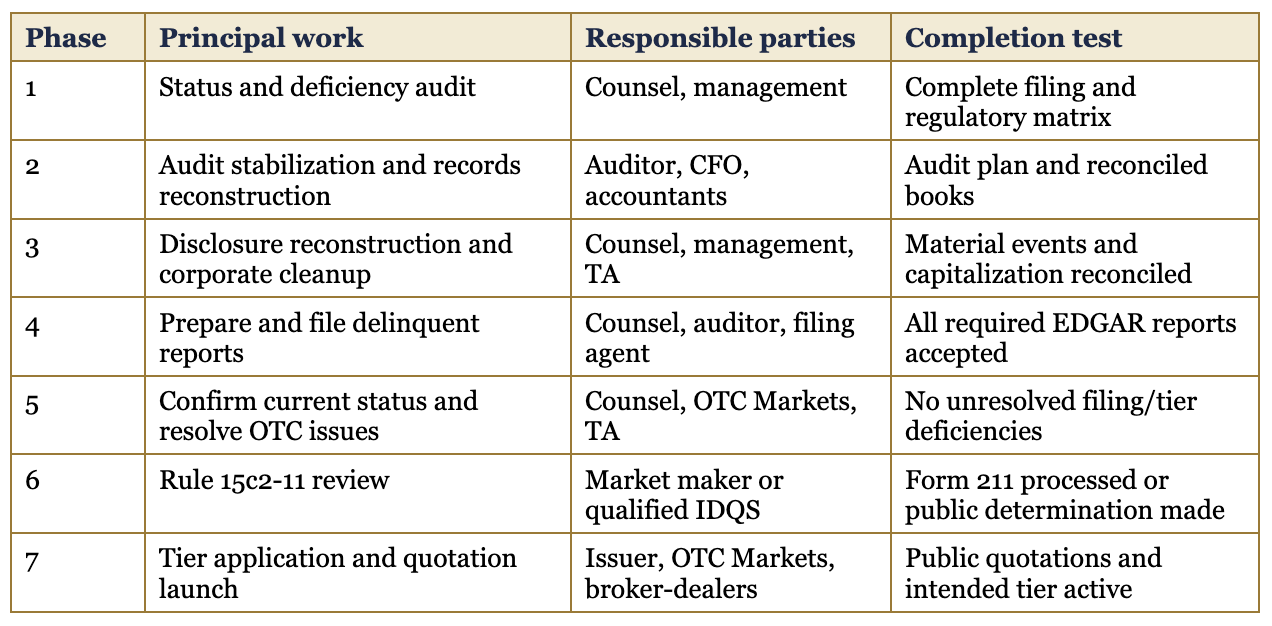
14. Recommended Project Sequence
15. Common Mistakes That Delay Restoration
- Assuming that filing the missing Form 10-K automatically returns the security to public quotation.
- Filing the annual report while leaving intervening Forms 10-Q or material Forms 8-K unfiled.
- Announcing a filing deadline before the auditor has confirmed that the audit can be completed.
- Changing auditors without addressing Item 4.01 of Form 8-K and predecessor-auditor requirements.
- Treating the Form 211 review as ministerial rather than a substantive red-flag inquiry.
- Paying or promising compensation to a market maker in violation of FINRA Rule 5250.
- Using promotional press releases while audited information is stale or incomplete.
- Failing to reconcile transfer-agent records, outstanding shares and beneficial ownership.
- Ignoring Section 12(j) notices or believing that late catch-up filings necessarily prevent revocation.
- Confusing a deleted symbol with cancellation of the shares or assuming the old symbol can be automatically restored.
16. Issuer Due-Diligence Checklist
☐ EDGAR filing history and registration basis reviewed.
☐ All missing Forms 10-K, 10-Q and 8-K identified.
☐ Forms 12b-25 and extension periods verified.
☐ SEC correspondence, trading suspensions and Section 12(j) proceedings checked.
☐ FINRA Daily List and symbol status checked.
☐ Auditor engagement, independence and PCAOB registration confirmed.
☐ Books, bank records, inventory, debt and equity schedules reconciled.
☐ Transfer-agent records and capitalization reconciled.
☐ Material agreements and related-party transactions collected.
☐ Officer, director and control-person histories verified.
☐ Press releases and public statements compared against filing disclosure.
☐ Catch-up filing architecture agreed with counsel and auditor.
☐ All reports filed and EDGAR acceptance confirmed.
☐ OTCIQ and issuer profile updated.
☐ Sponsoring market maker or qualified-IDQS pathway selected.
☐ New Form 211 or qualified-IDQS filing completed under FINRA Rule 6432.
☐ OTC Markets tier requirements separately satisfied.
17. Applicable SEC and FINRA Authorities
Exchange Act Section 12(j) — 15 U.S.C. § 78l(j) — suspension or revocation of a security’s registration after notice and opportunity for hearing. Official source
Exchange Act Section 12(k) — 15 U.S.C. § 78l(k) — SEC authority to suspend trading for up to 10 business days. Official source
Exchange Act Section 13(a) — 15 U.S.C. § 78m(a) — periodic and other reporting by issuers with securities registered under Section 12. Official source
Exchange Act Rule 13a-1 — 17 C.F.R. § 240.13a-1 — annual reports on Form 10-K. Official source
Exchange Act Rule 13a-13 — 17 C.F.R. § 240.13a-13 — quarterly reports on Form 10-Q. Official source
Exchange Act Rule 12b-25 — 17 C.F.R. § 240.12b-25 — notification of inability to timely file and limited extension periods. Official source
Exchange Act Rule 15c2-11 — 17 C.F.R. § 240.15c2-11 — publication or submission of OTC quotations; issuer information review; exceptions; qualified-IDQS determinations. Official source
SEC Release Nos. 33-10842; 34-89891 — Publication or Submission of Quotations Without Specified Information (Sept. 16, 2020) — adopting the 2020 amendments to Rule 15c2-11. Official source
SEC Release No. 34-105004 — Proposed amendments to Rule 15c2-11 limiting the rule to equity securities (Mar. 16, 2026). Official source
FINRA Rule 6432 — Compliance with the Information Requirements of SEA Rule 15c2-11; Form 211 and qualified-IDQS filing requirements. Official source
FINRA Form 211 guidance — FINRA instructions for initiating or resuming quotations and qualified-IDQS determinations. Official source
FINRA Rule 5250 — Payments for market making; restrictions on issuer or related-person compensation to a market maker. Official source
FINRA Rule 6490 — Processing company-related actions, including initial symbol setup, symbol changes and symbol deletions. Official source
FINRA Daily List — Deletions — Official list of deleted OTC equity issues and symbols. Official source
Securities Act Rule 144 — 17 C.F.R. § 230.144, including current public information under paragraph (c). Official source
Form S-8 — Eligibility and reporting-status requirements for employee benefit plan registration. Official source
Form S-3 — Eligibility and timely-filing conditions for short-form registration. Official source
18. Related SecuritiesLawyer101 Resources
- The Penny Stock Graveyard — The OTC Markets Expert Market Explained
- How the OTC Markets Expert Market Works
- What Is the OTC Markets Expert Market?
- Understanding the Rule 15c2-11 Current Information Standard
- FINRA Requirements for Form 211: OTC Market Quotation Eligibility Explained
- OTC Markets Direct — Bypassing the Sponsoring Market Maker Under Rule 15c2-11
- What Disclosure Is Required by Rule 15c2-11?
- Rule 15c2-11 Compliance Deadline Is Just Around the Corner
- Understanding the September 28 Amended Rule 15c2-11 Deadline
- Reverse Mergers After Amended Rule 15c2-11
Conclusion
An issuer on the Expert Market must treat the project as a coordinated SEC reporting, accounting, corporate-record, FINRA and OTC Markets matter. The correct sequence is to identify every delinquency and regulatory impediment, complete the audit and catch-up reports, become fully current, resolve OTC Markets issues, and then establish quotation eligibility through the applicable Rule 15c2-11 and FINRA Rule 6432 process.
Where a security’s Exchange Act registration has already been revoked and its symbol deleted, the issuer is no longer performing an ordinary catch-up. It is rebuilding the legal and market infrastructure for a public security and should evaluate whether a new registration and quotation process is economically justified.
This guide is provided for general informational purposes only. The applicable process depends on the issuer’s registration history, filing record, audit status, corporate history, trading history and regulatory circumstances. It does not create an attorney-client relationship and should not be relied upon as legal advice for a particular company or transaction.
To speak with a Securities Attorney, please contact Brenda Hamilton at 200 E Palmetto Rd, Suite 103, Boca Raton, Florida, (561) 416-8956, or by email at [email protected].
Hamilton & Associates | Securities Attorneys
Brenda Hamilton, Securities Attorney
200 E Palmetto Rd, Suite 103
Boca Raton, Florida 33432
Telephone: (561) 416-8956
Facsimile: (561) 416-2855
www.SecuritiesLawyer101.com