

Nasdaq-listed companies now face an additional and potentially unforgiving continued listing requirement. Under the SEC-approved rule, a company whose Market Value of Listed Securities remains below $5 million for 30 consecutive business days may receive a Staff Delisting Determination without the automatic cure period ordinarily available for many other Nasdaq deficiencies. A hearing request under this new rule does not automatically stay the trading suspension.
The new $5 million requirement makes early Nasdaq compliance planning more important than ever. Companies should not wait until they receive a Staff Delisting Determination to evaluate market capitalization, stockholders’ equity, minimum bid price, public float, shareholder count, reverse-stock-split history and SEC reporting status.
A Nasdaq deficiency notice is not always an immediate delisting notice, but it should never be treated as routine correspondence. The available response depends on the precise Listing Rule cited, the deadline stated in the notice, whether a compliance period is available, whether the company has multiple deficiencies and whether the proposed cure could create a new listing problem.

What Is a Nasdaq Delisting Notice?
The phrase “Nasdaq delisting notice” is frequently used to describe several different communications from Nasdaq. These notices do not all have the same consequences or response procedures.
- A deficiency notice that provides an automatic compliance period;
- A request for the company to submit a written compliance plan;
- A notice that the company is not eligible for a compliance period;
- A Staff Delisting Determination;
- A notice that trading will be suspended;
- A Nasdaq Hearings Panel decision; or
- A notice that the company failed to satisfy a condition imposed by a panel.
Management and the board should identify exactly which notice the company received, the Nasdaq Listing Rule involved, the response deadline and whether a hearing request will stay a trading suspension. A routine deficiency notice may provide time to regain compliance. A Staff Delisting Determination generally requires immediate action to preserve the company’s appeal rights.
What Should a Company Do Immediately After Receiving a Nasdaq Notice?
1. Calendar Every Deadline
Nasdaq notices may establish separate deadlines for requesting a hearing, paying the hearing fee, submitting a written hearing brief, filing delinquent SEC reports, completing a reverse stock split, obtaining shareholder approval or demonstrating compliance. Missing a deadline can eliminate an otherwise available remedy.
2. Identify Every Existing Deficiency
A company may have more than one continued listing deficiency. Regaining compliance with one requirement will not prevent delisting if another independent deficiency remains unresolved.
- The $1.00 minimum bid price requirement;
- Minimum stockholders’ equity;
- Market Value of Listed Securities;
- Market Value of Unrestricted Publicly Held Shares;
- Minimum publicly held shares or round-lot holders;
- Timely SEC reporting;
- Audit committee or other corporate governance requirements.
3. Determine Whether a Compliance Period Is Available
Nasdaq provides automatic compliance periods for some deficiencies, but not all. Eligibility may depend on the applicable market tier, the specific rule, the company’s financial condition, satisfaction of other listing standards and the company’s reverse-stock-split history.
4. Model the Cure Before Announcing It
The company should prepare a detailed pro forma capitalization and compliance analysis before announcing or implementing a proposed cure. A transaction that solves one problem may create another.
- A reverse stock split may improve the bid price but reduce publicly held shares or round-lot holders.
- A discounted financing may increase stockholders’ equity but require shareholder approval under Nasdaq’s issuance rules.
- A debt conversion may improve equity while causing a change of control or substantial dilution.
- An acquisition may strengthen the balance sheet but implicate Nasdaq’s change-of-control or reverse-merger requirements.
- An issuance of additional shares may increase the number of listed shares but depress the stock price and fail to produce a lasting increase in market capitalization.
5. Prepare Evidence, Not Predictions
A credible Nasdaq compliance plan should be supported by executed documents, realistic timing and calculations showing that the company can achieve and sustain compliance. Nasdaq generally gives more weight to completed or firmly committed transactions than to management’s expectation that the stock price or financial results will improve.
Nasdaq’s New $5 Million Market Value Requirement
The new rule requires companies listed on the Nasdaq Capital Market, Nasdaq Global Market and Nasdaq Global Select Market to maintain a Market Value of Listed Securities, or MVLS, of at least $5 million.
For a company with one class of common stock listed on Nasdaq, MVLS is generally calculated as:
Consolidated closing bid price × outstanding shares of the listed class = MVLS
For example, a company with 10 million outstanding shares and a consolidated closing bid price of $0.60 has MVLS of $6 million. If the closing bid declines to $0.45, its MVLS falls to $4.5 million. If MVLS remains below $5 million for 30 consecutive business days, the company may receive a Staff Delisting Determination.
MVLS is not the same as public float. The calculation generally uses all outstanding shares of the listed class, including shares held by officers, directors, affiliates and control shareholders. Authorized but unissued shares, treasury shares, unexercised warrants, unexercised options and unconverted securities generally do not count as outstanding listed shares.
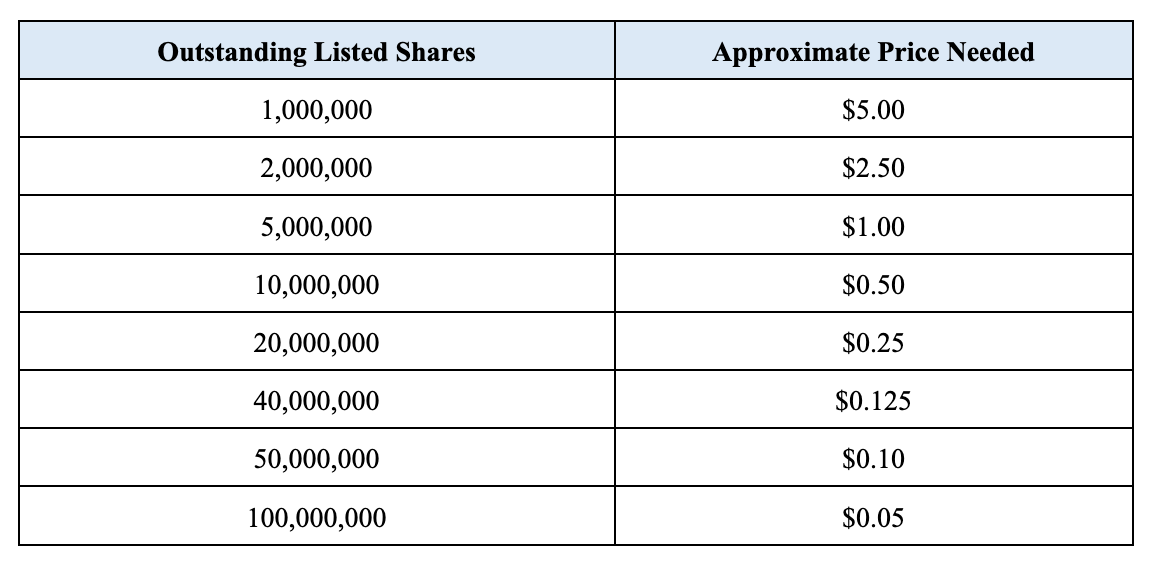
Price Needed to Maintain $5 Million in MVLS
The minimum closing bid price needed to maintain $5 million in MVLS can be estimated by dividing $5 million by the number of outstanding listed shares.
Common Nasdaq Deficiencies and Possible Cures
Nasdaq Minimum Bid Price Deficiency
The most common Nasdaq deficiency involves a closing bid price below $1.00. A company may receive an initial compliance period, and in some circumstances a second period, but eligibility is not automatic. The company must also consider Nasdaq’s limitations on repeated reverse stock splits and whether sufficient time remains to complete the split and satisfy the required consecutive-day trading period.
A reverse stock split requires coordinated corporate, SEC, Nasdaq, transfer-agent and DTC work. Depending on the issuer’s jurisdiction and governing documents, shareholder approval may be required. The company must also review fractional-share treatment, authorized shares, equity-plan adjustments, warrants, convertible securities and contractual price-protection provisions.
Nasdaq Stockholders’ Equity Deficiency
A company may seek to cure a stockholders’ equity deficiency through an equity financing, conversion or forgiveness of debt, exercise of warrants, restructuring of liabilities, acquisition transaction or improvement in operating results. The proposed cure should produce a meaningful equity cushion because Nasdaq may be reluctant to rely on a transaction that leaves the company barely above the applicable threshold or likely to fall below it again shortly after the hearing.
The company should provide a pro forma balance sheet, capitalization table, financing documents, use-of-proceeds information and projections demonstrating that it can sustain compliance after transaction expenses and continuing operating losses.
Delinquent Form 10-K, Form 10-Q or Form 20-F Filings
A company that fails to timely file required SEC reports may be required to submit a compliance plan or may receive a Staff Delisting Determination, depending on the circumstances and the duration of the delinquency. The Nasdaq strategy must be coordinated with the company’s auditor, audit committee and SEC reporting counsel.
A useful compliance submission should explain the cause of the delinquency, the work remaining, the auditor’s timetable, the status of any restatement or internal investigation and the specific date by which each delinquent report will be filed. Unsupported estimates or repeated missed deadlines can undermine the company’s credibility.
Public Float, Publicly Held Shares and Shareholder Deficiencies
Nasdaq’s public-float and shareholder requirements are distinct from total market capitalization. Shares held by officers, directors, 10% owners or other excluded holders may not qualify as publicly held shares. Restricted shares may also be excluded from certain calculations.
Reverse stock splits, issuer repurchases, redemptions, insider concentration and small public floats can cause a company to fall below the required number or market value of publicly held shares. Before implementing a reverse split, the company should model its post-split public float, round-lot holders and unrestricted publicly held shares using current transfer-agent and DTC position information.
Does a Reverse Stock Split Cure a Nasdaq Delisting Deficiency?
A reverse stock split may assist with a minimum bid price deficiency, but it does not cure every Nasdaq problem and does not increase the company’s economic value by itself.
Assume a company has 20 million outstanding shares trading at $0.20 per share. Its market capitalization is $4 million. After a 1-for-10 reverse split, it would theoretically have 2 million shares trading at $2.00 per share. Its market capitalization would remain $4 million.
- A reverse split does not increase stockholders’ equity.
- A reverse split does not automatically increase MVLS.
- A reverse split may reduce publicly held shares and round-lot holders.
- Repeated reverse splits may limit eligibility for a compliance period.
- The post-split price may decline after trading resumes.
- The company must leave enough time to complete the split and establish the required trading history before the Nasdaq deadline.
How Does a Nasdaq Hearings Panel Appeal Work?
A company that receives a Staff Delisting Determination may request a hearing before a Nasdaq Hearings Panel. The request must be submitted by the deadline stated in the notice and generally requires payment of a hearing fee. The company then submits a written presentation and appears at a hearing to explain why continued listing is appropriate.
Whether the hearing request stays suspension depends on the rule involved. Companies should not assume that an appeal will always keep the security trading on Nasdaq. Under the new $5 million MVLS requirement, the appeal does not automatically stay suspension.
What Should the Hearing Submission Include?
- A concise history of the company and the deficiency;
- A complete description of every current listing issue;
- The company’s proposed cure and completion timetable;
- Executed financing, debt-conversion or transaction documents;
- Board and shareholder approvals already obtained or required;
- Pro forma financial statements and capitalization calculations;
- Post-transaction public-float and shareholder calculations;
- The status of SEC reports, audits and reviews;
- Cash requirements and operating projections; and
- A demonstration that the company can maintain compliance after the cure.
The panel may grant an exception subject to conditions and monitoring. Depending on the deficiency, the panel may require the company to satisfy applicable initial listing standards rather than merely the less demanding continued listing standard. A company should therefore analyze both sets of requirements before proposing a cure.
What Makes a Nasdaq Compliance Plan Credible?
A successful Nasdaq compliance plan should be specific, documented, achievable and internally consistent. It should answer five questions:
- What exact listing requirement is the company failing?
- What completed or firmly committed action will cure the deficiency?
- When will each required corporate, SEC, Nasdaq and market step occur?
- Will the company satisfy all other listing standards after the cure?
- How will the company maintain compliance rather than merely touch the threshold temporarily?
Nasdaq generally wants evidence that a company can achieve and sustain compliance—not merely a proposal that might temporarily satisfy one numerical standard.
What Happens If Nasdaq Suspends or Delists the Company’s Securities?
A Nasdaq suspension can sharply reduce liquidity and access to capital. The security may become eligible for quotation in the over-the-counter market, but OTC trading is not necessarily automatic. Broker-dealer quotation eligibility, Exchange Act Rule 15c2-11, OTC Markets requirements and the company’s SEC reporting status must be evaluated.
- The stock may trade on an OTC market or, in some circumstances, the Expert Market;
- Broker-dealers may restrict purchases or require enhanced review;
- Institutional investors may be required to sell;
- Financing agreements may contain Nasdaq-listing defaults;
- The company may lose index or investment-mandate eligibility;
- Bid-and-ask spreads may widen and trading volume may decline;
- The company may still remain subject to Exchange Act reporting obligations after delisting.
Companies facing a possible suspension should prepare an OTC Markets contingency plan before the Nasdaq trading halt occurs. The plan should address market-maker quotation eligibility, current SEC filings, transfer-agent records, DTC eligibility, investor communications and any contractual consequences of losing the Nasdaq listing.
Form 8-K and Public Disclosure of a Nasdaq Deficiency
A domestic reporting company generally must disclose receipt of a Nasdaq notice under Item 3.01 of Form 8-K within four business days. The disclosure should accurately identify the rule, the nature of the deficiency, the available compliance period or appeal rights and the effect on continued listing. Foreign private issuers should consider their Form 6-K and home-country disclosure obligations.
The company should avoid suggesting that compliance is assured when the proposed cure remains subject to financing, shareholder approval, Nasdaq review or market-price performance. Public statements concerning a reverse split, capital raise, hearing or expected compliance date remain subject to the federal securities laws and antifraud provisions.
Frequently Asked Questions About Nasdaq Delisting
Does every Nasdaq deficiency notice mean the company will be delisted?
No. Some notices provide a compliance period or permit the company to submit a plan. The notice must be reviewed carefully to determine the applicable procedure and deadline.
Can a company appeal a Staff Delisting Determination?
Generally, yes, but the hearing request must be timely. Whether the request stays suspension depends on the applicable Nasdaq rule.
Will a 1-for-10 reverse stock split solve a bid price deficiency?
It may increase the per-share price mathematically, but Nasdaq compliance depends on actual post-split trading. The company must also consider public float, shareholder count, prior reverse splits and the deadline for maintaining the required bid price.
Does issuing more shares increase MVLS?
It can increase the number of outstanding listed shares, but dilution may reduce the stock price. The company must evaluate the transaction’s net effect on market value and whether shareholder approval is required.
Can a Nasdaq-delisted company trade on OTC Markets?
Possibly, but quotation is not automatic in every case. The company must evaluate Rule 15c2-11, its SEC reporting status, broker-dealer participation and the requirements of the applicable OTC market tier.
When should a company retain Nasdaq delisting counsel?
Ideally, before the company receives a Staff Delisting Determination. Counsel can help assess the deficiency, model potential cures, coordinate corporate actions and financings, prepare the compliance plan and represent the company in the Nasdaq hearing process.
Nasdaq Delisting Counsel and Compliance Planning
Hamilton & Associates Law Group, P.A. assists Nasdaq-listed companies with deficiency notices, compliance plans, Hearings Panel submissions, reverse stock splits, shareholder approvals, SEC reporting deficiencies, financings, stockholders’ equity cures and OTC Markets contingency planning.
Early planning is critical. A financing, shareholder meeting, reverse stock split, audit or SEC filing often requires more time than management expects, and a rushed transaction may create additional Nasdaq deficiencies.
Related Nasdaq and Going-Public Resources
For additional information, review the Nasdaq, SEC reporting, reverse stock split, OTC Markets and going-public resources available at SecuritiesLawyer101.com and GoPublic101.com.
Disclaimer: This article is provided for informational purposes only and does not constitute legal advice. Nasdaq listing matters are fact-specific, and the applicable procedures and deadlines depend on the issuer’s market tier, deficiencies, capital structure, SEC reporting status and prior corporate actions.
To speak with a Securities Attorney, please contact Brenda Hamilton at 200 E Palmetto Rd, Suite 103, Boca Raton, Florida, (561) 416-8956, or by email at [email protected].
Hamilton & Associates | Securities Attorneys
Brenda Hamilton, Securities Attorney
200 E Palmetto Rd, Suite 103
Boca Raton, Florida 33432
Telephone: (561) 416-8956
Facsimile: (561) 416-2855
www.SecuritiesLawyer101.com