

Short selling is a lawful and valuable component of market efficiency. It provides liquidity, supports price discovery, and uncovers fraud. But when false information is weaponized to drive prices down for profit, it crosses into manipulation.
This practice—known as a “short-and-distort” campaign—is the mirror image of a pump-and-dump scheme. A short-and-distort campaign occurs when a trader takes a short position in a company’s stock and then spreads false or misleading statements to panic investors into selling.
These operations thrive on online virality, using blogs, research reports, social-media threads, and anonymous message boards to create fear and confusion. Such conduct violates federal securities laws, including Section 9(a)(2) and Section 10(b) of the Securities Exchange Act of 1934, Rule 10b-5, and Section 17(a) of the Securities Act of 1933. It can lead to civil enforcement, criminal prosecution, and private lawsuits.
Anatomy of a Short-and-Distort Campaign
- Positioning: The trader opens a significant short position, often through borrowed shares, put options, or swaps.
- Publication: A negative “research” report or online post appears, alleging fraud, accounting issues, or insolvency. It is framed as analysis but often relies on falsehoods or selective data.
- Amplification: Bots, influencers, and message boards spread the claims. Algorithmic traders respond to the surge in negative sentiment, accelerating the decline.
- Covering: Once the price collapses, the operator repurchases shares to close the short, realizing profit.
- Evasion: The campaign dissolves; posts are deleted or the actor rebrands under new pseudonyms.
Common Statutory Violations
- Exchange Act § 9(a)(2): Market manipulation—transactions creating a false or misleading appearance of active trading.
- Exchange Act § 10(b) and Rule 10b-5(a)–(c): Any manipulative or deceptive scheme in connection with a security.
- Securities Act § 17(a): Fraudulent interstate communications in the offer or sale of securities.
- Regulation SHO, Rule 204: Failure to timely close out naked shorts resulting from false locate documentation.
Notable Enforcement and Civil Cases
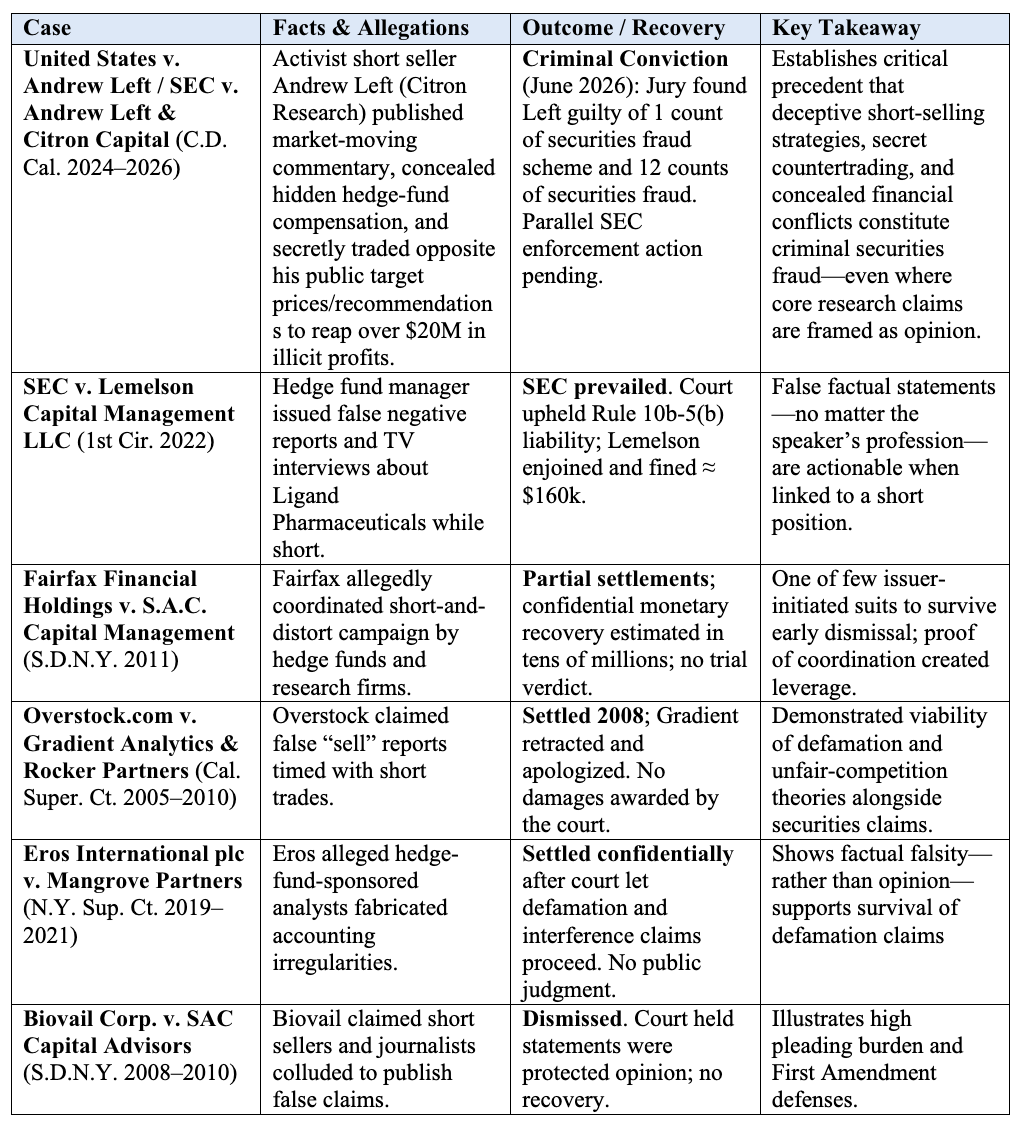
The Regulatory Landscape and Detection Tools
- SEC & FINRA Oversight: The SEC’s Market Abuse Unit analyzes short-position data and social-media chatter through the Consolidated Audit Trail (CAT) and MIDAS systems. FINRA tracks chronic fails-to-deliver under Regulation SHO.
- Whistleblowers: The SEC Office of the Whistleblower awards 10–30 percent of sanctions for credible tips. Multimillion-dollar awards arise from insiders exposing false short-biased research coordination.
- Civil & Criminal Liability: Violators risk injunctions, disgorgement, and civil penalties under Exchange Act § 21(d), as well as criminal securities-fraud charges under 18 U.S.C. § 1348 and § 1343 (wire fraud).
What Issuers Should Do if They Believe They Are Victims of a Short-and-Distort Campaign
- Document Everything
- Preserve the original report, posts, and timestamps.
- Correlate publication times with trading spikes and short-interest changes.
- Obtain DTCC position reports and broker-dealer communications showing delivery failures.
- Engage Experienced Securities Counsel
- Counsel can analyze violations under Rule 10b-5, Reg SHO, Section 9(a)(2), and relevant defamation laws;
- Prepare TCR filings to the SEC and Market Regulation Tips to FINRA;
- Advise whether a civil action is viable.
- Coordinate a Factual Public Response
- File a Form 8-K or press release correcting inaccuracies using verifiable data.
- Avoid accusatory language or speculation—false corporate statements may create issuer liability under Rule 10b-5(b).
- Consider Private Litigation When Evidence Supports It
- Viable claims include Section 9(a)(2) manipulation, Rule 10b-5 fraud, and defamation/interference under state law.
- Retain economic experts to quantify price impact and damages.
- Explore subpoenas to identify anonymous posters (as in Nobilis Health v. The Pump Stopper).
- Engage Regulators Early
- Parallel SEC or FINRA investigations strengthen credibility and may yield subpoenaed trading data unavailable in civil discovery.
- Maintain Disclosure and Compliance Discipline
- Staying current with SEC periodic reports, audits, and corporate governance reduces vulnerability to credibility attacks.
- Investor Communication Strategy
- Educate shareholders through factual Q&A updates. Discourage online rumor-based “short squeezes,” which themselves can violate Exchange Act § 9(a)(2).
Policy Debate and Reform
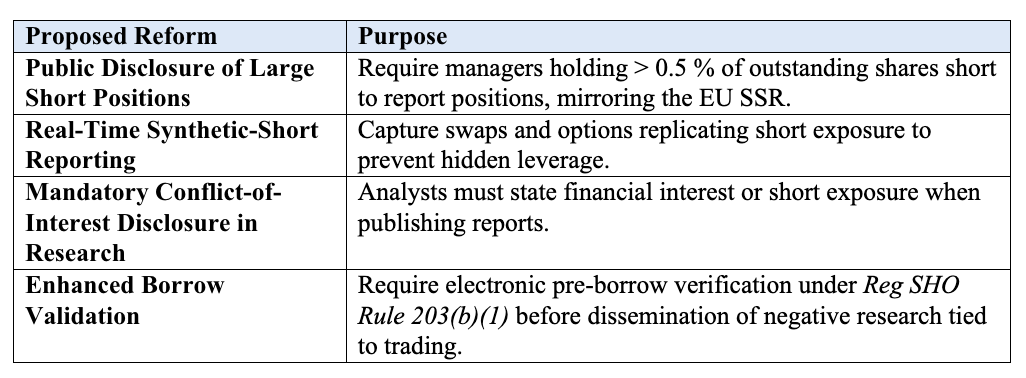
Proponents argue these reforms would deter manipulative short campaigns and improve transparency. Critics warn they could expose legitimate research funds to retaliation and reduce market efficiency.
Conclusion
Short-and-distort campaigns erode confidence, destroy shareholder value, and undermine the credibility of legitimate market research.
While few issuers historically won large civil verdicts, milestone enforcement cases—culminating in the 2026 criminal conviction of Citron Research founder Andrew Left—demonstrate that federal regulators and juries are taking action against deceptive short campaigns.
Issuers should respond methodically—document, verify, engage regulators, and communicate truthfully. With the SEC’s expanded short-position reporting under Rule 13f-2 and heightened DOJ oversight of manipulative research commentary, the regulatory environment is shifting toward greater accountability.
References
- Securities Exchange Act §§ 9(a)(2), 10(b), 21(d) (15 U.S.C. §§ 78i(a)(2), 78j(b))
- SEC Rule 10b-5 (17 C.F.R. § 240.10b-5)
- Securities Act § 17(a) (15 U.S.C. § 77q(a))
- Regulation SHO (17 C.F.R. § 242.200–204)
- United States v. Andrew Left, No. 2:24-CR-456 (C.D. Cal. 2026)
- SEC v. Andrew Left and Citron Capital, LLC, No. 2:24-cv-06311 (C.D. Cal. 2024)
- SEC v. Lemelson Capital Management LLC, 2022 WL 4096513 (1st Cir.)
- Fairfax Financial Holdings v. S.A.C. Capital Management, 2011 WL 2279549 (S.D.N.Y.)
- Overstock.com v. Gradient Analytics, Cal. Super. Ct. (2005–2010)
- Eros International plc v. Mangrove Partners, N.Y. Sup. Ct. (2019–2021)
- Biovail Corp. v. SAC Capital Advisors, 2008 WL 2622913 (S.D.N.Y.)
- FINRA Regulatory Notice 24-03 (Jan 2024) — Short-Interest Reporting Guidance
This article is provided for informational purposes only and does not constitute legal advice. To speak with a Securities Attorney, please contact Brenda Hamilton at 200 E Palmetto Rd, Suite 103, Boca Raton, Florida, (561) 416-8956, or by email at [email protected].
Hamilton & Associates | Securities Attorneys
Brenda Hamilton, Securities Attorney
200 E Palmetto Rd, Suite 103
Boca Raton, Florida 33432
Telephone: (561) 416-8956
Facsimile: (561) 416-2855
www.SecuritiesLawyer101.com