

OTC Markets Listing Requirements 2026: How to List on OTCQX, OTCQB or OTCID
Companies seeking an OTC Markets quotation in 2026 must navigate separate market-tier standards, securities-law reporting obligations and quotation requirements. This guide compares OTCQX, OTCQB and OTCID and explains the issues issuers should evaluate before applying.
Companies seeking to “list on the OTC Markets” in 2026 generally evaluate three principal issuer markets: the OTCQX Best Market, OTCQB Venture Market and OTCID Basic Market. OTC Markets Group describes OTCQX as its market for established, investor-focused companies, OTCQB as its venture market for entrepreneurial and development-stage companies, and OTCID as its basic market for companies meeting minimum information requirements.
Although companies and market participants commonly use terms such as “OTC listing,” “OTCQB listing” and “OTC Markets listing,” OTCQX, OTCQB and OTCID are not national securities exchanges such as Nasdaq or the New York Stock Exchange. OTC securities generally trade off-exchange. That distinction matters because OTC Markets qualification, SEC reporting status and eligibility for broker-dealer quotations are related but separate concepts.
For a company researching how to list on OTC Markets, the practical question is not simply which tier has the lowest fee. The issuer should determine whether its reporting status, financial statements, capitalization, shareholder distribution, stock price, governance and quotation pathway support both initial qualification and continuing compliance.

OTCQX vs. OTCQB vs. OTCID: 2026 Requirements at a Glance
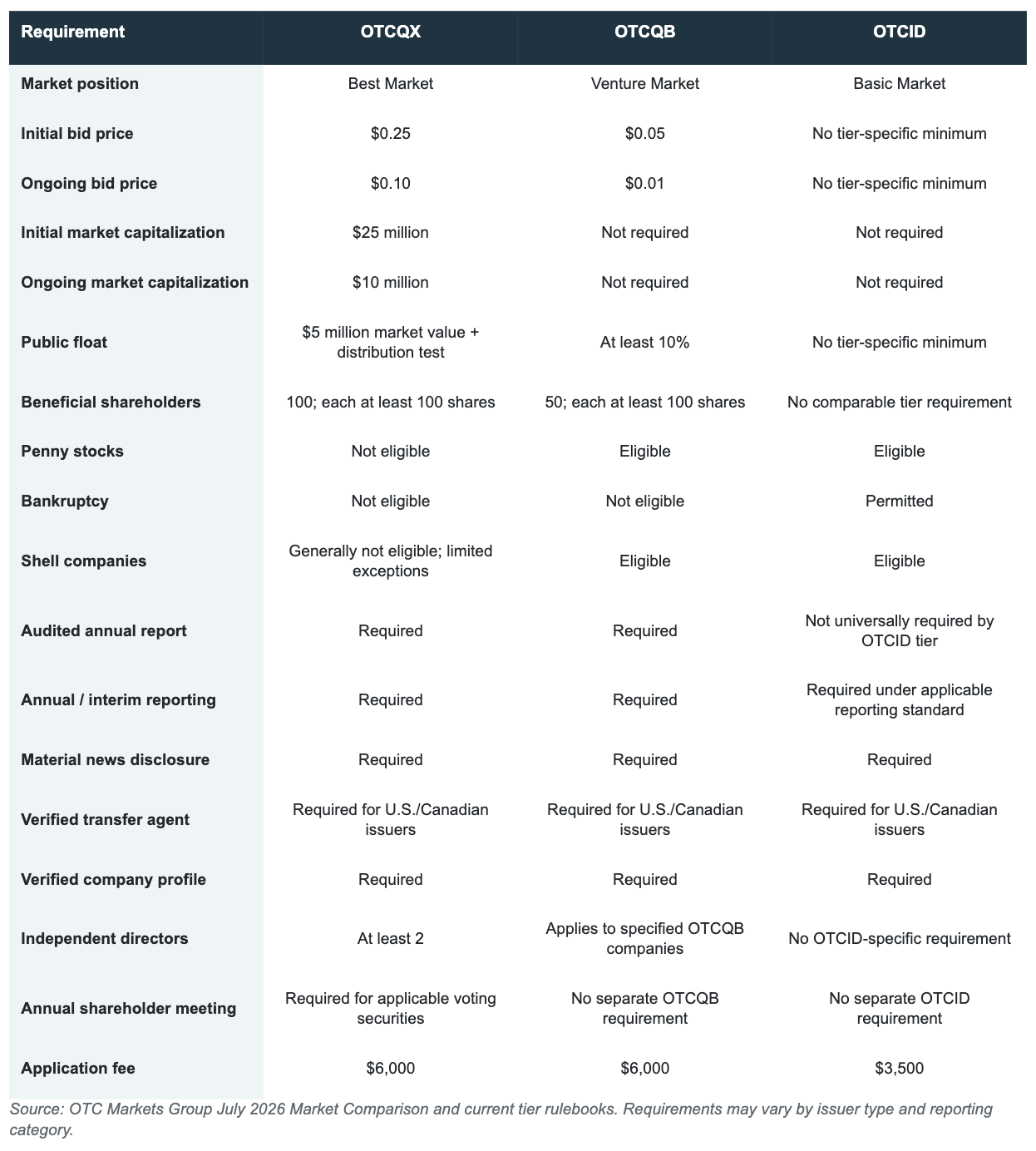
The following comparison summarizes major requirements reflected in OTC Markets Group’s July 2026 U.S. company market comparison and the current OTCQX and OTCQB rulebooks (found here, here and here). Specialized rules and exceptions may apply to banks, SPACs, international issuers and other categories.
What Is an OTC Markets Listing?
An “OTC Markets listing” generally refers to a company’s securities becoming eligible for quotation and trading on a market operated by OTC Markets Group. The phrase is useful because it reflects how issuers and search users describe the process, but legally it should not be confused with a listing on a national securities exchange.
OTC Markets Group organizes securities into markets based on the quality and timeliness of issuer information and other qualification standards. Its current issuer markets include OTCQX, OTCQB, OTCID and Pink Limited.

What Is the OTCID Basic Market?
The OTCID Basic Market is OTC Markets Group’s baseline issuer market for companies that publish required information but do not meet the higher qualifications of the premium OTCQX and OTCQB markets. OTCID companies provide ongoing financial disclosure, management certification and a verified company profile.
OTCID Reporting Requirements
OTCID permits several reporting categories, including SEC Reporting Companies, Regulation A Reporting Companies, Regulation Crowdfunding Companies, qualifying International Reporting Companies, Alternative Reporting Companies exempt from SEC registration and qualifying U.S. banks.
Accordingly, a company does not necessarily have to become an SEC reporting company to qualify for OTCID. A non-SEC reporting company may qualify under the Alternative Reporting Standard if it is eligible and complies with the applicable OTC Markets disclosure requirements.
Does OTCID Require Audited Financial Statements?
Not as a universal tier requirement. OTC Markets Group’s current U.S. company comparison does not impose an across-the-board audited annual report requirement for OTCID, while expressly noting that an audit may be required under applicable federal or state rules.
That does not mean every OTCID issuer can use unaudited financial statements. An issuer may independently need an audit because of its SEC reporting status, Regulation A reporting obligations, a securities offering, bank-reporting rules or another applicable requirement. The correct analysis is issuer-specific.
OTCID Company Profile, Certification and Transfer Agent
An OTCID company must verify its company profile through OTCIQ before joining or requalifying and must refresh the profile at least every six months. Except for qualifying international reporting companies, management certification is required initially and on an ongoing annual basis under the OTCID rules.
A company incorporated in the United States or Canada generally must retain a transfer agent participating in the Transfer Agent Verified Shares Program, unless the company acts as its own transfer agent and provides the required share data directly. The issuer must also authorize the transfer agent to provide specified capitalization and issuance information to OTC Markets Group on request.
Does OTCID Have a Minimum Stock Price?
The current U.S. company comparison does not impose an OTCID-specific minimum bid price, minimum market capitalization or minimum public-float percentage. OTCID is therefore potentially available to companies that can satisfy the information and issuer-participation standards but do not yet meet OTCQB or OTCQX quantitative thresholds.
What Are the OTCQB Listing Requirements in 2026?
The OTCQB Venture Market is designed for entrepreneurial and development-stage U.S. and international companies. The current OTCQB rules, version 6 effective April 6, 2026, require companies to remain current in applicable reporting obligations, satisfy a $0.05 initial bid-price requirement and meet audit, public-float, shareholder and other eligibility standards.
OTCQB Minimum Bid Price
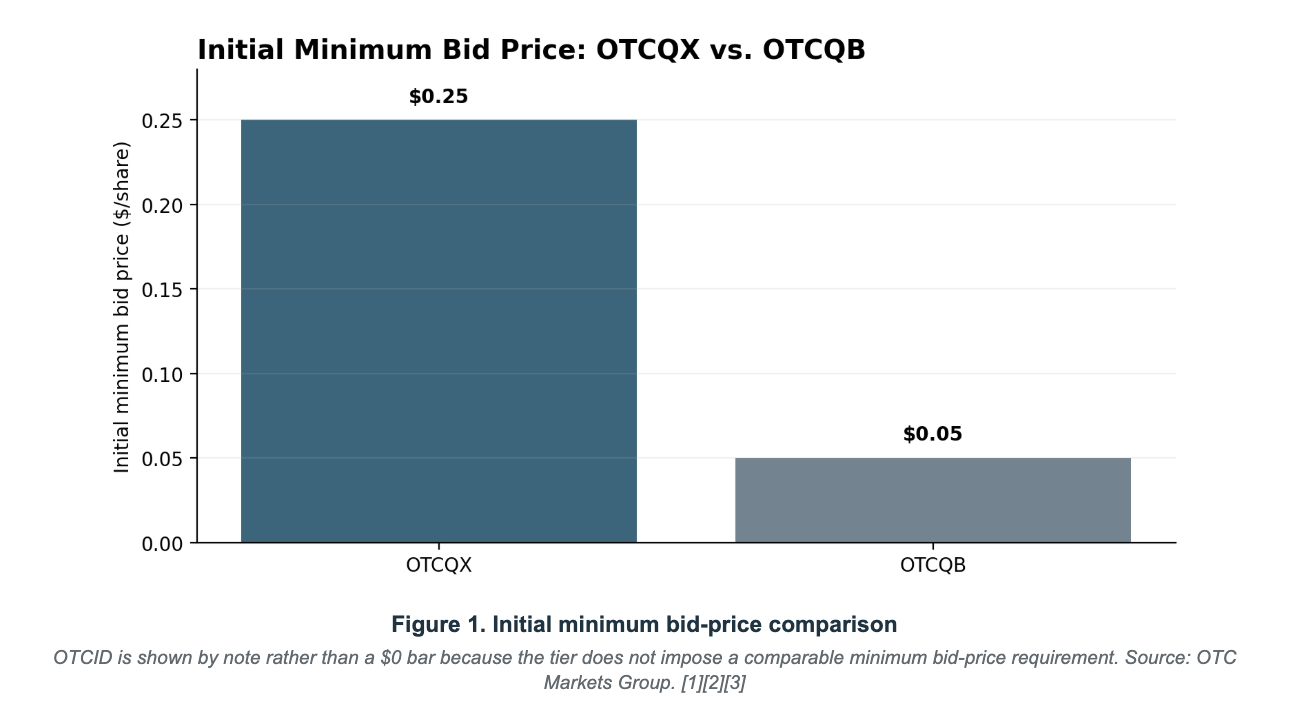
Each class of securities applying to OTCQB generally must have a minimum bid price of $0.05 per share as of the close of business on each of the 30 consecutive calendar days immediately preceding admission. The rules provide conditional treatment in specified circumstances where there has been no prior U.S. public market.
After admission, the current ongoing OTCQB bid-price standard is $0.01. A company considering a reverse stock split to meet the initial threshold should evaluate whether its post-split trading market can also support continuing compliance.
OTCQB Public Float Requirement
Each class of securities applying to OTCQB generally must have a Public Float of at least 10% of the total class outstanding. Because OTC Markets Group defines how Public Float is calculated, issuers should review affiliate holdings and other excluded shares rather than assume that 10% of total shares outstanding will automatically qualify.
OTCQB Shareholder Requirement
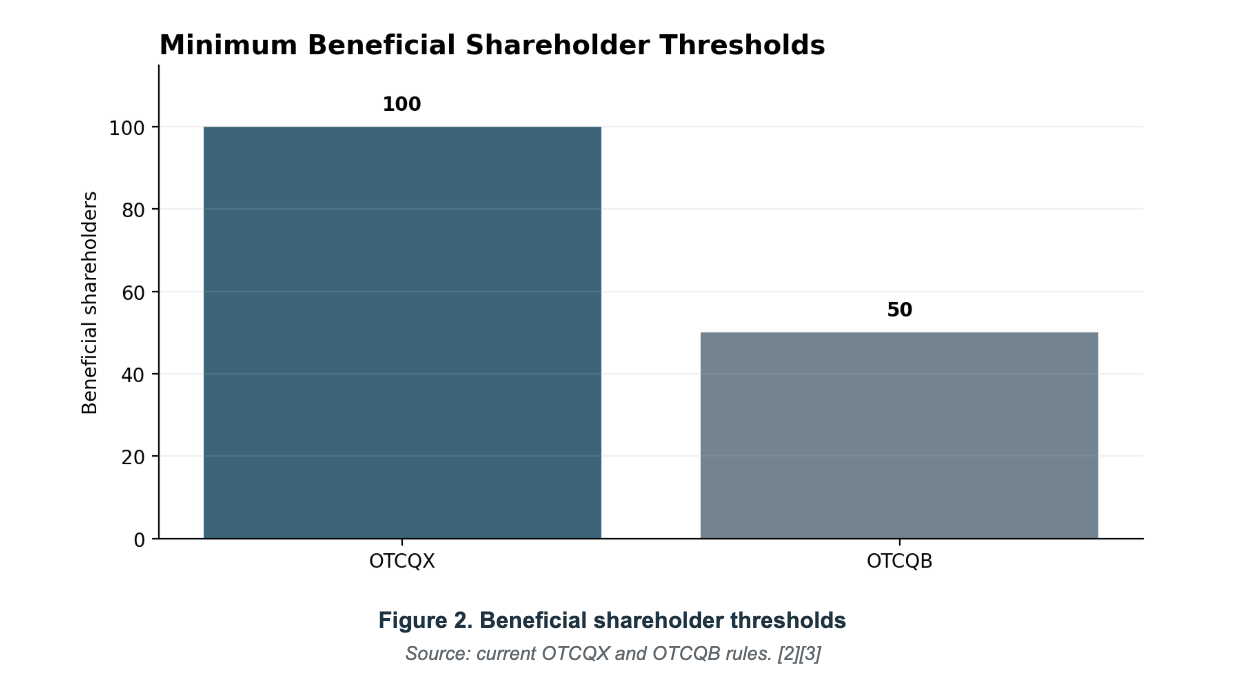
Current OTCQB rules generally require at least 50 Beneficial Shareholders, each owning at least 100 shares of the class seeking qualification. This is a beneficial-holder test, which should not be confused with the number of registered holders appearing on a transfer-agent list.
Does OTCQB Require an Audit?
Generally, yes. Annual financial statements must be audited and the audit opinion may not be adverse, disclaimed or qualified. Audits generally must be performed by a PCAOB-registered auditor, subject to specified exceptions for certain international companies and for Regulation A reporting companies at initial eligibility.
A company planning an OTCQB application should therefore address auditor eligibility and any financial-statement deficiencies before it files the application. Audit problems can delay both securities-law reporting and market qualification.
Does a Company Have to Be SEC Reporting to Trade on OTCQB?
No. The current OTCQB rules recognize multiple reporting categories, including SEC Reporting Companies, Regulation A Reporting Companies, qualifying international issuers, Alternative Reporting Companies and qualifying banks. An eligible Alternative Reporting Company can therefore potentially qualify for OTCQB without becoming an Exchange Act reporting company.
OTCQB Corporate Governance Requirements
OTCQB governance requirements do not apply identically to every issuer. Alternative Reporting Companies, and any other company notified by OTC Markets Group at the time of application, must have at least two independent directors and an audit committee of at least two members, a majority of whom are independent. The rules allow phase-in requests in specified circumstances.
What Are the OTCQX Listing Requirements in 2026?
The OTCQX Best Market is OTC Markets Group’s highest issuer market. Current OTCQX rules for U.S. companies state that qualifying companies must meet financial standards, follow corporate-governance practices, demonstrate compliance with U.S. securities laws and remain current in filing obligations. Penny stocks, ordinary shell companies and companies in bankruptcy cannot qualify, subject to the rulebook’s specified provisions and exceptions.
OTCQX Minimum Bid Price
A U.S. operating company applying to OTCQX generally must maintain a minimum bid price of $0.25 per share for each of the 30 consecutive calendar days immediately preceding admission. The ongoing standard is $0.10 per share as of the close of business on at least one day during each 30-consecutive-calendar-day period.
OTCQX Market Capitalization Requirement
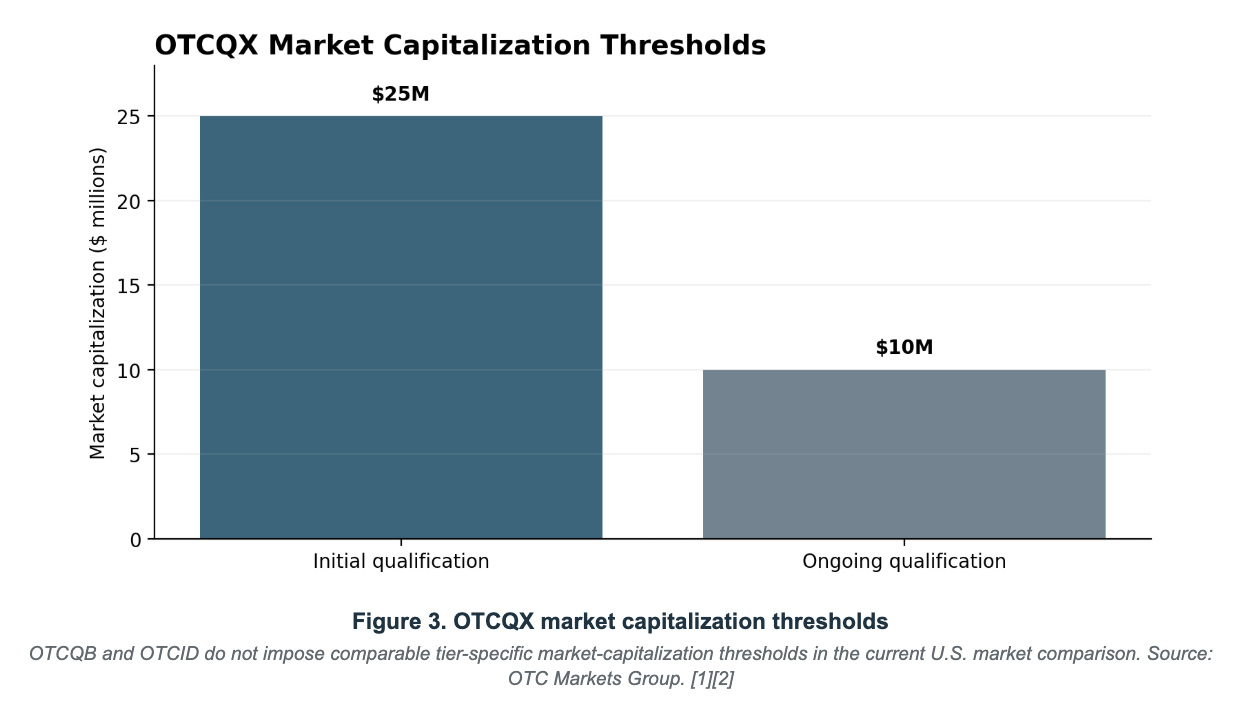
Current OTCQX standards require a market capitalization of at least $25 million on each of the 30 consecutive calendar days immediately preceding admission, subject to a possible exemption from the look-back period where there has been no prior U.S. public market. Continuing qualification requires at least $10 million in market capitalization on at least one day during each 30-day period.
OTCQX Penny Stock Exemption
A U.S. company seeking OTCQX qualification generally must satisfy an applicable exemption from the definition of a penny stock under Exchange Act Rule 3a51-1. Under the current OTCQX rules, one route is audited financial statements showing net tangible assets of at least $2 million for a company with at least three years of continuous operations or $5 million for a company with less than three years of continuous operations. Another route is average revenue of at least $6 million for the preceding three years for a company meeting the applicable operating-history requirement.
The rules also provide for conditional qualification in specified circumstances where the security has a minimum bid price of $5.00 and interim financial statements demonstrate to OTC Markets Group’s satisfaction that the company is expected to satisfy an applicable financial test by its next annual report.
OTCQX Public Float Requirement
Each class of securities seeking OTCQX qualification must have a market value of Public Float of at least $5 million and satisfy one of two distribution tests. The class can have Public Float of at least 20% of the outstanding class, or Public Float between 10% and 20% if the company also has at least $50 million in total assets and $10 million in stockholders’ equity.
The public-float analysis is independent of the $25 million initial market-capitalization test. An issuer can satisfy one quantitative standard while failing another, which is why the cap table should be modeled before the application is submitted.
OTCQX Shareholder and Market Maker Requirements
Each class of securities seeking OTCQX qualification generally must have at least 100 Beneficial Shareholders, each owning at least 100 shares. The company also must ultimately have proprietary priced quotations published by two market makers on OTC Link ATS. The current rules permit phased compliance with the market-maker requirement, including special timing where an Initial Review is used.
OTCQX Corporate Governance Requirements
U.S. OTCQX companies generally must maintain at least two independent directors and an audit committee of at least two members with a majority of independent directors. A company with common stock, voting preferred stock or an equivalent voting security must conduct an annual shareholder meeting and satisfy the related financial-report and proxy-material requirements. Phase-in provisions may apply where there has been no prior U.S. public market. [2]
OTC Markets Application Fees
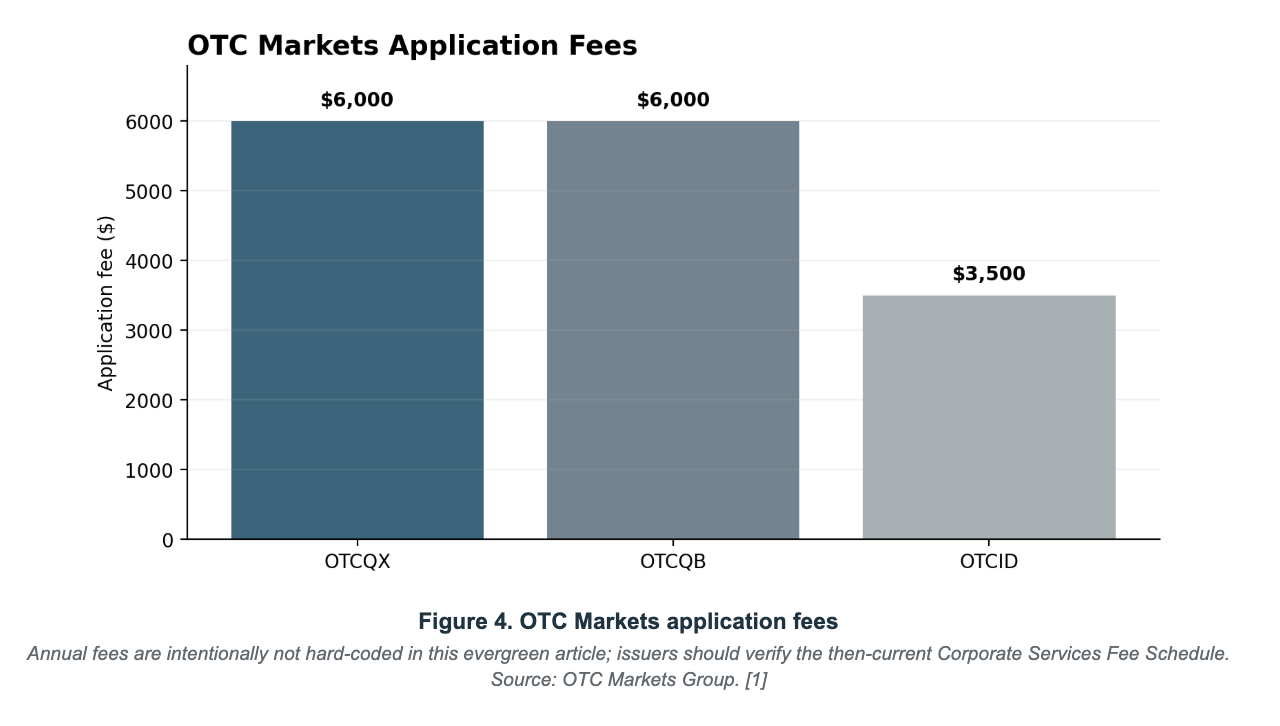
The current U.S. company comparison reflects application fees of $6,000 for OTCQX, $6,000 for OTCQB and $3,500 for OTCID. Issuers should confirm the fee schedule immediately before applying because OTC Markets Group may change pricing.
The OTC Markets fee is only one component of the total cost of being public. Depending on the issuer, additional expenses can include securities counsel, audit and accounting, transfer-agent services, EDGAR preparation, D&O insurance, investor relations, corporate actions, shareholder meetings and continuing compliance.
OTC Markets Qualification Is Different From Form 211 Quotation Eligibility
One of the most common misconceptions about OTC Markets is that an issuer files Form 211 itself and then becomes publicly traded. That is not how the process works. FINRA states that market makers and Qualified Interdealer Quotation Systems use Form 211 to demonstrate compliance with SEC Rule 15c2-11 and FINRA Rule 6432 when initiating or resuming quotations, unless an exemption applies.

FINRA’s Form 211 page, updated for the streamlined platform launched March 30, 2026, explains that market makers must comply with Rule 15c2-11 when initiating or resuming quotations in a non-exchange-listed security and that Form 211 is not necessary when an exemption applies. [5]
SEC Rule 15c2-11 and OTC Quotations
SEC Rule 15c2-11 remains central to OTC quotation eligibility. The SEC explains that, subject to limited exceptions, information about a company generally must be current and publicly available for broker-dealers to quote the company’s securities in a quotation medium. The SEC’s small-business guidance was last updated April 24, 2026.
In March 2026, the SEC proposed amendments to Rule 15c2-11 in Release No. 34-105004, File No. S7-2026-08. The proposal would revise the rule to refer only to equity securities. Because the matter remains a proposal unless and until adopted, issuers should distinguish pending rulemaking from current law.
Is Becoming Public the Same as Listing on OTC Markets?
No. A private company can become subject to public-company reporting or otherwise take steps toward becoming publicly traded without automatically obtaining an active OTC quotation. Likewise, becoming an SEC reporting company does not automatically place the company’s securities on OTCQX, OTCQB or OTCID.
Depending on the transaction, an issuer may need to coordinate its corporate structure, capitalization, securities issuance history, shareholder base, financial statements, reporting status, transfer-agent records, Rule 15c2-11 information, OTC Markets application and quotation pathway. The sequence can materially affect the result.
How to List on OTC Markets: Step-by-Step
- Determine the target OTC market. Analyze whether OTCID, OTCQB or OTCQX fits the issuer’s present eligibility and long-term strategy before restructuring the capitalization or closing a going-public transaction.
- Determine the company’s reporting status. Identify whether the issuer will qualify as an SEC Reporting Company, Regulation A Reporting Company, Alternative Reporting Company, International Reporting Company or another permitted category.
- Review the capitalization table. Confirm authorized, issued and outstanding shares; restricted and unrestricted shares; affiliate ownership; convertible securities; options; warrants; public float and beneficial ownership.
- Complete the required financial statements. For OTCQB or OTCQX, resolve auditor eligibility, audit timing and financial-statement deficiencies before the market application is submitted.
- Review bid price and market capitalization. OTCQB applicants should model the $0.05 initial bid-price test. OTCQX applicants must analyze the $0.25 initial bid price, $25 million initial market capitalization, public float and penny-stock exemption together.
- Review the shareholder base. Determine whether the class satisfies the applicable beneficial-shareholder test, including the 100-share minimum for each qualifying holder on OTCQB and OTCQX.
- Confirm transfer-agent compliance. Reconcile the transfer-agent records with the issuer’s cap table and public disclosures and confirm participation in the required verified-shares program where applicable.
- Prepare the OTC Markets application and company profile. Ensure that the application, shareholder records, financial statements, management certification and prior public disclosures are internally consistent.
- Address Rule 15c2-11 and quotation eligibility. Determine whether the facts support an OTC Markets Initial Review, a Form 211 pathway, an exception or another available route.
- Maintain continuing compliance. Admission is not the endpoint. Monitor disclosure deadlines, certifications, bid price, capitalization, governance, corporate actions and other ongoing standards.
OTCID vs. OTCQB: Which Is Better?
OTCID may be appropriate where an issuer’s immediate objective is to establish current public information and it does not yet satisfy OTCQB’s audit, bid-price, public-float or shareholder standards. OTCQB may be appropriate for a development-stage company that can satisfy the $0.05 initial bid price, audited annual financial statement requirements, 10% public-float test, 50-beneficial-shareholder threshold and other applicable requirements.
OTCQB should therefore be treated as more than a branding upgrade. It adds objective eligibility standards that should be verified before the application is filed.
OTCQB vs. OTCQX: Which Is Better?
The difference between OTCQB and OTCQX is substantially greater. OTCQX adds the $25 million initial market-capitalization threshold, $5 million market value of public float plus the applicable float-distribution test, penny-stock-exemption requirements, a higher bid-price standard, a larger shareholder base and more extensive corporate governance.
An OTCQB company considering OTCQX should perform a full eligibility analysis before announcing an intended upgrade. Market price alone is not sufficient.
Can a Company Go Directly to OTCQX?
A company does not necessarily have to progress sequentially from OTCID to OTCQB and then OTCQX. If it satisfies the applicable requirements and completes the relevant qualification and quotation process, it may pursue the market appropriate to its circumstances. For some issuers, however, OTCQB can provide an intermediate stage while the company develops its reporting history, shareholder distribution and trading market.
Can an OTC Company Eventually Uplist to Nasdaq or NYSE?
Potentially. A company whose securities trade on OTCQX or OTCQB may later apply to a national securities exchange if it satisfies that exchange’s applicable listing standards. OTC qualification does not guarantee a future exchange listing. Companies planning a later uplisting should consider future exchange governance, shareholder, liquidity and capitalization requirements when structuring earlier transactions.
Blue Sky Considerations
State securities or “Blue Sky” laws can affect OTC trading and solicitation. OTC Markets Group currently states that OTCQX has Blue Sky status in 41 jurisdictions and OTCQB in 37, while also cautioning that individual state coverage may vary. OTCID does not receive comparable market-level status in the current U.S. market comparison.
An issuer should not assume that market designation alone resolves every state-law question. Applicable exemptions and transaction-specific requirements should be analyzed separately.
Common OTC Markets Listing Mistakes
- Using outdated OTCQX or OTCQB requirements. The April 2026 rule changes materially altered key quantitative standards.
- Confusing an OTC Markets qualification with an exchange listing. OTCQX, OTCQB and OTCID are off-exchange markets.
- Assuming the issuer files Form 211 itself. Where Form 211 is required, the qualifying firm makes the filing.
- Assuming every quotation requires a traditional sponsoring-market-maker Form 211. The available path depends on the facts and current Rule 15c2-11 framework.
- Failing to calculate Public Float under the applicable definition. Affiliate holdings and other exclusions can change the result.
- Confusing record holders with Beneficial Shareholders. The OTCQB and OTCQX tests are stated in beneficial-holder terms.
- Waiting too long to engage an appropriate auditor. Audit deficiencies can derail market timing.
- Completing a reverse stock split without modeling post-split compliance. Reaching an initial bid-price threshold does not guarantee continuing compliance.
- Ignoring governance until after the application is prepared. OTCQX and specified OTCQB applicants may need board and audit-committee changes.
- Treating admission as the end of compliance. All three issuer markets impose ongoing disclosure and issuer-participation obligations.
Frequently Asked Questions About OTC Markets Listings
What is the minimum price to list on OTCQB in 2026?
The current initial OTCQB minimum bid-price requirement is generally $0.05 per share, with a $0.01 ongoing standard. The initial rule includes a 30-consecutive-calendar-day requirement and conditional provisions for specified companies without a prior U.S. public market.
What is the minimum price for OTCQX?
The current initial OTCQX minimum bid price for applicable U.S. companies is generally $0.25 per share, with a $0.10 continuing standard.
What is the minimum market capitalization for OTCQX?
The current OTCQX rules generally require $25 million in initial market capitalization and $10 million for continuing qualification, subject to the rulebook’s timing and transition provisions.
Does OTCQB have a minimum market capitalization?
The current U.S. company comparison does not impose an OTCQB-specific minimum market-capitalization requirement. Other OTCQB standards still apply.
Does OTCID have a minimum stock price?
The current OTCID standards do not impose a comparable tier-specific minimum bid price.
Does OTCQB require audited financial statements?
Generally, yes. Current OTCQB rules require audited annual financial statements and generally require a PCAOB-registered auditor, subject to specified exceptions.
Does OTCID require an audit?
Not as a universal OTCID tier requirement. An audit may still be required under the issuer’s applicable reporting, offering, federal or state law requirements.
Does a company need to be SEC reporting for OTCQB?
No. The current OTCQB rules permit multiple reporting categories, including qualifying Alternative Reporting Companies.
Who files Form 211?
Where a traditional Form 211 filing is required, it is submitted by the qualifying firm, not by the issuer.
Is Rule 15c2-11 still important?
Yes. The SEC continues to describe current and publicly available issuer information as central to broker-dealer quotations in a quotation medium, subject to exceptions. The SEC also has a 2026 proposal concerning the rule’s scope.
Choosing the Right OTC Markets Tier
For a company evaluating an OTC Markets quotation in 2026, the appropriate market depends on its reporting status, financial condition, capitalization, shareholder base, stock price, public float, governance and long-term objectives.
- OTCID: A baseline issuer market for companies able to satisfy current-information, certification and profile requirements without meeting OTCQB or OTCQX quantitative standards.
- OTCQB: A venture market for companies able to satisfy audited financial statement, bid-price, public-float, shareholder and continuing-disclosure requirements.
- OTCQX: The highest issuer market, with materially higher capitalization, public-float, penny-stock-exemption, shareholder-distribution and governance standards.
The highest available tier is not automatically the best choice. The appropriate market is the one whose initial and continuing requirements the company can realistically maintain.
OTC Markets Listing Attorney
Becoming publicly traded and obtaining an OTC Markets quotation can involve federal and state securities laws, corporate law, audited financial statements, transfer-agent matters, public-company disclosure, Rule 15c2-11, Form 211, OTC Markets qualification and ongoing compliance.
Companies considering an OTC Markets listing, OTCQB application, OTCQX application, OTCID qualification, reverse merger, direct public offering or other going-public transaction should evaluate these requirements before completing the underlying transaction. Structuring the capitalization, reporting status, shareholder distribution and compliance program in advance can help avoid deficiencies that are substantially harder to correct after closing.
Conclusion
The OTC Markets listing requirements changed materially in 2026. OTCID, OTCQB and OTCQX now represent distinct levels of issuer qualification and participation. OTCID focuses on baseline public information and issuer engagement. OTCQB adds objective standards involving bid price, audited financial statements, public float and shareholder distribution. OTCQX adds substantially higher standards involving market capitalization, penny-stock exemption, public-float value, shareholder distribution, quotations and corporate governance.
Companies researching how to list on OTC Markets in 2026 should avoid relying on older guides without confirming that the underlying rules remain current. A successful OTC Markets strategy requires more than satisfying a checklist on the application date; the issuer’s disclosure, capitalization, shareholders, governance and trading-market plan should support continuing compliance after qualification.
This article is provided for general informational purposes only and does not constitute legal, tax or investment advice. OTC Markets Group, SEC and FINRA requirements, interpretations and fees may change. Companies should review the rules in effect at the time of a proposed application or transaction and obtain advice concerning their specific facts and circumstances.
To speak with a Securities Attorney, please contact Brenda Hamilton at 200 E Palmetto Rd, Suite 103, Boca Raton, Florida, (561) 416-8956, or by email at [email protected].
Hamilton & Associates | Securities Attorneys
Brenda Hamilton, Securities Attorney
200 E Palmetto Rd, Suite 103
Boca Raton, Florida 33432
Telephone: (561) 416-8956
Facsimile: (561) 416-2855
www.SecuritiesLawyer101.com