

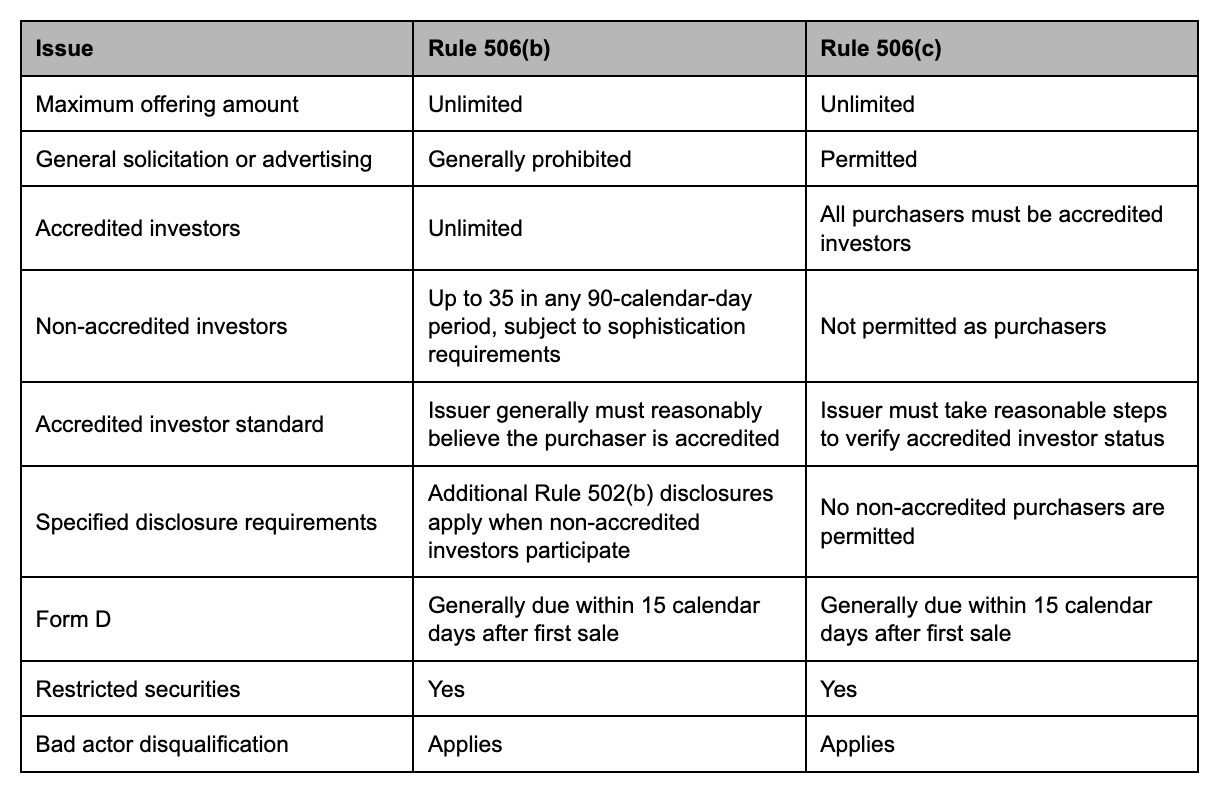
Rule 506(b) and Rule 506(c) are two of the most commonly used exemptions for private securities offerings under Regulation D. Both allow an issuer to raise an unlimited amount of capital without registering the offering with the Securities and Exchange Commission, but the rules differ sharply on general solicitation, who may purchase the securities, and how accredited investor status is established.
For an issuer choosing between a Rule 506(b) private placement and a Rule 506(c) offering, the key question is usually whether the issuer needs to advertise or broadly solicit investors. Rule 506(b) generally prohibits general solicitation. Rule 506(c) permits general solicitation, but every purchaser must be an accredited investor and the issuer must take reasonable steps to verify accredited investor status.
The choice should be made before marketing begins because the way an offering is promoted can affect which exemption is available.
Key Takeaways
- Rule 506(b) generally prohibits general solicitation and general advertising.
- Rule 506(c) permits general solicitation, but all purchasers must be accredited investors.
- Rule 506(c) requires reasonable steps to verify accredited investor status; a purchaser representation alone generally is not enough.
- Rule 506(b) may include up to 35 non-accredited purchasers in any 90-calendar-day period, subject to sophistication and disclosure requirements.
- Both Rule 506(b) and Rule 506(c) permit an unlimited offering amount and generally require a Form D filing within 15 calendar days after the first sale.
- Rule 506 offerings are federally preempted from state registration, but states may still require notice filings, fees, and consent to service of process.
- Both exemptions are subject to federal anti-fraud rules and Rule 506 bad actor disqualification provisions.
What Is the Difference Between Rule 506(b) and Rule 506(c)?
The central difference between Rule 506(b) and Rule 506(c) is whether the issuer may use general solicitation. Rule 506(b) is designed for private offerings that are not publicly advertised. Rule 506(c) allows an issuer to advertise or broadly solicit an offering, but only accredited investors may purchase and the issuer must verify their accredited investor status.
What Is a Rule 506 Offering Under Regulation D?
Rule 506 is a Regulation D safe harbor used for private offerings under Section 4(a)(2) of the Securities Act of 1933. Unlike Rule 504, Rule 506 does not impose a dollar cap on the amount an issuer may raise. Securities sold under Rule 506 are restricted securities and generally cannot be freely resold unless they are registered or an exemption from registration is available.
Securities offered under Rule 506 are also covered securities under federal law. That federal preemption prevents states from requiring substantive registration or qualification of the offering, but it does not eliminate all state securities compliance obligations.
How Does a Rule 506(b) Private Placement Work?
Rule 506(b) is commonly used when an issuer can reach prospective investors privately and does not need to advertise the investment opportunity to the public. The issuer may sell to an unlimited number of accredited investors and, subject to additional requirements, to a limited number of non-accredited investors.
Can a Rule 506(b) Offering Use General Solicitation?
Generally, no. Rule 506(b) incorporates the Regulation D prohibition on general solicitation and general advertising. Public advertisements, unrestricted internet communications, mass marketing campaigns, and certain broadly promoted investor events can create issues for an issuer attempting to rely on Rule 506(b).
Whether a particular communication constitutes general solicitation depends on the facts and circumstances. Issuers should therefore identify the intended exemption and review their marketing process before publishing offering terms or soliciting potential investors.
Who Can Invest in a Rule 506(b) Offering?
A Rule 506(b) offering may be sold to an unlimited number of accredited investors. It may also include up to 35 non-accredited purchasers in any 90-calendar-day period. Each non-accredited purchaser, alone or with a purchaser representative, must have sufficient knowledge and experience in financial and business matters to be capable of evaluating the merits and risks of the prospective investment.
Although Rule 506(b) permits qualifying non-accredited purchasers, many issuers elect to limit the offering to accredited investors because participation by non-accredited investors triggers additional disclosure requirements.
What Disclosure Is Required in a Rule 506(b) Offering?
When all purchasers in a Rule 506(b) offering are accredited investors, Regulation D does not prescribe the same specific information package that applies when non-accredited investors participate. The federal anti-fraud provisions still apply, however, and an issuer should not make material misstatements or omit material facts necessary to make its statements not misleading.
If non-accredited investors participate, Rule 502(b) requires specified information to be furnished to them a reasonable time before sale, including financial information appropriate to the issuer and offering. The issuer must also make specified information available to accredited investors upon request and provide non-accredited investors an opportunity to ask questions and receive answers concerning the terms and conditions of the offering.
How Does a Rule 506(c) Offering Work?
Rule 506(c) allows an issuer to use general solicitation and general advertising in connection with a Regulation D offering. That can make Rule 506(c) attractive when an issuer wants to reach prospective investors through public websites, media, online campaigns, investor events, or other communications that would be problematic in a Rule 506(b) offering.
The marketing flexibility comes with two essential conditions: every purchaser must be an accredited investor, and the issuer must take reasonable steps to verify that status.
Can You Advertise a Rule 506(c) Offering?
Yes. Rule 506(c) was adopted specifically to permit general solicitation and general advertising where its conditions are satisfied. An issuer may therefore publicly communicate about a Rule 506(c) offering, but broad advertising does not reduce the issuer’s obligations concerning investor eligibility, verification, disclosure, anti-fraud compliance, or broker-dealer considerations.
How Do Issuers Verify Accredited Investor Status Under Rule 506(c)?
Rule 506(c) requires an issuer to take reasonable steps to verify that each purchaser is an accredited investor. The SEC describes verification as a principles-based determination. Relevant factors can include the type of accredited investor the purchaser claims to be, the information the issuer already has, how the purchaser was solicited, and the terms of the offering, including the minimum investment amount.
Rule 506(c) also provides non-exclusive verification methods. Depending on the accredited investor category, these methods may involve reviewing income or net-worth documentation or obtaining written confirmation from specified third parties, including a registered broker-dealer, an SEC-registered investment adviser, a licensed attorney, or a certified public accountant.
A purchaser’s self-certification or checked box stating that the purchaser is accredited generally does not, by itself, satisfy the separate Rule 506(c) requirement to take reasonable steps to verify accredited investor status.
2025 SEC Staff Guidance on High Minimum Investments
In March 2025, the SEC’s Division of Corporation Finance issued a no-action letter addressing whether a high minimum investment amount, together with specified representations and other conditions, could support a principles-based verification determination under Rule 506(c).
Under the facts presented in the letter, the staff stated that it would not recommend enforcement action where an issuer used minimum investment amounts of at least $200,000 for natural persons and at least $1 million for legal entities, together with specified written representations, limitations concerning financing of the investment, and the issuer’s absence of knowledge of contrary facts.
The letter is staff guidance based on the particular facts presented; it is not a Commission rule and should not be treated as a universal safe harbor. Issuers relying on a principles-based verification method should document the facts supporting their conclusion.
Do Rule 506(b) and Rule 506(c) Offerings Require Form D?
Yes. Rule 503 generally requires an issuer conducting a Regulation D offering under Rule 506(b) or Rule 506(c) to file a notice on Form D with the SEC no later than 15 calendar days after the first sale of securities in the offering. If the due date falls on a Saturday, Sunday, or holiday, the filing is due on the next business day.
Form D is a notice filing, not a registration statement, and filing Form D does not mean that the SEC has reviewed or approved the offering. Amendments may also be required in specified circumstances.
Do State Blue Sky Laws Apply to Rule 506 Offerings?
Rule 506 securities are covered securities, so states generally may not require the offering itself to be registered or qualified. States may nevertheless require notice filings, filing fees, consent to service of process, and compliance with state anti-fraud laws. The filing requirements vary by state, so an issuer should identify the states in which purchasers reside and review the applicable notice requirements.
Bad Actor Disqualification Under Rule 506
Both Rule 506(b) and Rule 506(c) are subject to Rule 506(d) bad actor disqualification. Certain criminal convictions, court orders, regulatory orders, suspensions, expulsions, bars, and other specified disqualifying events involving the issuer or other covered persons can make Rule 506 unavailable.
Covered persons can include the issuer, directors, executive officers and certain other officers, certain beneficial owners, promoters, investment managers and principals of pooled investment funds, and compensated solicitors, among others. Issuers should conduct appropriate bad actor diligence before relying on Rule 506. Certain events that occurred before September 23, 2013 may require disclosure rather than disqualification.
Rule 506(b) vs. Rule 506(c): Which Exemption Is Better?
Neither exemption is inherently better. The appropriate choice depends on the issuer’s investor base and capital-raising strategy.
Rule 506(b) may be a better fit when:
- The issuer can reach prospective investors without public advertising or general solicitation.
- The issuer wants the flexibility to include a limited number of sophisticated non-accredited purchasers.
- The issuer does not want to undertake the separate Rule 506(c) accredited investor verification process.
- The offering is being conducted through private relationships or other channels consistent with the Rule 506(b) restrictions.
Rule 506(c) may be a better fit when:
- The issuer wants to advertise or broadly promote the offering.
- The issuer is willing to limit all purchasers to accredited investors.
- The issuer can implement and document reasonable accredited investor verification procedures.
- The issuer’s fundraising strategy depends on reaching investors beyond an existing private network.
The exemption should be selected early. An issuer that engages in general solicitation and later attempts to rely on Rule 506(b) may have a serious exemption problem. SEC staff guidance recognizes that an issuer that initially contemplated Rule 506(c) but did not actually engage in general solicitation may, depending on the facts, subsequently rely on Rule 506(b).
Frequently Asked Questions About Rule 506(b) and Rule 506(c)
Can non-accredited investors invest in a Rule 506(b) offering?
Yes, subject to the rule’s limits and conditions. Rule 506(b) permits up to 35 non-accredited purchasers in any 90-calendar-day period, provided the applicable sophistication and disclosure requirements are satisfied.
Can non-accredited investors invest in a Rule 506(c) offering?
No. Every purchaser in a Rule 506(c) offering must be an accredited investor. The issuer must also take reasonable steps to verify accredited investor status.
Is a Rule 506(c) offering a public offering?
Rule 506(c) permits public advertising and general solicitation, but the securities are still sold pursuant to an exemption from Securities Act registration. The securities are restricted securities and the issuer must comply with the conditions of Rule 506(c).
Is a Form D required for Rule 506(b) and Rule 506(c)?
Yes. Regulation D generally requires Form D to be filed with the SEC within 15 calendar days after the first sale in the offering. Form D is a notice filing and is not evidence that the SEC has approved the offering.
Can an issuer switch from Rule 506(c) to Rule 506(b)?
Potentially, but the facts matter. SEC staff guidance indicates that if an issuer began with an intent to rely on Rule 506(c) but did not engage in general solicitation, it may subsequently determine to rely on Rule 506(b). Once general solicitation has occurred, Rule 506(b) generally is not available for the same offering absent another applicable basis under the integration framework.
Are securities sold under Rule 506 freely tradable?
No. Securities sold under Rule 506(b) and Rule 506(c) are restricted securities and generally may not be resold unless the resale is registered or another exemption from registration is available.
Getting Legal Assistance With a Rule 506 Offering
SecuritiesLawyer101 assists issuers with Rule 506(b) and Rule 506(c) private offerings, including offering structure, private placement memoranda, subscription agreements, investor questionnaires, accredited investor procedures, Form D filings, state securities notice filings, and related securities law compliance matters.
Addressing the exemption, offering documents, marketing process, investor qualification procedures, broker-dealer issues, and federal and state filing requirements before an offering begins can reduce the risk of problems that are difficult to correct after securities have been offered or sold.
This article is provided for informational purposes only and does not constitute legal advice. Securities laws and their application depend on the facts and circumstances of each offering.
To speak with a Securities Attorney, please contact Brenda Hamilton at 200 E Palmetto Rd, Suite 103, Boca Raton, Florida, (561) 416-8956, or by email at [email protected].
Hamilton & Associates | Securities Attorneys
Brenda Hamilton, Securities Attorney
200 E Palmetto Rd, Suite 103
Boca Raton, Florida 33432
Telephone: (561) 416-8956
Facsimile: (561) 416-2855
www.SecuritiesLawyer101.com