

A transfer agent’s refusal to remove a restrictive legend does not always mean the Rule 144 legal opinion is wrong. It may mean the request raises a different legal issue. The fastest path is usually to identify that issue, determine the governing law, and provide the legal opinion or legal process that actually resolves it.

Do Not Scream at the Transfer Agent. Find Out Why It Said No.
A shareholder who has obtained a Rule 144 legal opinion may expect restrictive legend removal to be routine. When the transfer agent says no, the reaction can be immediate: repeated calls, angry emails, demands for escalation, or threats of litigation.
That approach often makes the process slower rather than faster. A transfer agent can refuse or delay a legend removal request for very different reasons. Some involve the Rule 144 opinion itself. Others involve an issuer instruction, an adverse claim, a stop transfer demand, a contractual transfer restriction, a court order, or uncertainty about the law governing registration of transfer.
Those issues should not be treated as interchangeable. The first task is to identify the precise reason the transfer agent did not process the request.
A useful question is simple: What legal or documentary issue prevents the transfer agent from completing the restrictive legend removal, and what would resolve that issue?
First, Determine Whether the Problem Is the Rule 144 Legal Opinion
A Rule 144 legal opinion generally addresses whether restricted securities may be resold without registration under the Securities Act of 1933 and whether the federal securities law basis for maintaining a restrictive legend has been satisfied.
The opinion may require analysis of the holding period, affiliate status, current public information, former shell company status, tacking, convertible securities, warrants, reorganizations, gifts, estates, trusts, or other facts affecting Rule 144. The scope of the legal opinion also matters. An opinion supporting a particular sale may not be written broadly enough to support unrestricted legend removal from an entire position.
The Securities and Exchange Commission explains that a transfer agent generally will not remove a restrictive legend without issuer consent, which is commonly communicated through an opinion of counsel. The SEC also notes that disputes over restrictive legend removal are not resolved by the SEC and may depend on applicable law. See SEC guidance on restricted securities and restrictive legend removal.
If the transfer agent identifies a specific deficiency in a Rule 144 legal opinion, the practical response is usually to address that deficiency. Counsel may be able to provide a clarification, supplemental representation, or revised Rule 144 legal opinion without turning the matter into a larger dispute.
Common Rule 144 Legal Opinion Issues
- Whether the required Rule 144 holding period has been satisfied.
- Whether the shareholder is an affiliate or was recently an affiliate.
- Whether the issuer is or was a shell company and whether Rule 144(i) applies.
- Whether a prior holder’s holding period may be tacked.
- Whether convertible debt, warrants, options, exchanges, gifts, trusts, estates, or reorganizations affect the holding period.
- Whether current public information is required and available.
- Whether the legal opinion covers a specific sale, an as sold transaction, or unrestricted legend removal from the entire position.
- Whether the transfer agent needs additional factual representations or supporting documents before it can rely on the opinion.
Second, Determine Whether the Transfer Agent Is Actually the Party Saying No
Shareholders often say that the transfer agent refused the legend removal. Sometimes the transfer agent is only communicating an issuer decision.
That distinction matters. A transfer agent may have a transfer agency agreement requiring it to follow certain issuer instructions, but contractual instructions between the issuer and transfer agent do not automatically answer every statutory question involving the shareholder’s right to registration.
UCC Article 8 separates these issues. UCC Section 8-401 addresses the issuer’s duty to register a transfer when the statutory conditions are satisfied. UCC Section 8-407 provides that a transfer agent has the same obligation to the holder or owner, with respect to the particular transfer functions it performs, as the issuer has with respect to those functions.
For that reason, counsel should determine whether the transfer agent made an independent decision, whether the issuer instructed the transfer agent to stop processing, or whether issuer counsel provided a legal opinion explaining a separate basis for refusal.
Florida example. Florida has adopted these provisions as Sections 678.4011 and 678.4071, Florida Statutes. Section 678.4011 addresses the duty of an issuer to register transfer when its conditions are met. Section 678.4071 applies the issuer’s corresponding obligation to a transfer agent for the functions it performs.
Third, Determine Which Law Governs Before Arguing About the Refusal
A legend removal dispute cannot be analyzed correctly until counsel determines which law governs the issuer’s registration duties. The transfer agent’s physical location does not necessarily answer that question.
UCC Section 8-110 contains a specific choice of law rule for several Article 8 issues. Among other matters, it directs attention to the law of the issuer’s jurisdiction for the issuer’s rights and duties concerning registration of transfer and duties to adverse claimants. A Delaware issuer, Nevada issuer, Cayman Islands issuer, and British Virgin Islands issuer may therefore present different governing law questions even when the same United States transfer agent is involved.
The transfer agency agreement also matters, but its governing law clause may govern contractual matters between the issuer and transfer agent without necessarily selecting the substantive law that governs a shareholder’s right to registration.
This is why a governing law legal opinion may sometimes be necessary before anyone can determine whether the transfer agent must process the request or may continue to withhold registration.
Fourth, Ask Whether There Is an Actual Adverse Claim or Stop Transfer Demand
A Rule 144 legal opinion and an adverse ownership claim answer different questions. Rule 144 addresses a federal securities law exemption. An adverse claim may involve title, authority, fraud, a trust, a contract, a prior transfer, a marital or estate dispute, or another claimed interest in the securities.
The transfer agent should not be expected to conduct a trial by email and decide who really owns disputed shares. Experienced transfer agent counsel has long recognized the difficult position created when a transfer agent is caught between the issuer and a shareholder. Mark A. Harmon, who has represented transfer agents for decades, has written about the transfer agent’s duty to remain neutral when issuer records and a shareholder’s claim conflict.
The better question is whether applicable law provides a procedure for dealing with the adverse claim and whether that procedure has been followed.
Transfer agent neutrality. Harmon discusses the transfer agent’s difficult position when issuer records conflict with a shareholder presentation and the importance of remaining neutral between issuer and shareholder. Read the Harmon article.
UCC Section 8-403 Provides a Procedure for Certain Stop Transfer Demands
When the applicable law follows UCC Section 8-403, a qualifying demand that the issuer not register transfer can trigger a defined process. The statute is important because it provides a mechanism for protecting an adverse claimant without requiring the issuer or transfer agent to decide the merits of the ownership dispute.
Florida Section 678.4031 illustrates the procedure. After an effective demand has been received and a transfer request is presented, the issuer must promptly notify the person who initiated the demand and the person requesting registration that registration will be withheld for a stated period so the claimant can obtain legal process or an indemnity bond.
Under the Florida statute, the stated period may not exceed 30 days after the notification. If the claimant does not obtain an appropriate restraining order, injunction, or other court process, and does not provide a sufficient indemnity bond within the stated period, the statute protects the issuer from liability to that claimant for registering a transfer pursuant to an effective instruction. The bond is specifically required to protect the issuer and any transfer agent, registrar, or other agent involved.
Section 8-403 should not be applied mechanically without first determining governing law and whether the statutory requirements for an effective demand are satisfied. But where it applies, it demonstrates why a bare assertion of an ownership dispute is not necessarily the same thing as an unlimited right to freeze securities indefinitely.
Florida statute. Section 678.4031, Florida Statutes addresses demands that an issuer not register transfer, including the notice, legal process, indemnity bond, and maximum 30 day period described in the statute.
Fifth, Ask Whether There Is a Court Order
A dispute is not a court order. An allegation is not an injunction. An issuer email is not automatically judicial process.
If the refusal is based on litigation or an adverse claim, counsel should ask whether a court has actually entered a restraining order, injunction, attachment, or other process affecting the securities. If a court order exists, obtain and review it. The transfer agent should know exactly what the order prohibits, who is bound by it, what securities it covers, and whether it remains in effect.
If no court order exists, the analysis turns back to governing law. Some disputes may justify a temporary hold while the applicable statutory process is followed. Others may involve a valid contractual restriction or a separate corporate law issue. The legal basis should be identified rather than assumed.
A UCC legal opinion or transfer agent legal opinion can be useful where the central question is whether a stop transfer demand remains legally effective or whether the transfer agent may proceed in the absence of additional legal process.
Federal Transfer Agent Rules Can Explain Delay, But They Do Not Resolve the Ownership Dispute
Registered transfer agents are also subject to federal securities laws and SEC transfer agent rules. Those rules distinguish routine items from nonroutine items.
Under SEC Rule 17Ad-1, an item is not routine if the transfer agent has received notice of a stop order, adverse claim, or another restriction on transfer. An item is also not routine if additional documentation, explanations, instructions, or opinions of counsel are required before transfer can be effected.
SEC Rule 17Ad-2 generally requires registered transfer agents to turn around at least 90 percent of routine items within three business days. A disputed legend removal request may therefore fall outside the routine item standard.
That classification can explain why a transfer request is not completed within the ordinary turnaround period. It does not, by itself, decide whether the issuer or transfer agent has substantive legal authority to refuse the transfer indefinitely. That question depends on the law governing the underlying registration duty and the facts of the particular request.
Federal rules. SEC Rule 17Ad-1 defines routine and nonroutine items. SEC Rule 17Ad-2 contains the turnaround standard for routine items.
What Shareholder Counsel Should Ask Instead of Sending an Angry Email
A focused written request can often identify the problem quickly. Counsel should ask for the following information:
- Was the legend removal request rejected by the transfer agent, or was the transfer agent acting on an instruction from the issuer or issuer counsel?
- Does the transfer agent consider the Rule 144 legal opinion deficient? If so, what specific legal conclusion, factual representation, or document is missing?
- Has the transfer agent received a stop transfer demand, notice of adverse claim, court order, injunction, or other restriction?
- What is the legal basis for the refusal or delay?
- What law does the issuer or transfer agent contend governs the registration issue?
- What legal opinion or additional documentation would allow the transfer agent to process the request?
- If the refusal is based on an adverse claim, has the claimant obtained legal process or provided any indemnity bond required under applicable law?
- Is the request being treated as nonroutine under the federal transfer agent rules, and if so, what unresolved issue makes it nonroutine?
Ask What Legal Opinion Will Actually Resolve the Problem
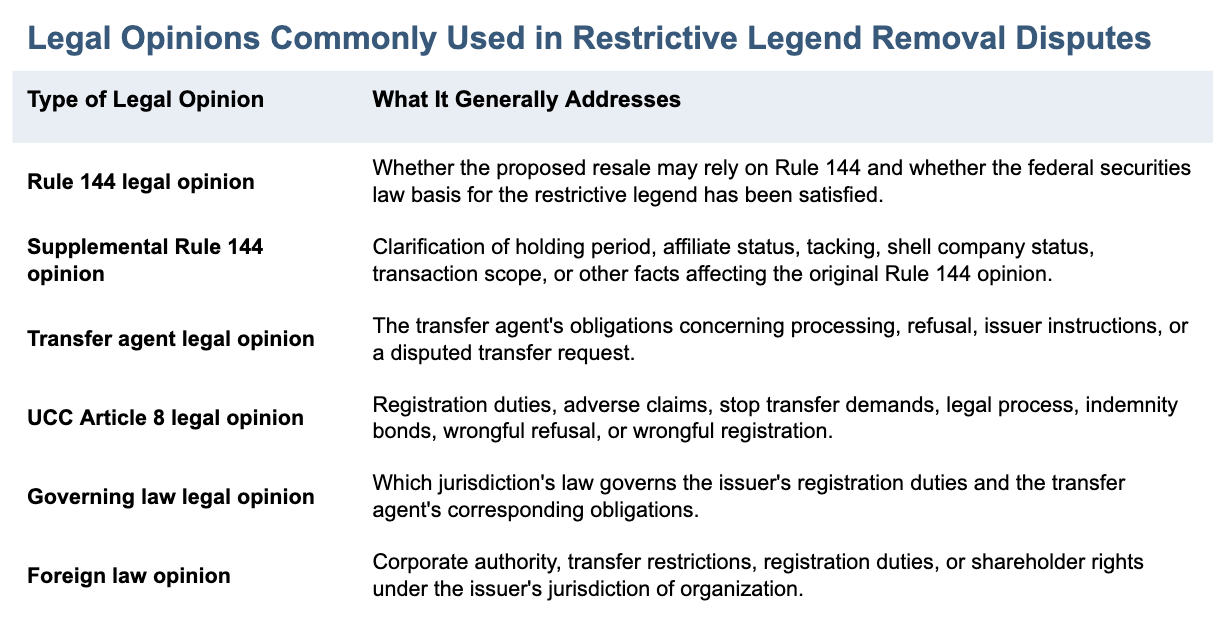
The phrase legal opinion is often used as though every opinion serves the same purpose. It does not. A legal opinion is useful only if it addresses the legal question that is preventing the transfer agent from acting.
If the issue is federal resale eligibility, the transfer agent may need a Rule 144 legal opinion. If the issue is a missing fact or assumption, counsel may need to provide a supplemental Rule 144 opinion. If the issuer claims a legal right to refuse registration, issuer counsel may need to identify and support that right. If governing law is disputed, the parties may need a governing law opinion. If an adverse claim is the obstacle, a UCC Article 8 legal opinion may be appropriate. If the issuer is foreign, local corporate counsel may need to address the issuer’s duties under the law of its jurisdiction.
The goal should be to give the transfer agent a reliable legal basis to act, not to pressure the transfer agent into deciding a question that belongs to counsel or a court.
The Transfer Agent Is Not the Courthouse
A transfer agent has important legal and administrative responsibilities, but it should not be forced to determine disputed beneficial ownership by choosing which party’s factual story is more credible.
That does not mean the transfer agent can ignore a legitimate adverse claim or valid issuer restriction. It means the transfer agent should identify the legal mechanism that applies to the dispute. If applicable law requires a claimant to obtain an injunction or provide an indemnity bond, that process protects the competing parties while allowing a court, rather than the transfer agent, to decide the underlying controversy.
The same principle protects shareholders. A shareholder should not have securities frozen indefinitely merely because someone made an accusation if applicable law requires more. The legal basis for continuing a refusal should be identified, documented, and evaluated under the governing law.
This is where experienced securities counsel and a properly reasoned legal opinion can be more effective than confrontation.
When Securities Counsel Should Become Involved
Counsel should consider becoming directly involved when a legend removal request presents any of the following issues:
- The transfer agent rejects or questions a Rule 144 legal opinion.
- The issuer refuses to authorize legend removal despite a Rule 144 opinion.
- The issuer or another party asserts an adverse claim to the shares.
- A stop transfer instruction remains in place for an extended period.
- The parties disagree about which jurisdiction’s law governs.
- The issuer is organized outside the United States.
- The transfer agent receives conflicting legal opinions.
- A court order or injunction is alleged but has not been produced or its scope is unclear.
- The transfer agent is being asked to determine disputed ownership facts.
- The shareholder is considering litigation for refusal or delay.
Counsel can often narrow the dispute by identifying the governing law, determining the scope of the Rule 144 legal opinion, communicating directly with the transfer agent and issuer counsel, and preparing any supplemental legal opinion necessary to address the unresolved issue.
Frequently Asked Questions About Transfer Agent Legend Removal Refusals
Can a transfer agent reject a Rule 144 legal opinion?
A transfer agent may request clarification or additional documentation when a Rule 144 legal opinion does not address the facts or legal issues needed to process the request. Whether a refusal is legally justified depends on the reason for the refusal, the governing law, the issuer’s rights and duties, and the transfer agent’s corresponding obligations.
Does a Rule 144 legal opinion require immediate restrictive legend removal?
Not necessarily. A Rule 144 legal opinion addresses the federal securities law basis for resale and legend removal. A separate adverse claim, valid transfer restriction, court order, corporate law issue, or governing law question may require additional analysis.
Can an issuer tell the transfer agent not to remove a restrictive legend?
An issuer can communicate instructions to its transfer agent, but the legal effect of those instructions depends on applicable law, the transfer agency agreement, the nature of the restriction, and the issuer’s own duties concerning registration of transfer. A bare instruction should not automatically be treated as a complete legal analysis.
Does a transfer agent need a court order before refusing a transfer?
Not in every circumstance. A valid transfer restriction, incomplete transfer instruction, insufficient legal opinion, or other legal impediment may justify refusal without a court order. When the issue is an adverse claim, however, UCC Section 8-403 or the applicable jurisdiction’s equivalent may establish a procedure involving legal process or an indemnity bond. Governing law must be determined first.
What is the 30-day rule for a stop transfer demand?
Florida Section 678.4031 provides that, when its statutory procedure applies, the period stated in the issuer’s notice for withholding registration to permit the claimant to obtain legal process or an indemnity bond may not exceed 30 days after the notice. Other jurisdictions may have different rules, and UCC Section 8-110 may affect which law applies.
What should I do if the transfer agent says the issuer denied legend removal?
Ask for the specific basis for the denial, determine whether the Rule 144 legal opinion is being challenged, identify any adverse claim or court order, determine governing law, and ask what legal opinion or documentation would permit the transfer agent to proceed.
What type of legal opinion may be needed after a legend removal refusal?
Depending on the issue, counsel may need to prepare a revised Rule 144 legal opinion, a supplemental Rule 144 opinion, a UCC Article 8 opinion, a governing law opinion, a transfer agent legal opinion, an issuer law opinion, or a foreign law opinion.
Conclusion: Identify the Legal Issue Before You Fight About the Answer
When a transfer agent refuses restrictive legend removal, anger is rarely the fastest route to a solution.
Start with the reason for the refusal. Determine whether the issue is the Rule 144 legal opinion, an issuer instruction, an adverse claim, a stop transfer demand, a court order, a contractual restriction, or governing law. Then determine which law controls and what that law requires.
A transfer agent should not be asked to decide an ownership dispute that belongs in court. At the same time, a shareholder should not accept an unexplained or indefinite refusal when applicable law imposes a duty to register or provides a procedure for resolving an adverse claim.
The practical approach is straightforward: identify the legal issue, identify the governing law, and obtain the legal opinion or legal process that addresses the actual obstacle to restrictive legend removal.
Legal Opinion Assistance
SecuritiesLawyer101 assists with Rule 144 legal opinions, restrictive legend removal, transfer agent legal opinions, UCC Article 8 issues, governing law questions and related securities law matters. The appropriate legal opinion depends on the issuer, the security, the requested transaction and the specific reason the transfer agent or issuer has declined to process the request.
This article is intended for general informational purposes and does not constitute legal advice. The governing law and required legal opinion depend on the facts and jurisdictions involved. To speak with a Securities Attorney, please contact Brenda Hamilton at 200 E Palmetto Rd, Suite 103, Boca Raton, Florida, (561) 416-8956, or by email at [email protected].
Hamilton & Associates | Securities Attorneys
Brenda Hamilton, Securities Attorney
200 E Palmetto Rd, Suite 103
Boca Raton, Florida 33432
Telephone: (561) 416-8956
Facsimile: (561) 416-2855
www.SecuritiesLawyer101.com