

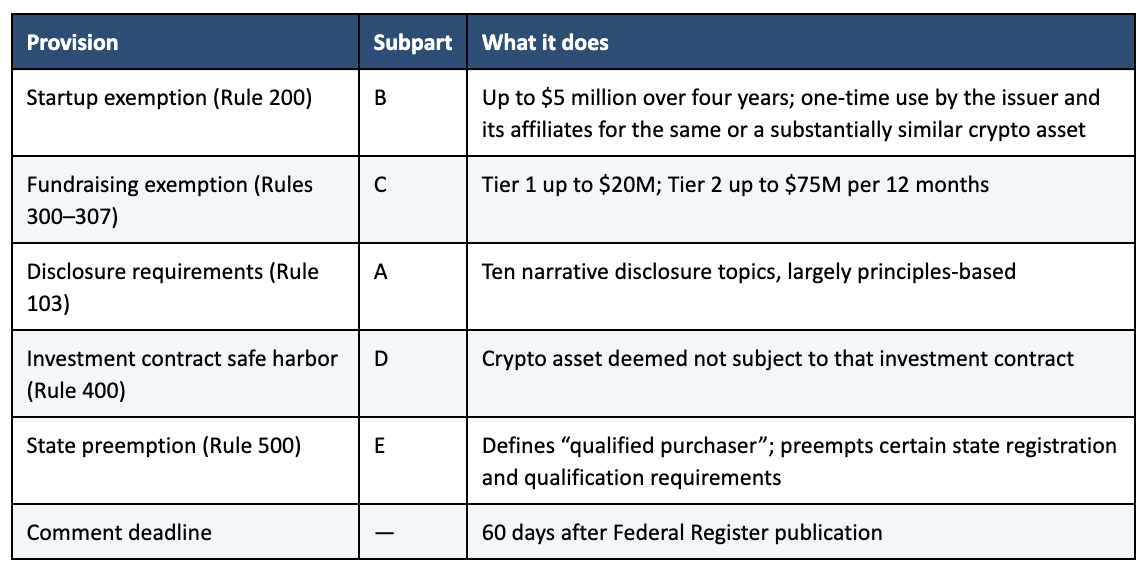
The SEC proposed Regulation Crypto Assets on August 18, 2026, creating two exemptions from Securities Act registration for offerings of covered investment contracts involving crypto assets — $5 million under a “startup exemption” and $75 million under a “fundraising exemption.” The proposal also includes a conditional safe harbor for issuers that complete or permanently cease their promised managerial efforts, and preemption of certain state securities registration and qualification requirements. Public comments are due 60 days after Federal Register publication.
The proposal appears at Release Nos. 33-11434 and 34-106150, File No. S7-2026-27, and would add a new part 228 to Title 17 of the Code of Federal Regulations. It runs 402 pages and is a rulemaking written specifically to create a tailored crypto-asset capital-formation regime.
Regulation Crypto Assets at a glance
Why the SEC proposed new crypto rules
The Commission’s argument is that its existing rules, most written decades before crypto assets existed, fit these offerings poorly in both directions. They compel disclosure that is immaterial to purchasers while failing to elicit what those purchasers actually need: network governance, token supply and allocation, lockups and release schedules, source-code security, and similar information.
Existing exemptions also impose resale restrictions or accredited-investor limits that work against the network effects on which a crypto asset’s value often depends. The release warns that without fit-for-purpose rules, issuers may simply move offerings offshore, leaving U.S. investors in markets with weaker protections.
The proposal builds on the Commission’s March 2026 interpretive release (No. 33-11412), which took the position that a crypto asset can be sold subject to an investment contract at issuance and later cease to be, once the issuer’s promised managerial efforts are complete. Existing securities rules, the release notes, generally do not contemplate an instrument whose regulated status is designed to expire. The Commission frames both actions as complementing rather than substituting for congressional work on market structure legislation.
What is a “covered investment contract”?
Everything in Regulation Crypto Assets turns on this defined term, and the distinction it draws is easy to lose. The regulation does not govern crypto assets as such. It governs a particular kind of contract involving them.
Under proposed Rule 100, a covered investment contract is a contract, transaction, or scheme that constitutes an investment contract, provided that: a crypto asset is subject to it, that crypto asset is not itself a security, and no other asset is subject to it.
The regime therefore targets the arrangement wrapped around a crypto asset — not tokenized stock, bonds, or funds, and not the asset standing alone. “Crypto asset” is separately defined as any digital representation of value recorded on a cryptographically secured distributed ledger.
The SEC startup exemption: $5 million over four years
Subpart B would let an issuer raise up to $5 million across a four-year window. Compliance is deliberately light. The issuer files a notice of reliance on new Form NOR, posts the required disclosures at a public website free of charge, keeps them updated, and files a transition report on Form TR no later than four years after the notice. Unlike the fundraising exemption, the startup exemption does not require an offering statement to be qualified by the SEC.
Form NOR would require the issuer to certify not only that the form’s information is true, complete, and correct, but that it intends to fulfill its represented or promised essential managerial efforts within four years of filing. That certification is what makes this a temporary regulatory runway rather than an open-ended exemption, and the fundraising exemption contains no equivalent. The Commission asks for comment on whether “intent” is the right standard.
Three features stand out:
- Covered investment contracts sold under the exemption would not be restricted securities
- General solicitation would be permitted
- There would be no bar on selling to non-accredited investors
The Commission explains each feature as avoiding impediments to a network’s growth. The one-time-use rule prevents the issuer and its affiliates from relying on the startup exemption again for the same subject crypto asset, or a substantially similar crypto asset, after the permitted four-year period.
A “covered transaction” is defined broadly enough to cover the non-fundraising distributions that development requires: airdrops falling outside the 2026 interpretation’s safe zone, staking and governance rewards, gas-fee transfers, and payments for testing.
The SEC fundraising exemption: $75 million a year
Subpart C is the heavier regime, modeled closely on Regulation A and adopting its two-tier structure and dollar limits.
Tier 1 permits up to $20 million in a 12-month period, including no more than $6 million from selling securityholders who are issuer affiliates. Tier 2 permits up to $75 million, including no more than $22.5 million from affiliates. Securities offered by selling securityholders cannot exceed 30 percent of the aggregate offering price in the issuer’s first offering or in another offering qualified within one year after that first qualification date.
Who is eligible
The eligibility criteria in Rule 300(b) are a material gate, and much narrower than the startup exemption’s. The issuer must be an entity organized in the United States, with:
- A majority of executive officers or directors who are U.S. citizens or residents
- More than 50 percent of its assets located in the United States
- Its business administered principally in the United States
The exemption also would be unavailable to development-stage companies with no specific business plan or a plan to acquire an unidentified company, registered or required-to-be-registered investment companies, business development companies, and issuers subject to a Section 12(j) order during the five years before filing the offering statement. The Section 12(j) exclusion would not apply to an order entered before Rule 300’s eventual effective date. An issuer also must have filed all required Regulation Crypto Assets or Exchange Act reports during the preceding two years, or the shorter period during which it was required to report, and must satisfy Subpart A, including Rule 104’s bad-actor disqualification provisions. The startup exemption, by contrast, is open to entities, individuals, or groups; the Commission ties the difference to the higher offering limit and the financial-statement requirement.
Filing and reporting
Issuers would file an offering statement on new Form 1-CRYPTO for Commission qualification, then report on an ongoing basis:
- Annual reports on Form 1-KC, within 120 days of fiscal year end
- Semiannual reports on Form 1-SC, within 90 days
- Current reports on Form 1-UC for specified events
Tier 1 carries no financial statement assurance requirement. Tier 2 requires audited financials prepared under Regulation S-X as though the issuer were a smaller reporting company.
The proposal also adds investor-protection conditions beyond Regulation A. In both tiers, the aggregate purchase price paid by a non-accredited natural person could not exceed 10 percent of the greater of annual income or net worth. For a non-accredited purchaser that is not a natural person, the limit would be 10 percent of the greater of revenue or net assets for its most recently completed fiscal year. Unlike Regulation A, the limitation would apply in both tiers and would not contain an exception for exchange-listed securities.
Rule 103 disclosure requirements: ten topics
Proposed Rule 103 would require narrative disclosure across ten topics:
- The covered investment contract itself
- The offering
- The subject crypto asset
- Management, related persons, and conflicts of interest
- The associated crypto network or application, and plan of development
- Security and source code
- Subject crypto asset economics and allocation
- Governance
- The crypto asset ecosystem
- Risk factors
The requirements are generally principles-based — issuers describe the material aspects of each topic rather than answering prescribed line items — although Rules 103(b)(1) and (b)(2), covering the covered investment contract and the offering, do enumerate specific information that must be provided.
The Commission acknowledges the tradeoff directly: some investors would prefer prescriptive rules producing comparable disclosures, and some issuers would prefer the certainty of a checklist. It requests comment on both alternatives.
Rule 104 would disqualify bad actors using Regulation A’s existing standard. Rule 102 would require the Commission to adjust the offering limits for inflation periodically, but at least once every five years, without notice-and-comment rulemaking for routine adjustments.
The investment contract safe harbor explained
Subpart D is one of the proposal’s most consequential provisions. Proposed Rule 400 would deem a covered investment contract to have ceased to exist — and the crypto asset that was subject to it deemed not to constitute, represent, or be subject to that investment contract for purposes of the “security” definitions in Securities Act Section 2(a)(1) and Exchange Act Section 3(a)(10) — once the issuer:
- Has completed or otherwise permanently ceased all essential managerial efforts it represented or promised, and is not making and does not intend to make any new such representations or promises; and
- Files a Form TR containing a certification to that effect plus a supporting analysis
The permanent-cessation branch matters. An issuer that permanently abandons development may satisfy this condition, but only if it ceases all promised essential managerial efforts, makes and intends to make no new such representations or promises, and files Form TR with the required certification and supporting analysis.
What the safe harbor does not do is equally important. It addresses the investment contract prong of the statutory definitions only — it does not declare that the asset could never be a security on some other theory. The Commission may still challenge whether the conditions were actually met, and the release states expressly that the safe harbor would not prevent other parties from asserting that a crypto asset is subject to an investment contract or is otherwise a security.
The safe harbor is available to any issuer meeting its conditions, including those that never used either exemption.
State preemption under Rule 500
Subpart E would define “qualified purchaser” under Section 18(b)(3) of the Securities Act to cover purchasers in Regulation Crypto Assets offerings and certain secondary transactions, making those covered investment contracts “covered securities” and preempting state registration and qualification requirements. This is not a general displacement of state securities law — state antifraud authority and other provisions are untouched.
The secondary-market provision reaches beyond contracts sold in the Regulation Crypto Assets offering itself. If an issuer satisfies a Regulation Crypto Assets exemption for a covered investment contract and separately sells the same covered investment contract under another federal exemption, such as Regulation D, qualifying secondary transactions in both sets of contracts would receive preemption while the issuer remains subject to and current with the applicable disclosure, filing, and periodic-reporting requirements. Merely assuming the new regime’s reporting obligations would not be enough; the issuer must satisfy a Regulation Crypto Assets exemption for that covered investment contract.
The release asks whether purchasers can practically determine that an issuer is current with those obligations, and whether preemption should instead turn on the issuer being merely subject to them. Separately, it asks whether Rule 500 should be revised to condition preemption on current reporting as well — and flags that secondary-market participants may be unable to tell whether a reportable event has occurred. That second question concerns a possible expansion of the rule, not the test as proposed.
SEC usage estimates
For Paperwork Reduction Act purposes, the Commission estimates approximately 130 offerings annually: 99 under the startup exemption and 31 under the fundraising exemption. The estimates are extrapolated from crypto-related offerings under Regulations D, A, and Crowdfunding in 2024 and should be understood as burden-analysis assumptions rather than firm forecasts of market adoption.
For the same burden analysis, the Commission separately estimates that 475 issuers annually would rely on Rule 400, based on an assumption that 15 percent of approximately 3,165 crypto projects launched in 2024 would seek to use the safe harbor. Those issuers would not need to have used either offering exemption.
The release is designated economically significant under Executive Order 12866 and has been reviewed by OMB.
What commenters told the Crypto Task Force
The proposal draws on comment letters submitted to the SEC’s Crypto Task Force before this rulemaking, and the release documents real disagreement among them:
- DeFi Education Fund argued a calibrated safe harbor would reduce information asymmetries while legislation is pending
- a16z supported the goal but urged the Commission to defer to Congress
- CrowdCheck Law questioned whether a safe harbor is needed at all if a Regulation A path exists
- DealMaker warned that an exemption of this kind could pull issuers away from Regulation A and Regulation Crowdfunding, and the investor protections that come with them
Reaction to the August 18 proposal itself will arrive during the comment period.
Issuers relying on either exemption would remain subject to the antifraud and antimanipulation provisions of the federal securities laws throughout.
Frequently asked questions
When is the comment deadline for Regulation Crypto Assets?
Comments are due 60 days after the proposing release is published in the Federal Register. Submissions should reference File No. S7-2026-27 and can be filed through the SEC’s internet comment form or by email to [email protected].
Does Regulation Crypto Assets make crypto assets legal to sell without registering?
No. It proposes two conditional exemptions from Securities Act Section 5 registration for a narrow category — covered investment contracts, meaning investment contracts involving a crypto asset that is not itself a security. Issuers must meet each exemption’s conditions, and antifraud and antimanipulation provisions continue to apply regardless.
What is the difference between the startup and fundraising exemptions?
The startup exemption caps offerings at $5 million over four years with website-based disclosure and no qualified offering statement, is open to individuals as well as entities, and can be used once for a given crypto asset. The fundraising exemption allows $20 million (Tier 1) or $75 million (Tier 2) per 12 months, but requires a U.S.-organized issuer, a qualified offering statement on Form 1-CRYPTO, financial statements, and ongoing periodic reporting.
Is Regulation Crypto Assets final?
No. It is a proposed rule. The Commission will review public comments before deciding whether to adopt final rules, and the final version may differ from the proposal.
This article is provided for informational purposes only and does not constitute legal advice.
To speak with a Securities Attorney, please contact Brenda Hamilton at 200 E Palmetto Rd, Suite 103, Boca Raton, Florida, (561) 416-8956, or by email at [email protected].
Hamilton & Associates | Securities Attorneys
Brenda Hamilton, Securities Attorney
200 E Palmetto Rd, Suite 103
Boca Raton, Florida 33432
Telephone: (561) 416-8956
Facsimile: (561) 416-2855
www.SecuritiesLawyer101.com