
Reverse mergers can provide small and emerging companies with a faster path to becoming publicly traded. But history has shown that this shortcut often carries serious risks for investors. The SEC, FINRA, and exchanges have repeatedly warned that reverse mergers are vulnerable to abuse, and many high-profile frauds have involved dormant shell companies. For investors and issuers alike, recognizing red flags is critical to avoiding financial loss and reputational damage.
History of Reverse-Merger Fraud
In the late 2000s and early 2010s, the U.S. markets saw an influx of foreign companies—particularly from China—going public through reverse mergers. Many of these issuers were later revealed to have weak financial reporting, undisclosed related-party transactions, or even fictitious operations. The SEC responded with trading suspensions, enforcement actions, and new rules, while Nasdaq and NYSE adopted stricter seasoning requirements.
These cases highlight that while reverse mergers can be legitimate, they have also been misused as vehicles for fraud.
Common Red Flags in Reverse Mergers
Investors and regulators should look closely for warning signs that a reverse-merger issuer may present heightened risk:
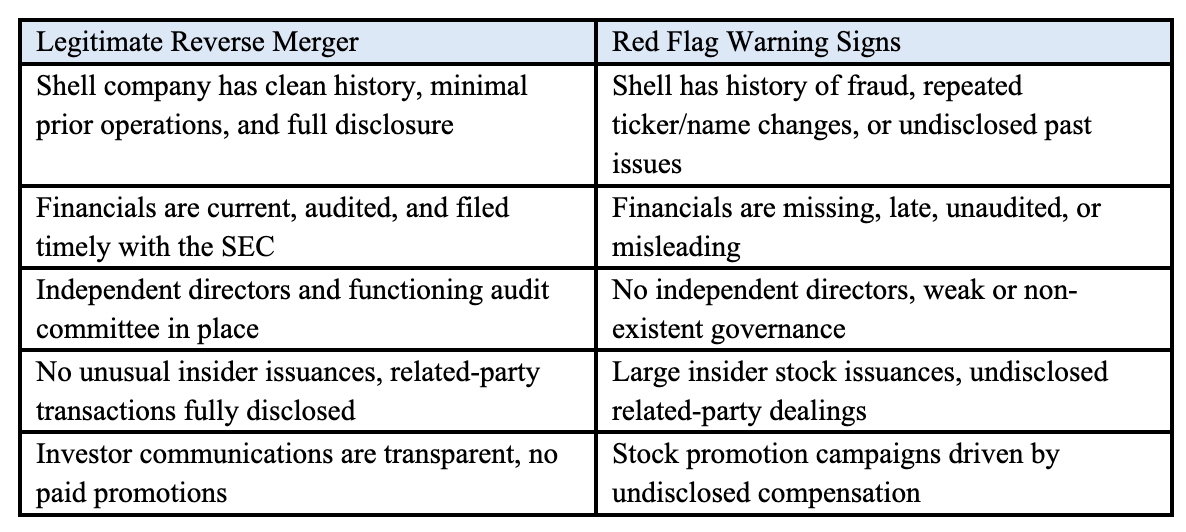
- Recycled Shells – The use of a dormant or previously failed shell company without transparent disclosure.
- Insider Enrichment – Large insider share issuances or related-party transactions not adequately disclosed.
- Unreliable Financials – Incomplete, late, or unaudited financial statements.
- Weak Governance – Absence of independent directors or functioning audit committees.
- Stock Promotion Schemes – Paid promoters touting the stock without disclosure of compensation.
- Frequent Corporate Actions – Name or ticker changes designed to confuse or obscure a company’s history.
Comparative Chart: Legitimate Reverse Merger vs. Red Flag Warning Signs
The chart below provides a simplified comparison of positive indicators vs. red flag warning signs:
Role of FINRA and the SEC
FINRA plays a critical gatekeeping role through Rule 6490 corporate actions review and Form 211 clearance for OTC trading. The SEC frequently intervenes when reverse-merger companies engage in suspicious activity, often through **trading suspensions** or enforcement actions. For example, issuers that fail to file required Form 8-K disclosures or provide misleading information in Regulation S-K filings are likely to draw scrutiny.
This article is general information, not legal or financial advice. Securities counsel with Regulation A experience is worth retaining early in this process.
To speak with a Securities Attorney, please contact Brenda Hamilton at 200 E Palmetto Rd, Suite 103, Boca Raton, Florida, (561) 416-8956, or by email at [email protected].
Hamilton & Associates | Securities Attorneys
Brenda Hamilton, Securities Attorney
200 E Palmetto Rd, Suite 103
Boca Raton, Florida 33432
Telephone: (561) 416-8956
Facsimile: (561) 416-2855
www.SecuritiesLawyer101.com