
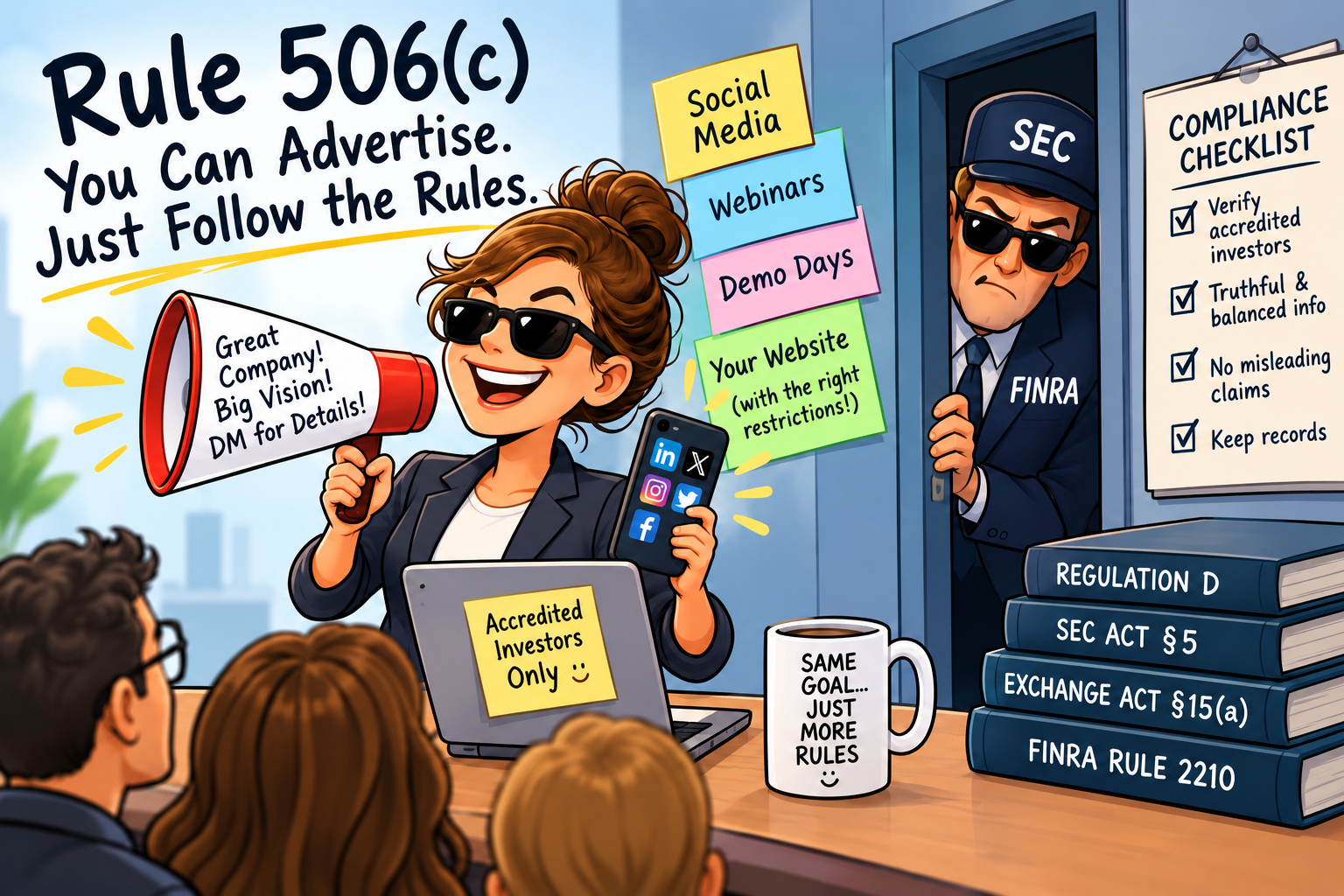
Rule 506(c) of Regulation D allows companies to publicly market private offerings—through websites, social-media posts, investor webinars, and other digital channels—so long as every purchaser is a verified accredited investor. This flexibility expands access to capital but creates risk: the SEC and FINRA closely monitor solicitation. Improper advertising or using unregistered intermediaries can invalidate the exemption and trigger enforcement under Securities Act Section 5 and Exchange Act Section 15(a).
What Is General Solicitation Under Rule 506(c)?
General solicitation refers to any public communication that could reach potential investors without a pre-existing, substantive relationship. Examples include press releases, social-media posts, investor webinars, and demo days. The SEC clarified that these communications are permissible only if the issuer complies with Rule 506(c) and all statements are accurate and not misleading.
Social Media and Online Advertising
Social-media advertising is now central to capital formation but also a frequent source of violations. Permissible activities include factual, balanced information or password-protected investor access. Risky activities include exaggerated claims, influencer promotions, or general public solicitation. FINRA Rule 2210 requires fair and balanced communications.
Webinars and Investor Presentations
Webinars and virtual roadshows are general solicitation when open to the public. Issuers can reduce risk by pre-registering attendees, avoiding investment terms, and including disclaimers. Even educational webinars may require compliance review under FINRA Rule 2210.
Demo Days and Pitch Events
Demo days may not constitute general solicitation if sponsors do not charge participants, presenters are limited to exempt issuers, and no specific offering terms are discussed. Issuers should restrict attendance to accredited investors or pre-screened contacts.
Issuer Websites and Landing Pages
A company website is a frequent compliance trap. Under Rule 506(b), investment content is prohibited; under Rule 506(c), it is permitted if limited to accredited investors, includes registration or verification, and maintains access logs. The SEC’s IPONET No-Action Letter recognizes password-protected sites for pre-qualified investors.
Use of Finders and Online Platforms
Rule 506(c) allows use of platforms and finders within limits. Registered broker-dealers may receive commissions, but unregistered finders may not. Violations can result in rescission liability. The SEC’s 2020 Finder Exemptive Order provides limited relief for Tier I and II finders.
Anti-Fraud and Disclosure Obligations
Even under Rule 506(c), issuers remain bound by anti-fraud provisions—Securities Act Section 17(a) and Exchange Act Rule 10b-5. All marketing materials must be truthful, balanced, and consistent with private placement memoranda.
Practical Checklist for Rule 506(c) Marketing
Website content: restrict to accredited investors. Social media: keep factual and avoid claims. Webinars: pre-registered accredited audience only. Demo days: no offering terms. Finders: use only registered or exempt intermediaries.
Key Enforcement Cases and Lessons
SEC v. Ascenergy LLC (2016) voided 506(c) for false online ads. In re Lombardo (2020) sanctioned an unregistered finder. SEC v. PlexCoin (2018) resulted in injunction for crypto issuer’s solicitation without verification. These cases show the need for truthful, documented, and verified investor engagement.
Conclusion — Promote Publicly, Verify Privately
Rule 506(c) modernized private offerings without deregulating them. Issuers must ensure accurate communications, investor verification, and recordkeeping. Compliance builds credibility with regulators and investors alike.
This article is general information, not legal or financial advice. Securities counsel is worth retaining early in this process. To speak with a Securities Attorney, please contact Brenda Hamilton at 200 E Palmetto Rd, Suite 103, Boca Raton, Florida, (561) 416-8956, or by email at [email protected].
Hamilton & Associates | Securities Attorneys
Brenda Hamilton, Securities Attorney
200 E Palmetto Rd, Suite 103
Boca Raton, Florida 33432
Telephone: (561) 416-8956
Facsimile: (561) 416-2855
www.SecuritiesLawyer101.com