

The United States remains the global benchmark for public-market access, capital formation, and investor confidence. Each year, dozens of non-U.S. companies—particularly from China, India, and Europe—seek listings on the Nasdaq Stock Market or the New York Stock Exchange (NYSE) to gain liquidity, visibility, and institutional credibility.
Yet these benefits come with substantial complexity. Non-U.S. issuers face heightened disclosure, governance, accounting, and tax compliance obligations, along with scrutiny under the U.S. securities-law enforcement regime. The decision to list in the United States versus a home exchange such as London, Frankfurt, or Mumbai therefore requires a nuanced cost-benefit analysis.
At Hamilton & Associates Law Group, P.A., we guide foreign private issuers through each phase of the U.S. listing process—evaluating strategic goals, coordinating cross-border counsel, and preparing for SEC, PCAOB, and exchange oversight.
Why Foreign Companies Pursue U.S. Listings
Foreign issuers are drawn to U.S. exchanges for both capital-markets and reputational advantages:
- Global Liquidity and Investor Base – Nasdaq and NYSE offer unparalleled access to institutional capital and analyst coverage. Daily trading volume and investor reach far exceed that of most home exchanges.
- Valuation Premium – U.S. markets often assign higher multiples to companies with transparent governance and audited IFRS or U.S.-GAAP financials.
- Access to U.S. Dollar Capital – Listing in the U.S. enables issuers to raise funds in the world’s reserve currency and hedge foreign-exchange risk.
- Brand Visibility – U.S. presence elevates credibility with global suppliers, customers, and investors.
For some, these factors justify the regulatory intensity of U.S. oversight.
Learn more: Nasdaq Listing Requirements and Process
U.S. Listing vs. Home Exchange: Core Trade-Offs
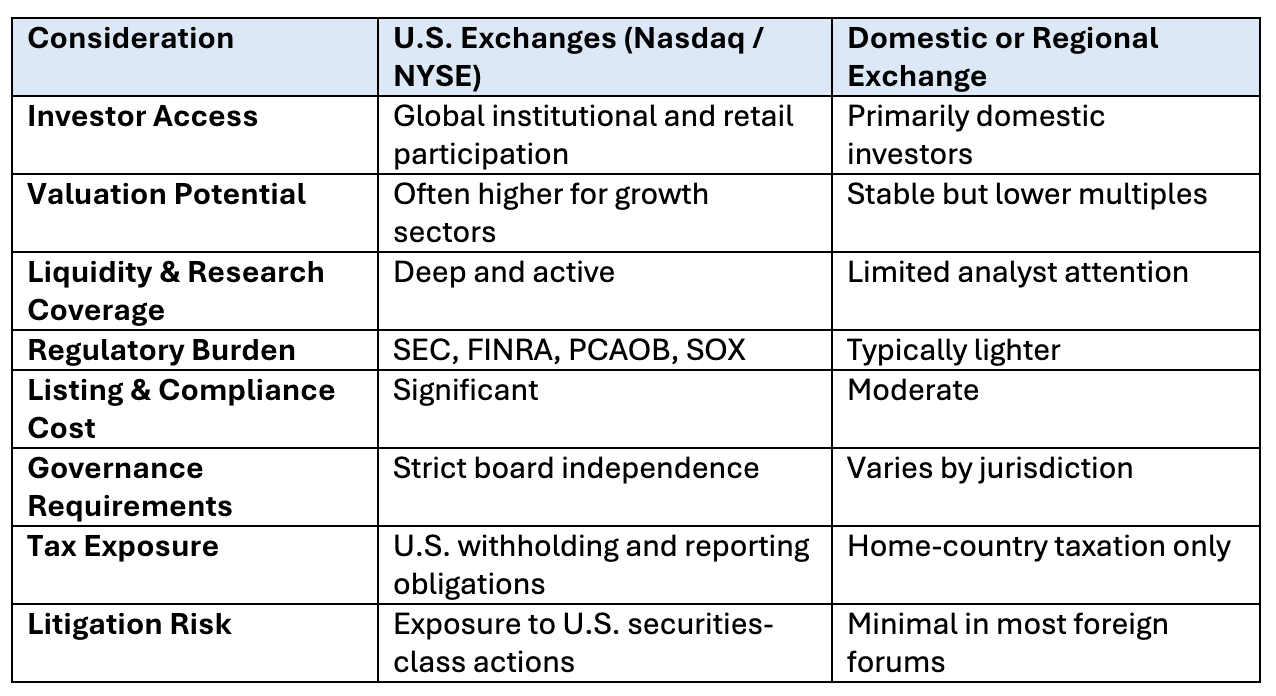
The U.S. path delivers prestige and liquidity but requires enduring investment in compliance infrastructure, governance, and investor-relations capabilities.
The Foreign Private Issuer (FPI) Framework
A Foreign Private Issuer (FPI) is a non-U.S. company that:
- Has less than 50% of its outstanding voting securities held by U.S. residents, or
- Has a majority of directors, officers, assets, or revenues located outside the U.S.
FPIs enjoy modified reporting obligations compared to domestic issuers. They file:
- Form F-1 / F-3 for registration statements,
- Form 20-F for annual reports, and
- Form 6-K for interim updates.
FPIs may follow home-country corporate-governance practices, but they must disclose those deviations to investors.
Reference: Reporting on Form 20-F and 6-K for Foreign Issuers
Dual-Listing and Cross-Border Coordination
Many non-U.S. companies maintain listings on both a home exchange and a U.S. exchange. Dual listings enhance liquidity but require harmonizing disclosure timing, accounting standards, and insider-trading rules across jurisdictions.
Key coordination steps include:
- Synchronizing financial-report release cycles between the SEC’s Form 20-F deadline and home-exchange requirements.
- Reconciling IFRS and U.S. GAAP differences or providing detailed footnote disclosure.
- Avoiding selective disclosure under differing investor-relations rules (e.g., Regulation FD vs. EU Market Abuse Regulation).
- Aligning shareholder-meeting and voting-rights procedures with Nasdaq or NYSE standards.
Issuers must also confirm that home-exchange regulators permit simultaneous or secondary listings abroad, particularly in China and India where outbound listing rules are evolving.
ADR Programs: Structuring the U.S. Presence
Foreign issuers typically list in the U.S. through American Depositary Receipts (ADRs), which represent shares held by a depositary bank in the issuer’s home jurisdiction.
ADR Levels:
- Level I – Traded over the counter; minimal reporting obligations.
- Level II – Listed on Nasdaq or NYSE; must register under the Exchange Act and file Form 20-F.
- Level III – Public offering in the U.S.; full registration and disclosure, equivalent to domestic issuers.
Some companies opt for direct listings instead of ADRs to simplify structure and reduce custodial costs, though this requires home-country law to permit share fungibility.
The choice between ADRs and direct shares affects trading liquidity, investor perception, and tax withholding on dividends.
Audit Oversight and PCAOB Access
One of the most significant challenges for non-U.S. issuers is compliance with PCAOB audit inspection access.
- Under the Holding Foreign Companies Accountable Act (HFCAA), the SEC must identify issuers whose auditors the PCAOB cannot inspect.
- If inspection access is denied for three consecutive years, the company faces mandatory delisting.
- The PCAOB has since reached cooperation agreements with several jurisdictions, including parts of the EU and, as of 2023, limited arrangements in China and Hong Kong.
Issuers should ensure their auditors are PCAOB-registered and subject to inspection, and disclose this status in their Form 20-F.
Tax and Treaty Considerations
Cross-border listings create complex tax implications:
- Withholding Taxes – Dividends paid to U.S. shareholders may trigger home-country withholding and U.S. information-reporting requirements.
- Tax Treaties – Most FPIs benefit from bilateral tax treaties reducing withholding rates on dividends and interest, provided proper documentation (Form W-8BEN-E) is maintained.
- Permanent Establishment (PE) – If the issuer establishes a U.S. office or management presence, it may be deemed to have a PE, subjecting a portion of income to U.S. taxation.
- Transfer Pricing – Intercompany transactions must comply with IRS rules to avoid adjustment penalties.
- D&O Insurance and Compensation – Payments to U.S. officers may trigger state and federal tax withholding obligations.
Issuers should engage international tax counsel early in the listing process to avoid double taxation and ensure compliance with FATCA and IRS Form 8938 requirements.
Disclosure and Enforcement Exposure
Once listed, foreign issuers become subject to the full spectrum of U.S. securities-law enforcement.
- Rule 10b-5 liability applies to misstatements or omissions made in connection with the purchase or sale of securities, even by foreign entities.
- Regulation FD requires equal access to material information for all investors.
- Section 16 and Schedule 13D/G filings apply to insiders and beneficial owners of more than 5% of outstanding shares.
Moreover, U.S. plaintiffs’ firms frequently target foreign issuers in class-action lawsuits following earnings restatements or short-seller reports. Maintaining a strong compliance culture and experienced U.S. counsel is the best defense.
Regional Trends and Case Studies
- Chinese Issuers – Following the HFCAA, many China-based issuers pursued dual listings in Hong Kong to preserve liquidity in case of U.S. delisting. Successful examples include Alibaba Group Holding Ltd. and JD.com, both maintaining parallel trading markets. Others, such as Didi Global, withdrew U.S. listings amid regulatory pressure.
- Indian Issuers – India’s regulatory shift under the GIFT City framework (2024) allows selected companies to list abroad while maintaining domestic compliance. Tech issuers like Zomato and MakeMyTrip continue to use U.S. listings for brand and capital access.
- European Issuers – Companies such as Birkenstock Holding plc (Germany, NYSE 2023) and CRH plc (Ireland, 2023 U.S. shift) demonstrate that European issuers pursue U.S. markets to increase liquidity and visibility, even when strong domestic options exist.
Key Lessons from Recent Cross-Border IPOs
- Compliance Readiness Determines Valuation – U.S. investors reward issuers that demonstrate robust governance and transparent IFRS reconciliations.
- Audit Quality Drives Investor Confidence – PCAOB-compliant audits reduce perceived risk.
- Home-Country Political Stability Matters – Issuers from jurisdictions with regulatory volatility face valuation discounts.
- Post-Listing Disclosure Consistency – Form 6-K filings must align with home-exchange announcements to prevent selective disclosure.
Practical Guidance for Issuers and Counsel
- Assess Home-Country Rules – Confirm your jurisdiction permits foreign or dual listings.
- Select the Right Vehicle – Evaluate ADRs vs. direct listing; consider shareholder logistics.
- Retain Experienced Advisors – Engage U.S. securities counsel, PCAOB auditors, and tax advisors early.
- Plan Governance Early – Recruit independent directors familiar with U.S. expectations.
- Prepare Investor-Relations Infrastructure – Establish an English-language IR site, Regulation FD policies, and press-release protocols.
- Understand Exit and Delisting Rules – Plan for potential future transitions between markets.
At Hamilton & Associates Law Group, we assist foreign private issuers with every phase—from initial readiness assessments through Form F-1 registration, Nasdaq/NYSE coordination, and ongoing SEC reporting compliance.
Conclusion
Listing on U.S. exchanges offers international companies an extraordinary opportunity—access to the world’s deepest capital pool, elevated global reputation, and liquidity unmatched by most home markets.
However, the rewards are balanced by demanding legal, tax, and disclosure regimes that require continuous commitment. Foreign issuers that approach the U.S. markets with strategic preparation, governance integrity, and transparent communication can realize long-term success.
For others, the cost of compliance, PCAOB access challenges, or misalignment between home-country and U.S. rules may make domestic or dual listings more appropriate.
Our firm advises foreign issuers to begin the decision process early.
Disclaimer: This article is provided for informational purposes only and does not constitute legal or tax advice. Foreign issuers should consult qualified counsel in both their home jurisdiction and the United States before pursuing any cross-border listing or offering.
To speak with a Securities Attorney, please contact Brenda Hamilton at 200 E Palmetto Rd, Suite 103, Boca Raton, Florida, (561) 416-8956, or by email at [email protected].
Hamilton & Associates | Securities Attorneys
Brenda Hamilton, Securities Attorney
200 E Palmetto Rd, Suite 103
Boca Raton, Florida 33432
Telephone: (561) 416-8956
Facsimile: (561) 416-2855
www.SecuritiesLawyer101.com