

Going public is about raising capital and gaining prestige. An exchange listing provides companies access to institutional capital, enhances liquidity for shareholders, raises brand visibility, and provides a currency for acquisitions.
Other benefits include the ability to attract and retain top talent with stock options, strengthen corporate governance, and improve credibility with customers, partners, and lenders.
These benefits apply across all listing tiers of both Nasdaq (Capital Market, Global Market, and Global Select Market) and the NYSE. Understanding these benefits and where a company fits within the tiers is the first step in selecting the right underwriter.
Role of Underwriters in an IPO
Underwriters serve as the financial gatekeepers of the IPO process. They are responsible for conducting due diligence, structuring the offering, pricing the shares, and marketing the IPO to institutional and retail investors.
Underwriters also provide stabilization in the aftermarket to reduce volatility. The choice of underwriter can directly influence investor demand, valuation, and post-IPO performance.
Factors in Selecting an Underwriter
Companies should evaluate underwriters based on:
- Industry expertise and sector track record
- Distribution strength across institutional and retail networks
- Research coverage and analyst credibility
- Reputation and prestige within capital markets
- Fee structures and willingness to negotiate terms
Each factor contributes to how well the IPO is received and supported in the market.
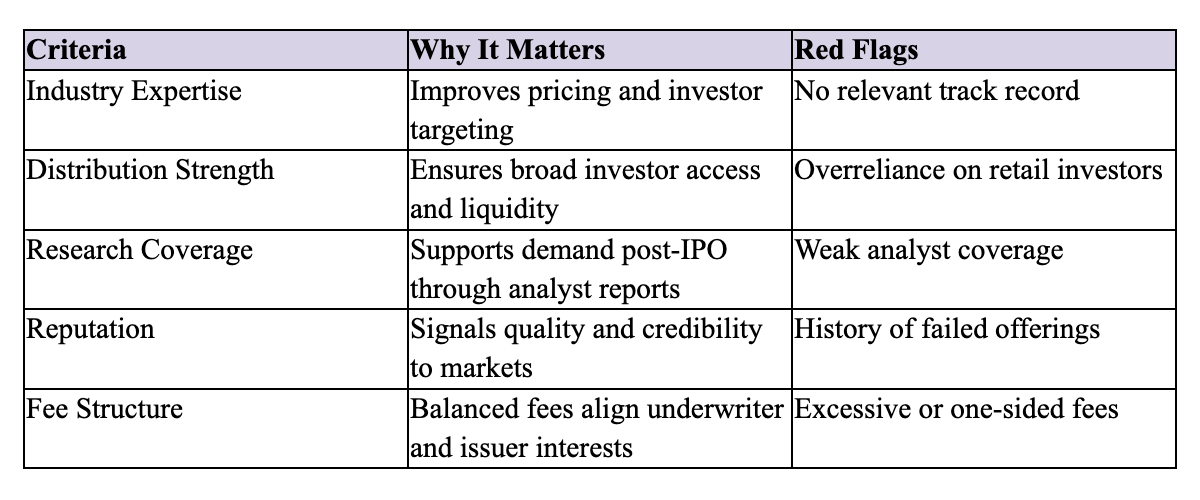
Comparative Chart: Top Criteria in Choosing an IPO Underwriter
The following chart summarizes the most important criteria and red flags to consider:
Red Flags to Avoid
Issuers should be cautious of underwriters with limited experience in their sector, overreliance on retail distribution, or weak post-IPO support. Other warning signs include excessive fees, opaque syndicate structures, and inadequate due diligence practices.
Negotiating Terms with Underwriters
Negotiations focus on underwriting spreads (fees), overallotment options (greenshoe), lock-up provisions, and syndicate participation. Well-prepared issuers benchmark terms against industry norms, ensuring that compensation structures align the underwriter’s incentives with long-term success.
Global vs. Boutique Underwriters
Global investment banks bring brand prestige, deep distribution channels, and extensive research coverage. However, they may prioritize larger clients and demand stricter terms.
Regional and boutique underwriters often provide more personalized service, flexibility, and lower costs, but may lack global investor reach.
The best approach usually involves balancing a prestigious lead underwriter with supportive co-managers that provide targeted investor access.
Case Studies and Practical Insights
Successful IPOs often involve underwriters with deep expertise in the issuer’s industry. For example, technology companies benefit from underwriters with ties to Silicon Valley, while biotech firms require banks with strong healthcare investor networks.
Conversely, issuers that choose underwriters based primarily on low fees often struggle with weak demand and poor aftermarket support.
Strategic Implications
The choice of underwriter extends beyond the IPO itself. A strong underwriter can provide ongoing analyst coverage, facilitate future capital raises, and attract long-term institutional investors. Selecting the right underwriter is therefore a strategic decision with lasting implications for valuation, liquidity, and corporate credibility.
Conclusion
Selecting the right underwriter is one of the most consequential decisions for any company going public. By carefully evaluating expertise, distribution strength, research coverage, reputation, and fee structures, issuers can partner with an underwriter that maximizes IPO proceeds and sets the stage for long-term success.
Strong IPOs on Nasdaq and NYSE alike often share one common factor: a trusted and capable underwriter guiding the process.
If you are considering taking your company public or would like to speak with a Securities Attorney, Hamilton & Associates Law Group, P.A. is ready to help. Brenda Hamilton founded Hamilton & Associates Law Group, P.A., a corporate finance and securities law firm in Boca Raton, Florida, in 1999. The firm has advised more than 300 issuers on going-public transactions, including IPOs, direct public offerings, and listings on Nasdaq, the NYSE, and the OTC Markets. Since 1998, Ms. Hamilton has been a leading voice in corporate and securities law, representing both domestic and international clients across diverse industries and jurisdictions. Whether you are taking your company public, raising capital, navigating regulatory challenges, or entering new markets, Brenda Hamilton and her team deliver the experience, strategic insight, and results-driven representation you need to succeed.
To speak with a Securities Attorney, please contact Brenda Hamilton at 200 E Palmetto Rd, Suite 103, Boca Raton, Florida, (561) 416-8956, or by email at [email protected].
Hamilton & Associates | Securities Attorneys
Brenda Hamilton, Securities Attorney
200 E Palmetto Rd, Suite 103
Boca Raton, Florida 33432
Telephone: (561) 416-8956
Facsimile: (561) 416-2855
www.SecuritiesLawyer101.com