

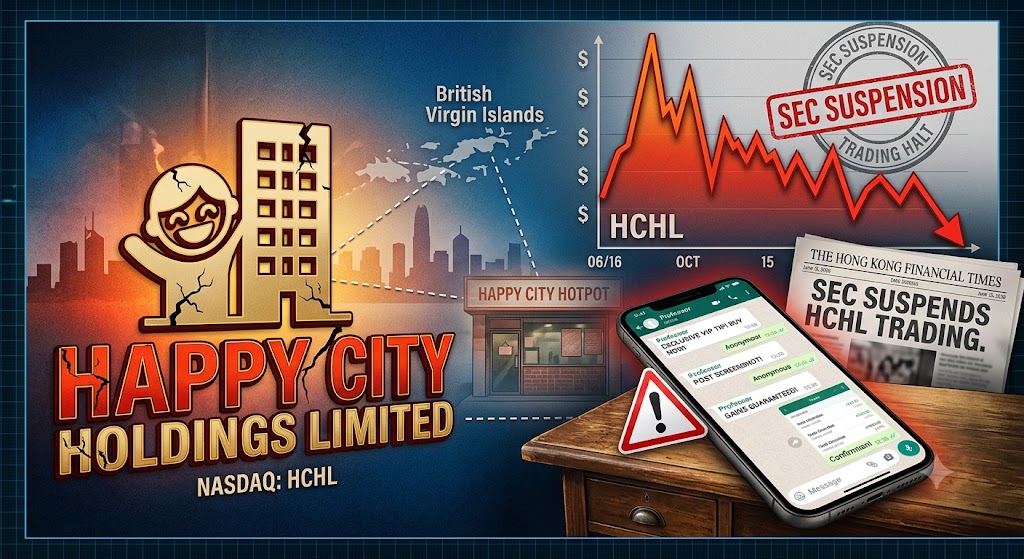
Updated July 15, 2026 | SEC trading suspensions, Nasdaq microcap fraud, WhatsApp stock scams
When the Securities and Exchange Commission suspended trading in Happy City Holdings Limited (Nasdaq: HCHL) on June 12, 2026, the order read like a form letter — because, in a sense, it was. The language in SEC Release No. 34-105675 tracks, almost word for word, the fourteen trading suspension orders the Commission issued between September 2025 and February 2026: potential market manipulation “effectuated through recommendations made to investors by unknown persons via social media” to buy, hold, or sell the stock, and to send screenshots documenting their transactions — activity that “appears to be designed to artificially inflate the price and trading volume” of the securities.
Happy City Holdings is, by any measure, an unlikely protagonist in a market-manipulation drama. The company is an all-you-can-eat hotpot restaurant operator in Hong Kong with roughly three dozen employees, incorporated in the British Virgin Islands. It went public on the Nasdaq Capital Market on June 24, 2025, selling 1.2 million Class A shares at $5.00 apiece for total gross proceeds of about $6.06 million after a partial over-allotment exercise — a micro-IPO led by boutique underwriter Dominari Securities LLC, with Revere Securities and Pacific Century Securities as co-underwriters. The stated use of proceeds was restaurant expansion in Hong Kong and Southeast Asia.
The HCHL Stock Timeline: IPO, Collapse, Spike, Suspension, Halt
What followed the IPO was a round trip familiar to anyone who has watched this corner of the Nasdaq microcap market. HCHL stock sank well below its $5.00 offering price — trading around $1.72 as recently as mid-April 2026, with a 52-week low of $0.80 — and in January 2026 the company disclosed a deficiency notice from Nasdaq staff. Then, in the weeks before the suspension, the shares climbed again; the 52-week range topped out at $7.25, and the last sale before the halt was $3.96.
On June 12, 2026, the SEC stepped in, suspending trading through late June. When the federal suspension lapsed, Nasdaq immediately converted it into an exchange halt of its own, announcing on June 29 that trading “is halted… for additional information requested from the company” and would remain so until Happy City fully satisfies that request. For its part, the company denied authorizing any social-media stock promotion and said its operations remain normal, with no material change to its financial position.
15 SEC Trading Suspensions, One Fingerprint: The Similarities
Happy City’s significance is less about the company itself than about how precisely it fits a template that securities practitioners had already mapped. A February 3, 2026 analysis published on SecuritiesLawyer101 — written just after the fourteenth suspension in the series, TechCreate Group Ltd. (TCGL) — laid out the shared fingerprint of the suspended issuers. The similarities across all fifteen cases are striking: offshore holding companies (mostly Cayman Islands or British Virgin Islands) with operations in China, Hong Kong, or Southeast Asia; uniformly low-priced IPOs of roughly $4.00 to $5.00 per share raising under $10 million; small boutique or regional underwriters; tiny public floats; listings on the Nasdaq Capital Market or NYSE American; nearly identical SEC suspension orders citing anonymous social-media promoters and transaction screenshots; and a price pattern of a sharp promotional run-up followed by a crash or halt.
The suspension series began on September 26, 2025, with Smart Digital Group (SDM) and QMMM Holdings (QMMM), and ran through Etoiles Capital Group, Platinum Analytics, Pitanium, Empro Group (EMPG), NusaTrip (NUTR), Premium Catering, Robot Consulting (LAWR), Charming Medical, MaxsMaking, Magnitude International (MAGH), JM Group (JMG), and TechCreate (TCGL). The price action ranged from merely suspicious to spectacular — TechCreate rocketed from $8 to over $300 per share in the two days before its halt; Magnitude went from $1 to $6 amid promotional activity.
The businesses themselves are deliberately mundane — hotpot restaurants, catering, custom aprons and tablecloths, toy wholesaling. As newsletter author Edwin Dorsey observed of the shift, past pump-and-dump scams faked numbers in filings, while today’s promoters barely bother — the schemes rely on the chatroom, not the company.
One connective thread is the underwriters. Bloomberg’s January 2026 investigation found that Dominari Securities — Happy City’s lead underwriter — took 29 companies public on the Nasdaq Capital Market over three years, of which 11 suffered one- or two-day price drops of more than 50% after being promoted in WhatsApp groups, and that Dominari’s CEO previously headed co-underwriter Revere Securities, which underwrote 40 microcap Nasdaq IPOs since 2023. No company or underwriter in Bloomberg’s analysis has been accused by authorities of wrongdoing in connection with the trading activity, but the recurring boutique-underwriter names are why FINRA opened a sweeping review of firms that take small overseas issuers public and filed a complaint against two other underwriters in January 2026.
Happy City checks nearly every box: BVI holding structure, Hong Kong operations, a $5.00 micro-IPO through boutique underwriters, a Nasdaq Capital Market listing, and a suspension order citing anonymous social-media promoters. The one wrinkle is timing. Where most of the 2025 cohort was halted within weeks or months of listing, HCHL traded for nearly a year — sagging first, then spiking — suggesting promoters may be adapting: rather than pumping a fresh IPO, targeting a beaten-down recent listing whose tiny float is just as easy to move.
How the Stock Promotion Is Done: Anatomy of the WhatsApp Ramp-and-Dump
Regulators, the FBI, and journalists have reconstructed the promotion playbook — sometimes called a “ramp-and-dump” — in detail from enforcement actions and victim accounts. It unfolds in stages.
The hook. Victims are recruited through online and social-media advertisements — including ads featuring deepfake videos of prominent financial professionals — that funnel them into WhatsApp or Telegram group chats. The group claims to be led by a famous investing guru, professor, or fund manager: either an impersonation of a real person (sometimes AI-generated) or an invented one. In some cases, the impersonation extends to real registered investment advisor firms and their actual employees, and one indicted variant involved filing false SEC investment-adviser forms for sham entities to make the operation appear registered.
The grooming. The groups run on a two-role structure the SEC described in its enforcement action against the Morocoin platforms: a “professor” posting market commentary and macro updates, and an “assistant” handling member communications, circulating trade recommendations supposedly generated by AI “signals.” Weeks of plausible-sounding advice build trust. Group members — many of them shills or fake accounts — post profit screenshots and praise, manufacturing social proof.
The pump. Members then receive the “exclusive VIP” tip: a specific thinly traded microcap, urgency to buy now, and promises of outsized returns. They are directed to buy — often at coordinated times — to hold, and, in the signature element the SEC keeps citing, to post screenshots of their executed orders back to the chat. The screenshot ritual works as compliance verification: it proves members are actually supplying real money into a float of only a million-odd shares, which is why even modest coordinated retail buying can send these stocks vertical.
The dump. The promoters and whoever controls the cheap pre-IPO stock sell into the manufactured demand. The group’s buyers are not “early” — they are the exit liquidity. With no real bid underneath, the stock collapses 50% or more in a day or two. In one reported episode involving NetClass Technology (NTCL), a single investor said she lost over $250,000 within minutes.
The squeeze and the exit ramp. The scheme often continues after the crash: promoters pitch additional microcap “recovery” tips to extract more money, or pivot victims to fraudulent crypto trading platforms falsely claiming regulatory licenses, where accounts display phantom profits but withdrawals require paying a fee, tax, or deposit — the pig-butchering hybrid.
Recovery prospects for victims are poor because the anonymous promoters are difficult to identify and pursue, though criminal cases are emerging: federal authorities indicted alleged perpetrators of the ramp-and-dump scheme involving China Liberal Education Holdings (CLEU), and the FBI is seeking additional victims.
Why the Suspensions Slowed — and Why HCHL May Be a Test Case
Notably, the drumbeat of suspensions went quiet in 2026: nine in the fall of 2025, two more in January and February, then a four-month gap before Happy City. Part of the explanation may be regulatory plumbing. In February 2026, Nasdaq proposed listing rule IM-5101-4, giving it explicit authority to delist a company whose stock shows trading indicative of manipulation once the SEC has imposed a Section 12(k) suspension — closing the gap in which the exchange could only halt “pending information” indefinitely. The SEC approved the rule in early June 2026, days before HCHL was suspended. That timing makes Happy City a likely first test of the new regime: instead of joining the prior fourteen issuers in indefinite-halt purgatory, it could face a fast-track Nasdaq delisting determination.
The broader context: Bloomberg found roughly a quarter of the 250-plus companies that listed on Nasdaq’s smallest tier since 2023 were promoted in WhatsApp group chats and then crashed or were suspended; Charles Schwab restricted trading in about 200 such companies and told the SEC many are “nexuses for major fraud”; and the SEC stood up a Cross-Border Task Force aimed at foreign issuers and the gatekeepers — underwriters, auditors, lawyers — who bring them to US markets.
Red Flags: How Investors Can Spot the Next One
The pattern gives investors a practical screen. Structural red flags include a recent micro-IPO priced near $4.00–$5.00 through a small boutique underwriter; an offshore holding company (Cayman or BVI) with operations in Asia; a tiny float and thin trading volume; and a parabolic price move with no news. Behavioral red flags include any stock recommendation arriving through a WhatsApp, Telegram, or other social-media group chat; a group “guru” or “professor” with an assistant handling members; AI “signal”-based picks; guaranteed or astronomical returns; pressure to act immediately; and — above all — requests to post screenshots of your trades. A listing on Nasdaq or the NYSE is not an endorsement, and regulators warn investors not to let their guard down merely because a stock trades on a major US exchange.
Important Caveats
Neither the SEC’s order nor Nasdaq’s halt accuses Happy City Holdings, its officers, or its directors of wrongdoing. As with the prior fourteen orders, the alleged manipulation is attributed to unknown third parties, and the Commission has stated that its suspension orders contain no specific allegations against the companies themselves. Some issuers may be genuine businesses victimized by promoters they never met. The consequences, though, are largely the same either way: a frozen stock, an indefinite halt, reputational damage, possible delisting, and — for the retail investors recruited through group chats — losses that are rarely recovered.
Frequently Asked Questions
Why did the SEC suspend Happy City Holdings (HCHL) stock?
The SEC cited potential market manipulation by unknown persons who used social media to recommend that investors buy, hold, or sell HCHL shares and to post screenshots of their transactions, activity that appeared designed to artificially inflate the stock’s price and trading volume.
Is Happy City Holdings accused of fraud?
No. The SEC’s suspension order contains no allegations against the company or its management; the cited conduct is attributed to unknown third parties. The company has denied authorizing any promotion.
When will HCHL stock trade again?
Unknown. After the SEC suspension expired on June 29, 2026, Nasdaq imposed its own halt pending additional information from the company, and under newly approved rule IM-5101-4 Nasdaq may move to delist securities subject to manipulation-related SEC suspensions.
How can I check whether a stock has been suspended?
The SEC publishes all trading suspensions, with the underlying orders, on its Trading Suspensions page at sec.gov, which offers an RSS feed and email alerts.
Sources: SEC Release No. 34-105675 and the SEC trading suspensions docket; Nasdaq halt notice (June 29, 2026); Happy City Holdings SEC filings and IPO press releases; SecuritiesLawyer101 (Feb. 3, 2026); Bloomberg (Jan. 29, 2026); SEC Investor Alerts on social media stock scams and group-chat investment scams; SEC/Nasdaq rule filing SR-NASDAQ-2026-009; Washington State DFI alert; DOJ/FBI materials on the CLEU ramp-and-dump indictment. This article is for informational purposes only and is not investment advice; it does not allege wrongdoing by any company or firm named.
To speak with a Securities Attorney, please contact Brenda Hamilton at 200 E Palmetto Rd, Suite 103, Boca Raton, Florida, (561) 416-8956, or by email at [email protected].
Hamilton & Associates | Securities Attorneys
Brenda Hamilton, Securities Attorney
200 E Palmetto Rd, Suite 103
Boca Raton, Florida 33432
Telephone: (561) 416-8956
Facsimile: (561) 416-2855
www.SecuritiesLawyer101.com