


BOEM Moves Toward a Historic Seabed Minerals Lease Sale
The Bureau of Ocean Energy Management has taken a significant step toward holding a competitive auction for mineral leases on the U.S. Outer Continental Shelf offshore American Samoa.
On July 16, 2026, BOEM announced the availability of the Proposed Leasing Notice for the American Samoa Outer Continental Shelf Pacific Mineral Lease Sale 1, designated PACM-1. BOEM has proposed holding the auction on November 19, 2026. Before the sale can occur, BOEM must consider comments from the Governor of American Samoa and publish a Final Leasing Notice at least 30 days before the auction.
PACM-1 could become one of the first major U.S. competitive lease sales directed specifically at polymetallic nodules, ferromanganese crusts and other critical minerals located on the deep seabed.
The proposed sale is important to the United States’ efforts to establish domestic and allied supplies of nickel, cobalt, copper, manganese and other minerals used in defense systems, batteries, energy infrastructure, electronics and advanced manufacturing. It is also likely to generate substantial legal, environmental and political scrutiny because the lease areas are located near American Samoa’s islands, marine resources, fishing grounds and culturally important ocean areas.
What Is Being Offered?
BOEM proposes to offer two large offshore lease areas on the American Samoa Outer Continental Shelf:
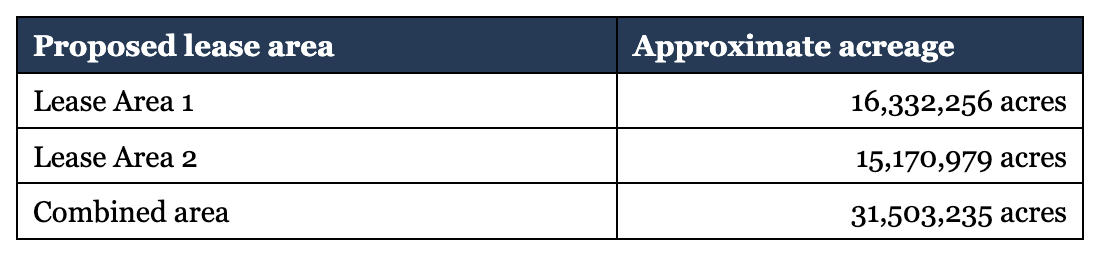
The leases would cover minerals and metals contained in polymetallic nodules and ferromanganese crust deposits. They would not include oil, natural gas, sulphur or source materials used to produce fissionable materials.
Polymetallic nodules are mineral deposits that form over extremely long periods on or near the ocean floor. Depending on their composition, they may contain commercially significant concentrations of:
- Manganese;
- Nickel;
- Cobalt;
- Copper;
- Rare earth elements; and
- Other critical minerals.
Ferromanganese crusts generally form on exposed rock surfaces, seamounts and other elevated seabed features. They may contain manganese, cobalt, nickel, tellurium and other valuable metals.
The existence of mineral deposits, however, does not establish that they can be recovered economically or environmentally responsibly. Substantial exploration, sampling, resource modelling, engineering, environmental baseline work and regulatory approvals would be required before any commercial operation could begin.
The Proposed Auction Does Not Immediately Authorize Deep-Sea Mining
Winning a BOEM auction would not allow the successful bidder to begin commercial mining.
The successful bidder would initially receive a federal mineral lease. That lease would provide the lessee with contractual rights to evaluate and potentially develop the covered minerals, subject to the lease terms, BOEM regulations and additional government approvals.
Before conducting delineation, testing or commercial mining, the lessee would generally be required to submit detailed operational plans to BOEM under 30 C.F.R. Part 582. BOEM would then review those plans and determine whether the proposed activities may proceed and under what conditions.
A commercial mining proposal could require:
- Geological and geophysical surveys;
- Mineral sampling;
- Resource estimates;
- Environmental baseline studies;
- Sediment-plume modelling;
- Equipment testing;
- Collector-system engineering;
- Riser and lifting-system engineering;
- Vessel and processing plans;
- Waste-discharge analysis;
- Marine-species surveys;
- Fisheries-impact studies;
- Cultural-resource reviews;
- Emergency-response plans;
- Financial assurance;
- Monitoring and mitigation measures; and
- Additional federal, territorial and maritime approvals.
BOEM may approve, condition, modify or reject a proposed operational plan.
Accordingly, companies should distinguish carefully among:
- Qualification to participate in the auction;
- Participation in the auction;
- Provisional selection as the winning bidder;
- Issuance of a mineral lease;
- Approval of an exploration or delineation plan;
- Approval of testing activities; and
- Approval of commercial mining.
These are separate legal and regulatory stages.
How the American Samoa Leasing Process Began
The American Samoa process began after BOEM received an unsolicited request on April 8, 2025, asking the agency to consider offering Outer Continental Shelf minerals offshore American Samoa for commercial lease.
On June 16, 2025, BOEM published a Request for Information and Interest. The request sought information from potential bidders, the American Samoa government, local communities, federal agencies, fishing interests, environmental organizations and other stakeholders.
A Request for Information and Interest does not commit BOEM to hold an auction. Its purposes include determining:
- Whether sufficient commercial interest exists;
- Which areas industry may wish to lease;
- What geological information is available;
- Whether other ocean uses could conflict with mineral development;
- What environmental resources may be affected;
- What cultural and subsistence concerns exist;
- What protections may be required; and
- Whether BOEM should continue the leasing process.
After reviewing the information received, BOEM proceeded with area identification, environmental review and preparation of the Proposed Leasing Notice.
BOEM’s Competitive Bidding Process
BOEM’s competitive leasing procedures for minerals other than oil, gas and sulphur are principally governed by the Outer Continental Shelf Lands Act and 30 C.F.R. Part 581.
The principal stages are described below.
1. Unsolicited Request or Government-Initiated Review
The process may begin through an unsolicited request from a company or through BOEM’s own initiative.
An unsolicited request does not provide the requesting company with an exclusive right to the area. If BOEM determines that competitive interest may exist, it generally must use a competitive leasing process.
This means that the company that originally requested the lease sale may ultimately be required to compete against other qualified bidders.
2. Request for Information and Interest
BOEM publishes a public notice seeking information about the proposed area and expressions of commercial interest.
Interested companies may identify blocks they would consider leasing and provide information about:
- Corporate identity;
- Technical qualifications;
- Financial capability;
- Proposed minerals;
- Exploration methods;
- Potential development concepts; and
- The geographic areas of interest.
The public, territorial officials and affected stakeholders may submit environmental, cultural, economic and scientific information.
3. Area Identification
BOEM determines which portions of the original area should receive further consideration.
The area-identification decision may reflect:
- Industry nominations;
- Water depth;
- Geological potential;
- Fisheries;
- Navigation routes;
- Marine protected areas;
- Cultural resources;
- Essential fish habitat;
- Endangered species;
- Territorial concerns;
- Military activities; and
- Other existing or reasonably foreseeable ocean uses.
Area identification does not create legal rights and does not guarantee that a sale will occur.
4. Environmental Review
BOEM conducts environmental review before deciding whether to hold a sale.
The initial review may address the reasonably foreseeable effects of issuing the leases and authorizing limited preliminary activity. More extensive environmental review would ordinarily be required before approval of testing, delineation or commercial mining.
For deep-sea minerals, the environmental analysis may consider:
- Disturbance of the ocean floor;
- Removal of nodules and habitat;
- Sediment plumes;
- Effects on benthic organisms;
- Effects on fish and marine mammals;
- Noise and vessel traffic;
- Light introduced into deep-ocean environments;
- Discharges from vessels or processing systems;
- Accidental releases;
- Carbon-storage effects;
- Cumulative effects;
- Transboundary impacts; and
- Uncertainty caused by limited scientific data.
5. Proposed Leasing Notice
The Proposed Leasing Notice describes the terms BOEM presently expects to use.
For PACM-1, the notice addresses:
- The proposed lease areas;
- Auction procedures;
- Minimum bids;
- Deposits;
- Lease duration;
- Rentals;
- Royalties;
- Bidder qualification;
- Affiliated bidders;
- Lease stipulations;
- Information to lessees; and
- The proposed auction date.
The Proposed Leasing Notice is not final. BOEM may change the acreage, fiscal terms, auction format, environmental conditions or sale date before publishing the Final Leasing Notice.
6. Review by the Governor of American Samoa
Under 30 C.F.R. § 581.16, the Governor of American Samoa has an opportunity to review and comment on the Proposed Leasing Notice.
BOEM’s July 17, 2026 Federal Register notice provides that comments from the Governor must be submitted by September 15, 2026.
The Governor’s review is important because the proposed federal lease areas could affect:
- American Samoa’s economy;
- Commercial and subsistence fishing;
- Ports and infrastructure;
- Local employment;
- Cultural practices;
- Coastal resources;
- Territorial waters;
- Tourism;
- Marine conservation; and
- Public services.
BOEM must consider the Governor’s recommendations, although the precise legal effect of any recommendation depends on OCSLA and the applicable regulations.
7. Final Leasing Notice
BOEM must publish a Final Leasing Notice at least 30 days before the sale.
The Final Leasing Notice will establish the controlling terms, including:
- The final lease areas;
- The sale date and location;
- Bidder deadlines;
- The minimum bid;
- Bid deposits;
- Auction procedures;
- Rental rates;
- Royalty rates;
- Lease stipulations; and
- Requirements for successful bidders.
Until the Final Leasing Notice is published, prospective bidders should treat the November 19, 2026 auction date and other proposed terms as subject to change.
Bidder Qualification Requirements
A company may not participate simply by appearing at the auction and offering the highest price. BOEM must first determine that the bidder is legally qualified.
Qualification requirements are governed principally by 30 C.F.R. §§ 581.4 and 581.20.
A prospective bidder may be required to provide:
- Articles or certificates of incorporation;
- Bylaws or operating agreements;
- Certificates of good standing;
- Ownership information;
- Corporate organizational charts;
- Identification of controlling persons;
- Board resolutions;
- Evidence identifying authorized representatives;
- Partnership or joint-venture agreements;
- Information concerning affiliates; and
- Other certifications requested by BOEM.
The bidder must also satisfy any statutory limitations concerning who may hold an Outer Continental Shelf mineral lease.
Companies using special-purpose entities, consortiums or joint ventures should establish the proposed ownership and control structure early. Last-minute changes may raise questions concerning qualification, affiliation, foreign control or bidder authorization.
The Bidder Financial Form
Under the proposed PACM-1 schedule, a bidder would be required to submit a Bidder Financial Form by October 29, 2026, unless BOEM changes that deadline in the Final Leasing Notice.
The proposed form requires information concerning:
- The bidder’s BOEM qualification number;
- Authorized bidding representatives;
- Payment and refund contacts;
- Affiliates;
- The bidder’s Pay.gov account;
- Authority to make binding bids; and
- The bidder’s obligation to pay the deposit and remaining bonus bid.
BOEM proposes to require an original wet signature.
An authorized representative would also be required to recertify the bidder’s information on the day of the auction. Failure to complete the recertification could prevent the company from bidding.
Affiliated Companies May Not Compete Against Each Other
BOEM’s proposed rules prevent affiliated companies from bidding against one another in the same auction.
Affiliation may exist where:
- One entity controls another;
- Two entities are controlled by the same parent;
- A person owns a majority of the voting interests of multiple bidders;
- Entities share common officers or directors;
- The same persons control bidding decisions;
- The companies jointly operate important assets; or
- Other facts establish direct or indirect control.
The restriction is intended to preserve genuine competition and prevent related bidders from manipulating the auction process.
A sponsor should therefore avoid submitting multiple related bidding entities merely to increase its tactical options. BOEM could disqualify affiliated bidders or reject their bids.
How the Proposed Oral Auction Would Work
BOEM proposes to conduct PACM-1 through an in-person ascending oral auction in Camarillo, California. The public would not be admitted to the auction venue, although BOEM proposes to provide a livestream.
The two areas would be auctioned separately and sequentially.
The proposed process would operate generally as follows:
- BOEM announces the opening price for a lease area.
- Qualified bidders indicate whether they remain willing to bid.
- BOEM increases the price in successive rounds.
- A bidder that does not indicate continued participation withdraws.
- The price continues to rise until only one bidder remains.
- The remaining bidder becomes the provisional winner.
A bidder’s oral bid would be binding.
Exit Bids
A withdrawing bidder may be permitted to submit an exit bid representing the maximum amount it was prepared to pay between the last completed round and the next announced price.
BOEM may use exit bids to determine the winner where:
- All remaining bidders withdraw in the same round;
- There is a tie;
- The apparent winner is disqualified;
- The provisional winner fails to make the required payment; or
- Another auction irregularity occurs.
The Final Leasing Notice should be reviewed carefully for the definitive tie-breaking and exit-bid procedures.
Proposed Financial Terms
The Proposed Leasing Notice includes the following principal terms:
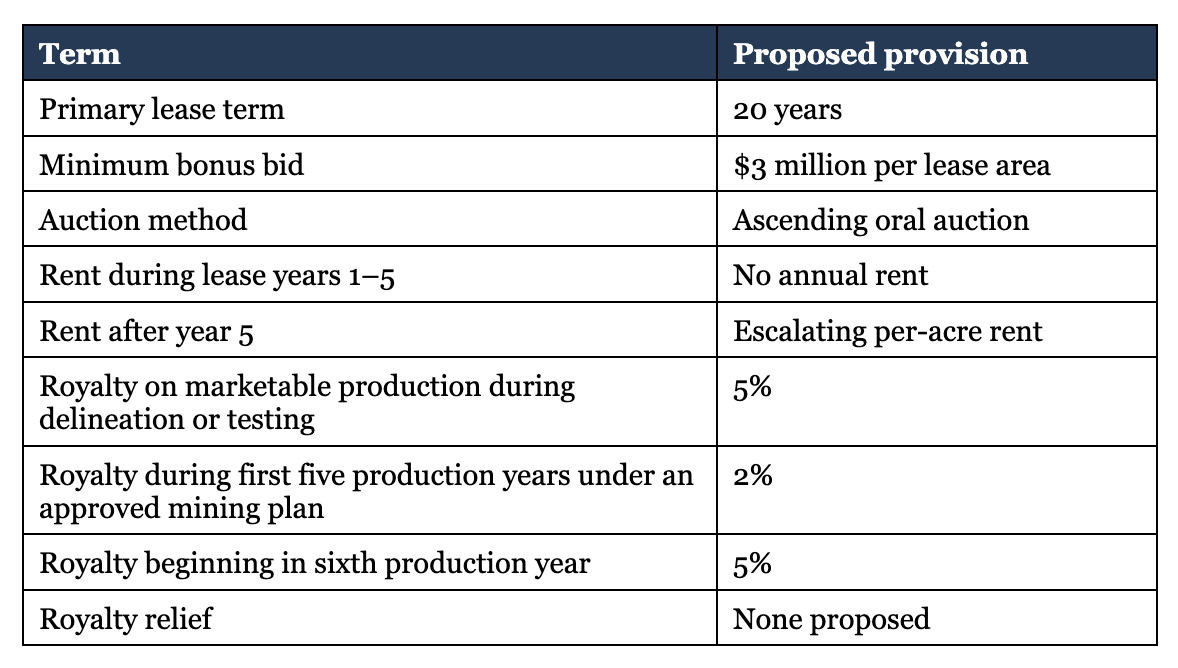
The $3 million minimum bid should not be confused with the total cost of the project.
The successful bidder may also need to fund:
- Geological surveys;
- Environmental studies;
- Research vessels;
- Remotely operated vehicles;
- Autonomous underwater vehicles;
- Sampling equipment;
- Collector-system development;
- Riser and lifting systems;
- Processing technology;
- Port improvements;
- Insurance;
- Financial assurance;
- Territorial engagement;
- Legal and technical consultants; and
- Long-term compliance and monitoring.
The actual cost of advancing a deep-sea minerals project could greatly exceed the initial bonus bid.
Escalating Rent and Acreage Relinquishment
BOEM proposes to charge no annual rent during the first five lease years, followed by escalating rent based on the number of acres the lessee continues to hold.
This structure appears intended to encourage lessees to evaluate their acreage promptly and relinquish areas they do not plan to explore or develop.
A company that continues holding millions of acres into later lease years could face substantial annual rental obligations.
Before bidding, the company should model:
- The expected exploration schedule;
- When acreage can be evaluated;
- Whether partial relinquishment is permitted;
- The cost of holding unevaluated acreage;
- Delays in vessel availability;
- Environmental-review delays;
- Technology-development delays; and
- The risk that no commercially viable mineral resource is identified.
Laws and Regulations to Know
Laws Governing the American Samoa Offshore Minerals Process
The proposed sale is governed primarily by U.S. federal law because it concerns minerals on the federal Outer Continental Shelf.
American Samoa law may nevertheless apply to onshore facilities, territorial waters, port activities, coastal development, environmental permits, local businesses and other activities within territorial jurisdiction.
Outer Continental Shelf Lands Act
The Outer Continental Shelf Lands Act, or OCSLA, is the principal federal statute governing leasing and development of minerals on the Outer Continental Shelf.
OCSLA provides the federal government with authority over submerged lands and mineral resources located seaward of state and territorial jurisdiction.
For minerals other than oil, gas and sulphur, OCSLA authorizes the Secretary of the Interior to:
- Offer mineral leases;
- Determine whether competitive interest exists;
- Establish bidding systems;
- Set rents and royalties;
- Impose lease terms;
- Require operational plans;
- Regulate assignments;
- Require financial assurance;
- Protect environmental resources; and
- Suspend, cancel or terminate leases under specified circumstances.
30 C.F.R. Part 581
30 C.F.R. Part 581 governs the leasing of Outer Continental Shelf minerals other than oil, gas and sulphur.
Part 581 addresses:
- Unsolicited requests;
- Requests for Information and Interest;
- Competitive lease sales;
- Proposed and Final Leasing Notices;
- Bidder qualification;
- Bid acceptance and rejection;
- Lease issuance;
- Bonus payments;
- Rentals;
- Royalties;
- Assignments;
- Lease extensions;
- Suspension;
- Cancellation; and
- Termination.
The PACM-1 auction procedures must comply with these regulations.
30 C.F.R. Part 582
30 C.F.R. Part 582 governs operations conducted under an Outer Continental Shelf mineral lease.
It addresses:
- General operational requirements;
- Exploration and delineation plans;
- Testing;
- Mining plans;
- Environmental information;
- Performance standards;
- Inspection;
- Data and records;
- Safety;
- Pollution prevention;
- Financial assurance;
- Suspension; and
- Enforcement.
Part 582 is especially important because it confirms that issuance of the lease is not the final regulatory approval.
National Environmental Policy Act
The National Environmental Policy Act, or NEPA, requires federal agencies to evaluate the environmental effects of major federal actions.
BOEM must conduct appropriate NEPA review before issuing leases and approving significant operational plans.
Depending on the reasonably foreseeable impacts, BOEM may prepare:
- A categorical-exclusion review;
- An environmental assessment;
- A finding of no significant impact; or
- An environmental impact statement.
Commercial deep-sea mining would likely require substantially more extensive environmental review than the preliminary leasing decision.
Endangered Species Act
The Endangered Species Act may require BOEM to consult with the National Marine Fisheries Service or the U.S. Fish and Wildlife Service if a proposed activity may affect listed species or designated critical habitat.
Potentially affected species could include:
- Whales;
- Dolphins;
- Sea turtles;
- Seabirds;
- Fish; and
- Other protected marine organisms.
Operational plans may require mitigation measures governing vessel speed, noise, lighting, timing, monitoring and protected-species observers.
Marine Mammal Protection Act
The Marine Mammal Protection Act generally prohibits the taking of marine mammals without authorization.
The term “take” includes more than killing or physically injuring an animal. It may include harassment caused by:
- Vessel activity;
- Underwater noise;
- Equipment deployment;
- Seabed disturbance;
- Testing;
- Mapping; or
- Other project operations.
A lessee may therefore need an incidental harassment authorization or other approval from the National Marine Fisheries Service.
Magnuson-Stevens Fishery Conservation and Management Act
The Magnuson-Stevens Fishery Conservation and Management Act requires federal agencies to consult regarding actions that may adversely affect essential fish habitat.
Deep-sea mineral activity could affect fisheries through:
- Habitat disturbance;
- Sediment plumes;
- Vessel exclusion zones;
- Noise;
- Changes in food-web conditions;
- Displacement of fishing activity; and
- Effects on spawning or migratory areas.
Fishing is particularly important to American Samoa’s economy, food security and cultural practices.
National Historic Preservation Act
Section 106 of the National Historic Preservation Act requires federal agencies to consider effects on historic properties.
In the offshore context, this may include:
- Shipwrecks;
- Submerged aircraft;
- Archaeological sites;
- Traditional cultural properties;
- Submerged landscapes; and
- Places of cultural or religious significance.
A lease or operational plan may contain requirements for archaeological surveys and procedures governing unanticipated discoveries.
Coastal Zone Management Act
The Coastal Zone Management Act establishes a federal-state and federal-territorial framework for managing coastal resources.
American Samoa administers a Coastal Management Program under territorial law and regulations. The program includes environmental review and interagency coordination for activities affecting the territory’s coastal zone.
Federal consistency requirements may become particularly important for:
- Onshore support facilities;
- Ports;
- Pipelines or cables;
- Equipment staging;
- Processing facilities;
- Vessel operations in territorial waters;
- Dredging;
- Discharges; and
- Coastal construction.
The extent to which a particular offshore activity is subject to federal consistency review will depend on its reasonably foreseeable effects on American Samoa’s coastal uses and resources.
Clean Water Act
The Clean Water Act may apply to discharges of pollutants into waters of the United States.
Potentially regulated activities could include:
- Vessel discharges;
- Sediment or process-water discharges;
- Discharges from onshore facilities;
- Dredged or fill material;
- Port construction;
- Wastewater; and
- Stormwater.
Depending on the activity, permits may be required from the Environmental Protection Agency, the U.S. Army Corps of Engineers or territorial environmental authorities.
Rivers and Harbors Act
Section 10 of the Rivers and Harbors Act may require U.S. Army Corps of Engineers authorization for structures or work affecting navigable waters.
This could apply to:
- Docks;
- Moorings;
- Cables;
- Pipelines;
- Loading facilities;
- Port modifications;
- Anchoring systems; and
- Other fixed or semi-fixed structures.
Marine Protection, Research and Sanctuaries Act
The Marine Protection, Research and Sanctuaries Act, sometimes called the Ocean Dumping Act, may apply if project activities involve transportation and disposal of material at sea.
A company cannot avoid environmental regulation merely by characterizing discharged or redeposited material as naturally occurring seabed sediment.
National Marine Sanctuaries Act
Activities affecting a national marine sanctuary may require additional review or authorization under the National Marine Sanctuaries Act.
The National Marine Sanctuary of American Samoa protects significant coral reefs, marine habitats and cultural resources. The proposed federal lease areas may be located outside sanctuary boundaries, but vessels, infrastructure, support activities or environmental effects could still require analysis depending on their location and nature.
American Samoa Coastal Management Laws
American Samoa has its own coastal-management statute and administrative regulations.
The American Samoa Coastal Management Program is codified principally in:
- A.S.C.A. §§ 24.0501 et seq.; and
- A.S.A.C. §§ 26.0201 et seq.
The program establishes territorial environmental review and coordination requirements intended to ensure that environmental, economic and technical considerations are evaluated before coastal development occurs.
Activities that could require territorial review include:
- Port construction;
- Shore-based processing;
- Warehouses;
- Fuel facilities;
- Roads;
- Utility improvements;
- Waste handling;
- Equipment staging;
- Dredging; and
- Vessel support facilities.
American Samoa Environmental Quality Laws
The American Samoa Environmental Protection Agency and Environmental Quality Commission administer territorial laws and regulations concerning matters such as:
- Water quality;
- Air emissions;
- Solid waste;
- Hazardous materials;
- Storage tanks;
- Wastewater;
- Pesticides; and
- Environmental permits.
Those laws would be particularly relevant to onshore processing or support facilities.
Territorial permits would not substitute for BOEM approval, and BOEM approval would not necessarily substitute for required territorial permits.
Fishing and Marine Resource Laws
American Samoa regulates fishing and marine-resource activities within territorial jurisdiction.
A deep-sea minerals project could affect:
- Commercial fishing;
- Subsistence fishing;
- Longline activity;
- Pelagic fisheries;
- Fish-aggregation areas;
- Traditional fishing practices;
- Marine protected areas; and
- Community-based fisheries-management areas.
BOEM’s analysis and lease stipulations are therefore expected to include fisheries coordination and consultation requirements.
Territorial Waters Versus the Federal Outer Continental Shelf
A critical legal distinction exists between:
- Waters and submerged lands under American Samoa territorial jurisdiction; and
- The federal Outer Continental Shelf.
BOEM’s lease would cover federal OCS minerals, not minerals owned by American Samoa within territorial waters.
Nevertheless, a federal project may require extensive interaction with American Samoa because:
- Vessels may use territorial ports;
- Employees may live and work in the territory;
- Equipment may be staged onshore;
- Minerals may be landed or processed locally;
- Territorial waters may be crossed;
- Coastal resources may be affected; and
- Emergency services may be required.
Companies should therefore avoid assuming that federal jurisdiction eliminates territorial permitting and consultation requirements.
Environmental Justice and Cultural Considerations
American Samoa’s relationship with the ocean is economic, cultural, historical and spiritual.
BOEM and prospective bidders should anticipate significant attention to:
- Samoan customary practices;
- Traditional fishing;
- Village consultation;
- Subsistence resources;
- Cultural heritage;
- Distribution of economic benefits;
- Effects on future generations;
- Scientific uncertainty;
- Environmental justice;
- Local employment; and
- Whether decisions affecting American Samoa are being made primarily outside the territory.
Compliance with formal notice-and-comment requirements may not be sufficient to establish community support.
A bidder should consider establishing a meaningful engagement process involving:
- The Governor;
- The Legislature of American Samoa;
- Village leaders;
- Matai;
- Fishing communities;
- Environmental organizations;
- Local businesses;
- Port authorities;
- Educational institutions;
- Workforce organizations; and
- Other affected stakeholders.
Proposed Lease Stipulations
BOEM’s proposed PACM-1 stipulations address a wide range of environmental, community and operational matters.
The stipulations include or contemplate requirements concerning:
- Fisheries communication;
- Marine mammals;
- Endangered species;
- Essential fish habitat;
- Birds;
- Marine archaeology;
- Unanticipated discoveries;
- Environmental reporting;
- Scientific research access;
- Emergency response;
- Maritime safety;
- Community investment;
- Economic development;
- Local labor;
- Port use;
- Infrastructure;
- Domestic supply chains; and
- Coordination with American Samoa.
These stipulations may materially affect project costs and scheduling.
They also indicate that BOEM expects the successful bidder to do more than pay the federal government for a lease. The lessee may be expected to establish a continuing relationship with American Samoa and address local economic and infrastructure needs.
Local Employment and Economic Development
BOEM’s proposed stipulations indicate that local employment and economic development will be important components of the lease.
Potential economic benefits could include:
- Port investment;
- Vessel services;
- Warehousing;
- Engineering support;
- Environmental research;
- Training programs;
- Skilled maritime employment;
- Equipment maintenance;
- Supply contracts;
- Educational partnerships; and
- Government revenues.
However, companies should avoid making unsupported claims that the project will necessarily produce large numbers of local jobs.
Deep-sea mining systems may be highly automated and may rely on specialized vessels, engineers and equipment manufactured outside American Samoa.
Accurate disclosure should distinguish among:
- Temporary construction jobs;
- Vessel-rotation employment;
- Permanent territorial employment;
- Contractor positions;
- Training opportunities; and
- Indirect economic effects.
Foreign Ownership, CFIUS and National Security
Foreign ownership may create additional legal issues.
BOEM’s information to lessees identifies possible review of lease assignments by the Committee on Foreign Investment in the United States, or CFIUS.
CFIUS concerns could arise where:
- A foreign person acquires control of the lessee;
- A foreign government obtains an ownership interest;
- A lease is transferred to a foreign-controlled entity;
- Sensitive technology is involved;
- The project affects defense supply chains;
- Port infrastructure is involved; or
- The minerals are considered strategically important.
Other potentially applicable laws include:
- Export Administration Regulations;
- International Traffic in Arms Regulations;
- Office of Foreign Assets Control sanctions;
- Anti-money-laundering laws;
- Federal procurement restrictions; and
- Restrictions on foreign investment in sensitive infrastructure.
A bidder should evaluate these issues before finalizing its ownership or financing structure.
International Law
The proposed lease areas are within U.S. jurisdiction and are not governed by the International Seabed Authority’s mining-contract system.
The International Seabed Authority regulates mineral activities in “the Area,” meaning the seabed beyond national jurisdiction.
PACM-1 instead concerns the U.S. Outer Continental Shelf and is governed primarily by:
- OCSLA;
- Federal regulations;
- The lease;
- BOEM-approved operational plans; and
- Other applicable U.S. laws.
Nevertheless, international-law issues could arise from:
- Maritime boundaries;
- Transboundary environmental effects;
- Navigation;
- Vessel registration;
- International pollution conventions;
- Crew and labor requirements;
- International shipping; and
- Effects extending toward neighboring Pacific countries.
Securities-Law Considerations for Public Companies
Public companies participating in PACM-1 must accurately describe their status and the limitations of any lease rights.
Qualification Is Not a Lease Award
A company should not state that it obtained mineral rights merely because BOEM qualified it to bid.
Qualification means only that the company may participate in the auction.
A Provisional Winning Bid Is Not a Final Lease
A provisional winner may still need to:
- Pay the required deposit;
- Pay the remaining bonus;
- Satisfy BOEM’s qualification requirements;
- Provide financial assurance;
- Execute the lease;
- Accept all stipulations; and
- Receive final agency approval.
Until the lease is issued, disclosure should clearly identify the award as provisional.
A Mineral Lease Is Not a Mining Permit
Even after a lease is issued, the company may not describe itself as having permission to conduct commercial mining unless BOEM has approved the required mining plan and all other necessary permits have been obtained.
Resource and Reserve Claims
Statements about nodule tonnage, grade, metal content, resources, reserves or project economics may implicate Subpart 1300 of Regulation S-K.
Depending on the nature of the disclosure, an SEC-reporting company may need:
- A qualified person;
- Supporting technical studies;
- A technical report summary;
- Appropriate resource classification;
- Cutoff-grade assumptions;
- Metallurgical information;
- Economic assumptions; and
- Disclosure of material risks and uncertainties.
A company should not convert regional scientific estimates into company-specific mineral resources without sufficient exploration data and qualified-person support.
Material Agreements
The company may need to file material agreements relating to:
- The lease;
- Joint ventures;
- Financing;
- Technology;
- Vessels;
- Processing;
- Offtake;
- Government support;
- Performance bonds;
- Contractors; and
- Related-party arrangements.
Risk Factors
Material risk-factor disclosure may need to address:
- The proposed nature of the lease sale;
- Competition at the auction;
- The possibility that the company will not win;
- The possibility that BOEM will delay or cancel the sale;
- Environmental opposition;
- Territorial opposition;
- Litigation;
- Scientific uncertainty;
- Technology risk;
- Extreme water depths;
- Vessel availability;
- Capital requirements;
- Financing risk;
- Regulatory changes;
- Royalty and rental obligations;
- Acreage relinquishment;
- Resource uncertainty;
- Processing limitations;
- Commodity-price volatility;
- Lack of commercial-scale precedent;
- Environmental liability;
- CFIUS;
- Foreign ownership; and
- Dependence on additional permits.
Related Deep-Sea Mining Articles
For additional discussion of deep-sea mining regulation, capital formation, permitting and disclosure requirements, see the following SecuritiesLawyer101.com articles:
- Deep-Sea Mining, Public Markets: Capital, Risk and Regulatory Turbulence — discusses public-company financing, Nasdaq and NYSE listings, permitting uncertainty, environmental opposition and securities-law disclosure risks affecting deep-sea mining companies.
- NOAA Accelerates Deep-Seabed Mining Permitting Under DSHMRA — explains NOAA’s revised permitting framework under the Deep Seabed Hard Mineral Resources Act and the consolidated process for exploration licences and commercial recovery permits.
- Deep-Sea Mining Litigation Risk: What NOAA’s New Rule and the UK License Challenge Mean for Capital Raises — examines administrative-law challenges, injunction risk, licence-transfer disputes and the consequences of regulatory uncertainty for IPOs, PIPEs and other capital raises.
- Why U.S. Deep-Sea Mining Companies Need an Industry Association Now — discusses the need for coordinated industry standards, federal-agency engagement, permitting guidance, data sharing and responsible-development principles.
This article is provided for general informational purposes only. To speak with a Securities Attorney, please contact Brenda Hamilton at 200 E Palmetto Rd, Suite 103, Boca Raton, Florida, (561) 416-8956, or by email at [email protected].
Hamilton & Associates | Securities Attorneys
Brenda Hamilton, Securities Attorney
200 E Palmetto Rd, Suite 103
Boca Raton, Florida 33432
Telephone: (561) 416-8956
Facsimile: (561) 416-2855
www.SecuritiesLawyer101.com