

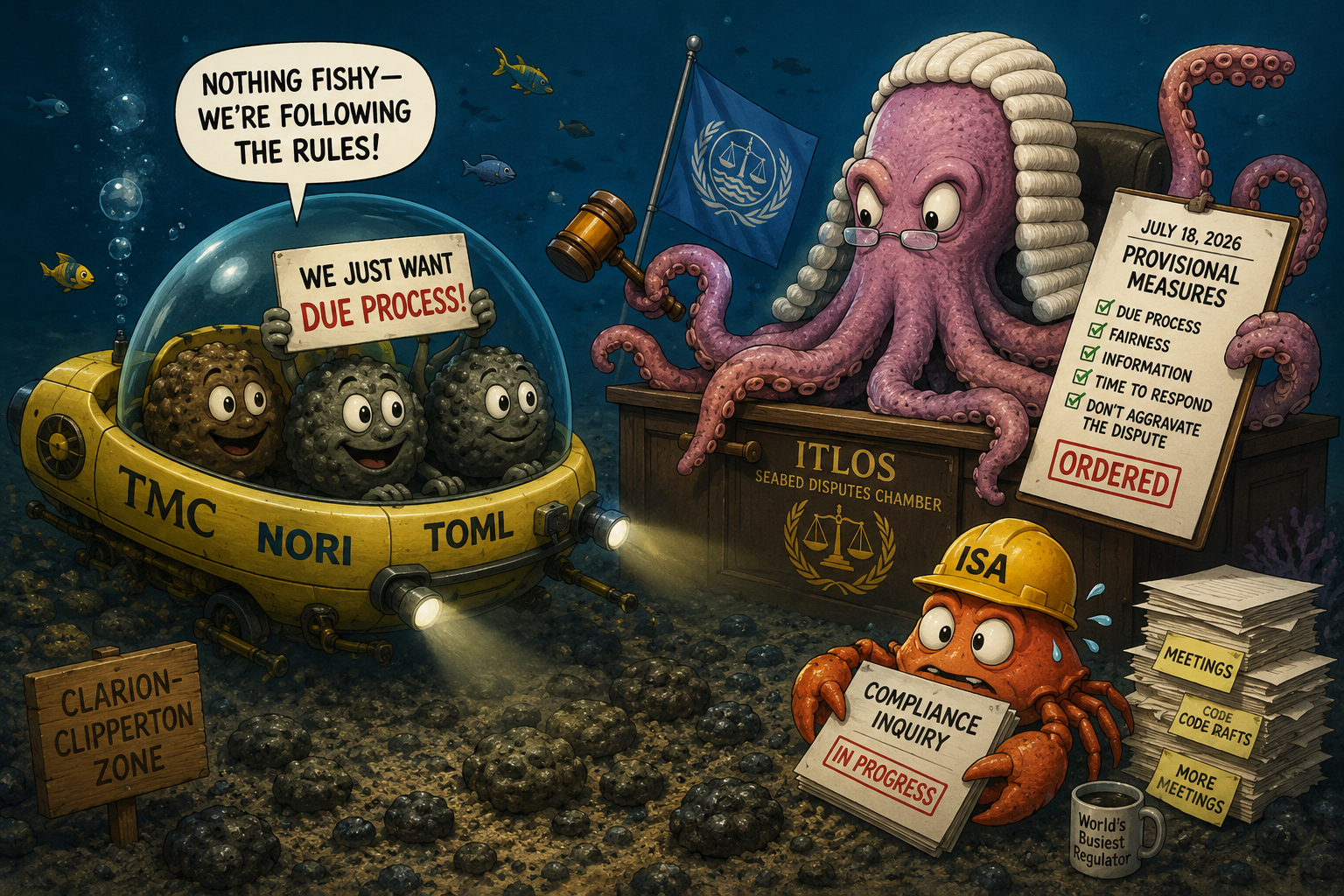
The first contentious proceedings ever brought against the International Seabed Authority have placed the rights of deep-sea mining contractors, the limits of administrative discretion and the credibility of the international seabed regime before the Seabed Disputes Chamber of the International Tribunal for the Law of the Sea.
Nauru Ocean Resources Inc. (NORI) and Tonga Offshore Mining Ltd. (TOML), both subsidiaries controlled by The Metals Company Inc. (TMC), instituted parallel cases on May 30, 2026—entered as ITLOS Case Nos. 34 and 35—after the ISA identified them as contractors requiring “specific attention” for possible noncompliance. NORI and TOML deny that the ISA followed a sufficiently clear, transparent and fair process before placing them under heightened scrutiny. Their claims do not ask the Chamber to excuse contractual noncompliance. Rather, they ask a more fundamental question: when an international regulator investigates contractors whose commercial rights depend on that same regulator, what minimum procedural safeguards must apply?
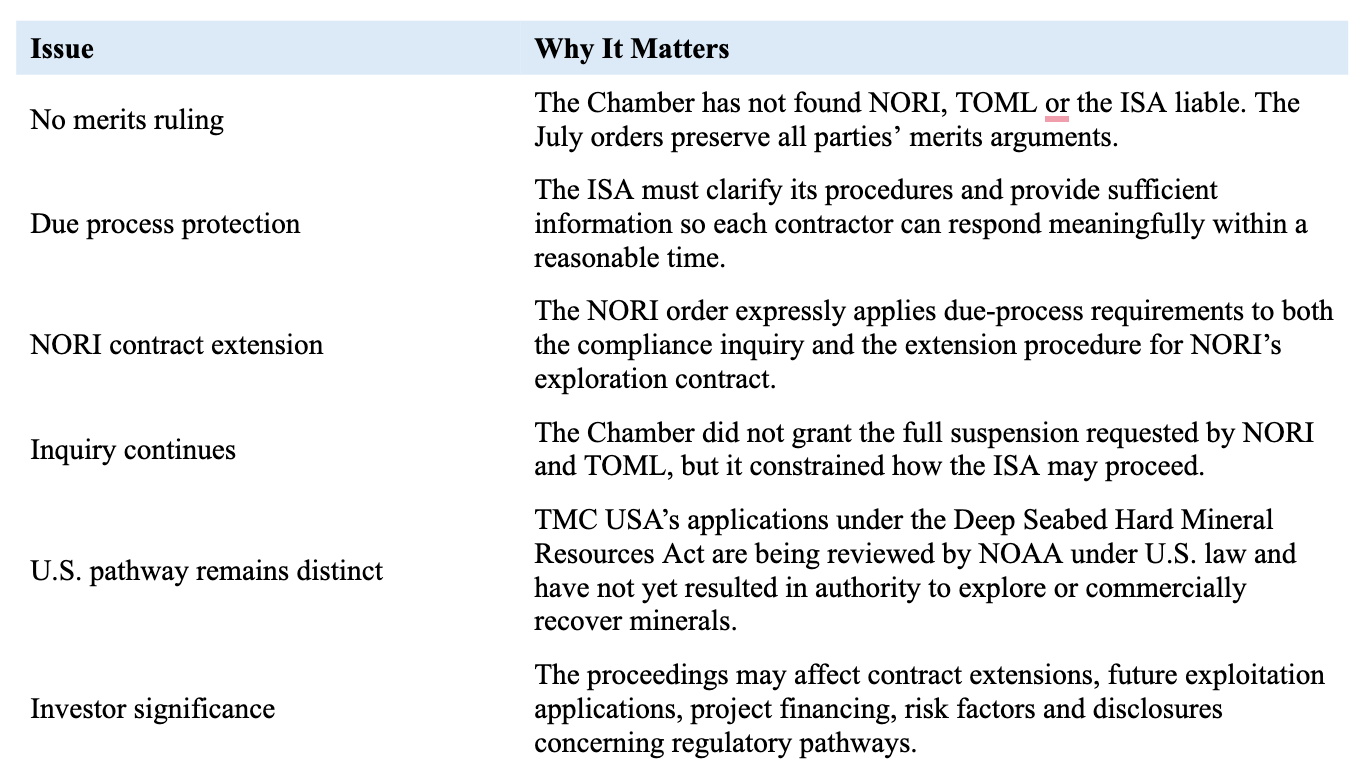
On July 18, 2026, the Chamber unanimously prescribed provisional measures requiring the ISA to act under the governing legal framework, including rules of due process, to clarify or provide the procedures and information necessary for NORI and TOML to answer meaningfully, and to cooperate without aggravating the dispute. The Chamber did not decide the merits, and it did not broadly suspend the inquiry. Even so, the orders are significant for TMC, NORI and TOML because they establish that the ISA cannot treat procedural fairness as optional while its inquiry proceeds.
Key Takeaways
Who Are TMC, NORI and TOML?
TMC is a publicly traded company developing a business around the collection and processing of polymetallic nodules from the Clarion-Clipperton Zone in the Pacific Ocean. NORI and TOML are TMC-controlled subsidiaries that hold separate ISA exploration contracts sponsored by Nauru and Tonga, respectively.
The corporate separation matters. NORI and TOML are the contracting parties before the ISA and the applicants before the Seabed Disputes Chamber. TMC is their controlling parent and the public company whose investors bear the economic consequences of regulatory delay, adverse contractual decisions and litigation. TMC USA LLC is a separate U.S. subsidiary pursuing applications under U.S. law.
NORI and TOML have invested years in exploration, environmental research, engineering and technology development under the ISA system. From their perspective, the exploration contracts were not merely permission to gather data; they were the legal foundation for a staged development process expected to lead toward consideration of exploitation once the ISA completed the Mining Code. The continuing absence of final exploitation regulations is therefore central to understanding why TMC began pursuing a parallel U.S. pathway.
How the ISA Compliance Inquiry Began
The dispute grew out of an ISA Council decision directing the Secretary-General to investigate whether contractors may have acted inconsistently with the UNCLOS framework governing activities in the international seabed area. In March 2026, the ISA informed NORI and TOML that they required “specific attention” regarding possible noncompliance.
The phrase “possible noncompliance” is important. It is not a finding that either company breached its contract. NORI and TOML argue that the designation itself can cause immediate legal and commercial harm because it may influence regulators, sponsoring states, investors, business partners and the ISA bodies that will consider contract extensions or future exploitation rights.
The contractors also contend that they were not initially given a sufficiently clear account of the legal theory, factual basis, methodology, evidence or procedures governing the inquiry. They argue that they could not meaningfully respond to a process whose standards and potential consequences had not been adequately defined.
The Core Claims Asserted by NORI and TOML
NORI and TOML frame their cases around due process, transparency, fairness, nondiscrimination and good-faith performance of the ISA’s contractual and institutional responsibilities. Their claims are grounded in UNCLOS, the 1994 Agreement relating to Part XI, ISA decisions, the applicable exploration regulations and section 13.4 of their exploration contracts.
The contractors’ position is strongest when stated narrowly: the ISA may investigate potential contractor noncompliance, but it must do so through a process that gives the affected contractor notice of the case it must answer, access to the relevant procedures and materials, a meaningful opportunity to respond, and protection against premature adverse consequences.
NORI faces an additional issue because its contract-extension application overlaps with the compliance inquiry. NORI argues that an unresolved or procedurally defective inquiry could contaminate the extension process and effectively prejudice contractual rights before the Chamber decides the merits. That timing concern is not abstract. NORI’s exploration contract term was set to expire on July 22, 2026, while the compliance inquiry remained unresolved. Exploration contracts, work programs and financing arrangements operate on defined terms, while international proceedings may take substantially longer.
The ISA’s Position
The ISA rejects the characterization that it denied due process and argues that the inquiry is a legitimate exercise of its supervisory and compliance functions. It has maintained that the contractors’ procedural rights have been and will continue to be respected.
The ISA also challenged the Chamber’s jurisdiction and the urgency of the requested relief. It argued that the contractors sought measures broader than necessary and that the Chamber should not halt an institutional inquiry before the merits are determined.
These arguments retain importance. The July 18 orders did not decide that the ISA acted unlawfully, did not determine that NORI or TOML complied with every contractual obligation, and did not prohibit the ISA from continuing its inquiry. The merits phase will address unresolved questions concerning jurisdiction, contractual interpretation and the legality of the challenged conduct.
What the July 18, 2026 Orders Actually Did
The Chamber unanimously found that NORI and TOML have plausible rights to due process and fair treatment and that there was a real and imminent risk of irreparable prejudice to those rights pending a final decision. On that basis, it ordered the ISA to act in accordance with the relevant legal framework, including rules of due process. It specifically required the ISA to clarify or provide the relevant procedural information and the questions posed to NORI and TOML so that each company can respond meaningfully and within a reasonable period.
For NORI, the Chamber applied the same due-process requirement to the procedure for extension of its exploration contract. The Chamber also ordered the parties to cooperate and refrain from conduct that might aggravate the dispute. NORI, TOML and the ISA must submit initial compliance reports by August 31, 2026.
The Chamber declined to impose the complete suspension sought by the contractors. Nevertheless, the orders can reasonably be viewed as a meaningful procedural victory for NORI and TOML. The ISA asked the Chamber to reject all provisional measures. Instead, the Chamber imposed affirmative obligations directed to the precise areas of concern raised by the contractors: procedural clarity, access to sufficient information, a meaningful response opportunity and nonaggravation.
The orders are also notable because they recognize that due-process concerns can become urgent before a final sanction is imposed. A contractor may be harmed by an opaque designation, an unresolved inquiry or spillover into a contract-extension process even if no ultimate noncompliance finding has yet been made.
Why the Orders Matter to TMC and Its Investors
For TMC, the cases affect more than litigation strategy. They bear on the reliability of the ISA system as a framework for long-term capital investment. Deep-sea mineral projects require substantial expenditures years before revenue. Investors must evaluate whether exploration contracts, regulatory procedures and extension rights provide predictable pathways or remain vulnerable to shifting institutional interpretations.
The provisional measures reduce, but do not eliminate, the risk that the inquiry will proceed without procedural guardrails. They may also help separate the existence of an inquiry from any assumption of wrongdoing. Public disclosures should continue to state clearly that the ISA has raised possible noncompliance issues but that no final merits determination has been made.
The orders also demonstrate that ISA contractors have an avenue for independent judicial review. That is potentially constructive for the ISA regime. A regulator’s credibility depends not only on environmental rigor and contractor oversight but also on transparent procedures and reviewable decision-making.
The Unfinished Mining Code and Regulatory Delay
The dispute cannot be separated from the ISA’s long-running effort to complete exploitation regulations. Contractors entered the exploration system and invested substantial capital while anticipating that a commercial framework would be developed. Yet no ISA exploitation contract has been issued, and the Mining Code remains unfinished.
TMC has argued that indefinite delay is commercially untenable and inconsistent with the expectations created by the treaty framework and exploration contracts. Critics respond that the environmental consequences of commercial-scale nodule collection require caution and that regulatory completeness should not be sacrificed to an applicant’s financing timetable.
Those positions are not mutually exclusive. Environmental protection can require demanding standards, while contractors can still insist that standards, procedures and timelines be sufficiently clear to support investment and fair adjudication. The NORI and TOML cases test whether the ISA can preserve both objectives.
TMC USA’s Separate U.S. Permitting Strategy
In 2025, TMC announced that TMC USA would pursue applications under the Deep Seabed Hard Mineral Resources Act of 1980, or DSHMRA. In April 2025, TMC USA submitted applications to NOAA for exploration licenses and a commercial recovery permit involving polymetallic nodules in the Clarion-Clipperton Zone.
In January 2026, NOAA issued a final rule establishing a consolidated application and review process, and TMC USA filed a consolidated application for an exploration license and commercial recovery permit covering approximately 65,000 square kilometers in the CCZ. NOAA subsequently determined that the consolidated application was in substantial compliance in March 2026 and in full compliance in April 2026, and it certified TMC USA’s separate USA B exploration license application in May 2026. These determinations and certifications are intermediate milestones. They do not authorize exploration or commercial recovery. Environmental review, public participation, substantive agency findings and other statutory requirements remain.
The U.S. strategy is controversial because the United States has not ratified UNCLOS and the requested areas overlap substantially with areas associated with NORI and TOML’s ISA contracts. Opponents characterize the U.S. route as an attempt to bypass the multilateral system. TMC’s more favorable argument is that DSHMRA is longstanding U.S. law, the United States maintains a domestic licensing regime for its nationals, and the company turned to that regime after years of ISA delay.
No court or tribunal has yet decided the ultimate legal compatibility of the overlapping pathways. It is therefore inaccurate to describe TMC USA’s applications as either unquestionably unlawful or equivalent to issued mining rights.
Can the ISA Treat Use of U.S. Law as Contractor Noncompliance?
This is one of the most important unresolved issues. The ISA may argue that contractors and their controlling group cannot invoke the benefits of ISA contracts while facilitating activities inconsistent with the UNCLOS system. NORI and TOML may respond that separate entities remain entitled to pursue legal rights under applicable national law and that the ISA cannot infer contractual breach without identifying a specific obligation, factual act and lawful procedure.
The answer may depend on the language of the exploration contracts, rules governing direct and indirect conduct, corporate control, good-faith obligations, sponsorship responsibilities and the precise actions taken by each entity. Mere common ownership does not automatically establish that every act of TMC USA is legally attributable to NORI or TOML for every purpose.
The Chamber’s merits decisions may clarify whether the ISA properly defined the obligations under investigation, applied its criteria consistently and afforded the contractors the process required before drawing adverse conclusions.
Nondiscrimination and Consistent Treatment
NORI and TOML also raise concerns that they may have been singled out or treated under standards that were not applied consistently to other contractors. Nondiscrimination does not prevent the ISA from focusing on contractors whose conduct presents distinctive issues. It does require a rational and legally supportable basis for differential treatment.
A credible compliance system should identify the applicable criteria in advance or explain them with sufficient precision, apply them consistently, disclose the basis for heightened scrutiny and provide affected contractors an opportunity to correct factual or legal misunderstandings.
This issue is especially important in an emerging industry where policy disagreements can easily be recast as compliance allegations. A regulator should distinguish between conduct prohibited by an existing contract or rule and conduct that exposes a gap in an unfinished regulatory framework.
The Role of Sponsoring States
Nauru sponsors NORI, and Tonga sponsors TOML. Under the UNCLOS system, sponsoring states must exercise due diligence to ensure that sponsored contractors comply with applicable obligations. They also have interests in preserving the legal and economic value of sponsorship arrangements and ensuring that the ISA treats their sponsored contractors fairly.
Nauru’s role has been central to the broader dispute: it was Nauru’s 2021 invocation of the two-year rule that pressed the ISA to finalize exploitation regulations, and its sponsorship interests remain directly tied to NORI’s contract and extension. The involvement of sponsoring states underscores that the cases are not simply a private commercial dispute. They concern the allocation of authority among contractors, states and an international organization governing resources designated as the common heritage of humankind.
Securities-Law and Disclosure Considerations
TMC and other public companies pursuing deep-sea mining projects must describe regulatory milestones accurately. An application deemed complete or certified for further review is not a license, permit or authorization to mine. An exploration contract is not an exploitation contract. Provisional measures are not a final judgment on the merits.
Disclosure should clearly address the ISA inquiry, the ITLOS proceedings, the U.S. applications, overlapping contract areas, regulatory uncertainty, environmental review, financing requirements and the possibility of adverse outcomes. At the same time, issuers should avoid language that implies wrongdoing where the record reflects only allegations or a preliminary inquiry.
Material developments may trigger Form 6-K or Form 8-K considerations depending on the issuer, event and existing disclosure framework. Risk factors and management’s discussion should be updated when developments materially change the probability, timing or cost of a regulatory pathway.
Companies should also evaluate Regulation S-K Subpart 1300 before publishing estimates concerning nodule tonnage, grade, mineral resources, recovery rates or project economics. Regional scientific data should not be presented as company-specific reserves or resources without appropriate technical support.
What Happens Next?
The immediate focus is compliance with the provisional measures and the August 31, 2026 reporting deadline. The ISA must clarify the applicable procedures and information, while NORI and TOML must engage constructively and answer within a reasonable period.
The merits proceedings may address jurisdiction, the contractual duty of good faith, the legality of the ISA’s methodology, the adequacy of notice and disclosure, nondiscrimination, and the relationship between the inquiry and NORI’s contract extension.
Separately, NOAA will continue its review of TMC USA’s applications under DSHMRA. The ISA will continue negotiating exploitation regulations, and political pressure will continue from both supporters and opponents of deep-sea mining.
For TMC, NORI and TOML, the best near-term outcome may be a process that separates legitimate oversight from premature conclusions, gives the contractors a fair opportunity to answer specific allegations, and prevents the inquiry from prejudicing unrelated contractual decisions before the merits are resolved.
A Defensible, Favorable Reading for TMC, NORI and TOML
The July orders do not give TMC or its subsidiaries everything they requested. They do, however, validate the central premise that an international regulator must provide procedural clarity and a meaningful opportunity to respond before its inquiry produces adverse consequences.
TMC can fairly argue that NORI and TOML used the dispute-resolution mechanism created by UNCLOS rather than abandoning the rule of law. They sought judicial supervision of the ISA’s process, participated in public hearings and remain subject to obligations to cooperate. That conduct is materially different from refusing oversight.
It is also significant that no tribunal has found that TMC, NORI or TOML unlawfully mined the international seabed, breached an exploitation contract or conducted unauthorized commercial recovery. The controversy concerns applications, corporate strategy, contractual interpretation and an inquiry into possible noncompliance.
The more persuasive pro-TMC position is therefore not that the ISA lacks authority or that environmental regulation is unnecessary. It is that regulatory authority must be exercised through defined rules, timely procedures, equal treatment and good-faith administration—particularly after contractors and sponsoring states have invested heavily in reliance on the ISA framework.
Conclusion
The NORI and TOML cases arrive at a turning point for deep-sea mining. The ISA is attempting to complete an unprecedented exploitation regime while confronting environmental concerns, geopolitical competition and pressure from contractors that have waited years for commercial rules.
The Seabed Disputes Chamber’s provisional measures preserve the ISA’s ability to investigate while requiring meaningful procedural safeguards. That balance is favorable to NORI and TOML in an important respect: it confirms that contractors are not merely subjects of administrative discretion but parties with cognizable contractual and procedural rights.
The final merits decisions may determine whether the ISA’s compliance process was lawful and whether its treatment of NORI and TOML met the standards embedded in UNCLOS and their contracts. More broadly, the cases may determine whether the international seabed regime can combine environmental stewardship with the predictability and procedural fairness necessary to attract long-term investment.
Frequently Asked Questions
Did ITLOS find that NORI or TOML violated their ISA contracts?
No. The July 18, 2026 orders concern provisional measures and expressly do not decide the merits. The ISA inquiry concerns possible noncompliance.
Did the Chamber stop the ISA investigation?
No. The Chamber did not broadly suspend the inquiry. It required the ISA to comply with due process, clarify or provide relevant procedural information, permit meaningful responses and avoid aggravating the dispute.
Why is NORI’s contract extension important?
NORI’s exploration contract reached a critical extension stage while the compliance inquiry was pending. The Chamber required due process in both the inquiry and the extension procedure.
Does TMC USA already have a U.S. deep-sea mining permit?
No. NOAA has taken intermediate application-processing steps, but TMC USA does not yet have authority to conduct exploration or commercial recovery under the pending applications.
Are NORI, TOML and TMC USA the same legal entity?
No. They are separate subsidiaries within the TMC corporate group. NORI and TOML hold ISA exploration contracts; TMC USA is pursuing applications under U.S. law.
Why do the cases matter to investors?
They may affect contract rights, permitting timelines, project financing, regulatory risk, public-company disclosure and the viability of parallel international and U.S. pathways.
Related SecuritiesLawyer101.com Deep-Sea Mining Articles
- Deep-Sea Mining, Public Markets: Capital, Risk and Regulatory Turbulence
- NOAA Accelerates Deep-Seabed Mining Permitting Under DSHMRA
- Deep-Sea Mining Litigation Risk: What NOAA’s New Rule and the UK License Challenge Mean for Capital Raises
- Why U.S. Deep-Sea Mining Companies Need an Industry Association Now
This article is provided for general informational purposes only. To speak with a Securities Attorney, please contact Brenda Hamilton at 200 E Palmetto Rd, Suite 103, Boca Raton, Florida, (561) 416-8956, or by email at [email protected].
Hamilton & Associates | Securities Attorneys
Brenda Hamilton, Securities Attorney
200 E Palmetto Rd, Suite 103
Boca Raton, Florida 33432
Telephone: (561) 416-8956
Facsimile: (561) 416-2855
www.SecuritiesLawyer101.com