


The Securities and Exchange Commission has approved a new Nasdaq continued listing requirement that may lead to the rapid suspension and delisting of small-cap and microcap companies whose Market Value of Listed Securities falls below $5 million.
Under Nasdaq Listing Rules 5450(a)(3) and 5550(a)(6), a company listed on the Nasdaq Global Select Market, Nasdaq Global Market or Nasdaq Capital Market must maintain a Market Value of Listed Securities, commonly called MVLS, of at least $5 million.
A Nasdaq-listed company whose MVLS remains below $5 million for 30 consecutive business days may receive a Staff Delisting Determination and face an immediate trading suspension. Unlike many other Nasdaq listing deficiencies, the company does not receive an automatic 180-day compliance period.
The new Nasdaq $5 million market value requirement is especially important for low-priced issuers, companies with declining market capitalizations, recent IPO companies, former reverse-merger companies and issuers considering reverse stock splits or highly dilutive financings.
What Is Nasdaq’s New $5 Million Market Value Requirement?
Nasdaq’s continued listing standard requires companies listed on all three Nasdaq market tiers to maintain MVLS of at least $5 million:
- Nasdaq Global Select Market;
- Nasdaq Global Market; and
- Nasdaq Capital Market.
For a company with one class of common stock listed on Nasdaq, MVLS is generally the market capitalization of that listed class. The basic calculation is:
Consolidated closing bid price × total outstanding shares of the listed class = MVLS
Example: $0.50 closing bid price × 12,000,000 outstanding shares = $6,000,000 MVLS. The company satisfies the $5 million requirement on that trading day.
If the consolidated closing bid declines to $0.40, the calculation becomes $0.40 × 12,000,000 = $4,800,000. The company is below the requirement on that trading day.
How Does Nasdaq Calculate the $5 Million Market Value?
Nasdaq Listing Rule 5005 defines Market Value by reference to the consolidated closing bid price multiplied by the applicable measure being valued. For most Nasdaq-listed operating companies, the two principal components are the consolidated closing bid price and the total number of outstanding shares of the Nasdaq-listed security.
The calculation is not ordinarily based on authorized shares, a fully diluted share count, public float or the last reported sale price.
Example 1: The Company Satisfies the Requirement
Assume a Nasdaq company has 10 million shares outstanding and a consolidated closing bid price of $0.60. Its MVLS is 10,000,000 × $0.60 = $6,000,000. The company satisfies the $5 million continued listing requirement.
Example 2: The Company Falls Below the Requirement
If the same company’s consolidated closing bid falls to $0.45, its MVLS is 10,000,000 × $0.45 = $4,500,000. If MVLS remains below $5 million for 30 consecutive business days, Nasdaq may issue a Staff Delisting Determination.
Example 3: The Price Needed to Maintain Compliance
Assume a company has 8 million listed shares outstanding. The minimum closing bid needed to produce $5 million in MVLS is $5,000,000 ÷ 8,000,000 = $0.625 per share.
Nasdaq $5 Million Market Value Calculator
A Nasdaq-listed company can calculate the minimum stock price needed to maintain compliance using this formula:
$5,000,000 ÷ outstanding listed shares = required consolidated closing bid price
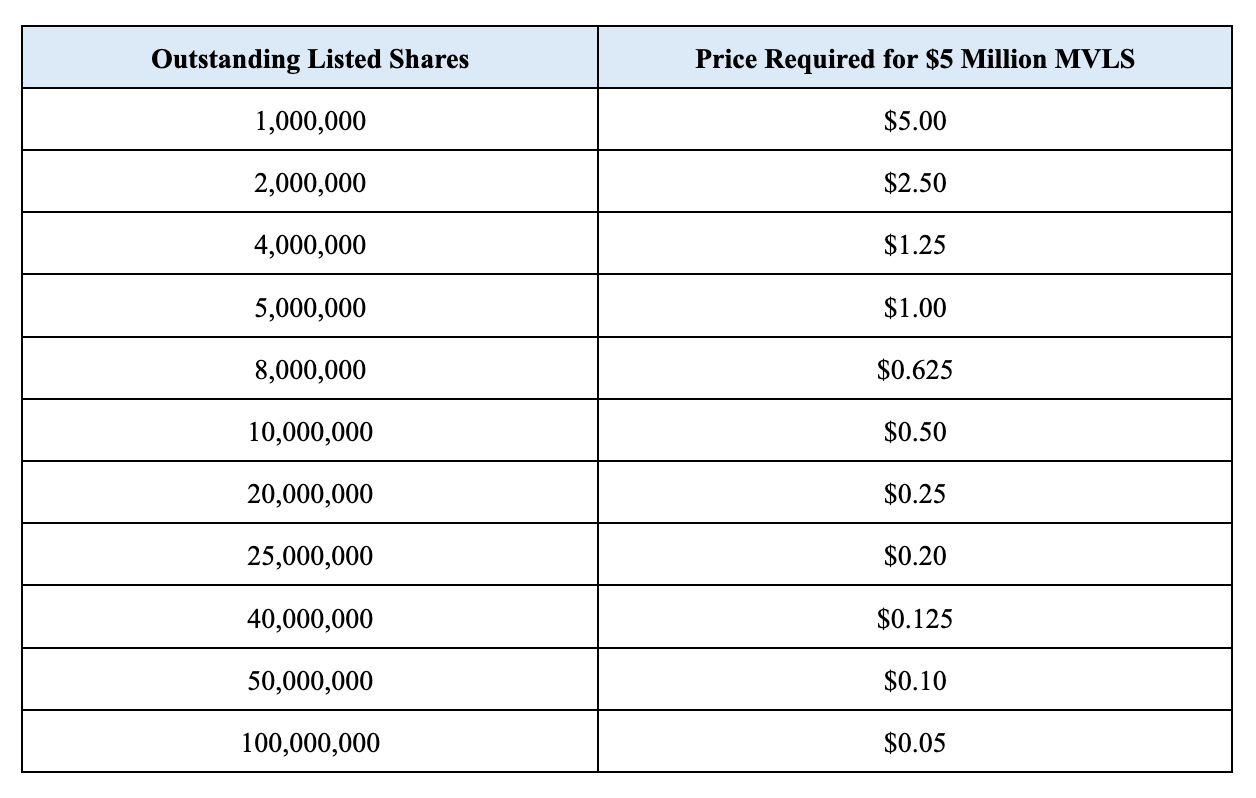
These calculations address only the $5 million MVLS requirement. Nasdaq companies must separately satisfy applicable minimum bid price, stockholders’ equity, unrestricted public float, shareholder, market-maker, SEC reporting and corporate governance requirements.
Which Shares Count Toward Nasdaq’s $5 Million MVLS?
The calculation generally includes all outstanding shares of the class listed on Nasdaq. Depending on the issuer’s capital structure, this may include shares held by officers, directors, founders, control shareholders, affiliates, institutional investors, holders of restricted stock and public shareholders.
This distinction matters because Market Value of Listed Securities is not the same as public float. Shares held by insiders or affiliates may be excluded when Nasdaq calculates publicly held shares or the Market Value of Unrestricted Publicly Held Shares, but those shares may still be included in MVLS.
Securities Generally Not Included
- Authorized but unissued shares;
- Treasury shares;
- Unexercised stock options or warrants;
- Unconverted convertible notes or preferred stock;
- Unvested equity awards that have not been issued; and
- Shares reserved for future issuance under an equity compensation plan.
An issuer with American Depositary Shares, multiple listed classes, exchangeable securities or another unusual capital structure should confirm Nasdaq’s calculation directly with Nasdaq Listing Qualifications.
Is MVLS the Same as Market Capitalization?
For a company with one publicly traded class of common stock, MVLS may closely resemble the market capitalization shown by financial websites. Nasdaq, however, uses defined terms and a specific methodology under its listing rules.
A financial website may use a last-sale price, delayed closing price, fully diluted share count, outdated outstanding-share figure or estimated number of shares. Nasdaq focuses on the consolidated closing bid price and the applicable number of outstanding listed securities. Issuers should not rely exclusively on market-capitalization figures displayed by third-party websites.
MVLS Is Not the Same as Nasdaq Public Float
Nasdaq’s MVLS requirement should not be confused with the Market Value of Unrestricted Publicly Held Shares, or MVUPHS.
Market Value of Listed Securities
MVLS generally uses the consolidated closing bid price multiplied by all outstanding shares of the listed class.
Market Value of Unrestricted Publicly Held Shares
MVUPHS generally uses the applicable market price multiplied by unrestricted shares held by qualifying public holders. Publicly held shares may exclude shares held by officers, directors, more-than-10-percent beneficial owners and other persons whose holdings do not qualify under Nasdaq’s public-float definitions.
A company may satisfy the $5 million MVLS requirement but fail a separate Nasdaq public-float requirement. Conversely, a company may have a meaningful percentage of its shares held by public investors but still fail MVLS because its total listed market value has fallen below $5 million.
Nasdaq Uses the Consolidated Closing Bid Price
The MVLS calculation is based on the consolidated closing bid price, not necessarily the final transaction price reported for the trading day. This distinction can materially affect thinly traded securities.
Assume a company has 10 million outstanding shares, a last reported sale of $0.55, a consolidated closing bid of $0.48 and a closing ask of $0.56. Using the consolidated closing bid, MVLS is 10,000,000 × $0.48 = $4,800,000. The company is below the $5 million requirement even though the final reported transaction occurred at $0.55.
A single trade at a higher price therefore may not restore compliance if the consolidated closing bid remains below the price required to produce $5 million in MVLS.
When Does a Nasdaq Company Become Deficient?
A company does not ordinarily receive a delisting determination merely because its MVLS falls below $5 million for one trading day. The company becomes subject to the new delisting process when its MVLS remains below $5 million for 30 consecutive business days.
Because the requirement is consecutive, a business day on which MVLS returns to at least $5 million should interrupt the count. Companies should nevertheless confirm their official status with Nasdaq because Nasdaq—not an issuer’s financial website, transfer agent or market-data provider—makes the listing-compliance determination.
No Automatic 180-Day Nasdaq Compliance Period
The most consequential feature of the new rule is the absence of an ordinary cure period. Under Nasdaq’s minimum bid price rules, an issuer that trades below $1.00 for 30 consecutive business days may initially receive a 180-calendar-day period to regain compliance, subject to applicable conditions. The new $5 million MVLS rule does not provide the same automatic cure period.
Once the company has remained below $5 million for 30 consecutive business days, Nasdaq staff may issue a Staff Delisting Determination providing for suspension and delisting. That gives issuers substantially less time to complete a financing, improve operating performance, close an acquisition, restructure indebtedness, obtain shareholder approval or develop another credible compliance plan.
Does an Appeal Stop the Nasdaq Trading Suspension?
A company may request a hearing before a Nasdaq Hearings Panel after receiving a Staff Delisting Determination. For the new MVLS deficiency, however, the hearing request does not automatically stay the trading suspension. The company’s common stock may therefore be suspended from Nasdaq while the appeal is pending.
- Loss of Nasdaq trading and liquidity;
- Migration to an over-the-counter market;
- Wider bid-and-ask spreads and broker-dealer purchase restrictions;
- Loss of institutional investor eligibility or index inclusion;
- Potential defaults under financing or commercial agreements;
- Additional selling pressure and reputational harm; and
- Greater difficulty completing future securities offerings.
Even if the issuer ultimately presents a successful compliance plan, material harm may occur before the Nasdaq appeal is decided.
What Must a Company Show at a Nasdaq Hearing?
A Nasdaq Hearings Panel may grant an exception of up to 180 days from the Staff Delisting Determination. The issuer may be required to demonstrate that it can satisfy all applicable initial listing requirements, rather than merely returning MVLS to $5 million. This may include the initial listing standards for stock price, stockholders’ equity, listed securities, unrestricted public float, publicly held shares, round-lot shareholders, market makers, operating history, corporate governance and SEC reporting.
A company seeking a panel exception should present a specific, documented and achievable plan rather than an unsupported prediction that its share price will recover.
Does a Reverse Stock Split Cure a $5 Million MVLS Deficiency?
A reverse stock split generally does not increase a company’s total market capitalization by itself.
Assume a company has 20 million outstanding shares, a closing bid of $0.20 and MVLS of $4 million. Before a one-for-ten reverse stock split, the calculation is 20,000,000 × $0.20 = $4,000,000. After the split, the company would theoretically have 2 million shares outstanding at an adjusted price of $2.00. The calculation remains 2,000,000 × $2.00 = $4,000,000.
A reverse stock split changes the number of shares and the per-share price but does not inherently increase aggregate market value. It may assist with Nasdaq’s $1.00 minimum bid price requirement, but it is not, by itself, a cure for an MVLS deficiency.
Can Issuing Additional Shares Increase MVLS?
Issuing additional common shares may mathematically increase the outstanding-share component of MVLS, but it may also dilute existing shareholders and place downward pressure on the stock price.
Assume a company has 8 million shares outstanding at $0.50, producing MVLS of $4 million. If it issues 4 million additional listed shares and the bid remains $0.50, MVLS becomes $6 million. If the dilution causes the bid to fall to $0.35, MVLS becomes only $4.2 million.
Any financing must also be analyzed under Nasdaq’s shareholder-approval rules, including rules governing below-market issuances, changes of control and transactions involving officers, directors or other related parties.
Why the New Rule Matters to Small-Cap Nasdaq Companies
The new requirement creates an additional and potentially unforgiving listing risk for microcap and small-cap issuers. A company can face suspension and delisting based solely on maintaining MVLS below $5 million for 30 consecutive business days. It need not be simultaneously deficient under another quantitative continued listing standard.
A company could therefore satisfy its minimum bid price, stockholders’ equity and public-float requirements but still be suspended because the aggregate market value of its listed securities remains below $5 million.
Steps Nasdaq-Listed Companies Should Consider
Nasdaq-listed companies approaching the $5 million threshold should monitor MVLS daily using the consolidated closing bid price and the current number of outstanding shares of the listed class. They should also consider:
- Confirming Nasdaq’s outstanding-share figure and MVLS calculation;
- Reviewing transfer-agent records, recent securities issuances and pending conversions;
- Preparing financial projections and alternative financing plans;
- Evaluating whether a pending transaction can close before the 30-business-day period expires;
- Reviewing debt, warrant and preferred-stock conversion terms;
- Determining whether shareholder approval is required for a proposed financing;
- Evaluating applicable initial listing requirements before relying on a potential panel exception;
- Preparing disclosure concerning any material listing deficiency or Nasdaq notice; and
- Developing a contingency plan for over-the-counter quotation if Nasdaq suspends trading.
Companies should not wait until the end of the 30-business-day period to address the problem. Capital raising, shareholder approval, SEC registration, exchange review and corporate-action processing can take substantially longer than 30 business days.
Nasdaq MVLS Frequently Asked Questions
What does MVLS mean?
MVLS means Market Value of Listed Securities. It is generally calculated by multiplying the consolidated closing bid price by the number of outstanding shares of the listed class.
What is Nasdaq’s minimum MVLS requirement?
The minimum continued listing requirement is $5 million under the new rules discussed in this article.
How many days can a company remain below $5 million?
The delisting trigger applies when MVLS remains below $5 million for 30 consecutive business days.
Does Nasdaq provide an automatic cure period?
No automatic 180-day cure period applies to this deficiency. Nasdaq may issue a Staff Delisting Determination after the 30-consecutive-business-day period.
Will a reverse stock split fix MVLS?
Not by itself. A proportional reverse stock split changes the share count and price but ordinarily does not change total market capitalization.
Does an appeal automatically keep the stock trading on Nasdaq?
No. A hearing request based on the new MVLS requirement does not automatically stay the suspension.
Conclusion
Nasdaq’s $5 million MVLS standard represents a significant change to the continued listing framework for all three Nasdaq tiers. The calculation is straightforward: consolidated closing bid price multiplied by outstanding listed shares. The consequences are not.
A company that remains below $5 million for 30 consecutive business days may receive a Staff Delisting Determination, face an immediate Nasdaq trading suspension and lose the benefit of an ordinary cure period. Although the company may request a hearing, the appeal does not automatically stay the suspension, and a panel exception may require proof that the issuer can satisfy all applicable initial listing requirements.
For small-cap Nasdaq issuers, daily monitoring, early financing analysis and a realistic Nasdaq compliance strategy are now essential.
This article is provided for informational purposes only and does not constitute legal advice. The application of Nasdaq’s listing rules depends on the particular facts and circumstances of each issuer.
For additional information about Nasdaq listing requirements, reverse mergers, direct public offerings and going-public transactions, visit SecuritiesLawyer101.com and GoPublic101.com.
Hamilton & Associates Law Group, P.A. represents public and private companies, broker-dealers, transfer agents, officers, directors and shareholders in securities transactions, SEC reporting matters, Nasdaq and NYSE listing matters, direct public offerings, initial public offerings, reverse mergers and corporate governance matters.
To speak with a Securities Attorney, please contact Brenda Hamilton at 200 E Palmetto Rd, Suite 103, Boca Raton, Florida, (561) 416-8956, or by email at [email protected].
Hamilton & Associates | Securities Attorneys
Brenda Hamilton, Securities Attorney
200 E Palmetto Rd, Suite 103
Boca Raton, Florida 33432
Telephone: (561) 416-8956
Facsimile: (561) 416-2855
www.SecuritiesLawyer101.com