

A private operating company may enter into a reverse merger with an OTC Markets shell expecting to become public quickly and uplist to Nasdaq shortly afterward. That expectation can be badly wrong. Nasdaq Rule 5110(c) imposes special seasoning requirements on companies formed through a reverse merger, and the familiar reference to a one-year waiting period tells only part of the story.
The one-year trading requirement is best understood as a floor for submitting a Nasdaq application, not as a reliable estimate of when Nasdaq can approve the listing. A separate annual-report requirement can control the actual timetable and, depending on the date of the reverse merger information filing and the issuer’s fiscal year, can push the practical Nasdaq listing date well beyond one year and, in some cases, beyond two years after closing.
This article focuses on traditional reverse mergers involving OTC Markets shells or OTC-traded companies, understanding Nasdaq Rule 5110(c), the annual-report requirement, share-price tests and planning traps before an OTC Markets reverse merger. SPAC and de-SPAC transactions are outside the scope of this discussion.
Key Takeaways
- The one-year period generally runs after the filing of the required reverse-merger information, including audited financial statements for the combined company; the shell’s years of pre-merger OTC trading do not satisfy that post-merger seasoning requirement.
- Nasdaq approval also requires at least one annual report containing audited financial statements for a full fiscal year commencing after the reverse-merger information filing. That requirement can be the real gating item and can extend the practical timeline to roughly two years or more.
- A Reverse Merger Company must satisfy the applicable initial-listing share-price standard for a sustained period, no less than 30 of the most recent 60 trading days, both before the application and before approval.
- Rule 5110(c) has a narrow offering exception for a firm-commitment underwritten public offering producing at least $40 million in gross proceeds to the company, and an older reverse-merger company can age out of Rule 5110(c) after the required trading period and four qualifying annual reports.
- A reverse split can help address price mechanically, but it does not erase seasoning, reporting, liquidity or Nasdaq discretionary-review issues, and Nasdaq has tightened its rules governing repeated reverse splits and later bid-price deficiencies.
Rule 5110(c): The One-Year Period Is Only the Starting Point
Nasdaq Rule 5110(c)(1) provides that a company formed by a Reverse Merger is eligible to submit an initial listing application only if the combined entity has traded for at least one year in the U.S. over-the-counter market, another national securities exchange or a regulated foreign exchange after filing all required information about the reverse merger, including audited financial statements for the combined entity.
The rule therefore does not measure seasoning from the age of the OTC ticker and does not simply measure twelve months from the closing date. The relevant period begins after the required reverse-merger information has been filed. If the transaction closes first and the required filing is completed later, that delay can move the Nasdaq timetable as well.
The distinction between eligibility to apply and eligibility to be approved is critical. The one-year trading period addresses when the Reverse Merger Company may submit its Nasdaq application. Rule 5110(c)(2) separately controls when Nasdaq may approve the listing.
The Annual-Report Requirement May Control the Real Nasdaq Timeline
Rule 5110(c)(2)(A) requires the Reverse Merger Company, at the time of Nasdaq approval, to have timely filed all required periodic financial reports for the prior year, including at least one annual report. The rule then adds a requirement that is easy to overlook: the annual report must contain audited financial statements for a full fiscal year commencing after the filing of the reverse-merger information described in Rule 5110(c)(1)(A).
That language can make the practical waiting period materially longer than twelve months. A fiscal year already in progress when the reverse-merger information is filed is not a full fiscal year commencing after the filing. The first qualifying fiscal year may therefore be the next fiscal year, and Nasdaq approval may have to wait until the annual report for that later year is filed.
For transaction planning, the better question is not simply, ‘When does the one-year seasoning period expire?’ It is, ‘What is the first full fiscal year that commences after the reverse-merger information filing, and when will the annual report containing audited financial statements for that year be filed?’
Worked Example: A 12-Month Assumption Becomes Roughly 26 Months
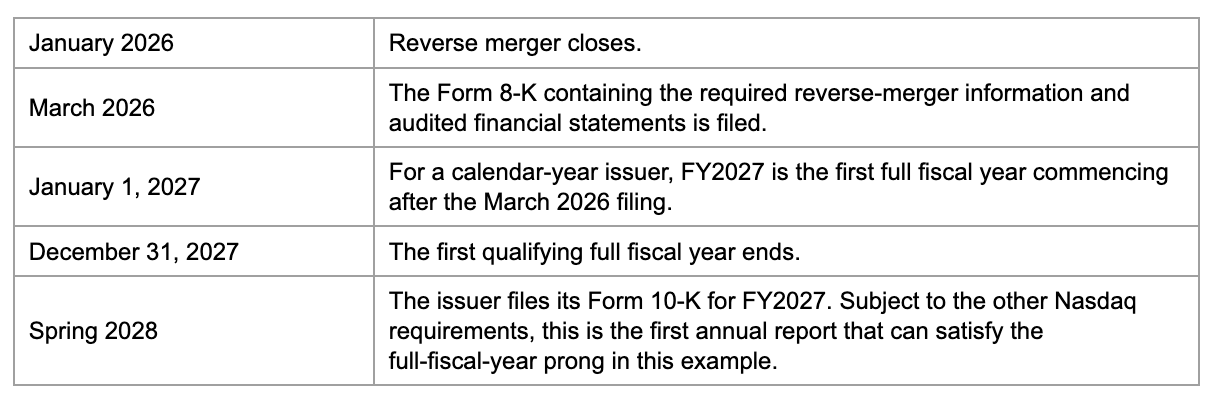
In that example, the first qualifying annual report arrives approximately 26 months after the January 2026 closing. The one-year trading requirement may have been satisfied long before Nasdaq can approve the listing. The exact timing will vary with the filing date, fiscal year end and reporting deadlines, but the example demonstrates why describing Rule 5110(c) simply as a 12-month wait can materially understate the real schedule.
The OTC Shell’s Prior Trading History Does Not Substitute for Post-Merger Seasoning
An OTC shell may have been quoted or traded for many years before the operating company arrives. That history does not satisfy Rule 5110(c)(1)(A) for the newly combined company. The rule expressly measures the one-year trading period after the filing of the required information about the reverse merger.
A shell that has traded since 2018 does not give a private operating company eight years of Nasdaq seasoning when the operating business merges into the shell in 2026. For purposes of the special reverse-merger rule, the relevant history is the post-merger company’s trading and reporting history after the required transaction information has been filed.
Share Price: $4 Is Common, but $3 and $2 Alternatives Exist
Rule 5110(c) ties the Reverse Merger Company’s price test to the share-price requirement of the Nasdaq initial-listing standard under which the company seeks to qualify. For the Nasdaq Capital Market, the standard initial bid-price requirement is $4 per share. Rule 5505 also permits a $3 closing price under the Equity or Net Income Standards, or a $2 closing price under the Market Value of Listed Securities Standard, if the issuer satisfies the additional net tangible asset or revenue conditions applicable to those alternatives.
Reverse Merger Companies face an enhanced duration test. The applicable closing price must be maintained for a sustained period, never less than 30 of the most recent 60 trading days immediately before the application, and the same sustained-price requirement applies again before Nasdaq approval. A currently public company relying on the Capital Market’s Market Value of Listed Securities Standard must also satisfy that standard’s 90-consecutive-trading-day market-value and price test before applying; those periods can overlap but are separate requirements.
Capital Market applicants that are trading in the U.S. over-the-counter market on the application date also face a separate liquidity requirement under Rule 5505(a)(5): generally, average daily trading volume of at least 2,000 shares over the relevant 30-trading-day period, with trading on more than half of those days, unless the specified firm-commitment offering alternative applies.
Two Important Ways Rule 5110(c) Can Stop Applying
1. The $40 Million Firm-Commitment Underwritten Offering Exception
A Reverse Merger Company is not subject to Rule 5110(c) if, in connection with its Nasdaq listing, it completes a firm-commitment underwritten public offering generating at least $40 million in gross proceeds to the company. The exception is narrow. A PIPE, private placement, convertible-note financing, best-efforts offering or aggregation of unrelated financings should not be treated as a substitute for the specified firm-commitment underwritten public offering.
2. The Four-Annual-Report Aging Provision
Rule 5110(c)(3) also provides an important path for older reverse-merger companies. A Reverse Merger Company is no longer subject to Rule 5110(c) once it has satisfied the one-year trading requirement and has filed at least four annual reports containing all required audited financial statements for a full fiscal year commencing after the reverse-merger information filing.
This provision matters for companies that completed an OTC reverse merger years ago and only later decide to seek Nasdaq. Once the conditions in Rule 5110(c)(3) are met, the company is no longer subject to the special Rule 5110(c) requirements, although it must still satisfy all otherwise applicable Nasdaq initial-listing requirements, including the applicable minimum price and filing requirements.
What If the OTC Shell Is Non-Reporting?
A truly non-Exchange Act reporting OTC shell presents a technical issue that should be resolved before closing. Nasdaq Rule 5005(a)(39) defines a Reverse Merger as a transaction in which an operating company becomes an Exchange Act reporting company by combining, directly or indirectly, with a shell company that is itself an Exchange Act reporting company.
If the OTC shell is not an Exchange Act reporting company, the business combination itself ordinarily does not cause the operating company to become an Exchange Act reporting company. Reporting status would arise through a separate registration step, such as an Exchange Act registration statement or an effective Securities Act registration statement, depending on the structure. That creates a real textual question as to whether the transaction falls within the defined term used by Rule 5110(c).
It is not a prudent basis, however, to promise an immediate Nasdaq uplisting. Nasdaq has broad discretionary authority under Rule 5101 to deny an initial listing or impose additional or more stringent criteria even when an applicant believes it satisfies the enumerated standards. If an OTC reverse-merger structure depends on the position that Rule 5110(c) does not apply because the shell was non-reporting, that issue should be analyzed transaction by transaction and, where appropriate, addressed with Nasdaq Listing Qualifications before the reverse merger is completed.
A Reverse Split Is Not a Shortcut Around Nasdaq Seasoning
OTC companies frequently contemplate a reverse stock split before an uplisting to reach the applicable Nasdaq share-price requirement. A reverse split can change the mathematical per-share price, but it does not create the post-merger trading history required by Rule 5110(c), satisfy the annual-report requirement, create liquidity or cure deficiencies in public float and shareholder distribution.
Nasdaq has also tightened its continued-listing rules for companies that rely repeatedly on reverse splits. Under the current bid-price framework, a Nasdaq-listed company that later becomes deficient with the $1 continued-listing bid-price requirement after having effected a reverse split during the prior one-year period is not entitled to the ordinary automatic bid-price compliance period and instead faces a delisting determination. Nasdaq also retains its earlier rule denying automatic compliance periods when one or more reverse splits over the prior two years have a cumulative ratio of 250-to-1 or greater.
Those provisions are continued-listing rules, not part of Rule 5110(c)’s initial-listing seasoning test. They nonetheless matter when an OTC company designs an uplisting capitalization around an aggressive reverse split. The objective should be a sustainable Nasdaq capitalization and trading market, not simply a temporary price above an initial-listing threshold.
Nasdaq Can Look Beyond Technical Compliance
Nasdaq Rule 5101 gives the exchange broad discretionary authority over initial listings. Nasdaq may deny an application or impose additional or more stringent criteria when it determines that listing would be inadvisable or unwarranted, even if the applicant satisfies the enumerated listing standards.
Nasdaq’s current interpretive guidance makes that review especially relevant to OTC reverse-merger companies. The exchange may consider management and board experience, significant shareholders, public-float concentration, securities issuances, unusual or volatile trading, regulatory referrals, going-concern issues and concerns involving advisors such as auditors, underwriters, law firms, brokers, clearing firms and other professional service providers. Nasdaq may also consider prior transactions involving those advisors and whether those securities developed concerning trading patterns.
For an OTC Markets company, Nasdaq readiness therefore involves much more than meeting a stockholders’ equity number and reverse-splitting the stock to the required price. The company’s history, capitalization, financings, consultants, shareholders, trading activity and professional relationships can all become part of the listing analysis.
NYSE American Has a Similar Reverse-Merger Seasoning Concept
Companies comparing exchanges should not assume that NYSE American automatically solves the reverse-merger timing problem. Section 101(e) of the NYSE American Company Guide contains an analogous reverse-merger framework that includes a one-year trading period, a sustained-price requirement and at least one annual report containing audited financial statements for a full fiscal year commencing after the required transaction filing. It also contains a $40 million firm-commitment underwritten public offering exception.
The exact text and application of the NYSE American requirements should be analyzed separately, but the broader planning lesson is the same: an OTC shell reverse merger is not necessarily a route to an immediate national-exchange listing.
Compare the Reverse Merger Timeline With the Alternatives Before Closing
If Nasdaq is the principal objective, the company should compare the OTC reverse-merger route with the available alternatives before acquiring a shell. A traditional underwritten IPO generally involves underwriting, SEC review, additional diligence and greater transaction expense, but a Reverse Merger Company that completes the specific $40 million firm-commitment offering described in Rule 5110(c)(3) is not subject to the Rule 5110(c) seasoning requirements.
A direct listing or resale-registration approach does not, by itself, create the $40 million exception. If a company is already a Reverse Merger Company within Rule 5110(c), choosing a direct listing rather than an IPO does not erase the seasoning requirements. Conversely, a private operating company that pursues a registration and listing path without first becoming a Reverse Merger Company should analyze that route under the rules applicable to the chosen listing structure rather than assuming an OTC shell is necessary.
The cost comparison should therefore include more than legal and underwriting fees. Management should assign value to the time spent on the OTC Markets, the financing consequences of a delayed Nasdaq listing, the cost of maintaining SEC reporting and audits during the seasoning period, potential reverse-split effects and the risk that investors or transaction documents were built around an uplisting date that the Nasdaq rules do not permit.
Nasdaq Due Diligence Before an OTC Reverse Merger
If an operating company expects to uplist to Nasdaq after an OTC Markets reverse merger, the Nasdaq analysis should be completed before the merger agreement is signed or the change of control occurs. At a minimum, counsel should determine:
- whether the OTC issuer is, or has been, a shell company for Nasdaq purposes;
- whether the transaction will fall within Nasdaq’s current definition of a Reverse Merger;
- the expected date of the filing that starts the Rule 5110(c)(1)(A) trading period;
- the first full fiscal year that will commence after that filing and the expected filing date of the qualifying annual report;
- which Nasdaq initial-listing standard the company expects to use and whether the applicable price is $4, $3 or $2;
- whether any additional 90-day market-value and price period applies under the selected Capital Market standard;
- whether the OTC trading-volume requirement and the applicable public-float, shareholder and market-maker requirements can be met;
- whether a reverse split is needed and whether the post-split capitalization and trading market are sustainable;
- whether the $40 million firm-commitment underwritten offering exception is realistic;
- whether the four-annual-report aging provision already removes the company from Rule 5110(c); and
- whether the company’s management, shareholders, financing history, consultants, promoters, advisors or trading history could raise issues under Nasdaq Rule 5101.
An OTC Reverse Merger Can Start the Nasdaq Clock Instead of Ending It
An OTC Markets reverse merger can be a legitimate method of becoming publicly traded, but it should not be sold to an operating company as an automatic shortcut to Nasdaq. For a company subject to Rule 5110(c), the one-year trading requirement is only the first timing hurdle. The annual-report requirement can be more important because Nasdaq approval requires audited financial statements for a full fiscal year that commences after the reverse-merger information filing.
In the wrong calendar, a transaction expected to produce a Nasdaq uplisting in twelve months can require roughly two years or more before the annual-report prong is satisfied. By the time management discovers the problem after closing, the company may already have issued control, completed the merger, incurred audit and legal costs, raised financing and made commitments to investors based on an uplisting schedule it cannot meet.
If Nasdaq is the objective, the exchange-listing analysis belongs at the beginning of the reverse-merger process. The company should know the seasoning timetable, annual-report date, price standard, liquidity requirements, capitalization strategy and likely Nasdaq review issues before it acquires an OTC shell.
Selected Authorities
- Nasdaq Listing Rule 5005(a)(39) – definition of Reverse Merger.
- Nasdaq Listing Rule 5101 and current interpretive material – Nasdaq discretionary authority over initial and continued listings.
- Nasdaq Listing Rule 5110(c) – Reverse Merger Company seasoning, annual report, price and exception provisions.
- Nasdaq Listing Rule 5505 – Nasdaq Capital Market initial price, liquidity and quantitative listing requirements.
- Nasdaq Listing Rules 5810 and 5815 – continued-listing bid-price and reverse-split consequences.
- NYSE American Company Guide Section 101(e) – analogous reverse-merger listing requirements.
- SEC Release No. 34-102245 (January 17, 2025) – approval of Nasdaq’s tightened bid-price compliance rules following reverse stock splits.
This article is for general informational purposes only and does not constitute legal advice. Nasdaq and NYSE American rules and interpretations are subject to change, and the application of listing requirements depends on the facts and structure of each transaction. Companies should obtain transaction-specific advice before completing an OTC reverse merger or relying on a proposed exchange-listing timetable. Attorney Advertising.
To speak with a Securities Attorney, please contact Brenda Hamilton at 200 E Palmetto Rd, Suite 103, Boca Raton, Florida, (561) 416-8956, or by email at [email protected].
Hamilton & Associates | Securities Attorneys
Brenda Hamilton, Securities Attorney
200 E Palmetto Rd, Suite 103
Boca Raton, Florida 33432
Telephone: (561) 416-8956
Facsimile: (561) 416-2855
www.SecuritiesLawyer101.com