


In a landmark shift for capital markets and distributed ledger technology (DLT), the U.S. Securities and Exchange Commission (SEC) announced Exchange Act Release No. 34-106402, introducing the “Innovation Exemption.”
This order provides a temporary, 5-year conditional exemption allowing Tokenized Securities Venues (TSVs) and liquidity providers to trade tokenized National Market System (NMS) stocks using permissioned Automated Market Maker (AMM) liquidity pools.
Importantly, the exemption is directed at tokenized NMS stock rather than every crypto asset that provides exposure to a publicly traded company.
The SEC’s Fact Sheet explains that tokenized NMS stock may be tokenized by or on behalf of the issuer of the underlying stock, or by an unaffiliated third party. It does not include certain synthetic products, such as a tokenized linked security or tokenized security-based swap, that merely provide synthetic exposure to an underlying security. Here is an in-depth breakdown of how the Innovation Exemption works, its key conditions, and what it means for market participants.
Here is an in-depth breakdown of how the Innovation Exemption works, its key conditions, and what it means for market participants.
Scope of the Relief
Under the Exchange Act of 1934, trading venues and liquidity providers usually trigger registration requirements as exchanges or dealers. Order No. 34-106402 provides dual exemptions:
1. Exemption from the Exchange Definition
The order provides qualifying TSVs with conditional relief from the definition of an “exchange” under Section 3(a)(1) of the Exchange Act and Rule 3b-16.
A TSV generally brings together buyers and sellers of tokenized NMS stock by providing one or more AMM liquidity pools for permissioned participants and establishing standards governing access to those pools.
2. Exemption from the Dealer Definition
The order separately provides conditional relief from the definition of “dealer” under Section 3(a)(5) of the Exchange Act for certain liquidity providers.
The relief applies to liquidity providers that supply tokenized NMS stock to an AMM liquidity pool using proprietary capital and may engage in additional activities that can be indicators of dealing activity, such as quoting prices to customers or entering into agreements to provide committed capital.
The exemption is subject to conditions, including a requirement that the liquidity provider’s securities activities be limited to activities related to trading tokenized NMS stock in an AMM liquidity pool operating under the TSV exemption.
What Counts as “Tokenized NMS Stock”?
To rely on the Innovation Exemption, TSVs must operate within a structured compliance framework designed to maintain market integrity and investor protection:
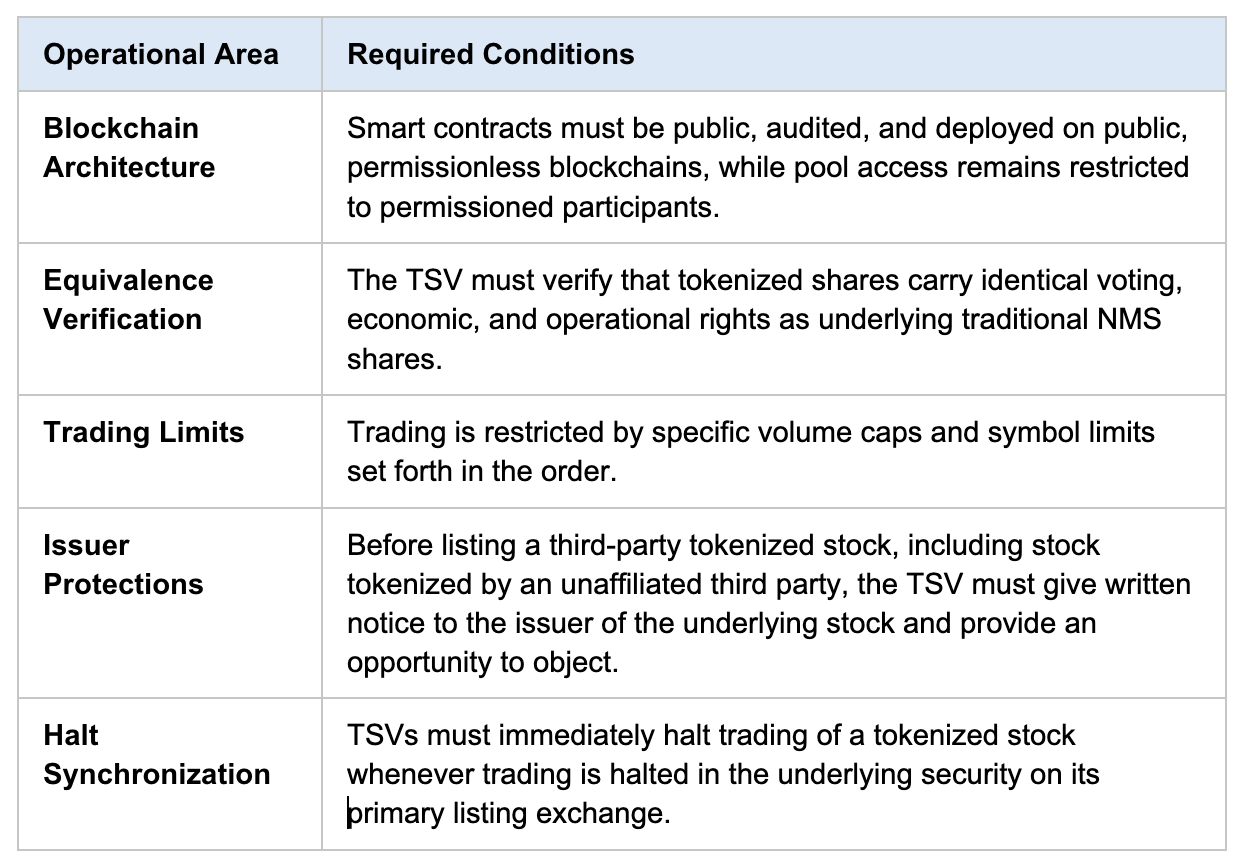
The SEC’s Fact Sheet also establishes specific advance-notice requirements. At least 30 calendar days before operating under the TSV exemption, a TSV must prominently publish a specified notice on its publicly available website. Within one business day after publishing that notice, the TSV must provide written notice to the SEC that it intends to operate pursuant to the exemption.
Impact on Market Participants
- For Fintech Operators & Trading Venues: Offers a clear, 5-year regulatory sandbox to build and test onchain equity trading infrastructure using AMMs without immediate exchange registration.
- For Liquidity Providers (LPs): Provides legal clarity, enabling LPs to supply automated liquidity to stock token pools using proprietary capital without triggering broker-dealer status.
- For Issuers: Protects corporate governance and capital structure by ensuring tokenized shares match traditional share rights and giving issuers a voice before third-party listing.
- For Investors & Other Market Participants: The SEC’s Fact Sheet identifies potential benefits of distributed ledger technology for securities trading, including investor self-custody, around-the-clock trading, fractional ownership, near-instantaneous settlement, greater transparency, and improved efficiency.
What’s Next? Request for Public Comment
The Innovation Exemption will remain in effect for five years following publication in the Federal Register.
The SEC is actively seeking public feedback during this period to evaluate whether the framework should be modified, made permanent, or expanded. Key areas for comment include:
The adequacy of risk management conditions for permissioned AMMs.
The impact of volume and symbol limits on liquidity.
Additional safeguards needed for retail and institutional participants.
In addition, the SEC’s Fact Sheet notes that the order solicits public comment regarding possible modifications to the exemptive relief and potential next steps.
This article is general information, not legal or financial advice.
To speak with a Securities Attorney, please contact Brenda Hamilton at 200 E Palmetto Rd, Suite 103, Boca Raton, Florida, (561) 416-8956, or by email at [email protected].
Hamilton & Associates | Securities Attorneys
Brenda Hamilton, Securities Attorney
200 E Palmetto Rd, Suite 103
Boca Raton, Florida 33432
Telephone: (561) 416-8956
Facsimile: (561) 416-2855
www.SecuritiesLawyer101.com