

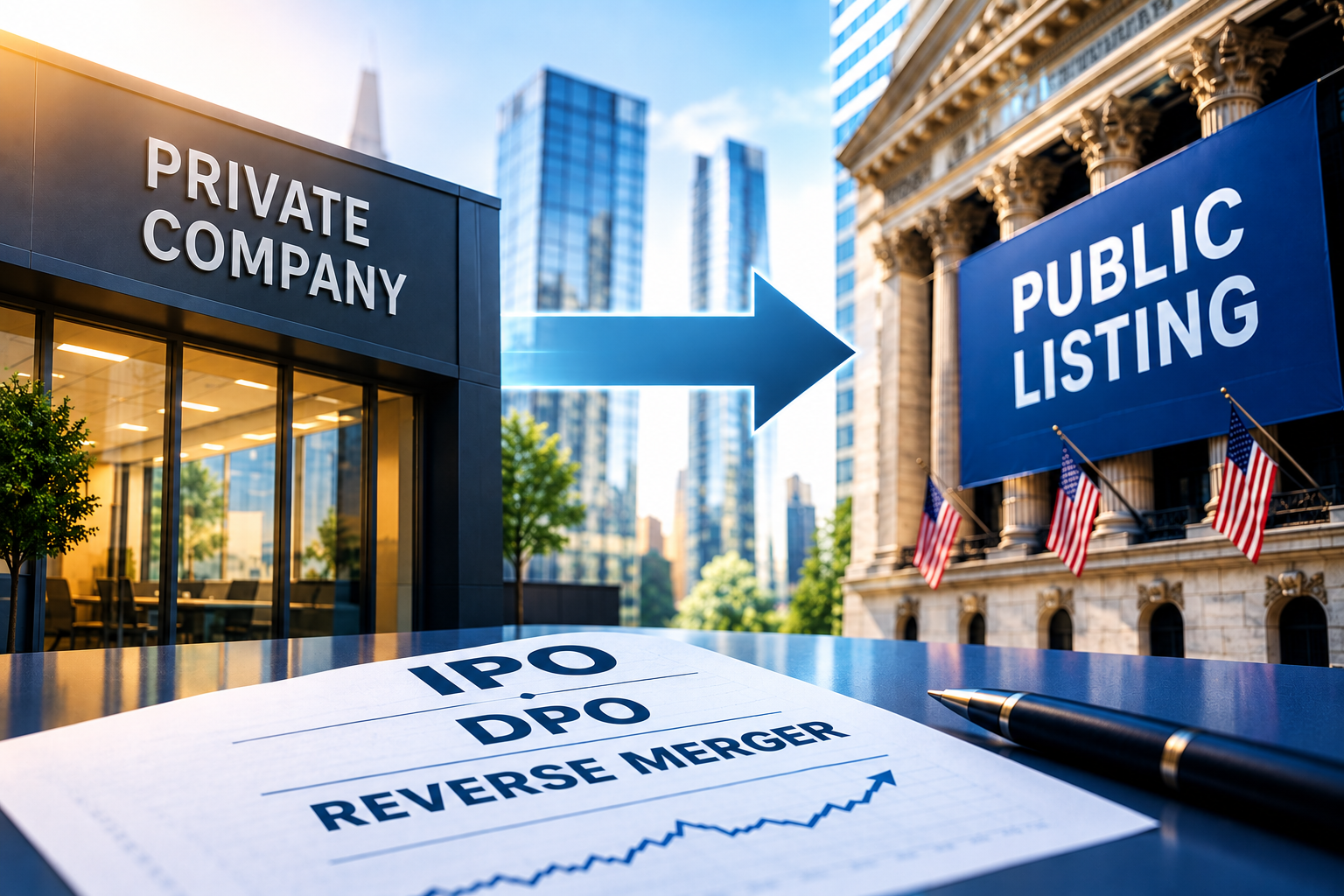
Taking a private company public is one of the most significant milestones in a business’s lifecycle. Founded in 1999 by securities attorney Brenda Hamilton, Hamilton and Associates Law Group in Boca Raton, Florida, has advised over three hundred companies on going-public transactions.
When evaluating how to transition a private company into a publicly traded entity, business owners generally consider three primary pathways, along with a few specialized alternatives.
The 3 Main Roads to Going Public
1. Initial Public Offering (IPO)
The traditional Initial Public Offering (IPO) is the most well-known method for going public. In an IPO, a company collaborates with an investment bank that serves as the underwriter.
- The Process: The company files a registration statement with the Securities and Exchange Commission (SEC). SEC staff reviews the document and provides comments, which the company addresses. Once the registration statement is declared effective, the underwriter sells the shares to the public.
- Benefits: An IPO allows companies to raise significant capital and typically results in a listing on a major national exchange.
- Drawbacks: It is generally the most expensive and time-consuming option. Underwriting fees, legal fees, audit costs, and months of preparation add up rapidly.
Learn more about IPOs by visiting our Additional Resources: Initial Public Offerings
2. Direct Public Offering (DPO)
A Direct Public Offering (DPO) allows a company to sell shares directly to investors without using an underwriter.
- The Process: The company registers the offering—often on Form S-1—or utilizes an exemption such as Regulation A.
- Benefits: Lower overall costs and greater management control over both pricing and timing.
- Drawbacks: The company is fully responsible for sourcing its own investors. Without an underwriter backing the transaction, building an active trading market requires deliberate effort, including locating a market maker willing to quote the stock.
Learn more about DPOs by visiting our Additional Resources: Direct Public Offerings
3. Reverse Merger
In a reverse merger, a private company combines with an existing public entity—frequently a shell company with minimal or no active operations.
- The Process: Owners of the private company acquire a controlling or substantial ownership position in the combined public company’s shares.
- Benefits: Reverse mergers can close faster than a traditional IPO.
- Drawbacks: It is not a shortcut around regulatory requirements. The combined entity must file comprehensive disclosures with the SEC shortly after closing. Additionally, shareholders face extra restrictions when reselling shares connected to a former shell company, and major exchanges often enforce strict seasoning requirements before allowing a listing.
Learn more about Reverse Mergers by visiting our Additional Resources: Reverse Mergers
Alternative Paths
Beyond the three primary methods, companies can also explore:
- SPAC Mergers: Merging with a Special Purpose Acquisition Company (SPAC)—a “blank check” company that raises money via its own IPO specifically to acquire an operating business. SPACs carry their own specific SEC rules and disclosure requirements.
- Form 10 Registration: Registering a class of stock directly via Form 10.
- Regulation A Offerings: Raising capital under Regulation A exemptions.
Visit the Following Links to Learn More:
How to Choose the Right Path
Selecting the proper structure begins with answering three key questions:
- Capital Needs: How much capital do you need, and when do you need it?
- Budget: How much can you afford to spend on going public—and maintaining public status?
- Target Market: Where do you want your stock to trade (e.g., a national exchange like Nasdaq/NYSE vs. OTC Markets)?
Life After Going Public
Going public is not a single, isolated transaction; it is a fundamental shift in how a business operates. Regardless of the road chosen, ongoing public-company obligations remain. Depending on reporting status and trading venue, these obligations include filing quarterly and annual reports, disclosing material events, and adhering to strict corporate governance standards.
Disclaimer: This article is provided for informational purposes only and does not constitute legal or tax advice. Securities rules change, so speak with qualified counsel about your specific situation
To speak with a Securities Attorney, please contact Brenda Hamilton at 200 E Palmetto Rd, Suite 103, Boca Raton, Florida, (561) 416-8956, or by email at [email protected].
Hamilton & Associates | Securities Attorneys
Brenda Hamilton, Securities Attorney
200 E Palmetto Rd, Suite 103
Boca Raton, Florida 33432
Telephone: (561) 416-8956
Facsimile: (561) 416-2855
www.SecuritiesLawyer101.com