
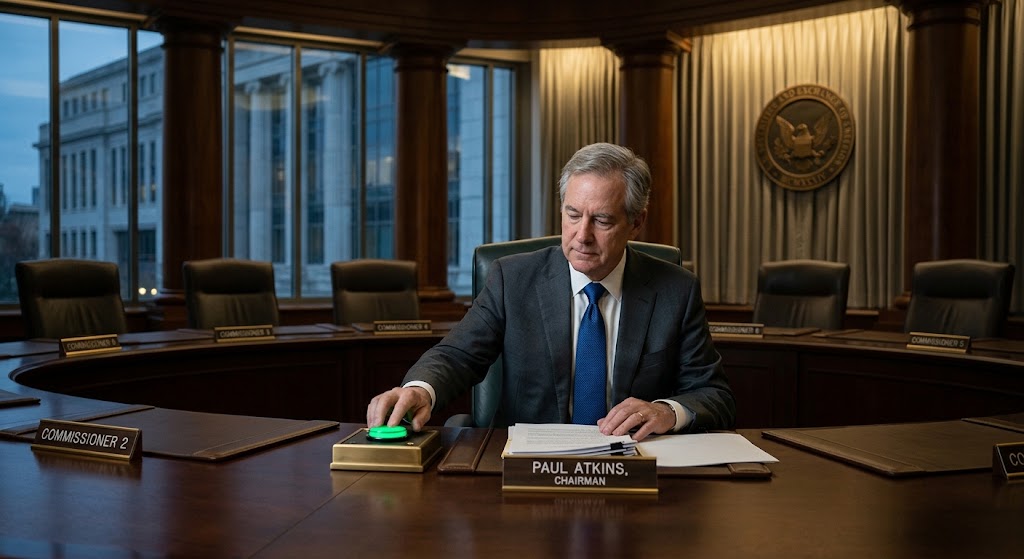
The Securities and Exchange Commission (SEC) has quietly adopted a controversial new rule allowing it to make major regulatory, policy, and enforcement decisions with just a single commissioner present. This significant shift comes as the Trump administration works to bring traditionally independent regulatory bodies under stricter executive control.
What the New Rule Means
Under the updated regulation finalized on October 2, the quorum requirement drops from previous thresholds down to just one commissioner. This single commissioner can unilaterally vote on new regulations, initiate enforcement lawsuits, order investigations, and set major policies.
The agency defended the move by pointing to the realities of its workload and strict ethics provisions, noting that a single-commissioner quorum ensures the SEC can still protect investors and pursue enforcement actions if multiple commissioners must recuse themselves.
A Broader Trend Across Federal Agencies
The SEC isn’t the only regulator undergoing a shift toward single-person authority. At the SEC’s sister agency—the Commodity Futures Trading Commission (CFTC)—Chairman Michael Selig currently serves as the sole sitting member of a board originally created by Congress to have five commissioners. Running the CFTC without other board members has enabled Chairman Selig to advance major policy initiatives without multi-member consultation, including his active advocacy for sports wagers in prediction markets.
Undermining a Century-Old Design
When Congress established the SEC nearly a century ago, it intentionally created a five-member, nonpartisan commission appointed by the president with Senate approval. To preserve political balance, federal law mandates that no more than three commissioners can belong to the same political party—with the president’s party traditionally holding that majority.
While a 1995 rule established three commissioners as a standard quorum (allowing two in certain enforcement recusal scenarios), the new rule takes centralizing power a step further.
A Shift Toward the “Unitary Executive”
The policy adjustment aligns with the administration’s “unitary executive” approach, which maintains that the president should hold direct authority over the entire executive branch, including the power to direct or remove agency heads at will.
Legal experts point out that the change effectively transforms a traditionally bipartisan watchdog intended by Congress into a more streamlined tool for whichever president is currently in office. Columbia Law School Professor John Coffee noted that the rule simplifies decision-making by allowing direct coordination between the administration and agency leadership, though he cautioned that the approach could face pushback in the courts.
Criticism and Context Behind the Vacancies
The rule was enacted without public notice or comment—a step the SEC justified by arguing it concerned internal agency operations rather than external rights. However, former SEC general counsel John Coates criticized the move, stating that it bypasses public input and eliminates even intraparty debate from difficult policy choices.
The current staffing shortage at the agency triggered the need for a revised quorum. Following the resignations of the remaining Democratic commissioners after the 2024 election and the recent retirement of Republican commissioner Hester Peirce, the commission is left with just two sitting members: Chairman Paul Atkins and Commissioner Mark Uyeda. With no immediate rush from the administration to fill the open seats, single-person decision-making may remain the norm for the foreseeable future.
While supporters argue that a streamlined commission increases speed and predictability, critics warn that losing Congress’s intended bipartisan structure and internal friction could reduce the long-term stability that U.S. financial markets rely upon.
Disclaimer: This article is provided for informational purposes only and does not constitute legal or tax advice. Securities rules change, so speak with qualified counsel about your specific situation.
To speak with a Securities Attorney, please contact Brenda Hamilton at 200 E Palmetto Rd, Suite 103, Boca Raton, Florida, (561) 416-8956, or by email at [email protected].
Hamilton & Associates | Securities Attorneys
Brenda Hamilton, Securities Attorney
200 E Palmetto Rd, Suite 103
Boca Raton, Florida 33432
Telephone: (561) 416-8956
Facsimile: (561) 416-2855
www.SecuritiesLawyer101.com