
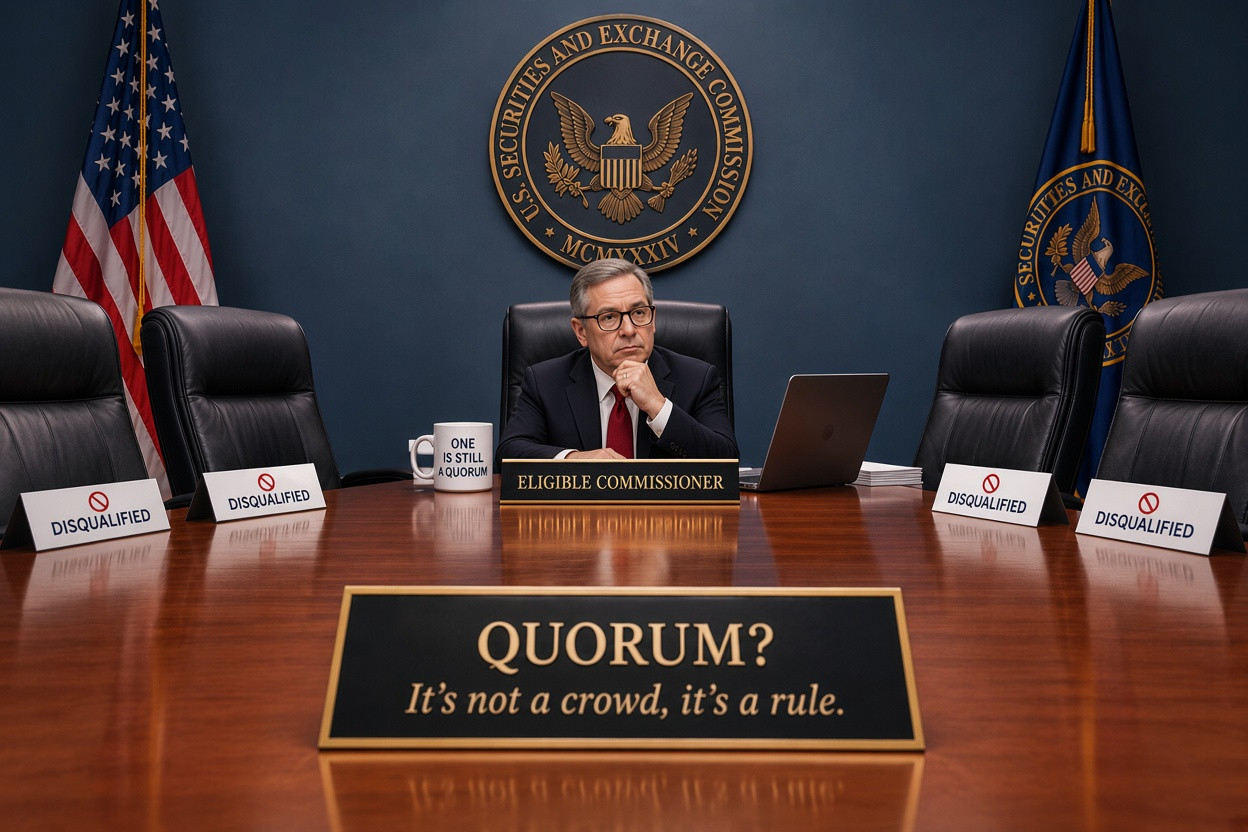
The SEC’s revised quorum rule permits one eligible commissioner to act on a particular matter when every other commissioner in office is disqualified. Adopted on September 30, 2026, and effective October 2, 2026, the amendment addresses the risk that recusals will prevent agency action. It also raises a governance question: when should continuity justify placing the Commission’s decision in the hands of one member? [1, 2]
The rule can help the SEC complete business despite conflicts of interest. Its value, however, should be assessed alongside the loss of deliberation among commissioners and the scope of decisions a single member may make. Operational efficiency and investor protection are related considerations, but faster action does not establish that a particular outcome serves investors.
What the SEC Quorum Rule Changes
Under 17 CFR 200.41, three commissioners remain the default quorum. If fewer than three commissioners are in office, the number serving constitutes a quorum. For a particular matter, if disqualifications leave two or one eligible commissioners, that number constitutes a quorum for that matter. [2]
The new feature is the express authorization for one commissioner to act when disqualifications leave only that member eligible. The earlier rule already addressed vacancies and two-member quorums resulting from disqualifications. The SEC had declined to address the one-member recusal scenario when it adopted its quorum rule in 1995. [1]
The amendment establishes who may act for the Commission. It does not itself decide how that authority will be exercised in any case. The examples and tradeoffs below describe possible effects rather than predictions about particular commissioners.
Potential Benefits of the SEC Quorum Rule
Continuity in Enforcement and Other Matters
A quorum that survives recusals can prevent an otherwise eligible matter from remaining unresolved solely because too few commissioners may participate. That may help the SEC authorize an enforcement action, consider a settlement or address a request for regulatory relief. It may also benefit respondents and applicants seeking a decision.
Continuity should not be equated with stronger enforcement. A single commissioner’s decision could favor bringing a case, approving a settlement, granting relief or another permissible outcome. The practical effect depends on the matter and the judgment exercised.
Recusals Without Automatic Paralysis
The rule offers a way for commissioners to comply with disqualification requirements while allowing an eligible member to address the matter. That is a practical response to conflicts that can arise from prior employment, representation or other relationships.
The amendment does not establish that recusal decisions will become more accurate or that ethics standards are strengthened. Those questions depend on the applicable ethics requirements and their administration. The narrower benefit is that a required recusal need not eliminate the Commission’s ability to act.
Greater Operational Resilience During Vacancies
Vacancies can make the consequences of one recusal more significant. For example, if two commissioners are serving and one is disqualified, the other can now constitute a quorum on that matter. [2] This reduces one source of disruption while seats remain unfilled.
The new provision does not fill vacancies or restore the range of views available on a fully staffed Commission. Its practical importance is likely to depend on both the number of commissioners serving and the frequency of disqualifications.
A Path to Decisions for Market Participants
Companies, investors and regulated firms may benefit when a pending matter can be resolved rather than delayed by a quorum problem. A decision may allow a settlement to proceed or clarify whether requested relief will be granted.
A decision is not necessarily durable merely because it can be made promptly. A controversial action may generate litigation or become a candidate for reconsideration. The relevant question is whether the process produces a timely decision that is also legally supported and adequately reasoned.
Governance Concerns About a One Commissioner Quorum
Congress established a five-member SEC and limited membership from a single political party to three commissioners. [3] Although vacancies and recusals can reduce participation, the statutory structure provides an important reference point for evaluating how the Commission makes decisions.
When one member acts alone, there is no second participating commissioner to test the reasoning, propose an alternative or disagree with the result. Staff analysis and outside submissions can inform the decision, but they serve different functions from deliberation among commissioners. The concern is structural and applies regardless of the party or identity of the member acting.
The rule is also broader than a mechanism for urgent enforcement cases. Its text applies to a matter of Commission business meeting the disqualification conditions; it contains no express limitation to emergencies or routine decisions. [2] The case for immediate action may be stronger for an expiring deadline than for a major policy question that could reasonably await broader participation.
These concerns have been raised formally. In Petition for Rulemaking 4-938, shareholder advocate James McRitchie requested rescission or reconsideration of the amendment, arguing that a one-member quorum weakens collegial decision-making and that the change warranted public comment. The petition presents an interested person’s objections, not an SEC finding or judicial ruling. [4]
Legal Authority and the Limits of Falcon Trading
The SEC relies on its statutory authority to regulate its operations, and the Exchange Act does not prescribe an express quorum requirement. [1] There is supporting precedent for the agency’s ability to establish quorum rules, but the relevant decision should be described precisely.
In Falcon Trading Group, Ltd. v. SEC, 102 F.3d 579, 582 (D.C. Cir. 1996), the court upheld action by the only two commissioners then in office under the SEC’s 1995 quorum rule. It recognized the Commission’s authority to set a quorum absent a contrary statutory constraint. [5]
Falcon Trading supports the SEC’s general authority to adopt a quorum rule. It did not decide the validity of the 2026 amendment allowing one member to act following other members’ disqualifications. The distinction leaves room for legal arguments about the new provision without treating the absence of a statutory quorum as proof that the amendment is invalid.
Why the SEC Adopted the Amendment Without Public Comment
The SEC classified the amendment as a matter of agency management and organization that did not substantially affect non-agency parties’ rights or obligations. On that basis, it concluded that advance notice and an opportunity for public comment were unnecessary. [1]
That is the Commission’s legal position. The objection is that changing who may exercise the Commission’s authority has consequences beyond internal administration. The competing views should be distinguished from any eventual judicial resolution. [4]
The quorum amendment does not remove procedural requirements that independently apply to a later SEC action. Notice and comment generally applies to substantive rulemaking, subject to statutory exceptions. Interpretive rules, policy statements and certain procedural rules are treated differently under the Administrative Procedure Act. Enforcement and exemptive matters follow their applicable procedures. It would therefore be inaccurate to say that every action by a one-member quorum must undergo public notice and comment. [6]
What Investors and Companies Should Watch
Assessment of the amendment should focus on its use in practice. Relevant considerations include whether the action is urgent or precedential, how its legal and factual basis is explained, and whether a broader Commission could reasonably consider it. Available judicial review and congressional oversight remain relevant, but neither supplies the deliberation lost when only one commissioner participates.
The rule addresses a real continuity problem. Its governance costs are also real. A balanced evaluation should examine both the need to act despite disqualifications and the importance of collective judgment when the SEC exercises consequential authority.
Frequently Asked Questions
Can One Commissioner Act for the SEC
Yes. The amended rule expressly permits one eligible commissioner to constitute a quorum for a particular matter when all other commissioners in office are disqualified. Three remains the default quorum, with a separate exception when fewer than three members are serving. [2]
Does the Rule Guarantee Stronger Investor Protection
No. It can prevent a quorum problem from blocking a decision. Investor protection depends on the substance and legal basis of the decision, as well as the process used to reach it.
Did Falcon Trading Uphold the New One Member Provision
No. The 1996 decision upheld a two-member quorum when only two commissioners were in office. It supports the SEC’s authority to set quorum rules but did not address the 2026 amendment. [5]
Sources
- SEC Release No. 34-106537 dated September 30, 2026, Commission Quorum Requirement
- 17 CFR 200.41, Quorum of the Commission
- Exchange Act Section 4(a), 15 U.S.C. 78d(a)
- James McRitchie, Petition for Rulemaking 4-938 dated September 30, 2026
- Falcon Trading Group, Ltd. v. SEC, 102 F.3d 579 (D.C. Cir. 1996), official court opinion
- Administrative Procedure Act, 5 U.S.C. 553
About the Author
Brenda Hamilton is a securities attorney with Hamilton & Associates Law Group, P.A.
Hamilton & Associates Law Group, P.A. | Securities Lawyer 101
Disclaimer: This article is provided for informational purposes only and does not constitute legal or tax advice. Securities rules change, so speak with qualified counsel about your specific situation.
To speak with a Securities Attorney, please contact Brenda Hamilton at 200 E Palmetto Rd, Suite 103, Boca Raton, Florida, (561) 416-8956, or by email at [email protected].
Hamilton & Associates | Securities Attorneys
Brenda Hamilton, Securities Attorney
200 E Palmetto Rd, Suite 103
Boca Raton, Florida 33432
Telephone: (561) 416-8956
Facsimile: (561) 416-2855
www.SecuritiesLawyer101.com