
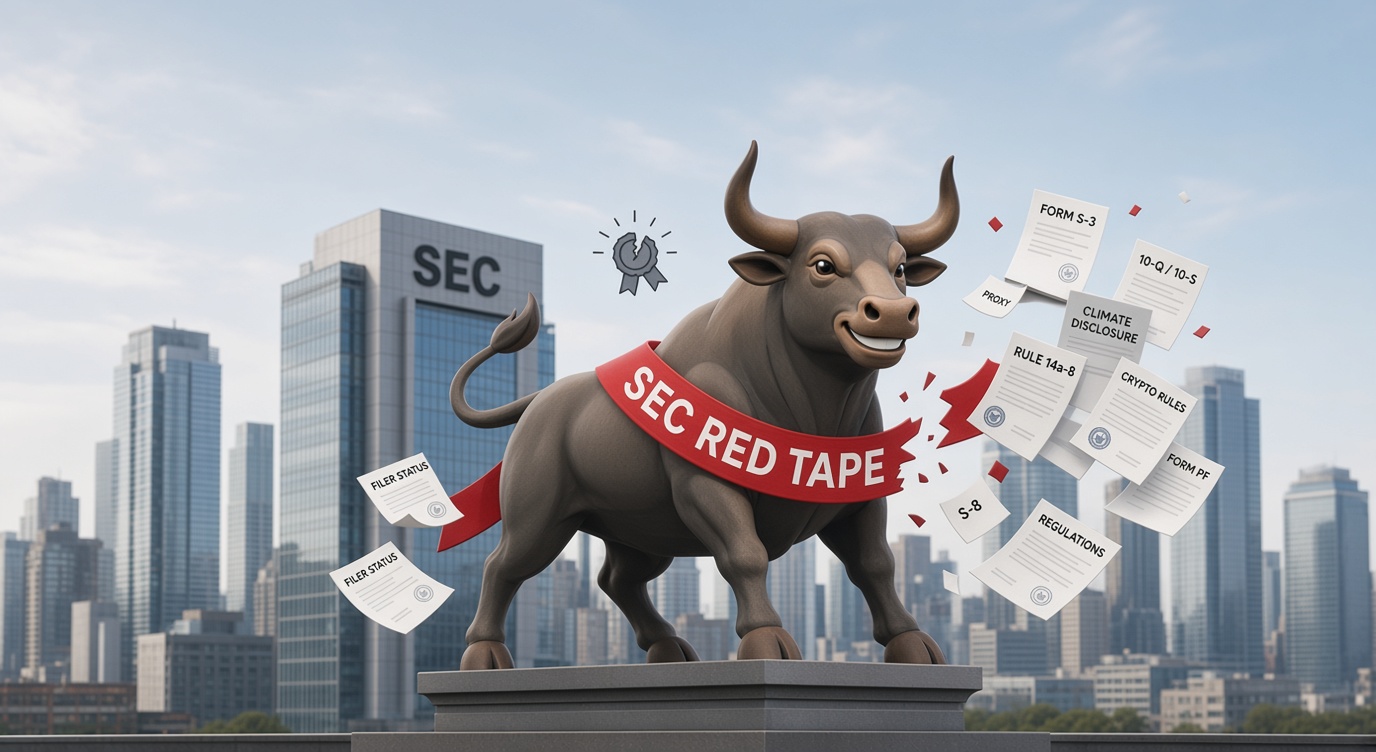
SEC deregulation under the Trump administration reaches well beyond cryptocurrency. Since January 2025, the Securities and Exchange Commission and its staff have withdrawn pending proposals, expanded filing accommodations, granted exemptions, delayed compliance deadlines, and reconsidered requirements affecting public companies, investment funds, advisers, and trading markets.
As of October 20, 2026, current SEC relief includes confidential registration review and targeted Form S-8 accommodations. Broader Form S-3 eligibility, filer-status reform, optional semiannual reporting and rescission of Rule 14a-8 remain proposals. A presidential policy preference, a proposed rule and a staff no-action position carry different legal weight. This review separates changes already available from pending reforms and subjects on the SEC’s 2026 regulatory agenda. SEC 2026 regulatory agenda. Chairman Atkins’s July 7, 2026 agenda statement.
In This Article
At a Glance
Public companies and IPOs
Proxy rules and governance
Crypto and tokenization
Funds and private markets
Trading markets and compliance delays
Enforcement and SEC decisions
Withdrawn proposals
What comes next
Frequently asked questions
SEC Deregulation at a Glance
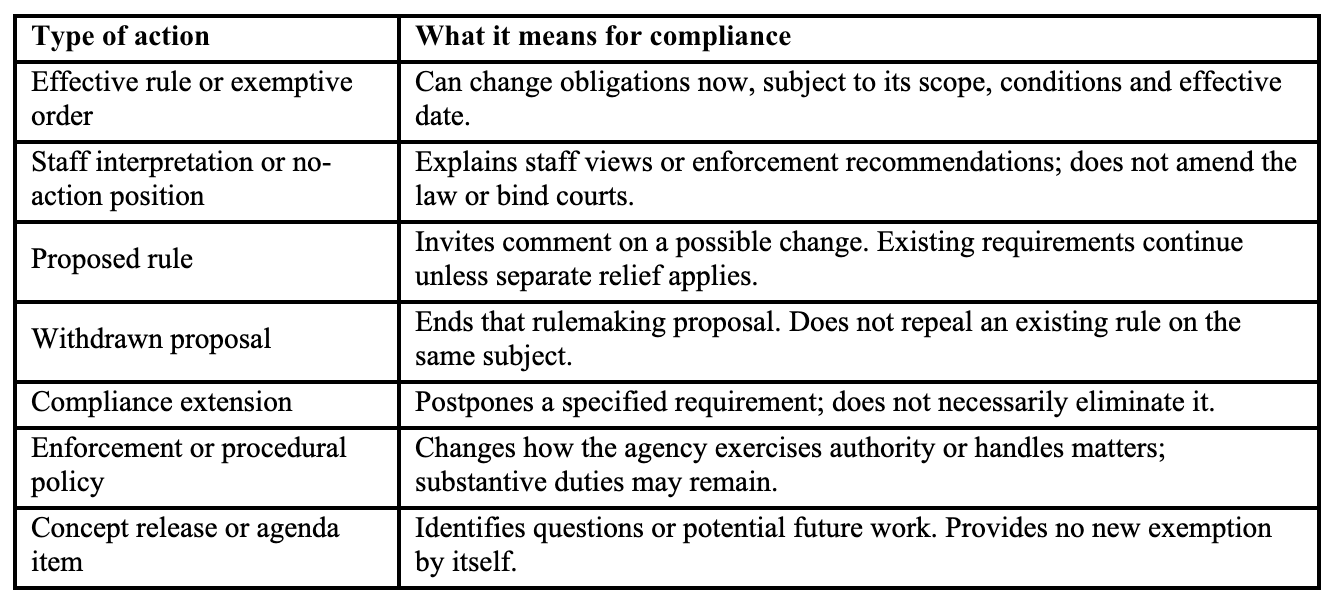
The cumulative effect could be substantial: lower preparation costs, more flexibility in raising capital and broader product access. Those benefits need to be weighed against reduced standardized disclosure, changes in shareholder participation, conflicts of interest, and the risks of less familiar investment products. Savings and benefits described in proposals remain projections.
Public Companies and IPO Capital Formation Reforms
Expanded Confidential Review of Registration Statements
Status: Staff accommodations available. In March 2025, Corporation Finance expanded nonpublic draft review beyond the earlier post-IPO window, added eligible registration forms and permitted omission of certain underwriter information from initial drafts. In September 2026, the staff extended accommodations to qualifying asset-backed-securities filings on Forms SF-1 and SF-3. These changes allow issuers to begin SEC review with more flexibility before public filing. March 2025 staff accommodations; September 2026 ABS accommodations.
Nonpublic review can reduce the commercial costs of exploring an offering. It does not eliminate the eventual public filing requirements, financial statements, staff review or Securities Act liability. An issuer must follow the applicable public-filing timetable before its road show or effectiveness.
Broader Form S-3 Access and Registered Offering Reform
Status: Proposed May 19, 2026. Registered Offering Reform would broaden access to Form S-3 and reform shelf-registration and offering communications requirements. It also addresses incorporation by reference on Form S-1, offerings by closed-end funds and business development companies, and state registration preemption for registered offerings. For smaller issuers, the potential value is a more usable and less costly route to recurring public financing. SEC Registered Offering Reform proposal.
A proposal to broaden short-form registration is not permission to disregard current Form S-3 eligibility, transaction requirements or offering limits. Companies should evaluate financing under the rules presently available while modelling how a final reform could affect future offerings.
For the current requirements, see our Form S-3 registration and shelf-offering guide.
Filer Status, Emerging Growth Companies and Audit Costs
Status: Proposed May 19, 2026. A companion proposal would simplify reporting-company classifications and expand emerging-growth-company accommodations. Among its proposed changes are a higher large-accelerated-filer threshold and broader non-accelerated-filer treatment, with implications for reporting deadlines and auditor attestation under Sarbanes-Oxley Section 404(b). SEC filer-status proposal.
Reducing audit and preparation costs could matter disproportionately to smaller public companies. The tradeoff is that more issuers could operate without an independent auditor’s attestation on internal control. A Section 404(b) exemption does not remove management’s responsibility for internal control or accurate financial reporting.
Quarterly Reporting and Proposed Semiannual Reporting
Status: Proposed May 5, 2026. The SEC proposed allowing eligible issuers to use a semiannual reporting framework, including proposed Form 10-S in place of Form 10-Q, and related changes to financial-statement age requirements. This would be a significant change in the cadence of mandatory interim reporting. SEC semiannual reporting proposal.
Fewer required interim filings could reduce recurring costs and management time. Investors could receive less frequent standardized information, and some companies might still face market or contractual pressure to provide quarterly results. As of this review, the proposal does not authorize companies to stop filing required Forms 10-Q.
Climate Disclosure Rule Rescission
Status: Rescission proposed May 29, 2026; the 2024 rules remain stayed. The SEC stopped defending the climate rules in March 2025 and later proposed rescinding them. The original April 2024 stay predates this administration and should not be counted as a new Trump-era action. SEC climate-rule rescission proposal.
Rescission could remove the separate federal climate-disclosure framework adopted in 2024. It would not erase duties to disclose material business risks under other SEC requirements or obligations imposed by applicable state, foreign or contractual regimes. Reduced compliance costs must be assessed alongside the loss of comparable climate-specific information.
Private Offerings and Accredited-Investor Verification
Status: Staff guidance available. The March 12, 2025 Latham & Watkins letter supports a facts-and-circumstances approach to Rule 506(c) verification using a high minimum cash investment together with specified accreditation and non-financing representations, where the issuer lacks contrary actual knowledge. It does not make a large check alone sufficient or dispense with verification. March 12, 2025 Latham & Watkins staff letter.
For qualifying offerings, the position can reduce the need to collect investors’ sensitive financial records. Issuers still must satisfy Rule 506(c), including its purchaser and verification requirements, and must document why their facts fit the staff’s position. Broader reforms to exempt offerings and accredited-investor access remain on the agenda.
Form S-8 Registration Deadlines and Equity Compensation Relief
Status: Staff interpretations available. The October 15, 2026 CFIs permit eligible issuers to register previously exempt pre-IPO awards on Form S-8 and address assumed awards held by former target employees. Under CFI 126.47, registration of the common stock issuable upon settlement of restricted stock or RSU awards must occur by the vesting date to rely on the staff’s position, even if settlement occurs later, and the issuer must also have been eligible to use Form S-8 on the grant date. Fees for forfeited, unvested RSUs may be carried to future RSU registrations when the underlying shares become available for reissuance under the plan. The package also addresses employee-plan fee calculations. Securities Act Forms CFIs 126.14, 126.19 and 126.46–126.47; Securities Act Rules CFIs 271.28–271.29.
An eligible non-reporting acquirer may use Rule 701 for assumed awards held by people whose service with the target ended before the acquisition. Separate May 2026 guidance addresses existing exemptions and Form S-8 use for pooled employer plans. These are targeted accommodations, with eligibility and disclosure conditions, rather than a general exemption for equity compensation. SEC pooled-employer-plan guidance.
For background on the registration form, see What Is Form S-8?.
Proxy Rules, Shareholder Engagement and Corporate Governance
Shareholder Proposal Exclusions and the End of Staff No-Action Responses
Status: Staff guidance and process changes available. Staff Legal Bulletin 14M, issued February 12, 2025, rescinded Bulletin 14L and restored approaches giving greater weight to a proposal’s significance to the particular company, ordinary business, and micromanagement. This can give companies a stronger basis for excluding some proposals, depending on their facts. Staff Legal Bulletin 14M.
The withdrawal occurred in two stages. On November 17, 2025, Corporation Finance announced that, for the 2025–2026 proxy season, it would stop providing substantive views on exclusion grounds other than Rule 14a-8(i)(1), while offering representation-based non-objection letters for other grounds. On August 14, 2026, it discontinued all Rule 14a-8 no-action responses, including those under the state-law ground in paragraph (i)(1), and ended representation-based non-objection letters. Investment Management adopted a substantially similar approach. Companies still must submit the notices required by Rule 14a-8(j). The lack of a staff response is not an adjudication that an exclusion is lawful. November 17, 2025 staff statement; August 14, 2026 staff statement.
This reduces the staff’s role in resolving proposal disputes and may save review resources. It also leaves companies and proponents with less informal assurance and potentially greater reliance on counsel, negotiation or litigation.
Proposed Rescission of Rule 14a-8 and Proxy Solicitation Changes
Status: Two proposals issued September 16, 2026. One would rescind Rule 14a-8’s federal shareholder-proposal framework and amend discretionary voting provisions in Rule 14a-4. The other would modernize proxy solicitation requirements, including annual-report delivery, documents incorporated by reference, exempt solicitation filings, and broker-search timing. SEC Rule 14a-8 rescission proposal; SEC Proxy Solicitation Modernization proposal.
The potential cost savings are accompanied by a meaningful shift toward state law and corporate governing documents. The result would not necessarily be a blanket prohibition on shareholder proposals. Nor would eliminating a delivery requirement eliminate the obligation to file an annual report. Existing proxy rules remain applicable while the proposals are pending.
Schedule 13G Engagement and Retail Voting Programs
Status: Staff interpretations and fact-specific no-action positions. February 2025 beneficial-ownership guidance clarified when shareholder pressure on management may disqualify an investor from Schedule 13G. September 2026 CFIs clarified that issuer-initiated discussions, conversations with soliciting persons, and requests to understand disclosures do not, by themselves, necessarily cause disqualification. These positions clarify boundaries; they do not abolish Schedule 13D obligations. Beneficial ownership CFIs 103.11–103.15.
Separate staff letters addressed Exxon Mobil’s retail voting program in September 2025 and a directed-voting program for funds in September 2026. Such programs can reduce repeated voting instructions or solicitation friction, but reliance depends on the representations and safeguards in the particular letter. They are not a universal exemption for management-directed voting. Exxon Mobil staff no-action letter; Mutual Fund Directors Forum staff letter.
Mandatory Arbitration and Registration Statement Effectiveness
Status: Commission policy adopted September 17, 2025. The SEC stated that an issuer-investor mandatory-arbitration provision will not determine whether it accelerates a registration statement’s effectiveness. Staff review instead focuses on adequate disclosure, including disclosure of the provision. SEC mandatory-arbitration policy statement.
This removes an SEC effectiveness obstacle for issuers considering arbitration provisions. It does not conclusively resolve enforceability under every applicable law. The possible reduction in litigation expense must be weighed against investors’ ability to pursue claims collectively and obtain judicial review.
SEC Crypto Regulation and Tokenized Securities
SAB 122 and Crypto Custody Accounting
Status: Staff accounting guidance rescinded. SAB 122, issued January 23, 2025, removed SAB 121’s specialized safeguarding accounting guidance. Entities instead assess applicable contingency recognition and measurement requirements and continue to provide appropriate risk and safeguarding disclosures. The change can remove a significant accounting obstacle to custody activity; it does not eliminate custody risk or all balance-sheet obligations. Staff Accounting Bulletin 122.
Crypto Asset Classification and Staking Guidance
Status: Staff statements followed by a Commission interpretation. During 2025, staff issued positions on certain meme coins, proof-of-work mining, dollar-backed stablecoins, protocol staking and liquid staking. Their conclusions depend on the described facts. A label such as “meme coin” or “staking” does not itself establish that federal securities laws are inapplicable. CorpFin crypto guidance collection.
On March 17, 2026, the Commission issued an interpretation addressing categories of crypto assets, when a non-security asset may be subject to an investment contract and when that relationship can end. It also addresses airdrops, protocol mining, staking, and wrapping. This Commission interpretation has a different status from staff guidance, but it remains subject to the governing statutes and judicial interpretation. SEC March 17, 2026 crypto interpretation.
Regulation Crypto Assets
Status: Proposed August 18, 2026. The proposal would create two conditional offering exemptions for covered investment contracts: up to $5 million over four years and up to $75 million over each 12-month period. It also proposes a conditional safe harbor addressing investment-contract status. Disclosure obligations would apply, with additional financial statements and ongoing reporting under the larger exemption. Regulation Crypto Assets proposal.
The proposal seeks a more tailored route to capital formation. It would not create an exemption from antifraud or antimanipulation provisions, and the proposed offering limits cannot be used until the framework is adopted and effective.
Crypto ETPs, Tokenized Stocks and the Innovation Exemption
Status: Approvals and conditional relief available. In July 2025, the SEC permitted in-kind creations and redemptions for covered bitcoin and ether exchange-traded products, along with related product and options approvals. In September 2025, approved generic listing standards allowed qualifying commodity-based trust shares, including qualifying crypto products, to list without a separate exchange rule-change approval for each product. SEC in-kind creation and redemption approvals; SEC generic-listing approvals.
The September 17, 2026 Innovation Exemption provides temporary, conditional relief for certain tokenized NMS-stock venues and liquidity providers. It runs for five years after publication and includes limits and safeguards concerning securities traded, volume, equivalent shareholder rights, trading halts, and public information. It is not a general exemption for every tokenized-security platform. SEC Innovation Exemption order and summary.
Other steps include withdrawal of the 2019 joint SEC/FINRA broker-dealer digital-asset custody statement, staff work on broker-dealer crypto activities and interfaces, and tokenization-related exchange and clearing arrangements. These developments ease particular operational or registration obstacles; the applicable order or staff position must be checked for each business model. Withdrawal of the 2019 joint custody statement; SEC crypto implementation inventory.
A Different Crypto Enforcement Approach
Status: Litigation decisions implemented. The SEC moved to dismiss its Coinbase case in February 2025 and its Binance case in May 2025. The Coinbase announcement expressly characterized the dismissal as a policy judgment supporting a new regulatory approach, rather than a determination on the merits. Such dismissals are not holdings that every crypto asset or activity is outside securities regulation. SEC Coinbase dismissal announcement; SEC Binance dismissal announcement.
More routes to market can increase competition and product choice. They can also expose investors to custody, manipulation, technology and liquidity risks. Registration relief and product approval should not be treated as SEC endorsement of investment quality.
Investment Funds, Advisers and Retail Access to Private Markets
Closed-End Funds Investing in Private Funds
Status: Staff review practice changed. ADI 2025-16 states that staff will no longer request that registered closed-end funds investing at least 15% in private funds impose accredited-investor and minimum-investment restrictions, or instead remain below that private-fund allocation. Registered-fund governance, disclosure and other legal protections continue. ADI 2025-16 on closed-end funds of private funds.
The change can broaden retail exposure to private-market strategies through registered funds. Indirect access still involves potentially illiquid holdings, valuation judgments and multiple layers of fees. A registered wrapper does not make the underlying investments liquid.
Performance Fees, Interval Funds and Multiple Share Classes
Status: Proposals issued September 30, 2026. The performance-compensation proposal would expand the conditions under which advisers may receive capital-gains or appreciation-based compensation from regulated funds and would broaden “qualified client” to include accredited investors. It includes related compensation disclosure. SEC performance-compensation proposal.
The interval-fund proposal would allow greater flexibility in periodic repurchases and permit multiple share classes for regulated closed-end funds, replacing reliance on individual exemptive orders with a rules-based framework. These changes could support more private-market offerings while raising questions about liquidity matching, fees and incentives. SEC interval-fund and multiple-share-class proposal.
The SEC separately requested comment on additional accredited-investor pathways, including a possible FINRA examination and specified professional credentials. Those requests do not presently confer accredited status on everyone holding the identified credentials. SEC retail private-market package.
ETF Share Classes and Affiliated Co-Investments
Status: Conditional exemptive relief available. The SEC has used its exemptive process to permit additional funds to combine ETF and mutual-fund share classes. Its March 17, 2026 order supplies related conditional Exchange Act relief for qualifying multi-class ETFs and intermediaries. These arrangements depend on applicable Investment Company Act relief and safeguards; they are distinct from the pending multiple-class proposal for closed-end funds. SEC March 17, 2026 multi-class ETF order; SEC multi-class ETF application notices.
The April 29, 2025 FS Credit Opportunities order is another example of targeted relief, permitting covered funds and affiliates to participate in specified joint investment transactions under its conditions. Such orders can broaden access to financing opportunities and reduce transaction friction. They do not create a general exemption from restrictions on affiliated transactions, and allocation conflicts require continued oversight. SEC FS Credit Opportunities co-investment order.
Form PF and Fund Portfolio Reporting
Status: Reporting reductions proposed; specific deadlines extended. The April 20, 2026 joint SEC/CFTC Form PF proposal would eliminate or streamline certain filing and reporting obligations. Separately, the August 31, 2026 extension moved compliance with the February 2024 Form PF amendments to July 1, 2027. That does not suspend every existing Form PF obligation. SEC/CFTC Form PF proposal; August 31, 2026 Form PF extension.
The February 18, 2026 Form N-PORT proposal would provide more filing time, reduce public release of portfolio reports from monthly to quarterly and revise reporting items. The Commission separately extended compliance for Names Rule-related N-PORT reporting to November 17, 2027 for fund groups with at least $10 billion in net assets and May 18, 2028 for smaller groups. SEC Form N-PORT proposal; SEC Names Rule reporting extension.
The broader Names Rule deadlines are different: the March 2025 six-month extension set June 11, 2026 for fund groups with at least $1 billion and December 11, 2026 for smaller groups. The later N-PORT extension did not postpone all substantive Names Rule requirements. SEC Names Rule extension.
Streamlining can reduce preparation costs and limit portfolio information that others could exploit. It can also reduce the frequency or detail of information available to investors and regulators. The relevant analysis concerns which data are removed and how they are otherwise obtained.
Pay-to-Play, Custody and Cross Trading
Status: Proposed. The September 3, 2026 pay-to-play proposal would rescind Rule 206(4)-5, including its two-year compensation restriction following certain political contributions, and revise related recordkeeping. Existing obligations remain while the proposal is pending. Other antifraud and fiduciary duties would continue even if the rule is rescinded. SEC pay-to-play rescission proposal.
The October 1, 2026 custody proposal would modernize adviser and regulated-fund custody requirements and permit specified crypto self-custody and state-trust-company arrangements subject to conditions, along with new records and disclosures. It should be distinguished from the separate 2023 safeguarding proposal that was withdrawn in 2025. SEC adviser and fund custody proposal.
The October 9, 2026 cross-trading proposal would expand eligible securities and modernize conditions for trades between funds and certain affiliates, while adding aggregate trading reports. These proposals combine additional flexibility with safeguards and, in some cases, new obligations. SEC cross-trading proposal.
Marketing Guidance and Small-Entity Treatment
Status: Staff guidance available; definition changes proposed. March 2025 Marketing Rule FAQs allow specified presentations of gross extracted performance and characteristics without corresponding net figures for each extract or characteristic, provided the total portfolio’s gross and net performance and other conditions are satisfied. The general prohibitions on misleading advertising remain. SEC staff Marketing Rule FAQs.
The January 7, 2026 small-entity proposal would raise asset thresholds used for Regulatory Flexibility Act analysis of advisers and funds and introduce inflation adjustments, with related changes. It is not a general exemption from SEC registration or substantive regulation for every firm newly treated as small. SEC small-entity definition proposal.
Trading Markets, Intermediaries and Compliance Delays
Debt Quotations and Regulation NMS
Status: Proposed. The March 16, 2026 Rule 15c2-11 proposal would limit the rule’s scope to equity securities rather than debt. The June 11, 2026 Regulation NMS proposal would rescind the trade-through rule and locked-and-crossed-market restrictions. These initiatives could reduce trading and information-gathering costs, with corresponding questions about quotation transparency, routing and execution quality. SEC Rule 15c2-11 debt proposal; SEC trade-through and locked-market proposal.
The Rule 15c2-11 debt proposal does not remove the information requirements that apply to OTC equity quotations. Likewise, a proposal to rescind the trade-through rule is not permission to disregard current execution obligations.
Short-Sale and Securities-Lending Reporting
Status: Temporary exemptions in effect. The December 3, 2025 order extends relief from Rule 13f-2 and Form SHO reporting until January 2, 2028, securities-loan reporting under Rule 10c-1a until September 28, 2028 and specified public dissemination requirements until March 29, 2029. The court remanded the rules without vacating them; the SEC granted the subsequent temporary relief. SEC December 3, 2025 exemptive order.
These are significant implementation reprieves. They should not be described as a repeal of short-sale regulation or an elimination of all short-position and lending reporting requirements.
Consolidated Audit Trail Cost and Privacy Changes
Status: Amendments and exemptions approved; broader review ongoing. The SEC approved CAT customer-information changes in January 2026 and additional cost reductions in March 2026. An April 2026 concept release asks broader questions about funding, governance, scope, privacy and other audit trails. The implemented changes and the questions in the concept release have different legal status. SEC CAT customer-information amendment; SEC CAT cost-reduction approval; SEC CAT concept release.
Lower costs and reduced collection of sensitive information can benefit firms and investors. The continuing policy issue is whether the remaining data and processing arrangements preserve the surveillance and investigative capabilities that justify the system.
Other Material Implementation Relief
Several extensions are material even where the delayed date has now passed. The following dates identify the relief granted; firms must check whether they are currently subject to the underlying requirement.
Order-execution disclosure. The SEC extended the 2024 Rule 605 amendments’ compliance date to August 1, 2026. That date has passed. Separate implementation details and exemptions must be assessed under their own terms. SEC Rule 605 extension.
Tick sizes and access fees. After initial October 2025 relief, the SEC’s June 11, 2026 order further postponed specified minimum-increment and access-fee requirements until the first business day of November 2027. Other market-data provisions have distinct schedules. These delays do not rescind the adopted rules. SEC June 11, 2026 Regulation NMS extension.
Daily reserve calculations. The SEC delayed the affected broker-dealers’ daily customer and PAB reserve-computation requirement by six months to June 30, 2026. That date has passed. SEC daily-reserve computation extension.
Electronic submissions and FOCUS reports. A September 2025 action extended specified compliance dates by twelve months. A separate September 2026 order exempts specified intermediary filings from Inline XBRL, including parts of Forms CA-1 and 1, Form X-17A-5 Part III, Form 17-H and specified swap-entity reports. This is not a broad public-company XBRL exemption. SEC electronic-filing and FOCUS extension; SEC Inline XBRL exemptive relief.
Treasury clearing. The SEC extended eligible cash-transaction clearing compliance to December 31, 2026 and eligible repo-transaction compliance to June 30, 2027. The extension supports implementation rather than abandonment of central clearing. SEC Treasury clearing implementation resources.
Electronic Delivery, Transfer Agents and Other Market Reforms
Status: Proposed or under consultation. Proposed Regulation E-Delivery would permit covered electronic delivery without first obtaining affirmative consent if its conditions are met. This could reduce mailing costs, while making access, notice and investor choice important design issues. Regulation E-Delivery proposal.
The September 2026 transfer-agent proposal modernizes rules and forms for electronic and blockchain recordkeeping but also introduces requirements, including provisions addressing compliance and restrictive legends. It is a mixed modernization package, rather than a pure rollback. SEC transfer-agent modernization proposal.
The August 2026 EU debt-futures proposal would treat specified futures consistently with futures on certain sovereign debt, placing the futures under CFTC jurisdiction while preserving SEC jurisdiction over the underlying securities. The September 2025 RMBS/ABS concept release considers asset-level disclosure and registration reforms but does not itself change Regulation AB. SEC EU debt-futures proposal; SEC RMBS and ABS concept release.
Enforcement, Examinations and SEC Decision-Making
Formal Investigations, Wells Notices and Settlement Waivers
Status: Procedural changes implemented. Effective March 14, 2025, the SEC removed the Enforcement Director’s delegated authority to issue formal investigative orders. This returns that authorization to the Commission rather than eliminating its power to investigate. SEC formal-investigation delegation amendment.
The February 2026 Enforcement Manual updates provide ordinarily four weeks for a Wells submission, meetings with senior Enforcement leadership, and clearer cooperation procedures. They also reflect restored simultaneous consideration of settlements and related requests for waivers from automatic disqualifications. A waiver remains discretionary; a settlement does not automatically confer one. SEC 2026 Enforcement Manual updates.
Unregistered-Dealer Enforcement Cases
Status: Selected claims dismissed. On May 22, 2025, the SEC moved to dismiss the Long, Tri-Bridge Ventures and LG Capital Funding cases with prejudice, and the unregistered-dealer claims against River North defendants, while continuing other claims. These decisions are important for convertible-security financing and the dealer-versus-trader debate. SEC May 22, 2025 dealer-case dismissals.
Dismissal of particular cases does not amend the statutory dealer definition or eliminate registration duties. Companies evaluating financing arrangements should distinguish an enforcement-policy change from a legal determination that every financing provider is exempt. The dealer-definition agenda item remains separate.
Criminal Referrals and Public Denials of Settled Allegations
Status: Policy changes implemented. A June 2025 policy identifies considerations for criminal referrals, including harm, gain, knowledge, repeat misconduct, and the additional protection a DOJ referral could provide. It neither repeals criminal law nor binds the Department of Justice. SEC criminal-referral policy.
Effective May 21, 2026, the SEC rescinded its policy requiring settling parties to agree not to deny the allegations publicly. The change concerns settlement terms and speech after settlement, rather than removing the underlying securities-law prohibitions. It should not be assumed to rewrite an existing settlement without examining its terms and any further applicable action. SEC settlement-denial policy rescission.
Examinations, Delegated Authority and Quorum
Status: Process guidance and organizational amendments. The October 2026 Exam Handbook explains examination stages, expectations, and channels for engagement. Greater predictability can reduce uncertainty and help firms prepare, but the handbook does not exempt registrants from examination or compliance. SEC October 2026 Exam Handbook.
The September 2026 quorum amendment, effective October 2, permits one eligible commissioner to act on a matter when every other commissioner in office is disqualified. Three remains the default quorum, with exceptions for vacancies and disqualifications. This prevents some decision-making paralysis but reduces collegial deliberation when only one member participates. It is an organizational change, not direct relief from a market participant’s obligations. SEC quorum amendment.
July 2026 delegation amendments consolidate certain registration and filer-support functions and update review procedures. A December 2025 amendment delegated additional adviser confidential-treatment decisions to Investment Management. These may improve processing efficiency; they do not make every covered filing confidential or eliminate Commission review rights. SEC staff-delegation modernization; SEC Investment Management delegation amendment.
All 14 Proposals Withdrawn in June 2025
On June 12, 2025, the SEC withdrew 14 proposed regulatory actions. These withdrawals ended the specified proposals without adopting them. Existing requirements on related subjects remain unless separately changed. The withdrawn proposals were: SEC withdrawal of 14 proposals.
- Shareholder-proposal substantial implementation, duplication and resubmission amendments.
- Predictive-data-analytics conflicts for broker-dealers and advisers.
- Safeguarding advisory client assets.
- Cybersecurity for investment advisers, funds and BDCs.
- ESG investment-practice disclosures for advisers and funds.
- Outsourcing by investment advisers.
- Large security-based-swap position reporting under proposed Rule 10B-1.
- Volume-based exchange transaction pricing.
- Regulation Best Execution.
- Order Competition Rule.
- Regulation SCI amendments.
- Cybersecurity requirements for specified market intermediaries.
- Exchange-definition and Regulation ATS amendments.
- Consolidated Audit Trail data-security amendments.
The package reduced the immediate prospect of additional obligations. Withdrawal is not a finding that cybersecurity, conflicts, best execution or other risks are unimportant; existing laws and oversight continue to address those subjects.
SEC Deregulation in 2026 and What Comes Next
The agenda discussed here is the 2026 Regulatory Agenda identified in Chairman Atkins’s July 7, 2026 statement and on Reginfo.gov’s agency rule list. SEC agenda statement; 2026 agency rule list.
The SEC’s agenda extends beyond the issued proposals discussed above. “Proposed Rule Stage” in an agenda means anticipated rulemaking work, not that an operative rule or even a published proposal necessarily exists. The following additional subjects complete the review of the principal agenda areas. Their direction and conditions must be assessed when an actual release is issued.
As of October 20, 2026, the Commission has only two members: Chairman Paul S. Atkins and Commissioner Mark T. Uyeda. Unless its membership changes, decisions to finalize pending proposals rest with those two commissioners; under the amended quorum rule, one may act alone on a matter if the other is disqualified. Current SEC commissioners; SEC quorum amendment.
This concentration of decision-making may accelerate the agenda, but it does not assure the durability of the resulting policies. Final rules remain subject to judicial review and may be revised through lawful rulemaking by a future Commission; staff positions can change without an amendment to a Commission rule.
- Rule 144 safe harbor. Potential expansion of resale availability; current holding periods and other conditions continue. SEC agenda RIN 3235-AM78.
- Foreign private issuer eligibility. Follow-up to the 2025 concept release. Could recalibrate access to accommodations rather than simply reduce regulation. SEC agenda RIN 3235-AN35.
- Exempt offering pathways. Simplification of private-capital formation and potential accredited-investor changes. SEC agenda RIN 3235-AN42.
- Disclosure rationalization. Potential revisions emphasizing material disclosure and access to information. SEC agenda RIN 3235-AN43.
- Executive compensation disclosure. Potential changes to Regulation S-K Item 402; existing disclosures remain required. SEC agenda RIN 3235-AN60.
- Financial-institution resolution transactions. Potential clarification of securities-law treatment in resolution processes. SEC agenda RIN 3235-AN61.
- Affiliated securities-lending agents. Potential conditional exemptive framework for fund lending through compensated affiliates. SEC agenda RIN 3235-AN62.
- Investment adviser recordkeeping. Potential revisions to adviser books-and-records requirements. SEC agenda RIN 3235-AN66.
- Broker-dealer crypto financial responsibility. Potential capital, custody, recordkeeping, and reporting changes for crypto activities. SEC agenda RIN 3235-AN48.
- Crypto market structure. Potential framework for intermediaries and trading involving crypto assets. SEC agenda RIN 3235-AN49.
- Definition of dealer. Potential clarification of dealer status; existing statutory registration duties continue. SEC agenda RIN 3235-AN51.
- Treasury alternative trading systems. Potential changes to oversight of government-securities ATSs; not necessarily deregulatory. SEC agenda RIN 3235-AN53.
- Clearing-agency registration. Potential changes to Rule 17Ab2-1 and Form CA-1. SEC agenda RIN 3235-AN67.
- Treasury clearing and customer protection. Potential amendments to Rules 17Ad-22(e)(18) and 15c3-3. SEC agenda RIN 3235-AN68.
- Finders. Potential clarification of regulatory status; no general finders exemption arises from the agenda. SEC agenda RIN 3235-AN69.
- Broker-dealer business communications. Potential clarification of Rule 17a-4’s “business as such” recordkeeping scope. SEC agenda RIN 3235-AN70.
The agenda also includes short-position/Form SHO, Regulation SHO and securities-lending amendments, alongside the reporting relief already discussed. Its other principal subjects—offerings, filer status, proxy rules, climate, crypto offerings, fund reporting, custody, cross trading, electronic delivery and retail private-market access—are addressed in the preceding sections. SEC 2026 regulatory agenda.
What Should Not Be Counted as a New Trump-Era SEC Rollback
A careful assessment distinguishes administrative choices from earlier court decisions. The 2023 private-fund-adviser rules were vacated in June 2024. Their removal was not a new 2025 or 2026 administration action. Likewise, the SEC’s August 2026 fund-governance technical amendments conformed the rulebook to a court vacatur that had already taken effect in 2006. SEC notice of the 2024 private-fund-rule vacatur; SEC technical fund-governance amendments.
The foreign-private-issuer concept review may result in tighter eligibility for some accommodations. Some custody, transfer-agent and cross-trading proposals also contain new safeguards or reporting requirements. Describing every SEC initiative during this period as deregulation would obscure these differences. SEC foreign-private-issuer concept release.
What the Changes Mean for Companies and Investors
The strongest case for the program is that fixed compliance costs can make a public listing or new investment product uneconomic, especially for smaller businesses. Removing duplicative processes, tailoring requirements and clarifying uncertain legal treatment can free resources for productive use. More usable registered offerings may also encourage companies to provide the disclosures and protections associated with public markets.
The strongest concern is the cumulative effect on accountability. Less frequent reporting, narrower shareholder access to company proxy materials, reduced public data and wider retail access to illiquid strategies can each shift risk or information costs to investors. Antifraud rules are essential, but remedies after a loss do not supply information that would have helped investors avoid it.
Neither outcome should be assumed. Lower SEC compliance costs do not guarantee a lower cost of capital: investors may demand more disclosure, stronger controls or a higher return. Conversely, a requirement’s protective purpose does not establish that its benefits exceed its costs in every application. The final texts, implementation experience, and market response will matter.
Practical Steps for Public Companies and Their Advisers
Maintain a rule-status inventory. Separate effective relief from proposals, staff positions and agenda items. Record conditions, effective dates, sunset dates and the company’s eligibility.
Revisit financing and IPO planning. Consider confidential review and currently available offering paths. Evaluate proposed Form S-3 and filer-status changes as scenarios, without relying on them prematurely.
Update equity and proxy calendars. Coordinate Form S-8 registration with vesting and acceleration dates. Review shareholder-proposal notices and governance documents in light of the changed staff process.
Preserve controls and meaningful disclosure. A reporting or attestation exemption does not make inaccurate financial statements acceptable. Assess what investors, lenders and counterparties still require.
Document reliance on targeted guidance. For Rule 506(c), tokenization, custody, fund marketing and voting programs, compare actual facts to every material representation and condition in the relevant source.
Review extensions individually. Some delayed dates have passed; others run into 2027–2029. Avoid treating a historical delay or pending rescission as a current exemption.
Frequently Asked Questions About Trump-Era SEC Deregulation
What does SEC deregulation under Trump mean?
It describes Commission and staff actions since January 2025 to reduce, simplify or reconsider specified securities-law requirements and compliance processes. The term includes final actions, staff positions, withdrawn proposals and pending reforms; each has a different legal effect. Existing requirements continue unless applicable relief changes them.
Has the SEC eliminated quarterly reporting?
No. The SEC has proposed an optional semiannual framework. Companies must continue filing the periodic reports required under current rules unless applicable relief is available.
Can public companies rely on proposed Form S-3 reforms now?
No. Proposed reforms do not expand current eligibility. Companies must satisfy the existing form and transaction requirements until a final change becomes effective.
Does SEC deregulation mean less exposure to securities fraud claims?
Not automatically. Registration or reporting relief changes specified obligations. It does not broadly repeal antifraud provisions, fiduciary duties, disclosure liability or private rights that otherwise apply.
Are staff CFIs and no-action letters binding law?
No. They express staff views and can help explain compliance expectations, but they are not Commission rules, do not bind courts and may change. Reliance requires careful attention to their scope and facts.
Which developments are especially relevant to smaller issuers?
Confidential registration review, Rule 506(c) verification guidance and Form S-8 accommodations can affect current transactions. Proposed offering, filer-status and reporting reforms could have a broader impact if adopted. Companies should evaluate current eligibility and future possibilities separately.
When must restricted stock and RSU shares be registered on Form S-8?
Under staff CFI 126.47, an eligible issuer relying on that position must register the offer and sale of shares issuable upon settlement by the vesting date, even if settlement occurs later. The issuer must also have been eligible to use Form S-8 on the grant date. SEC Securities Act Forms CFI 126.47.
Can one SEC commissioner act alone under the new quorum rule?
Yes, on a particular matter if every other commissioner in office is disqualified from participating. As of October 20, 2026, the Commission has two members, Paul S. Atkins and Mark T. Uyeda; one could constitute a quorum if the other is disqualified. The amendment became effective October 2, 2026. SEC Commission Quorum Requirement.
About the Author
Brenda Hamilton is a securities attorney with Hamilton & Associates Law Group, P.A.
Hamilton & Associates Law Group, P.A. | Securities Lawyer 101
Disclaimer: This article is provided for informational purposes only and does not constitute legal or tax advice. Securities rules change, so speak with qualified counsel about your specific situation.
To speak with a Securities Attorney, please contact Brenda Hamilton at 200 E Palmetto Rd, Suite 103, Boca Raton, Florida, (561) 416-8956, or by email at [email protected].
Hamilton & Associates | Securities Attorneys
Brenda Hamilton, Securities Attorney
200 E Palmetto Rd, Suite 103
Boca Raton, Florida 33432
Telephone: (561) 416-8956
Facsimile: (561) 416-2855
www.SecuritiesLawyer101.com