
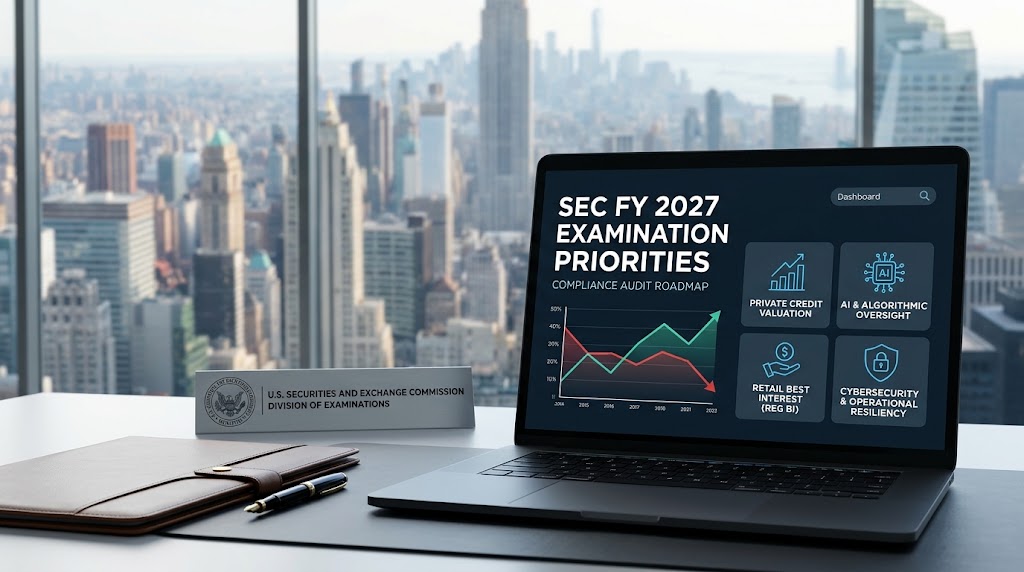
The SEC’s Division of Examinations has officially released its Fiscal Year (FY) 2027 Examination Priorities, mapping out the precise risk areas, asset classes, and compliance functions that regulators will target across its 34,000+ registrants.
For registered investment advisers (RIAs), private fund managers, broker-dealers, and compliance officers, this annual roadmap is more than just regulatory reading—it is an operational blueprint. If your compliance program has not accounted for these specific focus areas, now is the time to audit and adapt.
Here is a breakdown of the key takeaways from the FY 2027 priorities and actionable steps your firm can take to stay ahead of the exam cycle.
1. Fiduciary Obligations and Retail Investor Protection Remain Front and Center
The Division continues its unwavering focus on core fiduciary duties—specifically duty of care and duty of loyalty—when dealing with retail investors.
The Focus: Regulators are scrutinizing how firms handle conflicts of interest, investment recommendations, and the marketing of complex, high-risk, or illiquid products to retail clients.
What to Review: Ensure your conflict-of-interest disclosures are clear, transparent, and actively reflected in everyday operations. If your firm recommends structured notes, complex alternatives, or margin strategies, be prepared to demonstrate that suitability and cost factors were rigorously evaluated.
2. Private Funds and Private Credit Under Scrutiny
Private market strategies remain a major area of regulatory emphasis, with specific attention directed toward private credit, liquidity management, and valuation practices.
The Focus: The SEC is closely examining private fund advisers regarding fee and expense calculations, preferential treatment via side-letter arrangements, valuation rigor for hard-to-value assets, and cross-client trading practices.
What to Review: Review your valuation policies and procedures to ensure independent verification where necessary. Double-check that fee and expense allocations strictly align with your limited partnership agreements (LPAs) and Form ADV disclosures.
3. Emerging Technologies, AI, and “Super Intelligence”
As artificial intelligence and automated tools become deeply integrated into financial services, the SEC is ramping up its oversight of emerging fintech and algorithmic platforms.
The Focus: FY 2027 priorities highlight automated investment tools, AI technologies, trading algorithms, and data accuracy. Regulators want to ensure that marketing representations match operational reality—specifically that algorithms do not drift into making recommendations inconsistent with a firm’s stated strategy or risk profile.
What to Review: If your firm utilizes AI for client-facing recommendations, content generation, or quantitative trading models, conduct a comprehensive audit of your oversight controls, algorithmic validation processes, and investor disclosures.
4. Cybersecurity, Operational Resiliency, and Data Protection
Cyber threats, geopolitical tensions, and dispersed remote-work environments continue to elevate operational risk. Cybersecurity remains a top-tier enforcement and exam priority.
The Focus: Examinations will test firms’ technical, administrative, and physical safeguards for customer information, incident response readiness, and vendor oversight.
What to Review: Verify that your written Incident Response Plan (IRP) is up to date, that staff training is documented, and that vendor due diligence—particularly for third-party cloud and SaaS providers—is fully compliant with Regulation S-P and S-ID mandates.
5. Broker-Dealer Focus: Financial Responsibility and Reg BI
For broker-dealers, the FY 2027 priorities maintain a sharp focus on foundational financial health, supervision, and Regulation Best Interest (Reg BI) compliance.
The Focus: Net capital compliance, customer protection rules, trading practices (including extended-hours trading), anti-money laundering (AML) compliance, and supervisory controls over registered representatives.
What to Review: Perform a mock audit of your Reg BI documentation process, ensuring that recommendations made to retail customers are thoroughly justified and documented at the point of sale.
Your Pre-Exam Compliance Action Plan
Receiving an SEC examination notice can be stressful, but proactive preparation is your best defense. Consider taking these three steps immediately:
Conduct a Risk Assessment Gap Analysis: Compare your current compliance manual against the published FY 2027 priorities to identify any blind spots.
Test Your Policies in Practice: Regulators do not just look at whether policies exist on paper—they evaluate whether your firm actually follows them.
Engage Counsel Early: If your firm receives an exam notification or if you need help conducting a confidential mock audit, reach out to experienced securities counsel to guide your response strategy.
About the Author
Brenda Hamilton is a securities attorney with Hamilton & Associates Law Group, P.A.
Hamilton & Associates Law Group, P.A. | Securities Lawyer 101
Disclaimer: This article is provided for informational purposes only and does not constitute legal or tax advice. Securities rules change, so speak with qualified counsel about your specific situation.
To speak with a Securities Attorney, please contact Brenda Hamilton at 200 E Palmetto Rd, Suite 103, Boca Raton, Florida, (561) 416-8956, or by email at [email protected].
Hamilton & Associates | Securities Attorneys
Brenda Hamilton, Securities Attorney
200 E Palmetto Rd, Suite 103
Boca Raton, Florida 33432
Telephone: (561) 416-8956
Facsimile: (561) 416-2855
www.SecuritiesLawyer101.com