
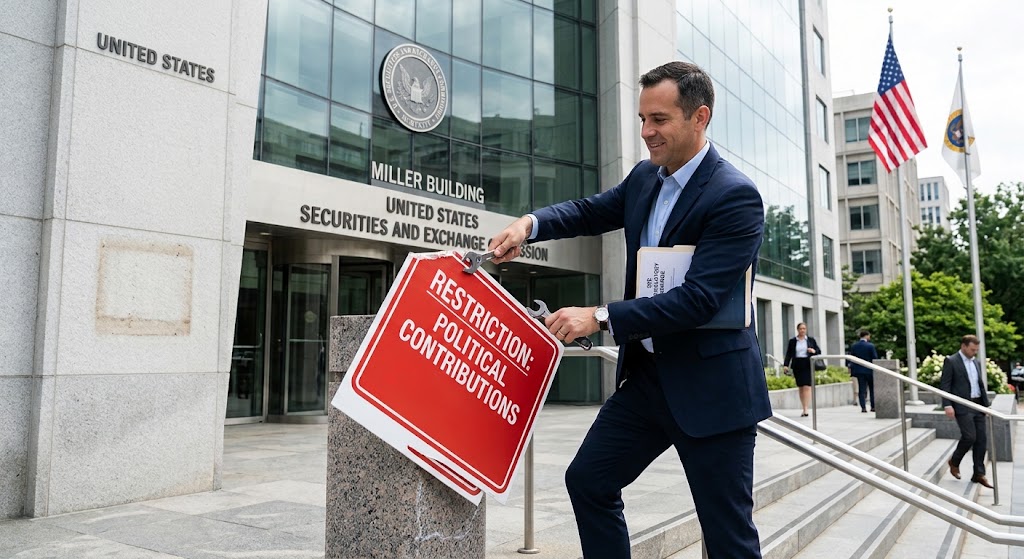
The U.S. Securities and Exchange Commission (SEC) has formally proposed the rescission of Rule 206(4)-5—commonly known as the “Pay-to-Play Rule.”
Since its adoption in 2010, Rule 206(4)-5 has served as one of the strictest compliance mandates for registered investment advisers (RIAs). Enacted in the wake of public pension scandals, the rule was designed to prevent investment firms from using campaign contributions to secure lucrative mandates to manage public pension money.
Now, as the SEC moves to dismantle the two-decade-old framework, investment advisers face both strategic relief and regulatory uncertainty. Here is what you need to know about why the rule is on the chopping block, what critics are saying, and how compliance teams should prepare for the transition.
What Was the Pay-to-Play Rule?
Adopted under the Investment Advisers Act of 1940, Rule 206(4)-5 established a strict, zero-tolerance framework governing political contributions:
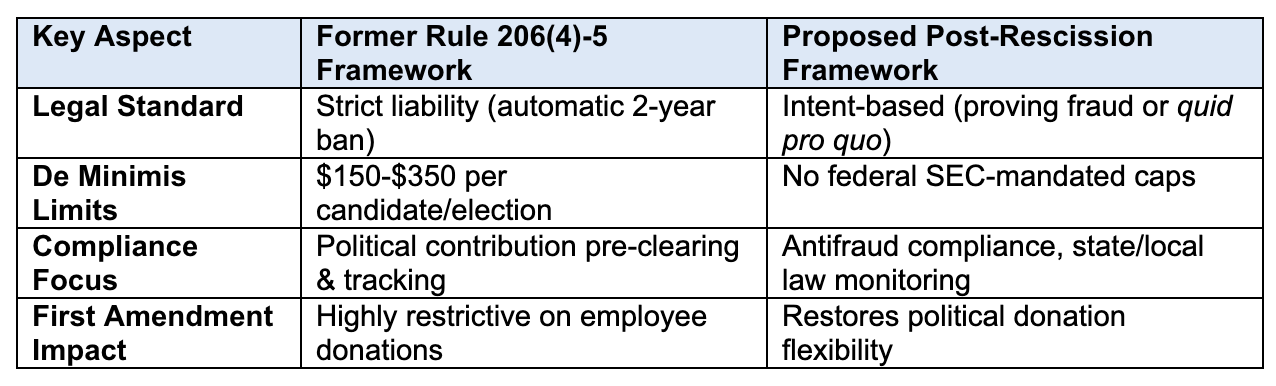
The Two-Year Timeout: If an investment adviser or its “covered associates” made a political contribution above de minimis limits ($350 if eligible to vote for the candidate; $150 if not) to an elected official capable of influencing public pension allocations, the firm was prohibited from receiving advisory compensation from that government entity for two full years.
Strict Liability Standard: The ban applied automatically. It required zero proof of intent, direct influence, or explicit quid pro quo agreement.
Broad Scope: Compliance departments were forced to monitor personal contributions from executives, managing members, sales reps, and even non-executive employees who solicited government business.
Why the SEC Is Rescinding Rule 206(4)-5
The SEC’s rationale for proposing the rule’s repeal centers on three primary arguments:
1. First Amendment & Employee Speech Rights
Critics and legal scholars have long argued that the rule’s draconian penalties heavily chilled constitutionally protected political speech. To eliminate corporate risk, many investment firms instituted blanket bans on all political contributions for all employees, effectively stripping individuals of their right to support local, state, or federal candidates.
2. Operational and Compliance Overhead
For over 15 years, compliance teams have poured substantial resources into tracking employee political contributions, pre-clearing political activity, and conducting background checks on prospective hires to uncover past contributions. Rescinding the rule eliminates significant administrative burdens for asset managers of all sizes.
3. Reliance on Existing Antifraud Frameworks
The SEC maintains that statutory antifraud provisions under Sections 206(1) and 206(2) of the Advisers Act—alongside state-level ethics laws and federal criminal statutes—provide adequate tools to prosecute actual corruption without requiring a broad, preventative ban on political speech.
The Pushback: Risks for Public Pension Governance
The proposal has drawn sharp criticism from public transparency groups, municipal worker unions, and pension governance watchdogs.
Opponents warn that repealing the rule removes a crucial barrier against political influence in public finance. Because proving an explicit quid pro quo in court is extraordinarily difficult, critics fear the decision could reopen the door to a systemic issue: public pension fund allocation decisions being guided by campaign cash rather than risk-adjusted returns and competitive management fees.
What Should Fund Managers and Compliance Teams Do Next?
While the proposed rescission promises to reduce administrative friction, compliance leaders should not dismantle their policies overnight.
Monitor State and Local Laws: The SEC rule was only one layer of regulation. Dozens of states, counties, and municipalities maintain their own independent pay-to-play restrictions. A contribution that is compliant at the federal level could still disqualify a firm from state or municipal mandates.
Focus on Fiduciary Duty and Antifraud Controls: Removing Rule 206(4)-5 does not legalize bribery or kickback schemes. Firms must ensure their internal policies clearly prohibit using firm resources or personal contributions to improperly influence institutional selection processes.
Review Pre-Clearance Policies: As the SEC finalized public comments and implementation timelines, compliance officers should decide whether to maintain internal pre-clearance rules to prevent reputational risk or to gradually ease constraints on non-soliciting staff.
This article is for informational purposes only and should not be construed as legal advice.
About the Author
Brenda Hamilton is a securities attorney with Hamilton & Associates Law Group, P.A.
Hamilton & Associates Law Group, P.A. | Securities Lawyer 101
To speak with a Securities Attorney, please contact Brenda Hamilton at 200 E Palmetto Rd, Suite 103, Boca Raton, Florida, (561) 416-8956, or by email at [email protected].
Hamilton & Associates | Securities Attorneys
Brenda Hamilton, Securities Attorney
200 E Palmetto Rd, Suite 103
Boca Raton, Florida 33432
Telephone: (561) 416-8956
Facsimile: (561) 416-2855
www.SecuritiesLawyer101.com