
In plain English: Regulation D is the set of SEC rules most U.S. companies rely on to raise money privately without registering the offering. It offers three exemptions: Rule 504, Rule 506(b) and Rule 506(c).
What the rule provides
Regulation D is Rules 500–508 under the Securities Act. Its exemptions address Securities Act registration; they do not eliminate antifraud obligations or other applicable federal and state requirements.
Rule 500 expressly preserves antifraud, civil-liability and other federal securities-law provisions.
The key building blocks:
Rule 501: definitions, including “accredited investor” and how purchasers are counted.
Rule 502(b): information that must be given to non-accredited investors.
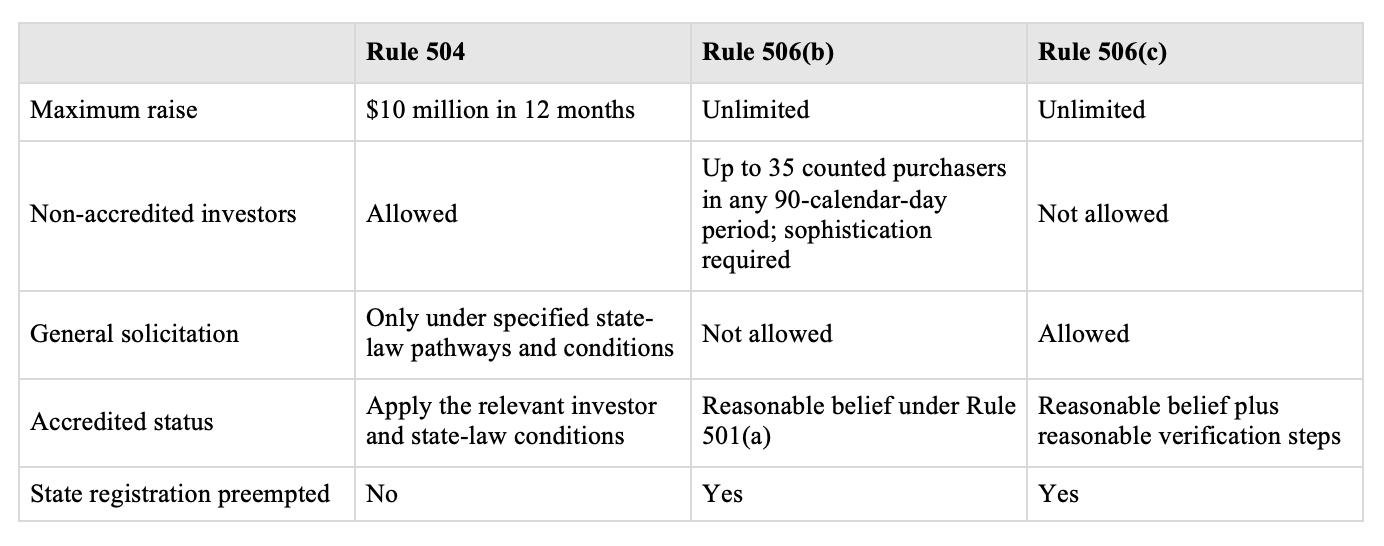
Rule 502(c): the ban on general solicitation and general advertising, except in Rule 506(c) offerings and certain Rule 504 offerings.
Rule 502(d): securities sold are restricted securities, and the issuer must use reasonable care to make sure purchasers aren’t underwriters, for example with restrictive legends and written disclosure.
Rule 503: Form D must be filed within 15 calendar days after the first sale.
Rule 504: up to $10 million in 12 months for eligible non-reporting issuers.
Rule 506(b) and 506(c): unlimited amounts, with different investor and solicitation conditions.
Rule 506(d): the “bad actor” disqualification.
What it means in practice
Common mistakes
Filing Form D late or not at all, and skipping state notice filings.
Posting the deal online or on social media in a 506(b) offering.
Paying unregistered finders a commission.
Failing to identify the covered persons for bad-actor diligence, including directors, executive and participating officers, applicable 20% voting owners, promoters and compensated solicitors.
Treating two closely timed raises as separate without an integration analysis under Rule 152.
Related terms: Accredited Investor · Rule 504 · Rule 506(b) · Rule 506(c) · Form D · Integration · Finder
Raising money privately? Call 561-416-8956 to choose the right Regulation D exemption.
Related articles and services
Rule 506(b) vs. Rule 506(c): Key Differences for Issuers — 2026-08-14
Form D: Deadlines, Amendments and Common Mistakes — 2026-08-19
Capital Raising and Private Placements
Podcast: Rule 506(b) versus Rule 506(c) — 2026-11-11
Governing authorities
This glossary is general information, not legal advice. Reading it does not create an attorney-client relationship.
Return to the Securities Law Glossary — proposed new index