
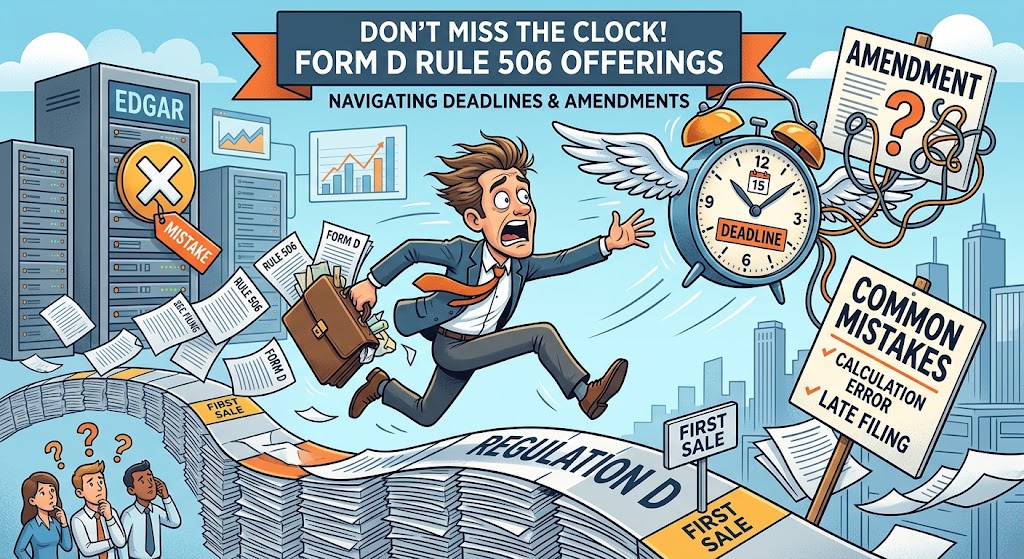
Issuers relying on Rule 506(b) or Rule 506(c) of Regulation D generally must file a Form D with the Securities and Exchange Commission. The filing is relatively short compared with a registration statement, but its timing and amendment rules create recurring compliance problems for private companies, private funds and other issuers raising capital in exempt offerings.
The basic federal deadline is straightforward: Form D generally must be filed within 15 calendar days after the first sale of securities in the offering. The harder questions are often determining when the first sale occurred, deciding when an amendment is required, and understanding what a late filing means for the Rule 506 exemption.
For Rule 506 issuers, Form D should be treated as part of the offering process from the beginning – not as an administrative filing to address after the financing closes.
Key Form D Rules for Rule 506 Offerings
- Rule 506(b) and Rule 506(c) offerings generally require a Form D filing with the SEC.
- The Form D is due within 15 calendar days after the first sale in the offering.
- For Form D purposes, the first sale occurs when the first investor becomes irrevocably contractually committed to invest.
- If the 15th day falls on a Saturday, Sunday or holiday, the deadline moves to the next business day.
- An issuer may file Form D before the first sale occurs.
- Form D and Form D amendments are filed electronically through EDGAR; the SEC does not charge a Form D filing fee.
- Certain material errors and changes require amendments, and a continuing offering generally requires an annual amendment.
- A late Form D does not, by itself, make Rule 506(b) or Rule 506(c) unavailable, but filing remains a regulatory requirement and noncompliance can have consequences under Rule 507.
- Form D filings are public on EDGAR and generally cannot simply be withdrawn or deleted.
What Is Form D?
Form D is the SEC notice used for exempt offerings conducted under Regulation D, including Rule 504, Rule 506(b) and Rule 506(c), as well as certain offerings under Section 4(a)(5) of the Securities Act. It is a notice filing rather than a registration statement.
For a Rule 506 offering, Form D identifies information about the issuer and the offering, including the exemption claimed, the type and size of the offering, certain related persons, the minimum investment amount, the number and type of investors, and certain sales compensation information.
Once accepted by EDGAR, the filing becomes publicly available. The SEC states that an issuer cannot request confidential treatment for information that Form D requires, and a filed Form D generally cannot be withdrawn or deleted from EDGAR.
When Is Form D Due for a Rule 506 Offering?
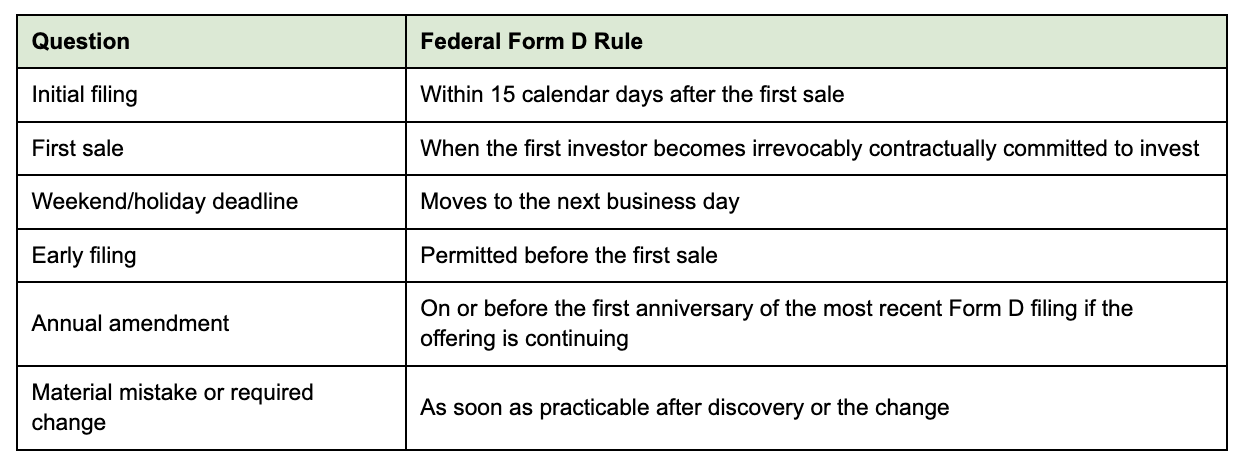
An issuer relying on Rule 506(b) or Rule 506(c) generally must file Form D no later than 15 calendar days after the first sale of securities in the offering.
The deadline is measured in calendar days, not business days. If the deadline falls on a Saturday, Sunday or holiday, the due date moves to the next business day.
An issuer does not have to wait for the first sale. SEC staff guidance permits an issuer to file Form D before any securities have been sold, which can be useful when the issuer wants to avoid uncertainty about the first-sale date.
Form D Timing at a Glance
What Counts as the First Sale for Form D?
For Form D purposes, the first sale is not necessarily the day the issuer receives cash in its bank account or formally closes the financing. The SEC defines the first-sale date as the date on which the first investor is irrevocably contractually committed to invest.
Depending on the transaction documents, that date may occur when an issuer accepts a subscription agreement, when a binding commitment becomes effective, or at another point established by the offering terms. The subscription documents and closing mechanics therefore matter when calculating the Form D deadline.
SEC staff has also stated that in a best-efforts offering where subscriptions are held in escrow until a minimum amount is raised, Form D should be filed no later than 15 days after the first subscription is received into escrow.
Does Rule 506(b) Require Form D?
Yes. An issuer conducting an offering in reliance on Rule 506(b) generally must file Form D under Rule 503. The Form D obligation applies even where the offering is conducted privately without general solicitation and all purchasers are accredited investors.
Does Rule 506(c) Require Form D?
Yes. Rule 506(c) offerings also generally require Form D. The ability to use general solicitation under Rule 506(c) does not eliminate the filing requirement. Issuers should identify Rule 506(c) as the claimed exemption on the Form D and separately maintain compliance with the accredited-investor verification requirements of Rule 506(c).
How Is Form D Filed?
Form D must be filed electronically through the SEC’s EDGAR system. Paper Form D filings are not accepted by the SEC.
A new EDGAR filer generally must obtain EDGAR access, including a CIK, through the SEC’s Form ID process. Current SEC guidance also requires the individual filing on the issuer’s behalf to use Login.gov credentials and to have the appropriate EDGAR role or permission for the issuer.
Because EDGAR access can take time to establish, an issuer should address EDGAR access before the Form D deadline is approaching. The SEC specifically encourages filers to gather the necessary Form D information before logging into the online form.
What Information Is Disclosed on Form D?
Form D is shorter than a Securities Act registration statement, but it still makes meaningful information about the issuer and financing public. Depending on the offering, the form calls for information concerning:
- the issuer’s legal name, entity type, jurisdiction and year of organization;
- the issuer’s principal place of business and contact information;
- certain directors, executive officers and promoters;
- the Securities Act exemption claimed, including Rule 506(b) or Rule 506(c);
- the type of securities being offered;
- the date of first sale;
- the duration of the offering;
- the minimum investment amount;
- the total offering amount, amount sold and amount remaining to be sold;
- the number of investors and, where applicable, non-accredited investors;
- persons receiving sales compensation and related information; and
- certain sales commissions, finder fees and uses of proceeds.
Because Form D becomes public, issuers should review the filing carefully for accuracy and consistency with their offering documents, capitalization information and compensation arrangements before submission.
When Is a Form D Amendment Required?
An issuer may amend a Form D at any time, but amendments are mandatory in several circumstances. Under the SEC’s current Form D guidance, an issuer generally must amend a previously filed Form D:
- to correct a material mistake of fact or error, as soon as practicable after the mistake or error is discovered;
- to reflect a change in previously reported information when the change is not covered by an exception, as soon as practicable after the change; and
- annually, on or before the first anniversary of the most recent Form D notice, if the offering is continuing at that time.
When an amendment is filed, the issuer must provide current information in response to all Form D items as of the amendment date, even if the amendment was triggered by only one change.
Which Form D Changes Generally Do Not Require an Amendment?
Not every change requires an immediate Form D amendment. The SEC identifies several categories of changes that generally do not require an amendment by themselves. These include certain changes to:
- the address or relationship to the issuer of a related person identified on the form;
- the issuer’s revenues or aggregate net asset value;
- the minimum investment amount, when it increases or when cumulative decreases since the last filing do not exceed 10%;
- an address or state of solicitation for a person receiving sales compensation;
- the total offering amount, when it decreases or when cumulative increases since the last filing do not exceed 10%;
- the amount sold or amount remaining to be sold;
- the number of non-accredited investors, so long as the change does not increase the number above 35;
- the total number of investors; and
- certain sales commissions, finder fees or specified use-of-proceeds amounts, when they decrease or when cumulative increases since the last filing do not exceed 10%.
These exceptions can be technical. If another change independently requires an amendment, the issuer must update the entire Form D with current information when filing that amendment.
When Is an Annual Form D Amendment Required?
If the offering is still continuing one year after the issuer’s most recent Form D notice or amendment, the issuer generally must file an annual amendment on or before that anniversary date.
An offering is considered continuing when the issuer remains engaged in an ongoing effort to offer and sell the securities, even if no securities have recently been sold. A recurring or long-running capital raise can therefore create annual Form D amendment obligations.
If the original offering has terminated and a later financing is a new and distinct Regulation D offering, the later financing generally requires a new Form D rather than an amendment to the old one. Whether offerings are separate can require analysis under Rule 152.
What Happens If Form D Is Filed Late?
A missed 15-day deadline should be addressed promptly, but a late Form D does not automatically eliminate the Rule 506 exemption.
The SEC’s 2026 Form D FAQs state that the Rule 503 filing requirement is not itself a condition to the availability of the Regulation D exemptions under Rule 504, Rule 506(b) or Rule 506(c). The SEC nevertheless emphasizes that filing Form D is required and points to Rule 507 for potential consequences of noncompliance.
SEC staff advises issuers that failed to file Form D within the required period to make a good-faith effort to file as soon as practicable. A late filing should therefore not be ignored simply because the underlying Rule 506 exemption may remain available.
Can an Issuer Withdraw or Delete a Form D?
Generally, no. Once Form D has been filed, it becomes publicly available on EDGAR and ordinarily cannot simply be withdrawn or deleted. The SEC states that removal is available only in very limited circumstances under the applicable EDGAR rules.
This is another reason to review the filing carefully before submission. Errors involving issuer names, offering amounts, related persons or sales compensation may remain visible even after a corrective amendment is filed.
Does Form D Require Confidential Information?
Form D is a public filing, and the SEC states that an issuer cannot request confidential treatment for information required by the form. Issuers should therefore understand which information will become public before the filing is submitted.
The public nature of Form D is especially important for private companies that may not otherwise disclose details concerning their capital raising, executives, offering size or sales compensation arrangements.
Do State Form D or Blue Sky Filings Still Apply?
Yes, potentially. Filing Form D with the SEC does not automatically complete an issuer’s state securities compliance.
Rule 506(b) and Rule 506(c) securities are federal covered securities, which generally prevents states from requiring substantive registration or qualification of the offering. States may nevertheless impose notice filings, consent-to-service requirements and filing fees, and they retain anti-fraud authority.
State requirements vary. Issuers should identify the jurisdictions implicated by their investors and determine whether a state Rule 506 notice filing is required. Florida currently does not require a separate Rule 506 notice filing or notice fee, but that does not eliminate the federal SEC Form D requirement.
Common Form D Mistakes in Rule 506 Offerings
1. Calculating the Deadline From the Closing Date Instead of the First Sale
The Form D clock begins when the first investor becomes irrevocably contractually committed, which may occur before funds are transferred or a later closing date stated on a capitalization schedule.
2. Assuming Form D Is Optional Because the Offering Is Exempt
Rule 506 provides an exemption from Securities Act registration, but Rule 503 still generally requires the Form D notice. Exempt does not mean filing-free.
3. Treating a Late Form D as Either Harmless or Fatal
Both conclusions are too broad. A late Form D does not automatically invalidate Rule 506, but it remains a compliance failure that should be corrected promptly and can have consequences under Rule 507.
4. Missing the Annual Amendment for an Ongoing Offering
An issuer conducting a continuing offering may focus on new subscriptions and overlook the anniversary of its most recent Form D filing. Annual amendment dates should be tracked as part of the offering calendar.
5. Filing an Amendment for Every Change
Some changes fall within specific exceptions and do not independently require an amendment. Over-filing can create unnecessary work and additional public records, while under-filing can create compliance issues.
6. Filing an Amendment When a New Form D Is Required
A new and distinct Regulation D offering generally requires a new Form D. Issuers should consider whether a prior offering has terminated and whether a later financing is a separate offering under the integration framework in Rule 152.
7. Ignoring Sales Compensation Disclosures
Item 12 requests information concerning persons receiving certain sales compensation. These disclosures should be evaluated carefully because compensation arrangements can also raise separate broker-dealer registration issues.
8. Waiting Until Day 15 to Obtain EDGAR Access
New filers need EDGAR access before they can file. Account setup, Login.gov credentials and filing permissions should be addressed early enough that administrative access problems do not cause a missed deadline.
9. Forgetting State Notice Filings
The SEC Form D is a federal filing. State Rule 506 notice requirements are separate and can have different deadlines, fees and filing procedures.
10. Failing to Keep the Form D Consistent With Offering Records
Offering amount, securities type, minimum investment, investor counts and compensation arrangements should be checked against subscription records and offering documents before the filing is submitted.
Practical Form D Compliance Checklist
- Confirm whether the offering relies on Rule 506(b), Rule 506(c), Rule 504 or another exemption.
- Establish the issuer’s EDGAR access and filing permissions before the deadline approaches.
- Identify the date the first investor becomes irrevocably contractually committed.
- Calendar the 15-calendar-day federal Form D deadline.
- Review the offering amount, security type, minimum investment and investor information for accuracy.
- Review directors, executive officers, promoters and sales compensation disclosures.
- Confirm that the exemption claimed on Form D matches the actual offering structure.
- Save the accepted EDGAR filing and accession information in the offering records.
- Analyze state Rule 506 notice filings separately.
- Calendar the anniversary of the most recent Form D if the offering may continue for more than one year.
- Monitor changes that could require an amendment and distinguish them from changes covered by the amendment exceptions.
- If a deadline was missed, make a good-faith effort to file as soon as practicable and evaluate any related state filing issues.
Frequently Asked Questions About Form D and Rule 506
Is Form D required for Rule 506(b)?
Yes. An issuer relying on Rule 506(b) generally must file Form D with the SEC under Rule 503.
Is Form D required for Rule 506(c)?
Yes. Rule 506(c) offerings also generally require Form D.
How many days does an issuer have to file Form D?
Generally 15 calendar days after the first sale. If the due date falls on a Saturday, Sunday or holiday, the deadline moves to the next business day.
What is the first sale for Form D purposes?
The first sale is the date the first investor becomes irrevocably contractually committed to invest, based on the terms of the transaction.
Can Form D be filed before the first sale?
Yes. SEC staff guidance permits an issuer to file Form D before any securities have been sold.
Does a late Form D destroy the Rule 506 exemption?
Not automatically. The SEC states that the Rule 503 Form D filing requirement is not itself a condition to the availability of Rule 506(b) or Rule 506(c), although filing is still required and Rule 507 addresses potential consequences of noncompliance.
When is a Form D amendment required?
Generally, when a material mistake must be corrected, when required information changes outside an exception, and annually while the offering continues.
Does an increase in the amount sold require a Form D amendment?
Not by itself. The SEC lists changes in the amount sold or remaining to be sold among changes that do not independently require an amendment.
Can Form D be kept confidential?
No. Form D filings are publicly available on EDGAR, and the SEC states that required Form D information is not eligible for confidential treatment.
Can a Form D be deleted after filing?
Generally no. A filed Form D ordinarily remains publicly available on EDGAR.
Does filing Form D with the SEC satisfy state blue sky requirements?
No. State Rule 506 notice requirements must be analyzed separately, although Rule 506 offerings are generally preempted from substantive state registration and review.
Does Florida require a separate Rule 506 Form D filing?
Florida currently does not require a separate Rule 506 notice filing or notice fee with the Florida Office of Financial Regulation, but the federal Form D filing with the SEC still generally applies.
Form D Compliance Should Begin Before the First Rule 506 Sale
Form D is often described as a notice filing, but issuers should not treat it as an afterthought. The first-sale definition can make the filing deadline arrive earlier than expected, EDGAR access must be established in advance, and continuing offerings can create amendment obligations long after the initial filing.
A disciplined Rule 506 process should connect the offering documents, subscription records, EDGAR filing, state blue sky analysis and amendment calendar. Doing so can reduce deadline problems and help ensure that the public Form D accurately reflects the offering being conducted.
This article is provided for informational purposes only and does not constitute legal advice. Federal and state securities laws, SEC filing procedures and interpretive guidance can change and should be evaluated based on the facts and circumstances of each offering.
Need Assistance With a Form D or Rule 506 Offering?
SecuritiesLawyer101 assists issuers with Rule 506(b) and Rule 506(c) offerings, Form D filings and amendments, Regulation D compliance, private placement memoranda, subscription agreements, investor questionnaires and state blue sky notice requirements.
Addressing Form D timing and amendment requirements as part of the offering process can help issuers avoid missed deadlines, inaccurate public filings and unnecessary compliance problems during a private capital raise.
To speak with a Securities Attorney, please contact Brenda Hamilton at 200 E Palmetto Rd, Suite 103, Boca Raton, Florida, (561) 416-8956, or by email at [email protected].
Hamilton & Associates | Securities Attorneys
Brenda Hamilton, Securities Attorney
200 E Palmetto Rd, Suite 103
Boca Raton, Florida 33432
Telephone: (561) 416-8956
Facsimile: (561) 416-2855
www.SecuritiesLawyer101.com