

Rule 506(b) and Rule 506(c) allow companies to raise capital in private offerings without registering the securities with the SEC. Because securities sold under Rule 506 are federal covered securities, states generally cannot require the offering itself to be registered or qualified. But that does not eliminate state securities-law compliance.
Many states may still require a Rule 506 notice filing, a consent to service of process, and a filing fee. Those requirements are commonly called blue sky filings. An issuer that files Form D with the SEC therefore should not assume that its state filing obligations are complete.
Florida is a notable exception. The Florida Office of Financial Regulation currently states that issuers offering or selling securities in Florida under Rule 506(b) or Rule 506(c) do not have to file a Rule 506 notice, including Form D, with the Office and do not have to pay a Rule 506 notice filing fee.
Key Rule 506 Blue Sky Filing Takeaways
- Rule 506(b) and Rule 506(c) securities are federal covered securities and are generally exempt from state registration and qualification.
- Federal preemption does not eliminate every state requirement. States may still impose notice filings, consent-to-service requirements, and filing fees, and they retain anti-fraud authority.
- Form D is a federal SEC filing. State blue sky filings are separate obligations and must be analyzed state by state.
- A Form D generally must be filed with the SEC within 15 calendar days after the first sale in a Regulation D offering.
- Florida currently does not require a Rule 506 notice filing, Form D filing with the Florida Office of Financial Regulation, notice filing fee, or consent to service for Rule 506 offerings.
- Broker-dealer, issuer-agent, or salesperson registration issues can still apply even when an offering is exempt from state securities registration.
What Are Blue Sky Laws?
Blue sky laws are state securities statutes and regulations. They address the offer and sale of securities within a state and can regulate securities offerings, securities professionals, anti-fraud conduct, and related filing requirements.
Before federal preemption, an issuer selling securities in several states could face separate registration or qualification requirements in each jurisdiction. Rule 506 substantially simplifies multi-state capital raising because securities sold under Rule 506 are treated as covered securities under Section 18 of the Securities Act.
The result is important but limited: states generally cannot require a Rule 506 offering to undergo substantive state registration or qualification. They may still exercise the authority preserved by federal law, including notice filing and anti-fraud authority.
Are Rule 506 Offerings Exempt From State Registration?
Yes. Offers and sales conducted in reliance on Rule 506(b) or Rule 506(c) are not subject to state securities registration and substantive review. The SEC describes Rule 506 securities as covered securities for this purpose.
This federal preemption is one of the principal reasons Rule 506 is frequently used for offerings involving investors in multiple states. An issuer does not ordinarily have to submit the offering for merit review or qualification in every state where a purchaser resides.
However, federal preemption should not be described as a complete exemption from state securities law. State notice requirements, fees, anti-fraud rules, and registration requirements applicable to persons selling securities may still matter.
What Is a Rule 506 Blue Sky Notice Filing?
A Rule 506 blue sky notice filing is generally a state filing notifying the applicable securities regulator that an issuer is conducting a Rule 506 offering involving that jurisdiction. The filing is not an application asking the state to approve the offering.
Depending on the state, the filing may involve a copy or electronic submission of Form D, a consent to service of process, a filing fee, or other information permitted under federal law. Filing deadlines, fees, amendment requirements, renewal requirements, and procedures vary by jurisdiction.
Because the requirements are not identical nationwide, issuers should track each investor jurisdiction during the offering rather than waiting until the capital raise is complete.
Form D and State Blue Sky Filings Are Separate Requirements
One of the most common Regulation D compliance mistakes is treating the SEC Form D filing as if it automatically satisfies every state requirement.
It does not.
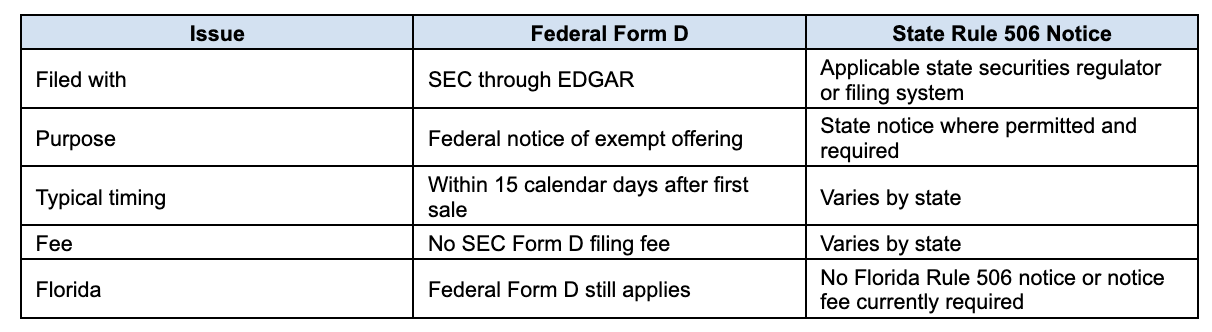
Rule 503 generally requires an issuer relying on Regulation D to file Form D electronically through EDGAR within 15 calendar days after the first sale of securities in the offering. For Form D purposes, SEC staff states that the first sale occurs when the first investor is irrevocably contractually committed to invest. The SEC does not charge a Form D filing fee.
After addressing the federal filing, the issuer must separately determine which states are implicated and whether those states require Rule 506 notice filings or fees.
Federal Form D vs. State Rule 506 Blue Sky Filings
Which States Require Rule 506 Notice Filings?
State requirements vary. The SEC expressly notes that while Rule 506(b) and Rule 506(c) offerings are not subject to state registration and review, states may require issuers to file notices and consents to service of process and to pay required state fees.
An issuer should therefore identify the states associated with its purchasers and review the rules of each applicable jurisdiction. The analysis should not be based solely on the issuer’s state of incorporation or principal place of business.
Many state Rule 506 filings can be submitted through NASAA’s Electronic Filing Depository, commonly called EFD. EFD supports Regulation D Rule 506 filings and allows filers to electronically submit certain filings and corresponding fees to participating state securities regulators. EFD makes the filing process more centralized, but it does not make substantive state requirements uniform.
Does Florida Require a Rule 506 Blue Sky Filing?
No. Florida currently does not require a Rule 506(b) or Rule 506(c) issuer to file a notice with the Florida Office of Financial Regulation or pay a Rule 506 notice filing fee.
The Florida Office of Financial Regulation states that Rule 506(b) and Rule 506(c) offerings are not subject to state registration or qualification and, unlike most states, Florida does not require an issuer relying on Rule 506 to file any notice, including Form D, with the Office or pay a filing fee to notice-file the offering.
Florida OFR guidance also states that Florida does not require a notice filing fee or consent to service for Rule 506 filings. This makes Florida unusual compared with jurisdictions that require a state Form D notice and fee.
Do You Still File Form D With the SEC if All Investors Are in Florida?
Yes. Florida’s lack of a state Rule 506 notice requirement does not eliminate the federal Form D obligation.
If an issuer relies on Rule 506(b) or Rule 506(c), Form D generally must still be filed with the SEC within 15 calendar days after the first sale, even if every purchaser resides in Florida. The Florida and federal requirements are separate.
- SEC: Form D generally required within 15 calendar days after the first sale.
- Florida OFR: no separate Rule 506 notice, Form D filing, notice filing fee, or consent to service currently required.
Florida Rule 506 Offerings Can Still Raise Dealer and Issuer-Agent Issues
The absence of a Florida Rule 506 notice filing does not mean that every aspect of the securities transaction is exempt from Florida law.
Florida OFR states that sales of securities in Florida must be made by a properly registered dealer or by a person using an applicable exemption. OFR specifically notes that this can include officers and employees of Rule 506 issuers who participate in selling the securities.
For issuers, this is an important compliance distinction: an offering may qualify for Rule 506, be federally preempted from state offering registration, and require no Florida Rule 506 notice filing, while the activities of the persons soliciting or selling the securities still require a separate registration or exemption analysis.
Do States Retain Anti-Fraud Authority Over Rule 506 Offerings?
Yes. Federal preemption of state registration does not eliminate state anti-fraud authority. SEC guidance specifically states that Rule 506(b) and Rule 506(c) offerings remain subject to state anti-fraud authority.
Accordingly, Rule 506 status is not a defense to misleading offering materials. Private placement memoranda, investor presentations, subscription materials, websites, emails, social media, and other communications should be reviewed for material misstatements and omissions.
When Do Rule 506 State Filing Deadlines Begin?
There is no single federal deadline that automatically governs every state Rule 506 notice filing. State deadlines and triggering events must be checked jurisdiction by jurisdiction.
The federal Form D deadline is different: Form D generally must be filed within 15 calendar days after the first sale in the offering. SEC staff defines the first sale for Form D purposes as the date the first investor becomes irrevocably contractually committed to invest.
Because state deadlines can differ, issuers should record the date and jurisdiction of each investor subscription as it occurs and determine whether that investment triggers a notice obligation.
What Information Should an Issuer Track for Blue Sky Compliance?
A practical Rule 506 compliance process should track state filing issues as investors enter the offering. Relevant information can include:
- The purchaser’s state of residence or, for entities, state of organization and principal location as relevant to the applicable analysis.
- The date the purchaser becomes irrevocably committed to invest.
- The amount invested.
- Whether a Rule 506 notice filing is required in the jurisdiction.
- The state filing deadline and filing fee.
- Whether a consent to service of process is required.
- Whether the filing can or must be made through EFD.
- Whether amendments or renewals may later be required.
- Proof of submission, acceptance, and payment.
- Any separate dealer, broker-dealer, issuer-agent, or salesperson registration issue.
What Happens if a Rule 506 Blue Sky Filing Is Late?
The consequences of a late or omitted Rule 506 state notice filing depend on the law and procedures of the particular state. An issuer should not assume that federal preemption makes the failure irrelevant.
If a filing is discovered to be late, the issuer should promptly determine whether the jurisdiction accepts late filings, imposes additional fees, requires an explanation or corrective submission, or provides another procedure. The appropriate response is state-specific.
The SEC separately states that a late Form D filing should be made as soon as practicable. SEC staff also notes that the Rule 503 Form D filing requirement is not itself a condition to the availability of the Regulation D exemptions, although Rule 507 addresses potential consequences for failures to comply with Regulation D filing requirements.
Common Rule 506 Blue Sky Filing Mistakes
Assuming federal preemption means no state compliance
Rule 506 preempts state registration and substantive review, but states may still impose permitted notice filings and fees and retain anti-fraud authority.
Treating Form D as a one-stop filing
The SEC Form D filing is federal. State notice requirements must be analyzed separately.
Looking only at the issuer’s home state
A multi-state offering should be reviewed based on the jurisdictions implicated by its investors and offering activity, not merely the issuer’s incorporation or headquarters.
Assuming all states follow the same deadline and fee schedule
State Rule 506 notice requirements are not uniform.
Making an unnecessary Florida Rule 506 notice filing
Florida currently does not require a Rule 506 notice, Form D filing with OFR, notice fee, or consent to service.
Ignoring securities-salesperson registration
Rule 506 offering preemption does not automatically exempt the persons selling the securities from applicable state registration requirements.
Waiting until the offering closes
Tracking state obligations only after the raise is complete can turn a manageable filing process into a late-filing problem.
Rule 506 Blue Sky Filing Checklist
- Confirm whether the offering is relying on Rule 506(b) or Rule 506(c).
- Determine the federal Form D filing date based on the first sale.
- Track the jurisdiction associated with every purchaser.
- Determine whether each applicable state requires a Rule 506 notice filing.
- Confirm the filing deadline, filing fee, and consent-to-service requirements.
- Determine whether the state filing is submitted through NASAA EFD or another process.
- Calendar any amendment or renewal requirements.
- Retain confirmation of each filing and payment.
- Separately analyze broker-dealer, issuer-agent, and salesperson registration requirements.
- Review offering communications for compliance with federal and state anti-fraud provisions.
Frequently Asked Questions About Rule 506 Blue Sky Filings
Are Rule 506 offerings exempt from blue sky laws?
Rule 506 offerings are generally exempt from state registration and substantive review, but they are not exempt from every aspect of state securities law. States may retain notice filing, fee, consent-to-service, anti-fraud, and securities-professional registration authority.
Do I need to file Form D in every state?
Not necessarily. Form D is filed federally with the SEC. Many states require a separate Rule 506 notice filing that uses Form D information, but the requirements vary by jurisdiction.
Does Florida require Form D for a Rule 506 offering?
Florida currently does not require a Rule 506 issuer to file Form D or another Rule 506 notice with the Florida Office of Financial Regulation, and it does not charge a Rule 506 notice filing fee.
Do I still file Form D with the SEC if Florida does not require a state filing?
Yes. The federal Form D obligation is separate. A Rule 506 issuer generally must file Form D with the SEC within 15 calendar days after the first sale.
Does filing Form D mean the SEC or a state approved the offering?
No. Form D is a notice filing. It is not SEC or state approval of the investment, issuer, offering terms, or disclosures.
Can Rule 506 state filings be made online?
Many can. NASAA’s Electronic Filing Depository supports Regulation D Rule 506 filings and associated fees for participating state regulators.
Are Rule 506(b) and Rule 506(c) treated the same for state preemption?
Both Rule 506(b) and Rule 506(c) offerings are covered securities and are generally exempt from state registration and substantive review. Permitted state notice, fee, anti-fraud, and other requirements can still apply.
Can a state require a Rule 506 offering to submit its PPM for approval?
States generally cannot subject a Rule 506 covered-security offering to substantive registration or qualification. States retain only the authority preserved by federal law, including anti-fraud enforcement and permitted notice requirements.
Does Florida’s no-filing rule mean officers can sell the securities without registration?
No. Florida OFR separately warns that persons selling securities in Florida, including officers and employees of Rule 506 issuers, must be properly registered or qualify for an applicable exemption.
Rule 506 State Notice Compliance Should Be Built Into the Offering Process
Rule 506 makes multi-state private placements significantly easier by preempting state registration and qualification of the offering. But an issuer still needs a process for identifying investor jurisdictions, determining state notice obligations, filing Form D, monitoring state deadlines, and addressing securities-salesperson issues.
Florida is a useful example of why state-by-state analysis matters. Florida currently requires no Rule 506 notice filing, Form D filing with OFR, notice fee, or consent to service, while many other states impose one or more of those requirements.
The best time to address blue sky compliance is while subscriptions are being accepted, not after the offering has closed. A state filing matrix tied to the issuer’s subscription records can help identify deadlines and reduce the risk of missed or unnecessary filings.
Need Assistance With Rule 506 Blue Sky Filings?
SecuritiesLawyer101 assists issuers with Rule 506(b) and Rule 506(c) offerings, Form D filings, blue sky notice filings, state securities compliance, private placement memoranda, subscription agreements, and Regulation D compliance.
Identifying federal and state filing requirements as investors enter an offering can help prevent late notices, unnecessary filings, and other compliance problems during a private capital raise.
This article is provided for informational purposes only and does not constitute legal advice. Federal and state securities laws and filing requirements can change and should be evaluated based on the facts and circumstances of each offering.
To speak with a Securities Attorney, please contact Brenda Hamilton at 200 E Palmetto Rd, Suite 103, Boca Raton, Florida, (561) 416-8956, or by email at [email protected].
Hamilton & Associates | Securities Attorneys
Brenda Hamilton, Securities Attorney
200 E Palmetto Rd, Suite 103
Boca Raton, Florida 33432
Telephone: (561) 416-8956
Facsimile: (561) 416-2855
www.SecuritiesLawyer101.com