

Public company debt-for-equity exchanges and convertible note restructuring
Article 1 in the Public Company Debt Restructuring Series
Debt Restructuring Structures at a Glance
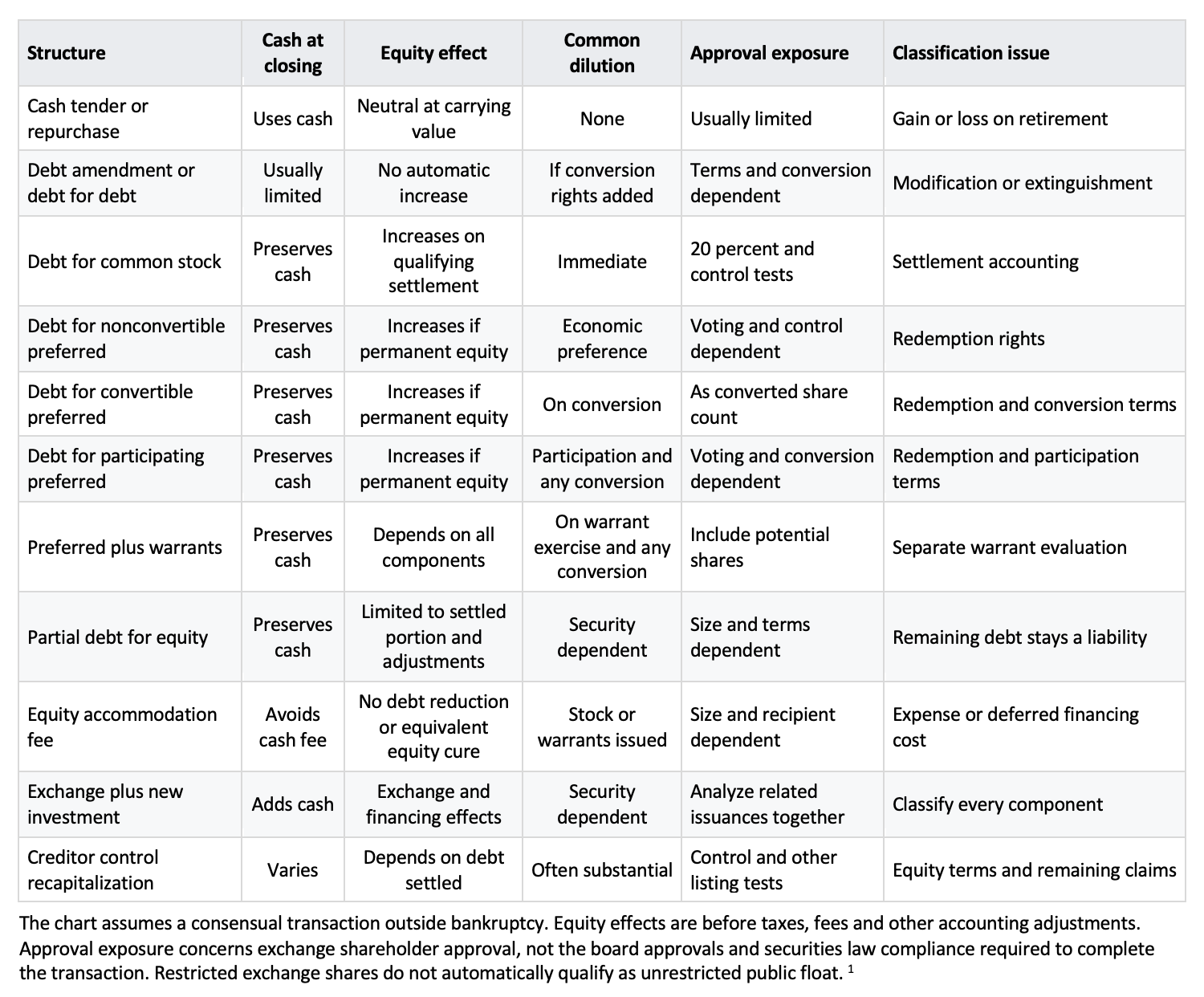
A Nasdaq Equity Deficiency and a Note Due in Nine Months
Consider a smaller public company that has received a Nasdaq stockholders’ equity deficiency notice. It reports $1 million of equity, has a $2 million note maturing in nine months, and needs its remaining cash to operate. Refinancing the note could postpone payment, but it would leave the debt outstanding. Paying it with existing cash would reduce assets and liabilities together without increasing equity at carrying value.
A debt-for-equity exchange can address a different problem. If the company extinguishes the $2 million liability for common stock or preferred stock classified as permanent equity, total equity can increase while cash remains available for operations. Assuming a $2 million carrying amount and no taxes, fees or other adjustments, equity would rise from $1 million to $3 million. That would exceed Nasdaq Capital Market’s $2.5 million equity threshold, subject to exchange confirmation and compliance with its other requirements.
For a company evaluating a Nasdaq restructuring or NYSE restructuring, the starting point is the specific listing standard and debt obligation that need to be addressed. NYSE American has its own rules and is discussed separately from the New York Stock Exchange throughout this article.
The investor must have a reason to accept the change. Preferred equity can provide a liquidation preference, dividends, participation rights or conversion rights in return for surrendering debt. The negotiated security must offer credible value to the investor without recreating the cash obligations or accounting classification that the company is trying to remove.
What Preferred Equity Means in a Debt Restructuring
Preferred equity is ownership with specified rights ahead of common equity. In a corporation, those rights are established in the charter and the terms of the preferred stock series. They can include dividend priority, a liquidation preference, conversion into common stock, participation in additional distributions, board representation and approval rights over specified actions.
A liquidation preference establishes priority among equity holders; it does not guarantee repayment. Creditors remain senior to preferred stockholders. An investor exchanging secured debt for preferred stock relinquishes the exchanged creditor claim and its associated security and remedies unless the transaction expressly preserves separate obligations. Calling the new instrument preferred debt does not change its legal character. [2]
The dividend provisions also matter. Cumulative dividends accumulate when unpaid under the instrument’s terms. Noncumulative dividends do not accumulate simply because the board did not declare them. A payment in kind, or PIK, provision allows payment in additional securities rather than cash. It preserves near-term cash but can enlarge the preferred claim and reduce future value available to common stockholders.
Debt Tender and Exchange Offers and the Available Structures
A cash debt tender offer asks holders to surrender debt for cash. An exchange offer provides new securities, potentially together with cash, for outstanding securities. A debt-for-equity exchange identifies the consideration being exchanged: a debt claim is settled for equity. The same economic exchange can be negotiated privately with a few creditors or offered more broadly through a registered or exempt exchange offer.
Cash repurchases, redemptions and debt-for-debt exchanges remain useful alternatives. A redemption follows the existing instrument’s call provisions, including any premium. A cash tender or negotiated repurchase can retire debt at a discount if holders accept the price. A debt-for-debt exchange can extend maturity, revise interest, change collateral or modify covenants. Consent solicitations can accompany a tender or exchange to amend provisions that the debt documents permit holders to amend. These techniques address maturity and liquidity problems, but they do not inherently produce the equity increase available from settling a liability for permanent equity. [3]
Common stock exchanges and convertible note restructuring
A direct common stock exchange fixes the amount of debt surrendered and the number of shares delivered. At an agreed $2 exchange price, a $2 million claim would receive one million common shares. The agreement must separately resolve accrued interest, default amounts, fees, existing warrants, collateral releases and the treatment of any debt left outstanding. The investor receives stock appreciation potential and accepts market risk and loss of creditor priority.
A convertible note restructuring can instead amend maturity, interest, the conversion price, conversion floors or the conversion schedule. A completed conversion settles debt; a contractual promise that a note might convert later does not necessarily settle the liability today. Sweetening conversion terms can also produce an accounting charge. A company pursuing an equity cure needs a closing structure that produces the required accounting result within its compliance timetable, rather than relying on a future discretionary conversion.
Preferred stock structures compared
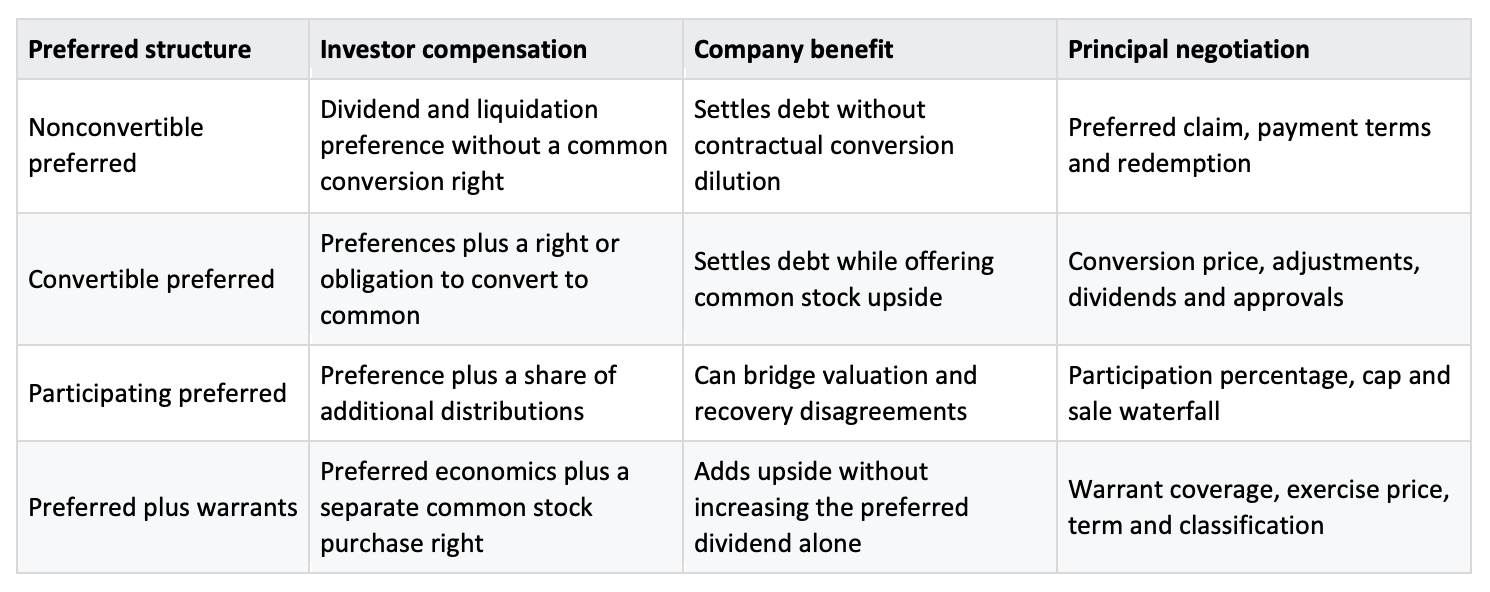
These structures can overlap. Preferred stock can be both convertible and participating, and either convertible or nonconvertible preferred can be issued with warrants. Structured preferred equity can also provide consideration for covenant relief, a method of reducing leverage, or the investment through which creditors receive control. [4]
Nonconvertible preferred avoids a contractual common conversion right, but it still changes the economics for common stockholders. Its dividend and liquidation preference can absorb proceeds otherwise available to them. Convertible preferred adds potential share dilution, with the exchange ratio, conversion adjustments and dividend treatment determining the eventual common share count.
Participating preferred needs a distribution model. Suppose an investor receives a $2 million preference and 20 percent participation in remaining proceeds. If $10 million is available to equity holders after senior obligations, the investor receives $2 million plus 20 percent of the remaining $8 million, for a total of $3.6 million. This example assumes no cap, accumulated dividends or competing preferred classes. A nonparticipating convertible preferred arrangement ordinarily gives the investor the preference or the as-converted distribution, rather than both. The actual charter terms control. [5]
Warrants separate the common stock upside from the preferred return. The investor can retain its preferred investment and exercise the warrants on their terms. Future warrant proceeds are not cash available at the restructuring closing unless exercise is actually required then. Liability classification or embedded derivative features can also reduce the expected equity benefit.
Partial exchanges and accommodation fees
An investor holding $5 million of debt could exchange $3 million for preferred stock and retain a $2 million note with an extended maturity. Only the settled portion produces debt cancellation. The remaining debt, guarantees, collateral and default provisions need to be addressed expressly.
An equity accommodation fee is different. A lender may receive shares or warrants for granting a waiver or extension while principal remains outstanding. An equity credit can be offset by an expense, or by subsequent amortization if the fee is capitalized as a financing cost. The fee therefore does not deliver the debt reduction and corresponding equity increase of a true debt-for-equity exchange; after the related expense is recognized, its standalone equity effect is often roughly neutral. Initial reported equity can differ when a fee is deferred. [6]
New capital and creditor control
A restructuring can pair debt cancellation with a cash investment. The exchange addresses existing liabilities while the financing funds operations or pays nonparticipating creditors. An existing lender or new investor can purchase common stock, preferred stock or preferred and warrant units. Closing conditions can require a minimum financing so the company has enough cash to execute its operating plan.
A larger recapitalization can transfer control to creditors through common stock, preferred voting rights or board changes. Existing shareholders may retain a subordinated interest. Change of control, voting rights, board independence, related-party transactions and, where applicable, a new initial listing review must be evaluated separately from the equity cure. [7]
Nasdaq Restructuring and NYSE Restructuring for Listing Compliance
Book equity, market capitalization and unrestricted public float are separate measurements. An unlisted preferred series can count toward qualifying book equity without adding to the market value or distribution of the listed common stock. A restricted common share issuance can increase equity while failing to supply the unrestricted public float needed for an initial listing.
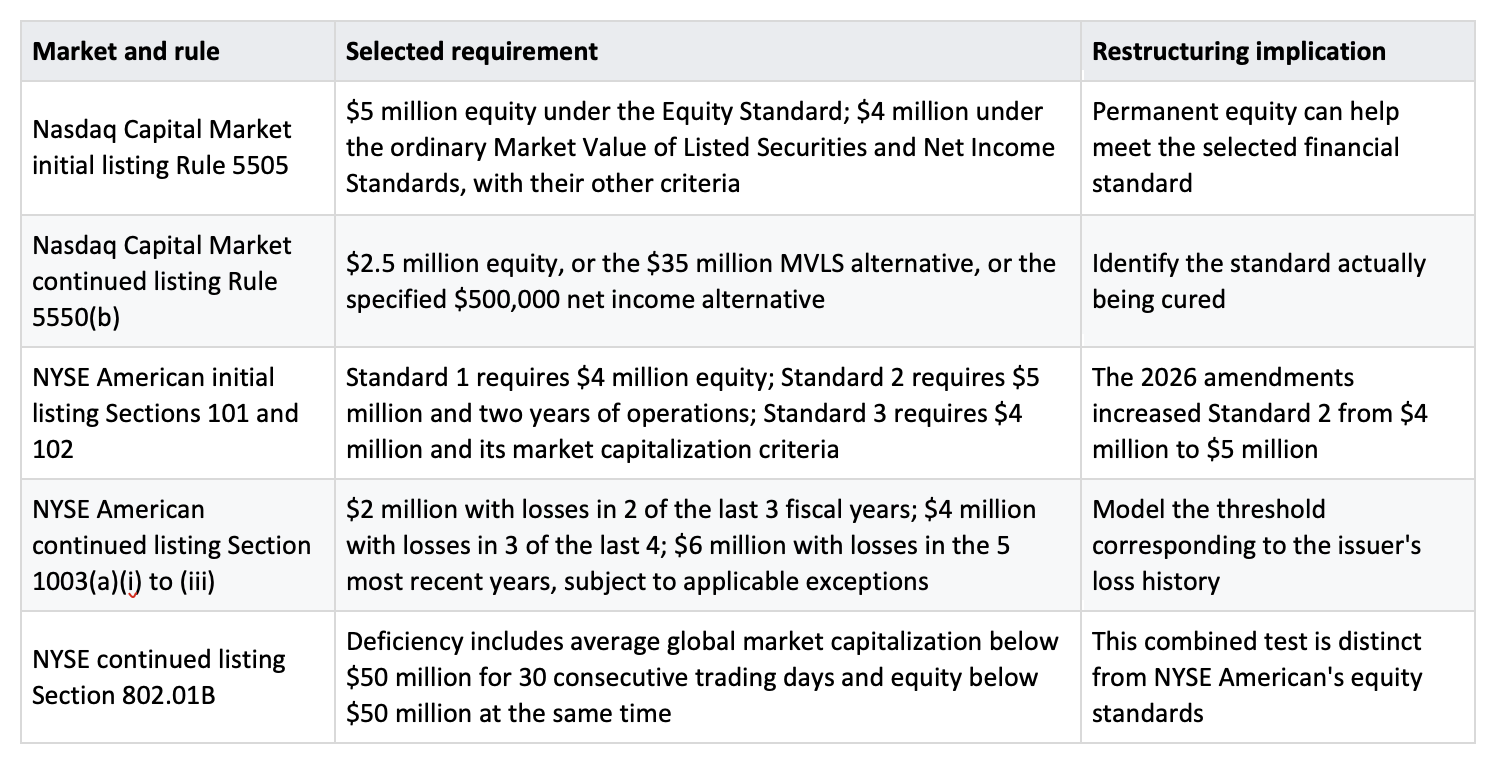
The table summarizes selected rules, not complete listing eligibility. Nasdaq and NYSE American have additional price, distribution, financial and governance requirements. NYSE has separate initial listing standards; it does not use the Nasdaq Capital Market equity tests. [8]
NYSE American’s 2026 amendments also require the applicable initial market-value thresholds to be met with unrestricted publicly held shares: $15 million under Standards 1, 2 and 3 and $20 million under Standard 4. Shares subject to resale restrictions or excluded because of their holder do not become qualifying public float merely because the exchange issuance is completed. Registration, transfer restrictions and public ownership must be evaluated independently. [9]
The new market capitalization floor is a separate obstacle
On November 13, 2026, the SEC approved NYSE American Section 1003(b)(i)(D). If a common stock class has average market capitalization below $5 million over 30 consecutive trading days, the exchange will immediately suspend trading and begin delisting proceedings. The ordinary Section 1009 compliance-plan period is unavailable for this deficiency; appeal rights remain. [10]
Nasdaq’s comparable $5 million MVLS requirement was approved in July 2026 under delegated authority, but that approval remains stayed pending full Commission review as of this article’s date. Nasdaq’s revised operative-date provision starts the 30-consecutive-business-day measurement only after the stay ends. It must not be described as an already operative floor. The separate $35 million MVLS alternative under Nasdaq Rule 5550(b)(2) is not the stayed $5 million rule [11]
Exchanging debt for preferred stock does not mechanically increase the market capitalization of the listed common stock. A common stock exchange changes shares outstanding, but price changes can offset that increase. Neither transaction guarantees compliance with a market-value test or repairs a previously failed averaging period. A reverse split changes price and share count proportionately at implementation and does not itself create equity or market capitalization.
How a Company Demonstrates That It Has Regained Compliance
A Nasdaq equity deficiency ordinarily begins with a staff notice. For a deficiency eligible for plan review, Rule 5810(c)(2) generally provides 45 calendar days to submit a plan. Staff can grant an extension of up to 180 calendar days from its initial notification; an extension is discretionary, and repeat deficiencies or existing proceedings can change the process.
The plan needs executed or credible transaction milestones, a timetable and financial projections showing that compliance can be maintained. Nasdaq’s published guidance calls for a transaction-adjusted balance sheet and income statement with historical amounts, adjustments and pro forma totals. Closing documents and accounting support must demonstrate the result actually achieved. [12]
In practice, an issuer can disclose completed transactions and an updated equity calculation in Form 8-K, often with an unaudited pro forma balance sheet. The calculation needs to account for losses and other changes through the relevant measurement date, rather than presenting an old balance sheet adjusted only for favorable transactions. The next Form 10-Q or Form 10-K then supplies a critical check on ongoing compliance. An issuer’s statement that it believes it has cured is not a substitute for Nasdaq’s determination. [13]
NYSE American Section 1009 provides a plan process for eligible deficiencies, with an accepted compliance period of up to 18 months subject to conditions and exchange review. The deficiency letter supplies the submission deadline and required milestones. NYSE uses its own procedures under Sections 802.02 and 802.03. In either market, the issuer needs written exchange confirmation and continued monitoring; the new NYSE American $5 million floor does not carry the ordinary plan opportunity. [14]
Imunon Shows How a Preferred Stated Value Premium Compensates the Investor
Imunon’s September 2026 exchange illustrates a partial restructuring into nonconvertible preferred equity. Its Form 8-K reports that $1.2 million of A-1 Note principal, together with accrued and unpaid interest on that amount, was exchanged for 120 Series B preferred shares at $10,000 per share. Its September 29 press release also identifies a $12,000 stated value per share. [15]
The difference is economically meaningful: 120 shares issued at $10,000 have a $1.2 million aggregate exchange price, while their $12,000 stated value totals $1.44 million. The 20 percent stated-value premium compensates the investor through the preferred terms. It is not a guaranteed 20 percent cash profit, a finding of fair value, or an additional $240,000 of book equity.
Imunon’s Form 10-Q for the quarter ended September 30, 2026 describes an 8 percent annual preferred return on stated value, payable in cash or additional preferred shares at the company’s election; no common stock conversion right; no holder right to demand redemption; and issuer-controlled redemption. It reports permanent equity classification and a separate loss on partial debt extinguishment reflecting the accounting carrying amounts. These details demonstrate why purchase price, stated value, fair value and the debt’s carrying amount must not be used interchangeably. [16]
Securities Act Registration and Exempt Exchanges
The company must register the exchange issuance or satisfy an available exemption. A registered exchange offer can reach a broader holder population but requires the applicable registration statement, disclosure and SEC review process. A private exchange can rely on Section 4(a)(2) or another available exemption if its conditions are met. Resale registration after an exempt exchange is a separate transaction from registration of the exchange issuance itself.
Section 3(a)(9) exempts a qualifying exchange by an issuer exclusively with its existing security holders, with no commission or other remuneration paid for soliciting the exchange. The surrendered claim must be a security of the relevant issuer; an ordinary commercial claim is not automatically eligible. The same-issuer and consideration requirements need attention when debt sits at a subsidiary or a creditor also supplies cash. Paying lawyers or advisers is not automatically disqualifying, but compensation for solicitation is. The SEC’s specific interpretations distinguish ministerial assistance from encouraging participation. [17]
Restricted securities and Rule 144 holding period tacking
Securities received in a Section 3(a)(9) exchange assume the restricted or unrestricted character of the securities surrendered. Restricted notes do not become unrestricted shares simply because they are exchanged. Rule 144(d)(3)(ii) generally permits holding-period tacking when securities are acquired solely in exchange for other securities of the same issuer. SEC Question 132.08 addresses character and tacking; Question 132.17 confirms that qualifying tacking is not limited to exchanges exempt under Section 3(a)(9). Interpretation 532.13 addresses accrued interest on convertible notes exchanged for shares. [18]
Tacking addresses the holding period, not every condition for sale. Affiliate status, current public information, volume and manner-of-sale conditions where applicable, Rule 144(i) for current or former shell companies, and other restrictions remain relevant. Registration rights can provide another resale route, but an effective registration statement does not assure market liquidity.
Concurrent financing and Rule 152 integration
A simultaneous cash raise needs its own registration or exemption. Under Rule 152’s integration framework adopted in 2020, offerings outside a safe harbor are evaluated to determine whether each complies with registration or its claimed exemption. Relevant communications and solicitation restrictions cannot be avoided by using separate agreements. The 30-calendar-day separation safe harbor is not a blanket safe harbor for concurrent closings. In particular, the company cannot assume that Section 3(a)(9) covers new cash subscribed alongside an exchange. [19]
Tender Offer Rules for Convertible Notes
A Securities Act exemption does not exempt an exchange from Exchange Act tender offer regulation. Notes convertible into stock fall within the Exchange Act definition of an equity security. An issuer tender or exchange offer for those notes can therefore trigger Rule 13e-4 and Schedule TO, as well as Regulation 14E. A conventional nonconvertible debt tender also falls within Regulation 14E, even though Rule 13e-4 does not apply merely because the securities are debt. [20]
Counsel must determine whether the negotiations constitute a tender offer, then apply the relevant commencement filings, offering period, withdrawal rights, dissemination and amendment requirements. A limited, individually negotiated exchange is not automatically a tender offer, but broad solicitation, uniform nonnegotiable terms, a deadline and minimum participation conditions can change the result. Do not import abbreviated nonconvertible debt tender procedures into a convertible note exchange without confirming their availability.
Shareholder Approval and Corporate Authority
Nasdaq Rule 5635(d) requires shareholder approval before a nonpublic transaction involving an issuance or potential issuance of at least 20 percent of pretransaction common shares or voting power at a price below Minimum Price. Minimum Price is the lower of the Nasdaq Official Closing Price immediately before signing and the average Nasdaq Official Closing Price for the five trading days before signing. Rule 5635(b) separately requires approval for an issuance or potential issuance resulting in a change of control.
Convertible preferred and warrants are evaluated for their potential common share issuance, including applicable conversion adjustments. The preferred certificate count is not the relevant common share count. Registration alone does not make a transaction a public offering under Nasdaq’s rules, and a 19.99 percent cap does not eliminate an independent change-of-control issue or validate a cap with coercive penalties. [21]
NYSE American Section 713 likewise addresses 20 percent issuances and change of control. Its Minimum Price exception is limited to qualifying cash sales; Commentary .02 prevents treating a noncash debt exchange as eligible merely because a negotiated conversion price meets Minimum Price. NYSE issuers must separately apply Listed Company Manual Sections 312.03 and 312.04. The exchange’s treatment of the actual transaction, rather than the security’s label, controls. [22]
For corporate authority, the charter must already establish the required preferred rights or authorize the board to designate them through blank check preferred authority, with enough shares available. Otherwise, a charter amendment and the required shareholder approval are needed before issuance. For a Delaware corporation, the board adopts the series terms within its charter authority and files the required certificate of designations. The company also needs sufficient authorized common shares for conversion and warrant exercise. Other jurisdictions have their own requirements. [23]
Accounting for Debt and Preferred Stock Restructuring
The accounting discussion assumes U.S. GAAP. Four determinations are especially important:
- ASC 470-60 still governs qualifying troubled debt restructurings by debtors. Financial difficulty and a creditor concession determine whether the model applies; eliminating creditor TDR accounting did not eliminate debtor accounting.
- ASC 470-20 addresses convertible debt, including induced conversions. Sweetened conversion terms can trigger inducement expense. ASU 2024-04 clarifies the boundary between induced conversions and extinguishments and applies for fiscal years beginning after December 15, 2025, including interim periods within those years.
- ASC 470-50 governs applicable debt modifications and extinguishments. Under ASC 470-50-40-2, an extinguishment involving a related party can be a capital transaction in substance, rather than generating an ordinary extinguishment gain. Related-party status alone does not dictate the result.
- ASC 480 and the SEC’s redeemable-equity guidance originating in ASR 268, reflected in ASC 480-10-S99-3A, distinguish liabilities, temporary equity and permanent equity. Redemption and settlement rights, including side agreements, must be reviewed before assuming an exchange will cure a stockholders’ equity deficiency. [24]
For a complete settlement solely with permanent equity, the simplified balance-sheet identity is useful: total equity increases by the carrying amount of liabilities derecognized, less cash paid, transaction costs, taxes and other applicable adjustments. Fair value still matters. It determines how the result is allocated between the issued equity and a gain or loss, or another required accounting treatment. It does not allow the company to create extra total equity by assigning a higher stated value to preferred stock. [25]
For example, assume $2 million of net debt carrying amount is settled for permanent equity measured at $1.5 million. Before costs, taxes and other adjustments, a $1.5 million equity credit plus a $500,000 gain produces a $2 million total equity increase. If the equity is measured at $2.5 million and a $500,000 loss results, the total increase is still $2 million. These are simplified extinguishment illustrations; they do not override the TDR, conversion, related-party or derivative rules applicable to the actual instrument.
Tax Consequences for the Company and the Debtholder
Internal Revenue Code Section 108(e)(8) treats a corporation satisfying debt with stock as paying cash equal to the stock’s fair market value. A shortfall relative to the debt’s applicable tax amount can generate cancellation-of-indebtedness income. Bankruptcy or insolvency exclusions can apply, with tax-attribute reduction. Tax-adjusted issue price and other tax rules, rather than the GAAP carrying amount or preferred stated value, determine the tax calculation. A reported book gain is not itself taxable COD income. [26]
Section 382 adds a separate issue for companies with net operating loss carryforwards. An ownership change generally involves increases of more than 50 percentage points by relevant 5-percent shareholders over the testing period, usually three years. A creditor exchange, combined with other ownership shifts, can trigger an annual limit on using prechange losses. The analysis is not simply whether one creditor owns more than 50 percent after closing. Preferred stock and options have special rules, so both the exchange and concurrent financing belong in the ownership study. [27]
For the holder, an exchange can qualify for nonrecognition as part of a recapitalization under Sections 354 and 368(a)(1)(E) when the requirements are satisfied, including treatment of the surrendered debt as securities for tax purposes. That tax concept is not identical to the Securities Act definition. Cash or other consideration, nonqualified preferred stock issues and amounts attributable to accrued interest require separate treatment. The company’s issuer-side COD result and the holder’s exchange treatment are distinct questions. [28]
Form 8-K Disclosure and Creditor Negotiations
The disclosure timetable starts with the triggering event, not a general decision to announce the deal. For a domestic reporting company, relevant Form 8-K items include Item 1.01 for a material definitive agreement; Item 3.01 for a reportable listing deficiency notice; Item 3.02 for unregistered equity sales when its thresholds are met; Item 3.03 for material modification or qualification of registered security holders’ rights; and Item 5.03 for charter changes, including a certificate of designations when applicable. Item 5.01 can apply to a change of control and Item 5.02 to board or officer changes. Agreements and the certificate of designations are filed as applicable exhibits under Item 9.01. Most of these items use a four-business-day deadline, but the applicable item and its exceptions control. [29]
Creditors receiving financial forecasts or proposed restructuring terms can become recipients of material nonpublic information. Before sharing that information, the company should establish appropriate confidentiality and trading restrictions through wall-crossing arrangements. Regulation FD excludes specified confidential disclosures, including disclosures to a person who expressly agrees to maintain confidentiality, but that exception does not authorize insider trading. Cleansing disclosures must address the material information actually shared before parties assume they can resume trading. [30]
A Closing Checklist for Public Company Debt Restructuring
- Identify the exact listing deficiency, cure deadline and any separate market-capitalization, price or unrestricted-float problem.
- Reconcile principal, interest, fees, debt carrying amount, tax amount, preferred purchase price and preferred stated value.
- Select the exchange securities and model dilution, dividends, participation, redemption and a sale of the company.
- Obtain the accounting conclusions needed to support permanent equity and the pro forma compliance calculation.
- Confirm charter authority, authorized shares, board approvals, shareholder approvals and exchange notifications.
- Select the registration or exemption route, evaluate integration and tender offer rules, and document the investor’s resale path.
- Complete the tax and Section 382 review, creditor releases, closing conditions and required public disclosures.
- Deliver closing evidence to the exchange, obtain its compliance determination and monitor the next periodic report and future losses.
Next in this series: Convertible Note Restructuring and Section 3(a)(9) Exchanges, including conversion price changes, accrued interest, holding-period tacking and resale registration.
This article provides general educational information as of November 28, 2026. It is not legal, tax or accounting advice. Exchange rules and their operative status can change; transaction-specific advice is required before relying on a restructuring to obtain or maintain a listing.
About the Author
Brenda Hamilton is a securities attorney with Hamilton & Associates Law Group, P.A.
Hamilton & Associates Law Group, P.A. represents companies in SEC reporting, private placements, going public transactions and exchange listings.
Hamilton & Associates | Securities Attorneys
Brenda Hamilton, Securities Attorney
200 E Palmetto Rd, Suite 103
Boca Raton, Florida 33432
Telephone: (561) 416-8956
Facsimile: (561) 416-2855
www.SecuritiesLawyer101.com
Endnotes
[1] Delaware General Corporation Law Section 151, Classes and series of stock; KPMG, Debt and Equity Financing, October 2025, Chapters 4 through 10; Nasdaq Rules 5635 and related interpretive material.
[3] SEC Regulation 14E, Rule 14e-1, Unlawful tender offer practices; Securities Act Section 3(a)(9), 15 U.S.C. Section 77c(a)(9); SEC Rule 13e-4, Tender offers by issuers.
[4] Delaware General Corporation Law Section 151, charter authority for preferred stock terms; Imunon Inc., Form 8-K dated September 28, 2026, Items 1.01, 3.02 and 5.03 and exhibits.
[7] Polar Power Inc., Form 8-K dated October 23, 2026, Item 3.01, financing and debt conversion transactions; Nasdaq Rule 5635(b), change of control, and Rule 5640, voting rights.
[8] Nasdaq Capital Market Rules 5505 and 5550(b), initial and continued listing financial standards; NYSE American Company Guide Sections 101, 102 and 1003(a)(i) through (iii); NYSE Regulation, Initial Listings, current NYSE American financial standards; NYSE Listed Company Manual Section 802.01B, capital and common stock continued listing standards; NYSE Regulation, Noncompliant Issuers, financial standard descriptions.
[9] SEC Release No. 34-105105, March 27, 2026, approval of NYSE American Sections 101 and 102 amendments, File No. SR-NYSEAMER-2026-02; NYSE American Company Guide Sections 101 and 102.
[10] SEC Release No. 34-106893, November 13, 2026, approval of NYSE American Sections 1003 and 1009 amendments, File No. SR-NYSEAMER-2026-17; NYSE American Company Guide Section 1003(b)(i)(D) and Section 1009.
[11] SEC Release No. 34-106338, September 11, 2026, order granting petitions for review and continuing the stay of File No. SR-NASDAQ-2026-004; SEC Release No. 34-106594, October 5, 2026, revised operative date and measurement period, File No. SR-NASDAQ-2026-081; Nasdaq Rule 5550, including the published notice of the SEC stay.
[12] Nasdaq Rule 5810(c)(2), compliance plans and staff extensions; Nasdaq Listing Center, Compliance Plans, Identification No. 1023, pro forma balance sheet and income statement requirements.
[13] Vivos Therapeutics Inc., Form 8-K dated October 15, 2026, Item 8.01, Nasdaq equity compliance and unaudited pro forma balance sheet; Polar Power Inc., Form 8-K dated October 23, 2026, Item 3.01, pro forma equity and next periodic report monitoring.
[14] NYSE American Company Guide Section 1009, continued listing evaluation and follow-up procedures; SEC Release No. 34-106893, November 13, 2026, discussion of ordinary compliance periods and the new exception; NYSE Listed Company Manual Sections 802.02 and 802.03, continued listing procedures.
[15] Imunon Inc., Form 8-K dated September 28, 2026, Item 1.01 and Exchange Agreement; Imunon Inc., IMUNON Converts 1.2 Million Dollars of Debt to Equity, press release dated September 29, 2026.
[17] Securities Act Section 3(a)(9), 15 U.S.C. Section 77c(a)(9); SEC Securities Act Sections Interpretations, Question 125.03, ministerial solicitation assistance; SEC Securities Act Sections Interpretations, Question 125.06, third-party solicitation compensation.
[18] SEC Securities Act Rules Interpretations, Question 132.08, character of exchanged securities and tacking; SEC Securities Act Rules Interpretations, Question 132.17, tacking in an exempt private exchange; SEC Securities Act Rules Interpretations, Interpretation 532.13, accrued interest on convertible notes; Rule 144(d)(3)(ii), 17 C.F.R. Section 230.144, conversion or exchange of securities.
[20] Exchange Act Rule 3a11-1, definition of equity security including securities convertible into stock; SEC Rule 13e-4, issuer tender offers and Schedule TO requirements; SEC Regulation 14E, Rule 14e-1, tender offer practices.
[21] Nasdaq Rules 5635(b), 5635(d), 5635(e), IM-5635-2 and IM-5635-3, control, Minimum Price, computations, caps and public offerings; Nasdaq Listing Center, Shareholder Approval FAQs, Identification Nos. 272 and 276, convertible security pricing and adjustments.
[22] NYSE American Company Guide Section 713 and Commentary .02; SEC Release No. 34-102396, February 11, 2025, immediately effective Section 713 Minimum Price and cash sale amendments; NYSE American File No. SR-NYSEAMER-2025-06, Exhibit 5, full Section 713 amendment text; NYSE Listed Company Manual Sections 312.03 and 312.04.
[24] KPMG, Debt and Equity Financing, October 2025, Chapters 4, 6, 7 and 10, debtor TDRs, extinguishments, equity classification and convertible instruments; EY, Issuers Accounting for Debt and Equity Financings, September 2024, Section 2.5.1.5, related-party extinguishments under ASC 470-50-40-2; EY, FASB Clarifies Accounting for Induced Conversions of Convertible Debt Instruments, December 5, 2024, ASU 2024-04 and effective date; FASB ASU 2023-03, SEC materials concerning ASR 268 and ASC 480-10-S99-3A.
[25] EY, Issuers Accounting for Debt and Equity Financings, September 2024, Section 2.5.1, debt extinguishment measurement; Imunon Inc., Form 10-Q for the quarter ended September 30, 2026, debt carrying amount, preferred fair value and extinguishment loss.
[28] Internal Revenue Code Section 354, exchanges of stock and securities and accrued interest treatment; Internal Revenue Code Section 368(a)(1)(E), recapitalization.
[29] SEC Form 8-K, General Instruction B and Items 1.01, 3.01, 3.02, 3.03, 5.01, 5.02, 5.03 and 9.01.
[30] Regulation FD, Rule 100(a) and 100(b)(2), selective disclosure and confidentiality exceptions.