
In plain English: Rule 144 is the SEC safe harbor that lets holders resell restricted securities, and lets affiliates resell any securities, without registration. A seller who meets its conditions is not treated as an “underwriter,” so the sale is exempt under Section 4(a)(1).
What the rule provides
Rule 144, 17 CFR 230.144, works through five conditions. Which ones apply depends on whether the seller is an affiliate and whether the issuer is a reporting company.
Current public information: Rule 144(c) distinguishes reporting and non-reporting issuers. For a reporting issuer, review the required reporting history and filed reports, excluding Form 8-K, for the preceding 12 months or shorter required period. Apply the specific information requirements to a non-reporting issuer.
Holding period: Restricted securities generally require six months when the issuer has been subject to Section 13 or 15(d) reporting for at least 90 days immediately before sale; otherwise, one year. The acquisition, full-payment and tacking rules affect the start date. Affiliate-held unrestricted securities do not acquire a holding period solely because the holder is an affiliate.
Affiliate volume limits: For equity securities, review the 1% outstanding-class test and any available exchange trading-volume alternative, using the prescribed period and aggregation rules. OTC trading volume generally does not provide the exchange-volume alternative. Debt securities have separate provisions.
Manner of sale (144(f) and (g), affiliates only): Equity securities must be sold in unsolicited brokers’ transactions, directly with a market maker, or in riskless principal transactions.
Form 144 notice: For affiliate sales relying on Rule 144, a notice generally is required when the three-month amount exceeds 5,000 shares or other units, or $50,000. Filing method depends on the issuer’s reporting status.
Shell companies: Rule 144(i) imposes a separate restriction for securities of issuers within its shell and former-shell provisions. Review the issuer’s reporting status, required filed reports, cessation of shell status and the one-year interval after current Form 10 information; elapsed ownership alone is insufficient.
Who must meet which conditions
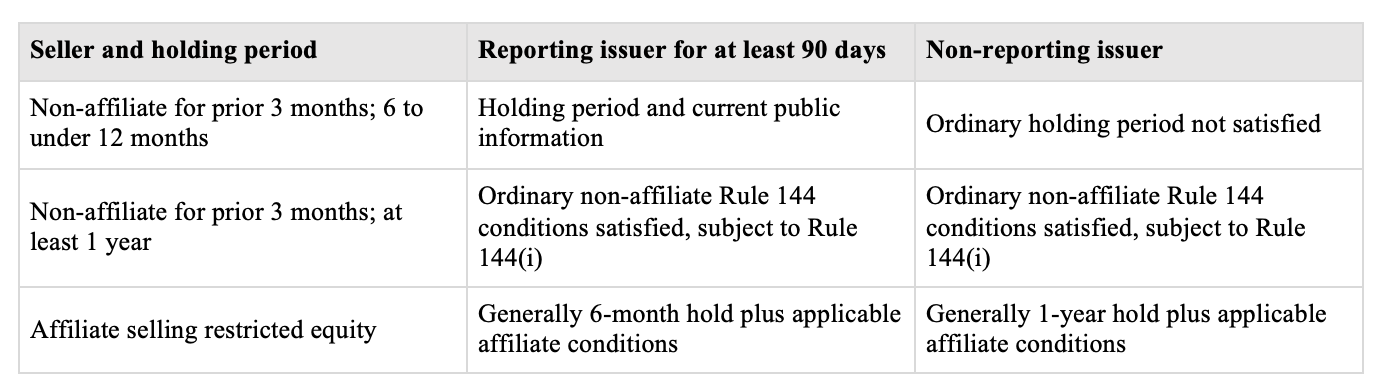
This table summarizes ordinary restricted-equity resales only. Rule 144(i), tacking, full payment, aggregation and transaction facts require separate analysis. Other restrictions and exemptions may apply.
Common mistakes
Relying on OTC trading volume for the volume test. In the SEC staff’s view, only exchange volume counts, so OTC affiliates are generally limited to 1% of the outstanding class.
Forgetting the 90-day look-back: a seller who was an affiliate in the prior three months is still treated as one.
Relying on the ordinary holding-period table without separately satisfying Rule 144(i) for an issuer within the shell or former-shell restriction.
Assuming the holding period starts at conversion when tacking rules may start it earlier, or later if the note wasn’t fully paid.
Related terms: Restricted Securities · Affiliate · Control Securities · Form 144 · Legend Removal · Shell Company
Need a Rule 144 opinion? Call 561-416-8956 to get started.
Related articles and services
Legal Opinion, Rule 144 Opinion and Section 4(a)(1) Opinion — 2026-05-12
Transfer Agent Refused Legend Removal? What to Do Next — 2026-08-14
Rule 144 and Other Legal Opinions
Governing authorities
This glossary is general information, not legal advice. Reading it does not create an attorney-client relationship.
Return to the Securities Law Glossary — proposed new index