
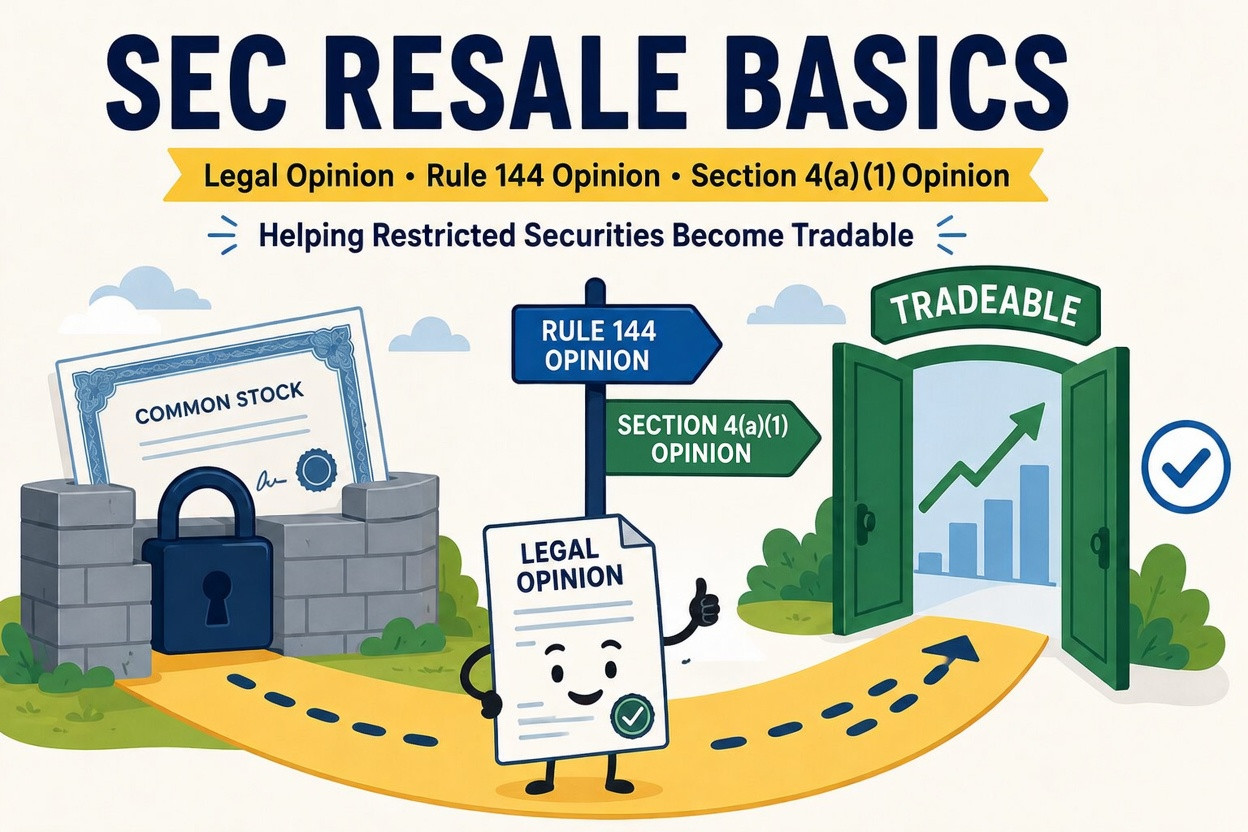
Why SEC Resale Opinions Matter
A legal opinion can be a critical step in moving restricted or controlled securities from a blocked position to a tradable position. In registered offerings, the SEC focuses on Exhibit 5 legality opinions and, where required, Exhibit 8 tax opinions. In resale transactions, a transfer agent, broker, issuer or shareholder may instead be focused on a Rule 144 opinion or a Section 4(a)(1) opinion. Although these legal Legal Opinion Rule 144 Opinion and Section 4a1 Opinion SEC Resale Restricted Securities opinions arise in different contexts, they share a practical purpose: they help confirm whether securities may be issued, transferred or resold without violating the registration requirements of the Securities Act of 1933.
For shareholders, the issue is often practical and immediate. The stock certificate or book-entry position may carry a restrictive legend. A broker may refuse to accept the shares for deposit. A transfer agent may require a written counsel analysis before removing the legend. The shareholder may believe the holding period has run, but the documents may not be complete. In these situations, the right legal opinion can make the difference between a stalled transaction and an orderly, compliant resale.
This article explains the relationship between an SEC-focused legal opinion, a Rule 144 opinion and a Section 4(a)(1) opinion. It is written for public company issuers, shareholders, transfer agents and market participants who need a plain-English overview of how these opinions fit into resale compliance. It is not legal advice, and each transaction requires a fact-specific review.
The SEC Framework: Registration Is the Default Rule
The starting point is simple: securities sold in the United States generally must be registered with the SEC unless the security or the transaction qualifies for an exemption. That default rule explains why resale opinions are so important. A shareholder seeking to resell restricted securities must identify a valid path outside registration or wait for registration to become available.
Section 4(a)(1) of the Securities Act provides an exemption for transactions by persons other than an issuer, underwriter or dealer. The challenge is that the word “underwriter” is broad. A person who purchased securities from an issuer with a view to distribution can be treated as an underwriter, which can make Section 4(a)(1) unavailable unless the facts support a different conclusion. Rule 144 was adopted to reduce uncertainty by creating a safe harbor that, when satisfied, deems the seller not to be engaged in a distribution and not to be an underwriter for that transaction.
In practice, a Rule 144 opinion is often the opinion requested when the seller can satisfy the rule’s conditions. A section 4a1 opinion may be requested when counsel is analyzing whether a resale exemption exists outside Rule 144, or when a transaction relies on Section 4(a)(1) principles rather than the Rule 144 safe harbor. The distinction matters because Rule 144 is not the only possible exemption, but it is often the most familiar and administrable route for public resales of restricted or control securities.
What Is a Legal Opinion in the SEC Context?
The term legal opinion is broad. In a registered offering, SEC rules generally require a signed opinion of counsel about the legality of the securities being registered. These opinions are commonly filed as Exhibit 5 opinions and typically address whether shares will be legally issued, fully paid and non-assessable, or whether debt securities will be binding obligations. For shelf registration statements, counsel may need to address securities that will be sold later in takedowns, which can affect the timing and form of the opinion.
The SEC Staff’s guidance on legality and tax opinions emphasizes that assumptions and qualifications must not be so broad that they avoid the legal issue being opined upon. Counsel should not assume away core matters such as whether the issuer is legally incorporated, has sufficient authorized shares or has taken required corporate action. That principle is useful beyond registered offerings. A resale legal opinion should be grounded in actual documents and facts, not in unsupported assumptions.
For resale purposes, a legal opinion usually does not say that new securities are being validly issued. Instead, it may address whether outstanding securities may be transferred without registration, whether a restrictive legend may be removed, or whether a proposed resale may rely on Rule 144 or Section 4(a)(1). The opinion recipient may be the transfer agent, the issuer, the broker or another transaction participant.
Rule 144 Opinion: The Most Common Legend Removal Path
A Rule 144 opinion is a securities law opinion addressing whether a holder may resell restricted or control securities under Rule 144. Rule 144 is a safe harbor, not the only exemption. If the conditions are satisfied, the seller is treated as not being an underwriter for the covered transaction, and the buyer receives securities that are not restricted securities as a result of that sale.
A Rule 144 opinion often evaluates several points. The opinion giver typically reviews how the securities were acquired, whether the issuer is subject to reporting obligations, whether the seller is an affiliate, how long the securities have been held, whether current public information is available, whether volume limits apply, whether manner-of-sale requirements apply, whether Form 144 is required and whether the transaction appears to be part of a plan to evade registration.
The analysis is different for affiliates and non-affiliates. A non-affiliate of a reporting issuer may have a shorter path after the required holding period and the satisfaction of current public information requirements. After a longer holding period, a non-affiliate may be able to resell without the same continuing conditions. Affiliates generally face more conditions, including volume limitations, manner-of-sale rules and notice requirements where applicable. This is why an accurate affiliate analysis is central to any Rule 144 opinion.
The holding period also deserves careful attention. Counsel may need to review subscription agreements, stock purchase agreements, conversion documents, promissory notes, corporate approvals, transfer records and prior owner information. Tacking can be available in some circumstances, but it is not automatic. A weak holding-period record can delay or prevent legend removal even when the shareholder believes the securities are old enough.
Section 4(a)(1) Opinion and Section 4a1 Opinion: When Rule 144 Is Not the Only Route
A Section 4(a)(1) opinion, sometimes searched online as a section 4a1 opinion, addresses whether a resale may qualify as a transaction by a person other than an issuer, underwriter or dealer. This type of opinion is more transaction-specific than a simple mechanical checklist. Counsel must consider whether the seller is acting as an underwriter, whether the transaction is a distribution, how the securities were acquired, whether there were general solicitation issues, the seller’s relationship to the issuer and the overall facts of the proposed resale.
A section 4a1 opinion may be relevant where Rule 144 is unavailable, incomplete or not the best fit. For example, a seller might seek a private resale exemption analysis outside the Rule 144 safe harbor. Another transaction may involve securities that are no longer restricted in the practical sense but still require transfer agent comfort. In other cases, a broker or transfer agent may ask counsel to explain why a transaction is not a distribution even though not every Rule 144 condition is being used.
Because Rule 144 is a safe harbor, failure to meet Rule 144 does not automatically mean a resale is unlawful. It means the seller cannot rely on that safe harbor for the transaction. The availability of another exemption depends on the facts. That is why Section 4(a)(1) opinions should be drafted carefully, with the factual record aligned to the legal conclusion. A conclusory letter that simply names Section 4(a)(1) without explaining the seller’s status and transaction structure may not satisfy a careful transfer agent or broker.
Rule 144 Opinion vs. Section 4(a)(1) Opinion: Key Differences
A Rule 144 opinion is usually built around the conditions of a specific SEC safe harbor. If the conditions are met, the opinion can explain why the seller should not be deemed an underwriter for the transaction. The review is still fact-intensive, but the rule provides a structured framework.
A Section 4(a)(1) opinion is broader and often more nuanced. It may rely on statutory exemption analysis rather than a safe harbor. That can be useful, but it may also require deeper diligence because the opinion giver cannot simply point to each condition of Rule 144 and conclude that the safe harbor applies. The stronger the factual record, the stronger the opinion.
For transfer agents and issuers, the practical difference is risk allocation. A Rule 144 opinion may be familiar and easier to process when the facts are clean. A section 4a1 opinion may require more explanation, particularly if the seller recently acquired the securities, has a relationship with the issuer, proposes a large resale or has facts suggesting a possible distribution.
Documents Counsel May Review Before Issuing a Resale Legal Opinion
A resale opinion is only as reliable as the diligence supporting it. Depending on the transaction, counsel may request and review:
- Stock certificates, book-entry statements or transfer agent records showing the securities and legend status.
- Subscription agreements, purchase agreements, conversion notices, warrants, notes or settlement agreements showing how the securities were acquired.
- Corporate records confirming issuance, consideration, share numbers and prior transfers.
- Seller questionnaires confirming affiliate status, intent, ownership history, prior sales and absence of arrangements inconsistent with the exemption.
- Issuer public filings, current reports or other information relevant to Rule 144 current public information requirements.
- Broker representation letters, transfer agent forms, medallion guarantees and proposed sale instructions.
The exact list depends on the facts. A simple non-affiliate Rule 144 opinion for seasoned shares of an SEC reporting company may require a different diligence package than a Section 4(a)(1) opinion involving a private resale, prior affiliate ownership or complex acquisition history.
Common Issues That Delay Rule 144 Opinions and Section 4(a)(1) Opinions
Several issues regularly slow down resale opinions. The first is an incomplete chain of title. If the shareholder cannot show how the securities were acquired and when the holding period began, counsel may not be able to support the conclusion. The second is uncertainty about affiliate status. A shareholder who is an officer, director, control person, significant shareholder or related party may face additional Rule 144 conditions.
A third issue is current public information. For reporting issuers, counsel may review whether required Exchange Act filings are current. For non-reporting issuers, the information requirement can be more difficult. A fourth issue is shell company history. Rule 144 has special limitations for securities of shell companies and former shell companies, and those issues can be decisive in microcap and reverse merger situations.
Finally, transfer agent requirements vary. Some transfer agents have specific opinion formats, representation letters or issuer approval procedures. Even a legally supportable opinion may need to be revised to match the transfer agent’s administrative process. Coordinating early with the transfer agent can reduce unnecessary delays.
SEO Takeaway: Legal Opinion Planning Should Start Before the Sale
The best time to plan for a legal opinion is not the day a shareholder wants to sell. Issuers and investors should preserve acquisition documents, board approvals, payment records and transfer records from the beginning. Shareholders should understand whether they are affiliates, whether their securities are restricted securities and whether a Rule 144 opinion or Section 4(a)(1) opinion is the better route.
For SEC reporting companies, counsel should also consider how resale opinions interact with public filings, transfer agent procedures and broker deposit requirements. For shareholders, the key is to avoid assumptions. A certificate legend does not disappear merely because time has passed, and a transfer agent generally will not remove a legend without a legal basis and appropriate instructions.
A well-prepared Rule 144 opinion or section 4a1 opinion can streamline resale transactions, reduce transfer delays and help market participants document compliance with the Securities Act. The opinion should be specific, fact-based and tailored to the securities, seller, issuer and transaction. In the SEC resale context, precision is not a formality; it is the substance of the exemption analysis.
Conclusion
A legal opinion in the SEC context can serve different functions depending on whether the matter involves registered securities, shelf offerings, tax disclosures, restricted securities, control securities, legend removal or private resale transactions. For registered offerings, the focus may be an Exhibit 5 legality opinion. For resale transactions, the focus is often a Rule 144 opinion or a Section 4(a)(1) opinion.
Rule 144 provides a structured safe harbor for resales of restricted and control securities. Section 4(a)(1) provides a statutory exemption for transactions by persons other than issuers, underwriters or dealers. A Rule 144 opinion and a section 4a1 opinion both require careful factual diligence, but they are not interchangeable. Choosing the right opinion path depends on the seller, the issuer, the securities and the transaction.
For issuers, shareholders, brokers and transfer agents, the practical lesson is clear: gather the documents early, identify the exemption accurately and use counsel experienced with SEC resale opinions. Doing so can help avoid unnecessary delays and support a compliant path to resale or legend removal.
This securities law blog post is provided as a general informational service. If you have any questions about this article, Hamilton & Associates Law Group, P.A. is ready to help.
Since 1998, our Founder, Brenda Hamilton, has been a leading voice in corporate and securities law, representing both domestic and international clients across diverse industries and jurisdictions.
To speak with a Securities Attorney, please contact Brenda Hamilton at 200 E Palmetto Rd, Suite 103, Boca Raton, Florida, (561) 416-8956, or by email at [email protected].
Hamilton & Associates | Securities Attorneys
Brenda Hamilton, Securities Attorney
200 E Palmetto Rd, Suite 103
Boca Raton, Florida 33432
Telephone: (561) 416-8956
Facsimile: (561) 416-2855
www.SecuritiesLawyer101.com