

A restrictive legend on a stock certificate acts as a practical trading freeze, signaling that shares cannot be sold unless registered under the Securities Act of 1933 or qualified for an exemption. Even if you are the registered owner, this legend can block brokerage processing and settlement
Removing a restrictive legend is not merely a clerical request; it is often the essential first step to liquidating your position.
Why Legend Removal is Treated as Transfer Registration
Courts and statutes generally treat a request to remove a restrictive legend as the functional equivalent of a request to register a transfer. This is a critical legal distinction because it triggers:
- A Statutory Duty to Act: Issuers cannot avoid their duties just because ownership isn’t changing hands.
- Potential Liability: If an issuer or transfer agent unreasonably delays or refuses to remove a legend, they may be liable for resulting losses.
- Official Acknowledgment: The process forces the issuer to officially recognize an unrestricted position that is ready for sale.
The legal framework: UCC Article 8 and the duty to register a transfer
Most states follow Uniform Commercial Code (UCC) Article 8, which governs investment securities. These statutes define when an issuer must register a transfer, what limited conditions allow a pause, and what liability attaches if the issuer unreasonably delays or refuses to act. When the shareholder’s request is rightful and properly supported, the issuer’s role is to process the registration or reissuance rather than to negotiate the outcome.
Florida law on restrictive legends and transfer registration: Chapter 678
Most states follow Uniform Commercial Code (UCC) Article 8, which governs investment securities. In Florida, these rules are codified under Florida Statutes Chapter 678.
Key Florida Statutes for Shareholders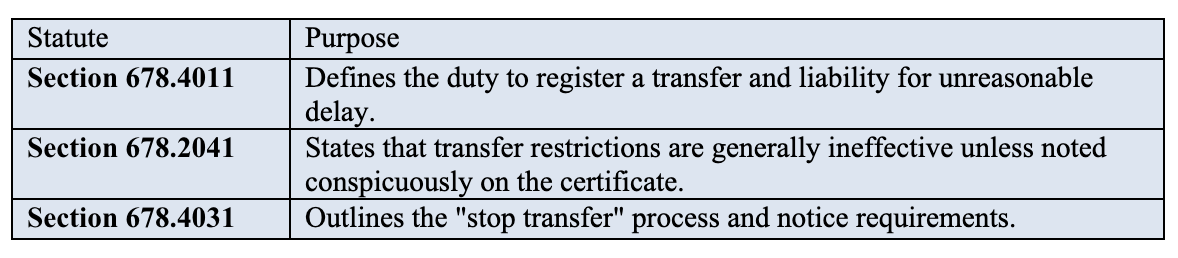
Common elements that trigger the duty to register and support legend removal
Courts applying Article 8 often analyze whether the shareholder has satisfied the conditions that trigger the issuer’s duty to register. In plain terms, the shareholder typically must show:
- eligibility to have the security registered as requested;
- a proper endorsement or instruction by the appropriate person or a properly authorized agent;
- reasonable assurance that the endorsement or instruction is genuine and authorized;
- compliance with applicable tax law;
- no violation of an effective issuer-imposed transfer restriction;
- no effective stop transfer demand that blocks registration under the statute, and
- a rightful transfer or protected purchaser status.
These elements matter in legend removal disputes because the request is effectively asking for registration of an unrestricted position. If the shareholder provides what the statute permits an issuer to request, the issuer’s refusal may become unreasonable.
Rule 144 and the Role of Legal Opinion Letters
For reporting companies, SEC Rule 144 is the primary pathway to resale after a required holding period. To manage risk, transfer agents often require a Rule 144 Opinion Letter from experienced securities counsel.
What a Rule 144 Opinion Should Include
A thorough legal opinion reduces the likelihood of “goalposting” or delays by addressing:
- Issuer Reporting Status: Whether the company is subject to Exchange Act requirements.
- Holding Period: Exactly how and when the shares were acquired.
- Affiliate Status: Whether the shareholder is considered an insider.
- Public Information: Confirmation that current public information requirements are met.
- Compliance: Detailed analysis of volume limits and manner-of-sale conditions.
Best Practices for Shareholders & Issuers
For Shareholders Requesting Removal:
- Submit a Written Demand: Include the endorsed certificate or clear instructions.
- Provide Assurances: Offer reasonable proof of authority and authenticity.
- Create a Paper Trail: Keep dated records of every submission to the transfer agent.
- Demand Specifics: If a request is denied, ask for the refusal and any requests for additional items in writing.
For Issuers and Transfer Agents:
To reduce liability risk, avoid “moving the goalposts” or relying on vague internal policies. While it is reasonable to request authentication and a competent legal opinion, the decision-making process must be documented and timely to prove any delay was justified.
Frequently Asked Questions (FAQ)
What does it mean to remove a restrictive legend?
It means the issuer replaces a restricted certificate (or book entry) with an unrestricted version, which is usually required before a broker will process a sale.
How long does the process take?
Timing depends on the completeness of your submission. Delays become legally problematic when a shareholder provides all reasonable documentation and the issuer still refuses to act.
Can I recover losses for a delayed removal?
Yes. Under Florida law, shareholders can seek orders to compel reissuance and pursue damages for market-based harm, such as a decline in stock value during the period the shares were wrongfully blocked.
Conclusion
A restrictive legend is meant to reflect a real legal limitation, not to create an indefinite barrier. Once a shareholder satisfies the statutory prerequisites and shows that the requested disposition is lawful, Florida Chapter 678 and Article 8 principles generally put the issuer under a duty to register the transfer or reissue the security in unrestricted form. When the issuer unreasonably delays or refuses without a legitimate basis, Florida law allows recovery for losses that result from that conduct.
This securities law blog post is provided as a general informational service. It should not be construed as and does not constitute legal advice. If you have any questions about this article, Hamilton & Associates Law Group, P.A. is ready to help.
Since 1998, our Founder, Brenda Hamilton, has been a leading voice in corporate and securities law, representing both domestic and international clients across diverse industries and jurisdictions.
To speak with a Securities Attorney, please contact Brenda Hamilton at 200 E Palmetto Rd, Suite 103, Boca Raton, Florida, (561) 416-8956, or by email at [email protected].
Hamilton & Associates | Securities Attorneys
Brenda Hamilton, Securities Attorney
200 E Palmetto Rd, Suite 103
Boca Raton, Florida 33432
Telephone: (561) 416-8956
Facsimile: (561) 416-2855
www.SecuritiesLawyer101.com