
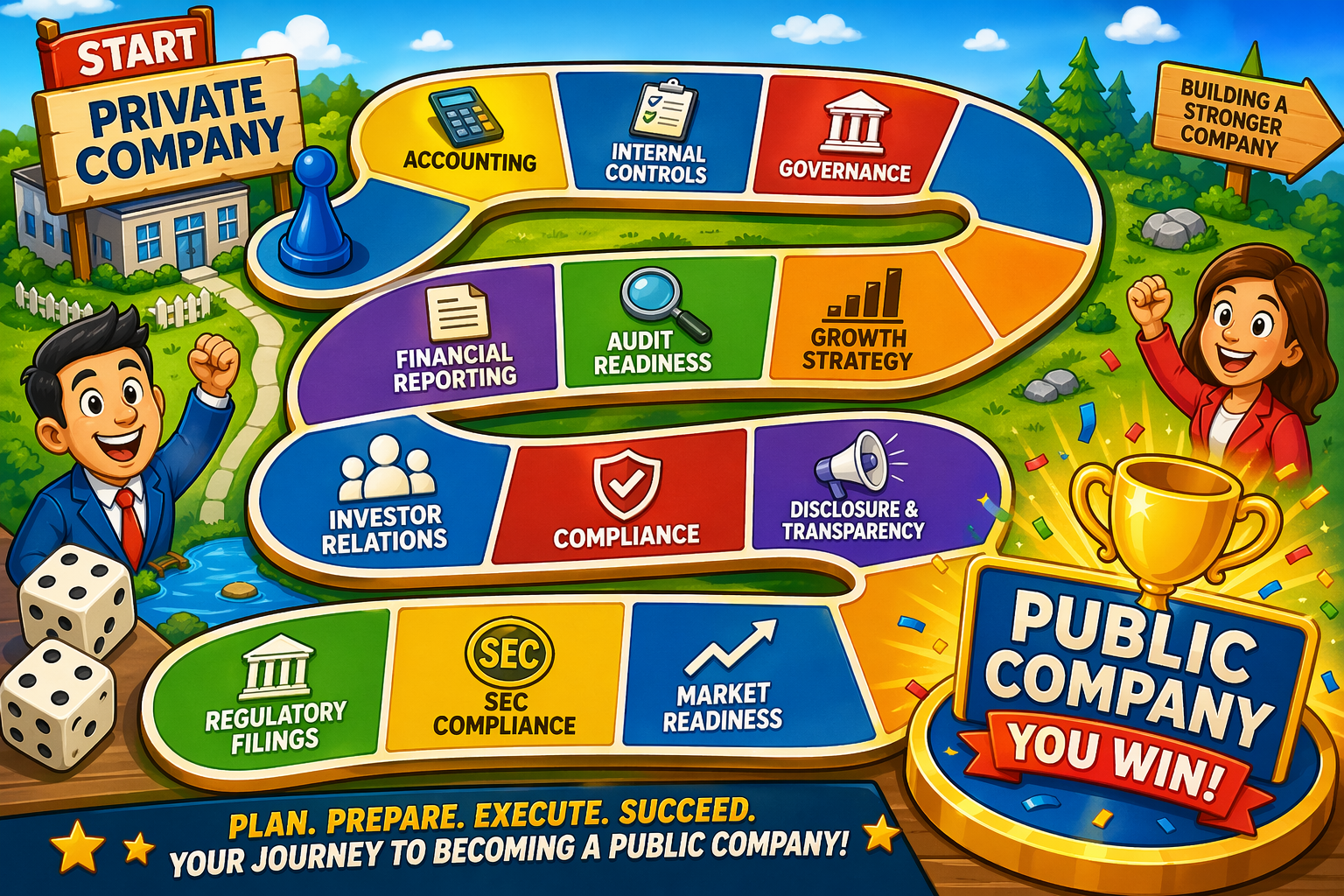
Transitioning from a private company to a public company involves more than filing a registration statement with the U.S. Securities and Exchange Commission (SEC). Going public requires a complete transformation in corporate governance, accounting systems, internal controls, and disclosure culture.
Understanding SEC Disclosure Obligations
Public companies are required to file reports under the Securities Exchange Act of 1934, providing transparent and accurate information to investors. These filings include Form 10-K (annual), Form 10-Q (quarterly), and Form 8-K (current events). Officers, directors, and large shareholders must file Forms 3, 4, and 5.
Establishing Effective Corporate Governance
Before filing with the SEC, issuers must strengthen governance practices to meet public company standards. A well-structured board of directors with independent members provides oversight and builds investor confidence.
Best practices include forming an Audit Committee, Compensation Committee, and Governance Committee. Each should have written charters and operate under independence standards outlined in Nasdaq Rule 5605 and NYSE Section 303A.
Public companies should also adopt key policies such as insider trading restrictions, a code of ethics, and whistleblower procedures under Section 301 of the Sarbanes-Oxley Act.
Strengthening Accounting Systems and Financial Reporting
SEC registrants must maintain GAAP-compliant financial statements audited by a PCAOB-registered firm. Private company audits are not sufficient. Before filing, companies should hire an experienced CFO or controller and adopt reporting systems that support quarterly and annual SEC filings.
Financial reporting must follow ASC 606 (Revenue Recognition) and ASC 842 (Leases). Issuers should ensure that their accounting systems can produce accurate interim and annual reports quickly.
Implementing Internal Controls and Disclosure Procedures
Strong internal control over financial reporting (ICFR) is essential for public companies. Companies must document financial processes, segregate duties, and test controls regularly to comply with Exchange Act Rules 13a-15 and 15d-15. Smaller reporting companies are exempt from auditor attestation under SOX 404(b) but must still evaluate ICFR annually. Disclosure controls and procedures (DCP) ensure timely and complete SEC filings. Management should adopt disclosure committee charters and implement certification requirements under Sections 302 and 906 of Sarbanes-Oxley.
Legal and Regulatory Readiness
Legal readiness begins with reviewing and amending the company’s charter, bylaws, and capitalization. Each share issuance since inception must be authorized and documented. Engaging an SEC-registered transfer agent early ensures accurate shareholder records and assists with DTC eligibility after registration.
Cultural Shift: From Private Secrecy to Public Transparency
Going public requires a shift in mindset. Management must adapt to continuous disclosure obligations and the scrutiny of investors, analysts, and regulators. Regulation FD requires that all material information be disclosed publicly, not selectively. Training senior management and investor relations teams in fair disclosure practices is vital.
Pre-Filing Checklist: Key Preparation Steps
The following checklist summarizes critical steps before filing with the SEC:
- Establish independent board and committees.
- Adopt governance and compliance policies.
- Engage a PCAOB-registered auditor.
- Implement ICFR and DCP frameworks.
- Review capitalization and shareholder records.
- Engage a transfer agent and counsel experienced in SEC reporting.
Conclusion: Readiness is the Best Disclosure
Preparing for SEC disclosure requirements long before filing enhances credibility, reduces SEC comments, and streamlines the registration process. Companies that establish strong governance, accounting, and internal control systems are better positioned to meet ongoing Exchange Act reporting obligations and investor expectations.
This securities law blog post is provided as a general informational service. If you have any questions about this article, Hamilton & Associates Law Group, P.A. is ready to help.
Since 1998, our Founder, Brenda Hamilton, has been a leading voice in corporate and securities law, representing both domestic and international clients across diverse industries and jurisdictions.
To speak with a Securities Attorney, please contact Brenda Hamilton at 200 E Palmetto Rd, Suite 103, Boca Raton, Florida, (561) 416-8956, or by email at [email protected].
Hamilton & Associates | Securities Attorneys
Brenda Hamilton, Securities Attorney
200 E Palmetto Rd, Suite 103
Boca Raton, Florida 33432
Telephone: (561) 416-8956
Facsimile: (561) 416-2855
www.SecuritiesLawyer101.com