
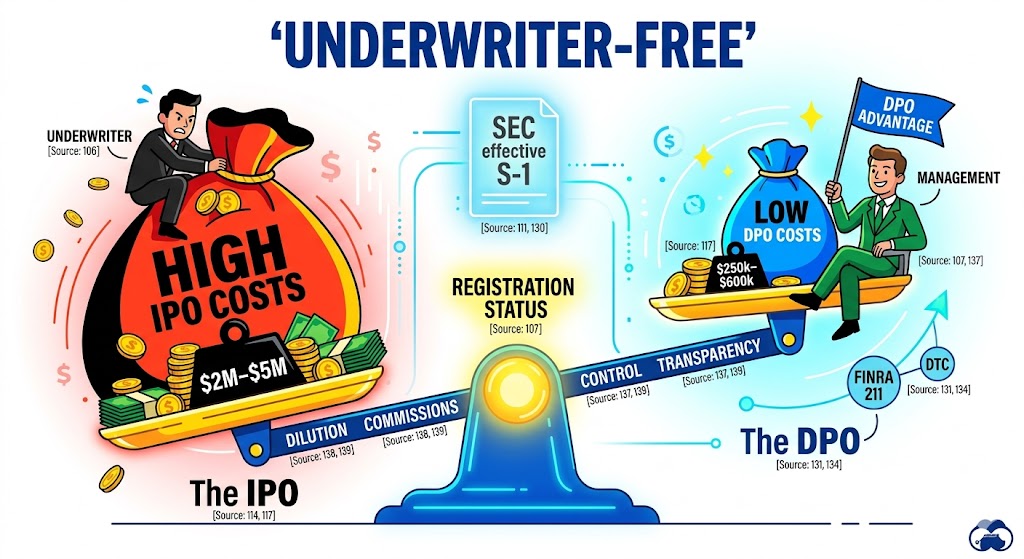
For small and mid-size companies, the costs, dilution, and loss of control associated with a traditional underwritten Initial Public Offering (IPO) can outweigh the benefits. A Direct Public Offering (DPO) provides an alternative—allowing the issuer to register its securities directly with the SEC, sell shares without an investment-bank underwriter, and control every stage of the offering.
This guide explains the Direct Public Offering advantage, including cost savings, SEC disclosure requirements, FINRA and DTC processes, and issuer-driven marketing strategies.
What Is a Direct Public Offering (DPO)?
A Direct Public Offering is a registered offering under the Securities Act of 1933 in which the issuer sells its own securities directly to investors. Instead of hiring an underwriter, the company files a Form S-1 Registration Statement with the SEC and, after effectiveness, offers shares through its own marketing channels. Once effective, issuers can seek quotation on the OTC Markets by engaging a market maker to file FINRA Form 211.
The Cost Advantage: Going Public Without an Underwriter
In a traditional IPO, underwriters receive 5%–7% of gross proceeds as commissions plus warrant coverage and reimbursed expenses. By eliminating the underwriter, a DPO avoids these costs entirely, producing savings that can exceed hundreds of thousands or even millions of dollars.
Professional expenses typically include SEC and corporate counsel, PCAOB auditors, a transfer agent, and a sponsoring market maker. Total costs usually range between $250,000–$600,000 versus $2–$5 million for an IPO.
Without underwriters dictating valuation or allocation, management retains control over share pricing, offering size, and timing.
Disclosure Obligations Under SEC Form S-1
A DPO requires full SEC registration under Section 5 of the Securities Act. Issuers must provide comprehensive disclosures under Regulation S-K, including:
- Item 101 – Business Description
- Item 303 – Management’s Discussion and Analysis
- Item 401 – Directors, Executive Officers, and Control Persons
- Item 504 – Use of Proceeds
- Item 505 – Determination of Offering Price
- Item 508 – Plan of Distribution
The SEC Division of Corporation Finance reviews the Form S-1, issues comments, and requires one or more amendments (Form S-1/A) before declaring the registration effective. Once effective, issuers must comply with Exchange Act reporting obligations, including Forms 10-K, 10-Q, and 8-K.
Marketing and Investor Outreach
In a DPO, the issuer takes responsibility for investor marketing, which may include digital communications, investor-relations websites, webinars, and press releases consistent with Regulation FD. All communications must comply with Rule 433 and the anti-fraud provisions of Section 17(a) and Rule 10b-5.
Best practice channels include company websites with links to SEC filings, newsletters to stakeholders, factual social-media updates, and investor webinars limited to information already disclosed in filings.
From SEC Effectiveness to Trading: FINRA and DTC
Once the SEC declares the registration statement effective, issuers can begin selling shares and prepare for public trading. A FINRA-member broker-dealer must file Form 211 under Rule 15c2-11 to initiate quotation. The application includes the SEC-effective S-1, current financials, and corporate records. Upon approval, FINRA assigns a ticker symbol and trading begins on the appropriate OTC Markets tier.
Issuers must also secure DTC eligibility through their transfer agent to enable electronic clearing and settlement. Without DTC eligibility, most brokerage firms cannot deposit or trade the company’s securities.
Advantages of the Direct Public Offering Structure
Compared to a traditional IPO, a DPO offers substantial cost savings, transparency, and control. Management dictates offering terms and marketing direction while avoiding the dilution and commissions associated with underwriters. Advantages include:
- Cost efficiency and reduced dilution
- Full SEC compliance and investor transparency
- Flexibility in pricing and allocation
- Control over timing and communication strategy
- Potential to uplist to Nasdaq or NYSE once requirements are met
Risks and Challenges
A DPO’s success depends on the issuer’s ability to manage its own investor outreach and compliance. Challenges include limited institutional participation, potential liquidity constraints, and heightened disclosure responsibility.
Working with experienced securities counsel and auditors minimizes these risks and ensures that marketing materials remain consistent with SEC regulations.
Best Practices for a Successful DPO
- Engage experienced SEC counsel and PCAOB auditors early.
- Establish a professional investor-relations program consistent with Regulation FD.
- Coordinate with a market-maker sponsor for FINRA Form 211 and DTC eligibility.
- Maintain accurate and timely SEC filings.
- Adopt governance and disclosure controls before the offering.
When a DPO Is the Right Choice
A Direct Public Offering is ideal for smaller reporting companies, emerging growth issuers, and community-based businesses seeking to raise between $2–$20 million while preserving management control. It is also effective for issuers planning to uplist after building a trading history and shareholder base.
The Bottom Line: The DPO Advantage
The Direct Public Offering offers a compliant, transparent, and cost-effective path to becoming a public company. By removing underwriters and managing the process internally, issuers retain control, reduce expenses, and build direct relationships with investors. In 2025’s evolving regulatory and market environment, DPOs represent one of the most strategic and efficient ways to access U.S. capital markets.
This securities law blog post is provided as a general informational service. If you have any questions about this article, Hamilton & Associates Law Group, P.A. is ready to help.
Since 1998, our Founder, Brenda Hamilton, has been a leading voice in corporate and securities law, representing both domestic and international clients across diverse industries and jurisdictions.
To speak with a Securities Attorney, please contact Brenda Hamilton at 200 E Palmetto Rd, Suite 103, Boca Raton, Florida, (561) 416-8956, or by email at [email protected].
Hamilton & Associates | Securities Attorneys
Brenda Hamilton, Securities Attorney
200 E Palmetto Rd, Suite 103
Boca Raton, Florida 33432
Telephone: (561) 416-8956
Facsimile: (561) 416-2855
www.SecuritiesLawyer101.com