

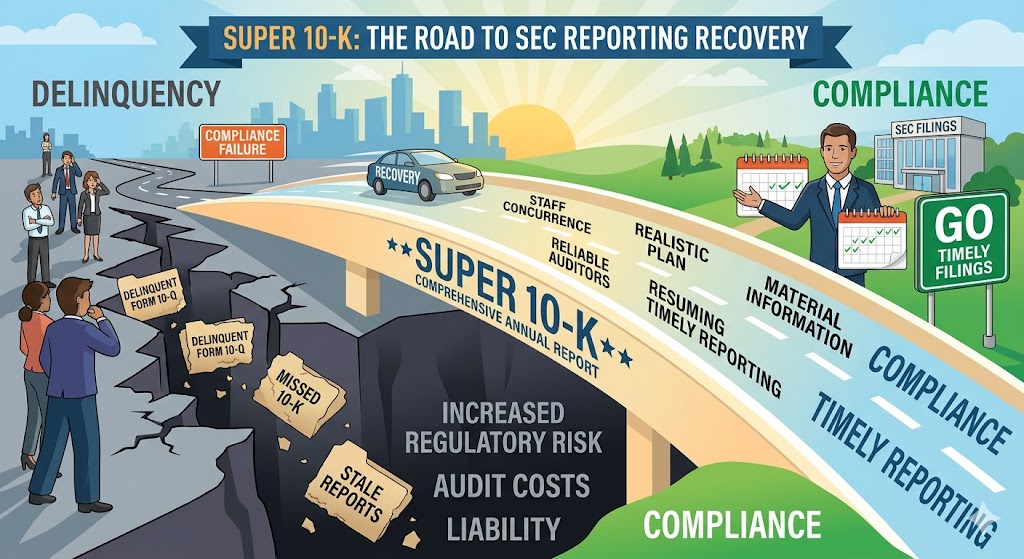
What Is a Super 10-K? How Delinquent SEC Filers Request Relief and the Downside of Using One
Issuers that fall behind on their SEC reporting requirements on Forms 10-Q and 10-K often learn that catching up is not just a filing exercise. Becoming delinquent in SEC reporting can trigger extraordinary audit costs, strain management resources, disrupt financing plans, damage credibility with the market, and increase regulatory risk. For many delinquent SEC filers, the practical question is whether the company must reconstruct every missed quarterly and annual report separately or whether it can ask the SEC staff to allow one comprehensive catch-up filing, commonly referred to in practice as a Super 10-K.
A Super 10-K is not an official SEC form. It is the market term commonly used to describe a comprehensive annual report on Form 10-K filed by a delinquent registrant in an effort to consolidate multiple missed SEC reporting periods into one filing. The concept is reflected in Section 1320.4 of the Division of Corporation Finance Financial Reporting Manual, which states that the Division generally will not issue comments asking a delinquent registrant to file all of its delinquent filings separately if the registrant files a comprehensive annual report on Form 10-K that includes all material information that would have been included in those filings.
How a Company Requests Permission to File a Super 10-K
In practice, the issuer typically proceeds through securities counsel and requests relief from the SEC staff, generally through the Office of the Chief Accountant in the Division of Corporation Finance. The request is usually made in writing and explains the company’s reporting delinquency, why separate catch-up Forms 10-Q and 10-K would be impractical or unduly burdensome, and how the company proposes to bring its public disclosure record up to date through one comprehensive annual report on Form 10-K.
Although practitioners often describe this as asking the SEC for permission to file a Super 10-K, the better way to understand it is as a request for staff concurrence or non-objection to the use of one comprehensive Form 10-K rather than a series of stale, delinquent SEC reports. Either way, the request should be made before the issuer assumes that a consolidated SEC filing approach will be accepted.
A request should identify every delinquent report, describe the reasons for the delinquency, explain the condition of the company’s books and records, set out the status of the audit and interim review work, and provide a realistic calendar for completing the filing. Counsel should also explain how the issuer will resume timely SEC reporting after the comprehensive filing is made. If records are missing, management has changed, internal controls are weak, or a prior auditor cannot be relied on, those facts should be addressed directly rather than minimized.
What FRM Section 1320.4 Says About Delinquent Filers
Section 1320.4 states that the Division of Corporation Finance generally will not issue comments asking a delinquent registrant to file separately all of its delinquent filings if the registrant files a comprehensive annual report on Form 10-K that includes all material information that would have been included in those filings. That language is the principal public source for the Super 10-K approach and is why practitioners look to the Office of the Chief Accountant in Corporation Finance when presenting a request.
The same guidance also makes clear that filing a comprehensive annual report does not absolve the registrant from liability under the Exchange Act for failing to file required reports and does not foreclose enforcement action for filing delinquencies. It also does not make the issuer current for purposes of Regulation S, Rule 144, or Form S-8 registration statements, and it does not restore Form S-3 eligibility until the issuer establishes a sufficient history of timely filings.
Super 10-K Requirements: What the Filing Should Include
A credible Super 10-K should be drafted as a current, comprehensive annual report, not as a loose collection of old disclosures. It should include all audited financial statements and other material information that investors would have received if the issuer had filed complete and timely reports in the first place. In most cases, that means current business disclosure, updated risk factors, management’s discussion and analysis, details concerning liquidity and capital resources, and a discussion of the company’s financial condition across the missing reporting periods.
Where quarterly periods have been missed, the filing should also include unaudited interim financial information and a meaningful discussion of operating results, trends, and liquidity for those interim periods. The report should describe the company as it exists at the time of filing, while also giving investors enough period-by-period disclosure to understand what occurred during the delinquent reporting periods.
The request letter and the resulting filing should be consistent. If the company tells the SEC staff that the comprehensive report will cover the material information that would have appeared in the missing reports, the filing itself has to deliver on that commitment. A weak or incomplete filing can undermine the company’s credibility with the staff and can create additional exposure rather than solving the delinquency problem.
The Downside of Using a Super 10-K
The biggest downside is that a Super 10-K is not a clean reset. Even if the SEC staff does not insist on separate delinquent filings, the company still carries the legal and practical consequences of having failed to file on time. Exchange Act liability is not erased. Enforcement exposure is not eliminated. The filing does not automatically make the issuer current for Rule 144, Regulation S, or Form S-8 purposes, and it does not reopen Form S-3 eligibility without a demonstrated history of timely reporting.
There are also serious business downsides. A Super 10-K can highlight internal control failures, poor recordkeeping, management instability, going-concern risk, financing problems, auditor turnover, and disclosure weaknesses that may make lenders, investors, transfer agents, and market makers more cautious. In some cases, one large catch-up filing can draw more focused scrutiny than a more orderly history of individual reports would have attracted. Another downside is cost. Companies sometimes pursue the Super 10-K route because they hope it will be cheaper than preparing each missing report separately, but that is not always true. If records must be recreated, audits refreshed, interim data rebuilt, or a replacement auditor engaged, the comprehensive filing can still be expensive and time-consuming. The BF Borgers fallout made that problem even more acute for issuers that had to replace unusable audit work with new PCAOB-compliant work before they could file.
There is also execution risk. If the issuer requests permission but cannot meet the timetable promised to the staff, or if the eventual filing is incomplete, the company may end up having both a continuing delinquency problem and a credibility problem. For that reason, a Super 10-K should never be treated as an easy shortcut. It is usually best viewed as a last-resort compliance tool for issuers that have a realistic plan, competent counsel, and reliable auditors.
Why the BF Borgers Matter Increased the Stakes
The SEC’s May 3, 2024 action against BF Borgers and Benjamin Borgers increased the pressure on delinquent issuers because it forced many companies to reassess whether their financial statements and prior audit work could still support Exchange Act filings. In its follow-up staff statement, the SEC addressed issuer disclosure and reporting obligations in light of the Rule 102(e) order and made clear that affected issuers filing reports after the order had to consider the status of prior audit and review work carefully.
For a delinquent filer seeking to file a Super 10-K, that matters immediately. If the company’s financial statements depend on audit work that can no longer be relied upon, the issuer may need a replacement auditor, new audit procedures, new review work, amended disclosure, or even reaudited periods before a comprehensive annual report can be filed responsibly. That increases cost, slows the timeline, and can complicate any request made to the SEC staff.
Why Delinquent SEC Filers Consider a Super 10-K Anyway
Despite the downsides, a Super 10-K can still be valuable in the right case. It may reduce duplication, present investors with one coherent disclosure record, and give the company a structured path back toward reporting compliance. It can also be more practical than filing a stack of stale Forms 10-Q and 10-K that each require separate drafting, review, certifications, and financial work.
Still, the filing should be approached as part of a broader recovery plan, not as the whole solution. The issuer must be prepared to resume timely reporting immediately afterward, address the market consequences of its delinquency, and accept that some transactional limitations may remain until it rebuilds a sufficient reporting history.
Conclusion
A company that wants to file a Super 10-K should not simply prepare the document and hope for the best. It should work through experienced securities counsel to request permission or non-objection from the SEC staff, generally through the Office of the Chief Accountant in the Division of Corporation Finance, and it should support that request with a realistic audit, disclosure, and filing plan. Section 1320.4 of the Financial Reporting Manual provides the core public guidance, but the company’s facts, records, auditors, and credibility will determine whether the approach is viable.
The reason to be cautious is simple: the Super 10-K can help manage delinquent SEC filings, but it does not eliminate the downside of being delinquent in the first place. It can leave Rule 144 issues unresolved, preserve enforcement risk, expose disclosure weaknesses, and impose significant cost. Used properly, it may be an efficient catch-up mechanism. Used casually, it can become another stage in a larger compliance failure.
This securities law blog post is provided as a general informational service. If you have any questions about this article, Hamilton & Associates Law Group, P.A. is ready to help.
Since 1998, our Founder, Brenda Hamilton, has been a leading voice in corporate and securities law, representing both domestic and international clients across diverse industries and jurisdictions.
To speak with a Securities Attorney, please contact Brenda Hamilton at 200 E Palmetto Rd, Suite 103, Boca Raton, Florida, (561) 416-8956, or by email at [email protected].
Hamilton & Associates | Securities Attorneys
Brenda Hamilton, Securities Attorney
200 E Palmetto Rd, Suite 103
Boca Raton, Florida 33432
Telephone: (561) 416-8956
Facsimile: (561) 416-2855
www.SecuritiesLawyer101.com