
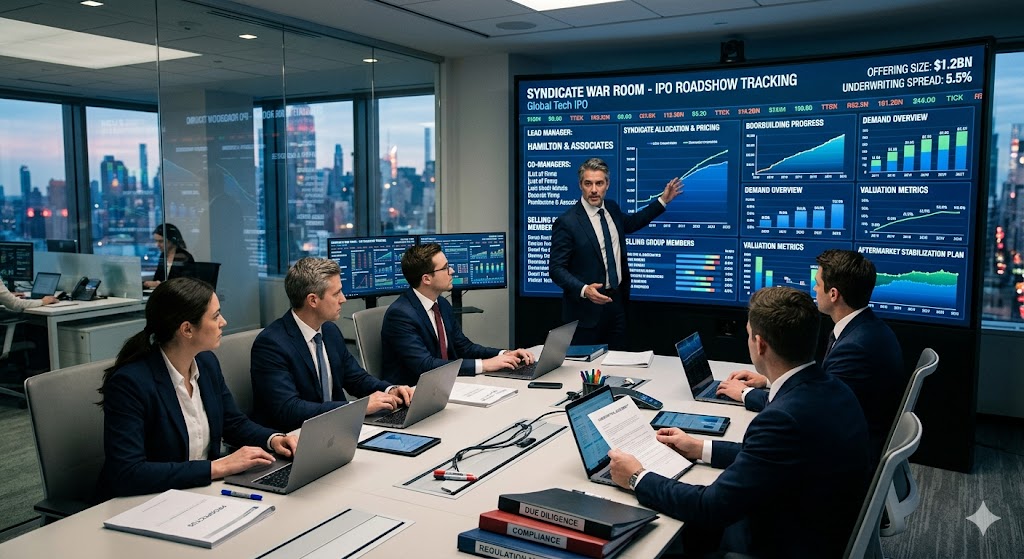
Every initial public offering (IPO) in the United States relies on a team of financial intermediaries known as underwriters.
Underwriters are investment banks that guide private companies through the process of going public, manage the sale of securities, and help ensure compliance with federal securities laws. They perform due diligence, negotiate pricing, coordinate syndicates, market the offering to investors, and stabilize aftermarket trading while assuming liability under Section 11 of the Securities Act of 1933.
Historical Overview and Regulatory Framework
Modern underwriting emerged in the early 20th century when investment banks began purchasing securities from issuers and reselling them to investors.
The Securities Act of 1933 codified the registration process and defined underwriters in Section 2(a)(11). The Financial Industry Regulatory Authority (FINRA) regulates broker-dealers engaged in underwriting under Rules 5110, 5121, and 5190, while the SEC oversees prospectus disclosures and stabilization practices under Regulation M.
Registration and FINRA Membership Requirements
Underwriters must be properly registered and supervised before participating in securities distributions.
- Section 15(a) of the Exchange Act requires registration with the SEC as a broker-dealer using Form BD. Registered firms must meet net-capital and recordkeeping obligations and comply with Regulation Best Interest.
- FINRA membership is mandatory for firms underwriting or distributing securities. Applicants file Form NMA and designate qualified principals who must pass Series 24 and Series 79 exams, while representatives generally hold the Series 7 license.
- FINRA requires firms to maintain net capital under Rule 4110, adopt written supervisory procedures (WSPs), and comply with anti-money-laundering (AML) and continuing-education rules.
- FINRA’s Corporate Financing Department reviews underwriting terms under Rule 5110 to ensure compensation is fair and reasonable.
- Unregistered activity can trigger SEC enforcement under Section 15(a) and investor rescission rights under Section 29(b).
Core Functions of IPO Underwriters
Underwriters structure offerings, conduct due diligence, assist in preparing the registration statement, market the deal, price the offering, and stabilize trading post-listing. They recommend offering size, share type, and exchange venue; perform legal and financial diligence; and manage roadshows and allocations.
The underwriting agreement defines responsibilities, indemnities, termination rights, and compensation subject to FINRA Rule 5110 review.
Underwriting Syndicates and Participants
Most IPOs involve multiple investment banks. The lead manager coordinates diligence and pricing; co-managers assist in marketing and allocations; selling group members distribute shares.
The underwriting spread averages 5–7% for mid-market IPOs. Responsibilities and liability are shared under the syndicate agreement.
Underwriter Liability and Defenses
Underwriters are liable under Section 11 of the Securities Act for material misstatements unless they prove a reasonable investigation (due diligence defense). They may also face Section 12(a)(2) and Rule 10b-5 liability for false or misleading statements. FINRA can impose sanctions for compensation or disclosure violations.
Disclosure and Compliance Requirements
Key regulatory obligations include:
- FINRA Rule 5110: Requires filing of underwriting terms and compensation.
- FINRA Rule 5121: Addresses conflicts of interest between issuer and underwriter.
- Regulation M: Restricts manipulative trading before and after offerings.
- Exchange Act reporting begins post-IPO on Forms 10-K, 10-Q, and 8-K.
Trends in Underwriting Practices
Emerging Growth Companies benefit from JOBS Act scaled disclosures. SPAC and de-SPAC transactions attract added scrutiny. Cross-border listings require coordination with home-market rules. Tech-sector IPOs demand enhanced diligence on cybersecurity and intellectual property. Regulators are increasing oversight of post-offering stabilization.
Practical Considerations for Issuers
Issuers should select experienced underwriters, prepare data rooms early, negotiate balanced indemnities, understand lock-up requirements, and coordinate investor-relations planning. Transparent collaboration with underwriters enhances credibility and valuation.
Conclusion
Underwriters are the bridge between private companies and the public markets. They act as gatekeepers and market stabilizers, ensuring IPOs meet federal disclosure standards. Selecting the right underwriter and maintaining transparency throughout the process lay the groundwork for long-term investor confidence and regulatory compliance.
This securities law blog post is provided as a general informational service. If you have any questions about this article, Hamilton & Associates Law Group, P.A. is ready to help.
Since 1998, our Founder, Brenda Hamilton, has been a leading voice in corporate and securities law, representing both domestic and international clients across diverse industries and jurisdictions.
To speak with a Securities Attorney, please contact Brenda Hamilton at 200 E Palmetto Rd, Suite 103, Boca Raton, Florida, (561) 416-8956, or by email at [email protected].
Hamilton & Associates | Securities Attorneys
Brenda Hamilton, Securities Attorney
200 E Palmetto Rd, Suite 103
Boca Raton, Florida 33432
Telephone: (561) 416-8956
Facsimile: (561) 416-2855
www.SecuritiesLawyer101.com