

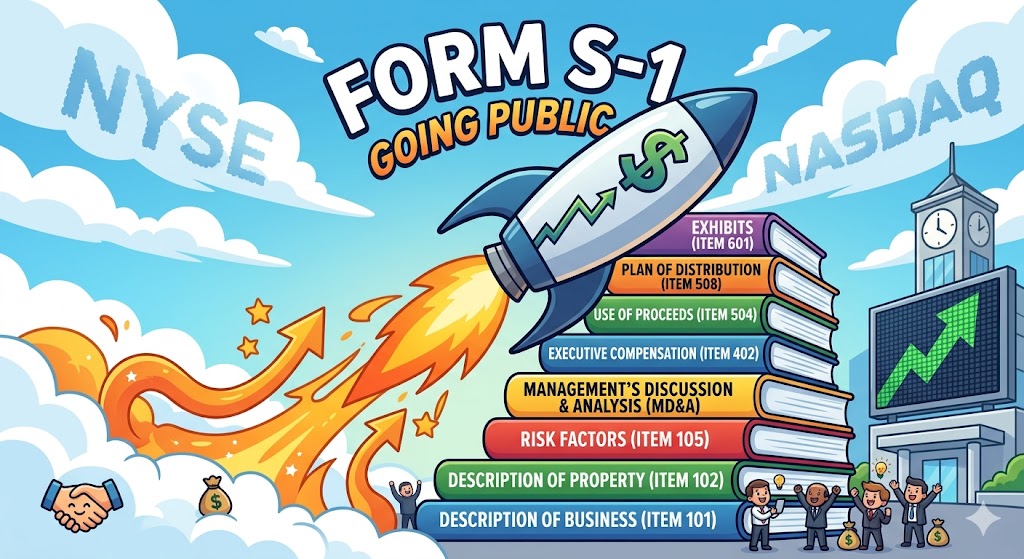
Form S-1 is the primary registration statement used by issuers under the Securities Act of 1933 to register securities for public sale. Whether through an Initial Public Offering (IPO), Direct Public Offering (DPO), or resale registration, Form S-1 provides investors with essential information about the issuer and the securities being offered. This guide outlines each Regulation S-K disclosure item, the SEC’s expectations, and practical tips for preparing a compliant Form S-1 registration statement.
The Purpose of Form S-1
Form S-1 combines narrative disclosure under Regulation S-K with financial statements under Regulation S-X. It is used for initial public offerings, direct public offerings, secondary offerings, and resale registrations. Issuers must update Form S-1 through amendments (Form S-1/A) until the SEC declares the filing effective.
SEC Review Process and Expectations
The SEC Division of Corporation Finance reviews every Form S-1 for completeness, consistency, and accuracy. Key review priorities include plain-English disclosure (Rule 421(d)), materiality, and consistency across sections. The first SEC comment letter typically arrives within 30 days of filing. Issuers must respond promptly and revise their filing as needed. For guidance on SEC comment responses, visit https://www.securitieslawyer101.com/sec-comments/.
Regulation S-K Item-by-Item Breakdown
- Item 101 – Description of Business: Narrative overview of operations, products, services, and competition. Include intellectual property, employees, and regulatory compliance. Avoid boilerplate.
- Item 102 – Description of Property: Disclose all material real properties owned or leased. Include mining or extractive operations where applicable (Regulation S-K Subpart 1300).
- Item 103 – Legal Proceedings: Describe pending or threatened litigation that could materially impact operations. Environmental proceedings exceeding $300,000 must be disclosed.
- Item 105 – Risk Factors: Provide specific, company-tailored risk factors explaining how each risk affects the issuer. Avoid generic statements.
- Item 201 – Market Price and Dividends: Disclose existing or planned trading markets, historical prices, and dividend policy.
- Item 303 – Management’s Discussion and Analysis (MD&A): Discuss liquidity, trends, and results of operations. Explain known uncertainties affecting future performance. See detailed MD&A guidance at https://www.securitieslawyer101.com/mdna-requirements/.
- Item 304 – Changes in and Disagreements with Accountants: Disclose changes in auditors and disagreements. Attach former auditor letters as exhibits.
- Item 305 – Market Risk: Describe interest rate, foreign currency, or commodity exposure if material.
- Item 401 – Directors and Executive Officers: Identify all officers, directors, and control persons. Provide five-year biographies and legal proceeding disclosures.
- Item 402 – Executive Compensation: Present detailed compensation tables for executive officers. Smaller reporting companies may use scaled disclosure.
- Item 403 – Security Ownership: Show beneficial ownership of directors, officers, and 5% shareholders both before and after the offering.
- Item 404 – Related Party Transactions: Disclose related-party transactions exceeding $120,000. Describe terms and relationships.
- Item 407 – Corporate Governance: Discuss board composition, independence, and audit committee structure. Include audit committee financial expert and ethics disclosures.
- Item 504 – Use of Proceeds: Specify how offering proceeds will be allocated. Broad terms like ‘general corporate purposes’ are insufficient.
- Item 505 – Determination of Offering Price: Explain valuation methodology and basis for pricing.
- Item 506 – Dilution: Show dilution to new investors before and after the offering. See dilution guide at https://www.securitieslawyer101.com/dilution-disclosure/.
- Item 507 – Selling Security Holders: Identify selling shareholders, shares offered, and post-offering ownership.
- Item 508 – Plan of Distribution: Explain how securities will be sold. Include underwriter details or self-underwritten plans.
- Item 509 – Interests of Experts and Counsel: Identify experts, auditors, and counsel with securities interests.
- Item 510 – Indemnification: Describe indemnification provisions and the SEC’s policy against indemnification for Securities Act liabilities.
- Item 512 – Undertakings: Include SEC-required undertakings for post-effective updates and reporting.
- Item 601 – Exhibits: Attach all material contracts, auditor consents, bylaws, and legal opinions.
Financial Statement Requirements (Regulation S-X)
Issuers must include audited financials for two fiscal years (one for smaller reporting companies) and interim statements not older than 135 days. Audits must be conducted by PCAOB-registered firms under U.S. GAAP.
Common SEC Comment Themes
Common SEC comments include inadequate risk factor specificity, inconsistent MD&A, missing related-party disclosures, and incorrect exhibit lists. Reviewing recent SEC comment trends can help issuers anticipate and address issues early.
Practical Tips for a Smooth Review
- Engage experienced SEC counsel and PCAOB auditors early.
- Conduct pre-filing due diligence on corporate records.
- Ensure consistent terminology and formatting throughout.
- Review comparable issuers’ SEC comment letters for insight.
- Use plain-English summaries in accordance with Rule 421(d).
Conclusion
Form S-1 is the foundation of the going-public process. A well-prepared Form S-1 addressing each Regulation S-K item in detail demonstrates transparency, builds investor confidence, and streamlines SEC review.
This securities law blog post is provided as a general informational service. If you have any questions about this article, Hamilton & Associates Law Group, P.A. is ready to help.
Since 1998, our Founder, Brenda Hamilton, has been a leading voice in corporate and securities law, representing both domestic and international clients across diverse industries and jurisdictions.
To speak with a Securities Attorney, please contact Brenda Hamilton at 200 E Palmetto Rd, Suite 103, Boca Raton, Florida, (561) 416-8956, or by email at [email protected].
Hamilton & Associates | Securities Attorneys
Brenda Hamilton, Securities Attorney
200 E Palmetto Rd, Suite 103
Boca Raton, Florida 33432
Telephone: (561) 416-8956
Facsimile: (561) 416-2855
www.SecuritiesLawyer101.com