

A shareholder who obtains a Rule 144 legal opinion and asks a transfer agent to remove a restrictive legend may assume the transfer agent is performing a purely administrative function. Uniform Commercial Code Article 8 says otherwise. When Article 8 applies, the transfer agent can owe direct statutory duties to the holder or owner of the security.
Two provisions sit at the center of many restrictive legend removal disputes. UCC Section 8-407 gives a transfer agent the same obligation to the holder or owner, with respect to the functions it performs, that the issuer has. UCC Section 8-401 identifies when the issuer must register a transfer and creates liability for unreasonable delay, failure or refusal when that duty exists.
These provisions are especially important when a shareholder presents a Rule 144 legal opinion, the issuer objects, and the transfer agent is caught between competing instructions. In Florida, Sections 678.4011, 678.4031 and 678.4071 provide a particularly useful framework for understanding when a transfer may be temporarily withheld, when a claimant must obtain a court order or provide an indemnity bond, and when the transfer agent may face increasing risk from continuing to refuse the request.
The analysis is statutory, but it is not automatic. Before applying Florida law, counsel must first determine whether Florida law governs the issuer’s registration duties under the Article 8 choice-of-law rules. A valid issuer restriction, an ineffective instruction, a transfer that is not rightful, or a court order may change the result.
UCC Section 8-407: The Transfer Agent Has the Same Obligation as the Issuer
UCC Section 8-407 changes the traditional agency analysis. A transfer agent is not protected from a shareholder claim simply because it was acting for the issuer. With respect to registration of transfer, issuance of new certificates or uncertificated securities, and cancellation of surrendered certificates, Section 8-407 gives the transfer agent the same obligation to the holder or owner that the issuer has regarding the particular function performed.
Florida adopts this rule in Section 678.4071, Florida Statutes. The statute expressly states that a transfer agent has the same obligation to the holder or owner as the issuer with respect to the functions performed.
The practical consequence is important. If applicable law requires the issuer to register a transfer, a transfer agent performing that function may have the corresponding obligation. A transfer agent therefore should not assume that the statement, “the issuer told us not to process it,” necessarily resolves the legal analysis.
Section 8-407 creates a direct statutory duty, but it does not create automatic or strict liability every time a legend removal request is denied. The scope of the transfer agent’s duty depends on whether the issuer itself has a duty under Section 8-401 and whether the statutory conditions for registration have been satisfied.
UCC Section 8-401: When the Duty to Register a Transfer Is Triggered
UCC Section 8-401 provides the operative checklist. If a certificated security in registered form is presented with a request to register a transfer, or an appropriate instruction is presented for an uncertificated security, the issuer must register the transfer if the statutory requirements are satisfied.
Florida’s version appears at Section 678.4011, Florida Statutes. The Florida statute uses mandatory language: when the conditions are satisfied, the issuer shall register the transfer as requested.
The Seven Conditions Under Section 8-401
- The person seeking registration is eligible under the terms of the security to have the security registered in that person’s name.
- The indorsement or instruction is made by the appropriate person or by an agent with actual authority.
- Reasonable assurance is given that the indorsement or instruction is genuine and authorized.
- Applicable tax collection laws have been satisfied.
- The transfer does not violate a restriction imposed by the issuer in accordance with UCC Section 8-204.
- No effective demand not to register transfer remains as an impediment under UCC Section 8-403, or the statutory process has been followed and no legal process or indemnity bond was obtained.
- The transfer is in fact rightful or is made to a protected purchaser.
If the issuer is under a duty to register, Section 8-401 also provides a damages remedy for losses resulting from unreasonable delay, failure or refusal to register. Through Section 8-407, that statutory structure can become directly relevant to the transfer agent.
Does UCC Section 8-401 Apply to Restrictive Legend Removal?
A recurring defense is that removing a restrictive legend is not literally a transfer from one registered owner to another. Courts addressing the issue have nevertheless recognized that a properly presented request to reissue securities without a restrictive legend may fall within the Article 8 registration framework because clean reissuance can be a necessary predicate to transfer.
In Guilfoyle v. Olde Monmouth Stock Transfer Co., the Nevada Supreme Court discussed Bender and American Securities Transfer as cases in which shareholders presented securities for reissuance without restrictive legends. The court distinguished those cases because the Guilfoyle shareholder never actually submitted a completed transfer or reissuance request. The result reinforces two propositions: legend removal can implicate Section 8-401, and proper presentment matters.
The federal decision in American Securities Transfer, Inc. v. Pantheon Industries, Inc. is particularly instructive. The holder submitted a certificate and requested a new certificate without the restrictive legend. The transfer agent notified the issuer that the request would be completed unless a court order or indemnity bond was obtained within the applicable period. No court order or bond was supplied, yet the transfer agent did not proceed. The court treated the reissuance request as a predicate for transfer and analyzed the transfer agent’s duties under Article 8.
Rule 144 Legal Opinions and the “Rightful Transfer” Requirement
The requirement that a transfer be “rightful” is where Rule 144 legal opinions frequently become central. A transaction that would violate the Securities Act may not qualify as a rightful transfer under Section 8-401. A properly reasoned Rule 144 legal opinion can therefore provide an important part of the legal basis for processing restrictive legend removal.
The SEC explains that Rule 144 provides a safe harbor for certain public resales of restricted and control securities when its conditions are met. The SEC also explains that only the transfer agent removes the legend, and issuer consent is commonly communicated through an opinion letter of counsel. The SEC further states that disputes over restrictive legend removal are governed by state law rather than resolved by the SEC.
For additional background, see Removing Restrictive Legends From Stock: Legal Opinions.
A Rule 144 legal opinion should address the federal securities law question actually presented. Depending on the facts, that may include the holding period, tacking, affiliate status, current public information, former shell company status, convertible securities, warrants, and whether the requested legend removal is appropriate. A conclusory legal opinion that leaves a material Rule 144 issue unresolved may not establish that the requested transfer is rightful.
At the same time, a favorable Rule 144 legal opinion does not resolve every possible objection. A genuine adverse ownership claim, a valid contractual restriction, an injunction, or a corporate law issue may require a different legal opinion or court process. The key is to identify the legal question that remains unresolved.
Florida UCC Timeline When an Issuer Tries to Block Legend Removal
The following timeline applies when Florida Article 8 governs the registration and adverse claim issues, a proper legend removal or transfer request has been presented, and the asserted basis for withholding registration is a qualifying stop transfer demand under Section 678.4031. It should not be used to bypass a valid independent restriction, an ineffective instruction, a transfer that is not rightful, or an existing court order.
Threshold Step: Confirm That Florida Law Governs
Before starting the Florida timeline, counsel should review Section 678.1101, Florida Statutes. For registration of transfer and duties to adverse claimants, the statute generally points to the law of the issuer’s jurisdiction. The transfer agent’s physical location in Florida does not, by itself, establish that Florida substantive law controls.
If Florida law does govern, Sections 678.4011, 678.4031 and 678.4071 fit together as a coordinated statutory process.
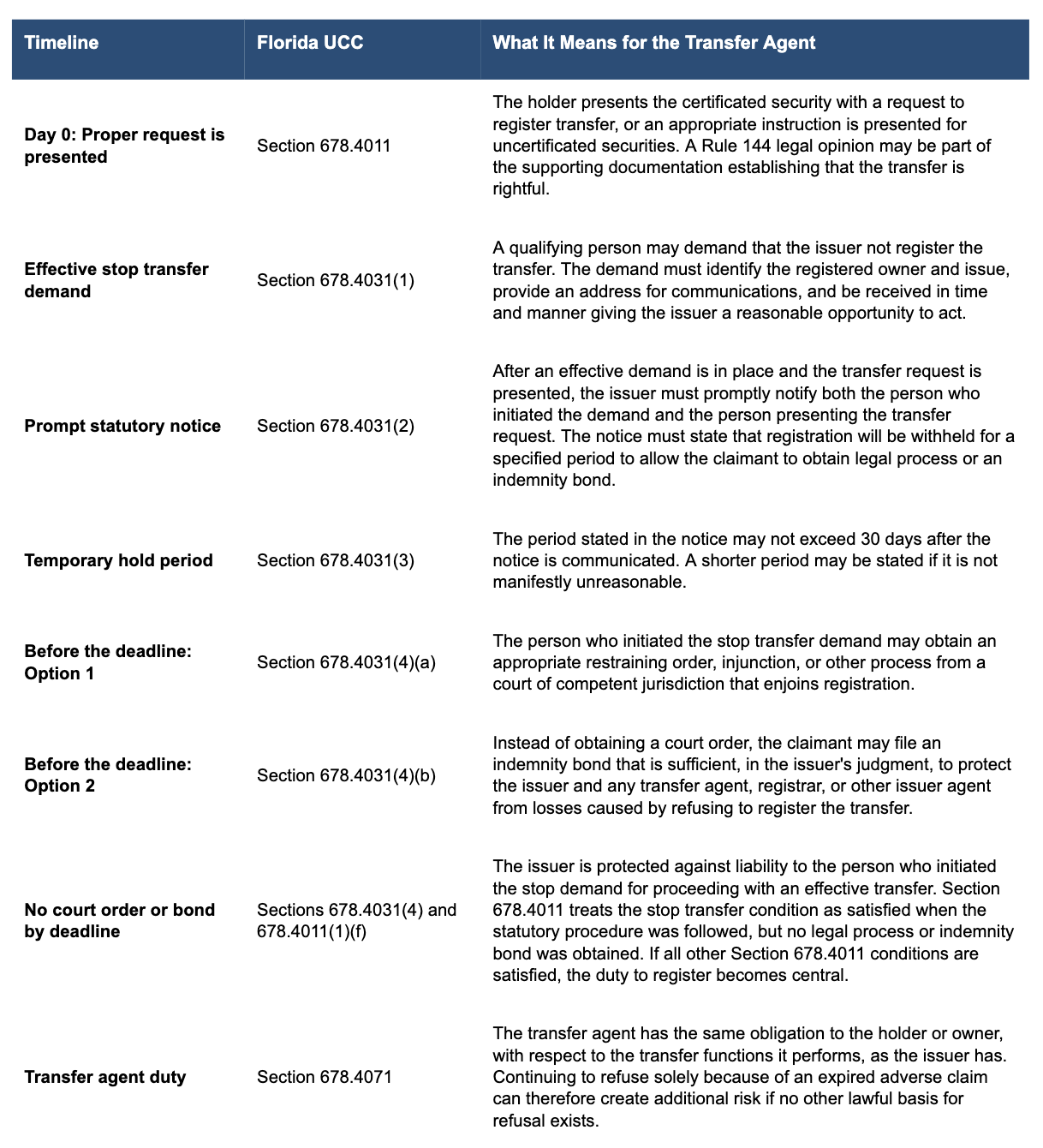
Florida Requires Court Process or an Indemnity Bond to Preserve a Qualifying Stop Transfer Demand
Section 678.4031 is designed to keep the issuer and transfer agent from becoming the tribunal that decides the adverse claim. The statute allows a temporary pause, but it puts the burden on the person who initiated the stop transfer demand to take the next legal step.
Under Section 678.4031(4)(a), the claimant may obtain an appropriate restraining order, injunction, or other process from a court of competent jurisdiction that enjoins registration of the transfer.
Alternatively, under Section 678.4031(4)(b), the claimant may file an indemnity bond sufficient, in the issuer’s judgment, to protect the issuer and any transfer agent, registrar, or other issuer agent from loss caused by refusing to register the transfer.
The statute uses an alternative. The claimant must obtain the required legal process or provide the adequate indemnity bond. It does not require both.
The bond provision is especially important for transfer agents because the statute expressly requires the bond to protect the transfer agent. The claimant asking the transfer agent to continue withholding registration therefore bears the burden of supplying financial protection if judicial process is not obtained.
The Maximum Statutory Hold Is 30 Days After Notice
Section 678.4031(3) provides that the period stated in the statutory notice may not exceed 30 days after the notice is communicated. A shorter period is permitted if it is not manifestly unreasonable. This does not mean every legend removal dispute automatically has a 30-day deadline. The rule applies when the Section 678.4031 stop transfer procedure governs the asserted adverse claim.
When it does apply, the transfer agent should calendar the notice date and the stated deadline. The statutory mechanism is built around a temporary hold while the claimant obtains a court order or posts the bond. It is not written as an indefinite administrative freeze.
When Is the Transfer Agent Protected During the Stop Transfer Process?
A transfer agent has legitimate risk on both sides. Processing too quickly can create exposure if an effective stop transfer demand or court order exists. Refusing too long can create exposure if the issuer is under a duty to register and no lawful basis for continuing the refusal remains.
- During a valid temporary hold under Section 678.4031, the transfer agent can refrain from completing the transfer while the statutory process runs.
- If a court of competent jurisdiction enters an injunction, restraining order or other process prohibiting registration, the transfer agent should comply with the order.
- If an adequate indemnity bond is filed, the statutory scheme contemplates protection for the transfer agent against losses caused by continuing to refuse registration.
- If the stated period expires without legal process or a bond, Section 678.4011(1)(f) no longer treats the stop demand itself as an impediment, assuming the statutory procedure was followed and all other requirements are met.
- Section 678.4071 then requires analysis of the transfer agent’s corresponding duty because its obligation for the transfer function mirrors the issuer’s obligation.
An Issuer Objection Is Not Always a Section 8-403 Stop Transfer Demand
The court order or bond procedure should not be overstated. Section 8-403 addresses a qualifying demand that the issuer not register transfer. An issuer may assert a separate legal basis for refusal that arises elsewhere in Section 8-401 or under other applicable law.
For example, the issuer may contend that the instruction is unauthorized, that reasonable assurance has not been provided, that the transfer violates a valid issuer restriction, or that the requested transfer is not rightful. Those issues are not automatically converted into a Section 8-403 adverse claim simply because the issuer says “stop.”
Accordingly, when an issuer blocks restrictive legend removal, the transfer agent and counsel should identify the precise legal basis for the objection. If the basis is a third-party adverse ownership claim, Section 8-403 may be central. If the issuer asserts an independent legal restriction or a Rule 144 defect, the analysis may be different and an additional legal opinion may be appropriate.
UCC Article 8 Also Protects Against Wrongful Registration
Article 8 does not favor transfer at all costs. It balances the duty to register with protections against wrongful registration. Florida Section 678.4041 addresses liability for wrongful registration in specified circumstances, including certain transfers made despite an effective demand or applicable legal process.
That is why a transfer agent should take an effective adverse claim seriously. See Section 678.4041, Florida Statutes. The key distinction is between a legitimate temporary statutory hold and an indefinite refusal that no longer has support under the governing law.
Common Transfer Agent Defenses in Legend Removal Litigation
No Proper Presentment
A transfer agent may argue that the statutory duty never arose because the holder did not submit a completed request. Guilfoyle illustrates the importance of this defense. A preliminary telephone inquiry concerning what documents might be required was not the same as presenting the securities with a completed legend removal or reissuance request.
The Transfer Was Not Rightful
A transfer agent may contend that the requested transaction would violate federal securities law or another applicable legal requirement. This is where the quality and scope of the Rule 144 legal opinion can become critical. The legal opinion should address the facts necessary to support the conclusion that the Securities Act restriction no longer prevents the requested transaction.
A Valid Transfer Restriction Applies
Section 8-401 does not require registration if the transfer violates a restriction imposed by the issuer in accordance with the applicable Article 8 provisions. Counsel should distinguish a federal securities law restrictive legend from a separate contractual or corporate transfer restriction and determine whether that restriction is legally effective.
A Valid Stop Transfer Demand or Court Order Exists
An effective stop transfer demand can support a temporary refusal while the Section 8-403 procedure is followed. A court order can independently require continued withholding. The transfer agent should obtain and review the actual order rather than rely on a generalized statement that litigation exists.
The Holder Is an Entitlement Holder Through a Securities Intermediary
Article 8 distinguishes direct holdings from security entitlements maintained through securities intermediaries. Part 5 governs important aspects of the entitlement holder relationship. The actual holding structure should be identified before assuming that every Part 4 registration duty runs directly to a beneficial owner whose position is held entirely through a broker or other intermediary.
Which Legal Opinion Does the Transfer Agent Need?
Legend removal disputes often become more difficult because the parties use the phrase “legal opinion” without identifying the legal question the opinion is supposed to answer. A Rule 144 legal opinion and a UCC Article 8 legal opinion can address entirely different issues.
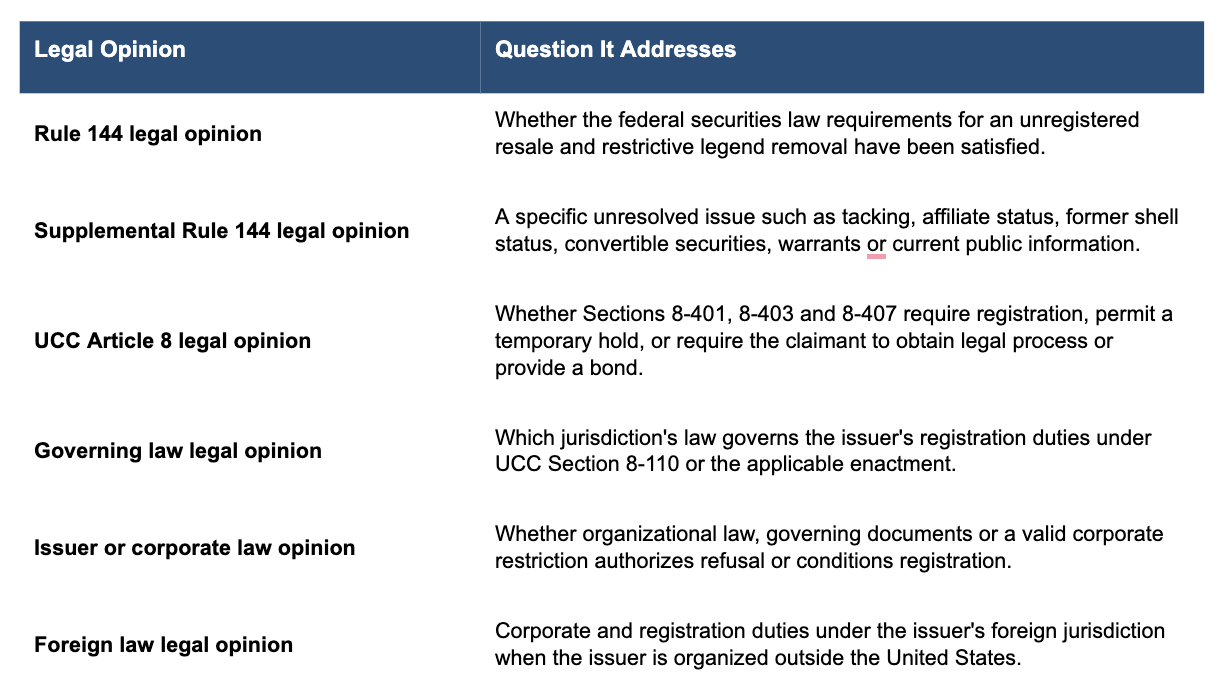
A transfer agent should not be asked to decide disputed ownership facts merely because two lawyers have supplied different letters. It should identify what proposition each legal opinion addresses, determine which law governs that proposition, and determine whether court process or additional legal analysis is required.
Practical Checklist After a Rule 144 Legend Removal Request Is Submitted
- Confirm the issuer’s jurisdiction and determine the law governing registration of transfer.
- Confirm that a proper legend removal or reissuance request has actually been presented.
- Review the Rule 144 legal opinion and supporting shareholder representations.
- Identify every stated reason for the issuer’s objection.
- Determine whether the objection is a qualifying Section 8-403 stop transfer demand or a different legal issue.
- If Section 8-403 applies, send the required prompt notices and state the temporary hold period.
- Calendar the deadline, which under Florida law may not exceed 30 days after communication of the notice.
- Determine whether the claimant obtained a court order or supplied an adequate indemnity bond protecting the issuer and transfer agent.
- If no order or bond is obtained, reassess the duty to register under Section 8-401 rather than automatically continuing the stop.
- If a separate legal issue remains, identify the specific legal opinion needed to resolve it.
- Document the legal basis for processing, delaying or refusing the request.
Frequently Asked Questions About Transfer Agent Duties and Legend Removal
Does UCC Section 8-407 give a shareholder a direct claim against a transfer agent?
Section 8-407 gives a transfer agent the same obligation to the holder or owner, with respect to the transfer functions it performs, that the issuer has. Whether liability exists in a particular case depends on whether the underlying duty to register arose and whether the statutory requirements were satisfied.
Does a Rule 144 legal opinion automatically require the transfer agent to remove the legend?
No. A Rule 144 legal opinion addresses the federal securities law basis for resale and legend removal. The transfer agent must still consider the applicable Article 8 requirements, valid transfer restrictions, adverse claims, court orders, authority and other issues that may affect whether the requested transfer is rightful.
Can the issuer stop legend removal just by sending an email to the transfer agent?
Not necessarily. If the asserted basis is a qualifying adverse claim governed by Section 8-403, the statute establishes a specific procedure. A bare objection is not automatically equivalent to an effective statutory stop transfer demand. The exact basis for the issuer’s refusal should be identified.
How long can a transfer be withheld under Florida Section 678.4031?
The period stated in the statutory notice may not exceed 30 days after the notice is communicated. A shorter period may be used if it is not manifestly unreasonable. This timeline applies to the Section 678.4031 stop transfer procedure, not to every possible legal basis for refusing a transfer.
Does Florida law require a court order to keep the stop in place?
Florida Section 678.4031 permits the claimant to obtain appropriate judicial process, such as a restraining order or injunction, or instead to file an adequate indemnity bond. The statute uses an alternative: court process or bond.
Who must be protected by the Florida indemnity bond?
The bond must be sufficient, in the issuer’s judgment, to protect the issuer and any transfer agent, registrar or other issuer agent involved from losses caused by refusing registration.
What happens if no court order or bond is obtained?
Section 678.4031 protects the issuer against liability to the person who initiated the stop demand for proceeding with an effective transfer. Section 678.4011(1)(f) also treats the stop transfer condition as satisfied when the statutory procedure was followed but no legal process or indemnity bond was obtained. The remaining Section 678.4011 requirements must still be satisfied.
Which law determines whether Florida Sections 678.4011 and 678.4031 apply?
Florida Section 678.1101 generally directs registration of transfer and adverse claimant issues to the law of the issuer’s jurisdiction. Governing law should therefore be determined before applying the Florida 30 day court order or bond timeline.
Conclusion
UCC Sections 8-401 and 8-407 give restrictive legend removal disputes a statutory structure that is often overlooked. The transfer agent is not merely a messenger for the issuer, but neither is it required to process every request without examining the statutory conditions. Its duty is tied to the issuer’s duty and to the legal requirements governing the particular transaction.
When Florida Article 8 governs and the issuer seeks to stop a transfer because of a qualifying adverse claim, Section 678.4031 supplies a defined process. The claimant receives a temporary period to obtain a court order or provide an adequate indemnity bond. The notice period cannot exceed 30 days. If neither legal process nor a bond is obtained, the stop transfer demand itself no longer supplies the same statutory obstacle, and the issuer and transfer agent must return to the Section 678.4011 analysis.
A Rule 144 legal opinion answers the federal securities law question. A UCC Article 8 legal opinion may answer the registration and adverse claim question. A governing law legal opinion may be necessary before either analysis can be completed. The legal opinion should match the legal problem confronting the transfer agent.
The practical objective is straightforward: identify the governing law, identify the legal obstacle, obtain the legal opinion or court process that addresses that obstacle, and avoid turning the transfer agent into the judge of an ownership dispute.
Legal Opinion Assistance
SecuritiesLawyer101 assists with Rule 144 legal opinions, restrictive legend removal, transfer agent legal opinions, UCC Article 8 issues, governing law questions and related securities law matters. The appropriate legal opinion depends on the issuer, the security, the requested transaction and the specific reason the transfer agent or issuer has declined to process the request.
This article is intended for general informational purposes and does not constitute legal advice. The governing law and required legal opinion depend on the facts and jurisdictions involved. To speak with a Securities Attorney, please contact Brenda Hamilton at 200 E Palmetto Rd, Suite 103, Boca Raton, Florida, (561) 416-8956, or by email at [email protected].
Hamilton & Associates | Securities Attorneys
Brenda Hamilton, Securities Attorney
200 E Palmetto Rd, Suite 103
Boca Raton, Florida 33432
Telephone: (561) 416-8956
Facsimile: (561) 416-2855
www.SecuritiesLawyer101.com