
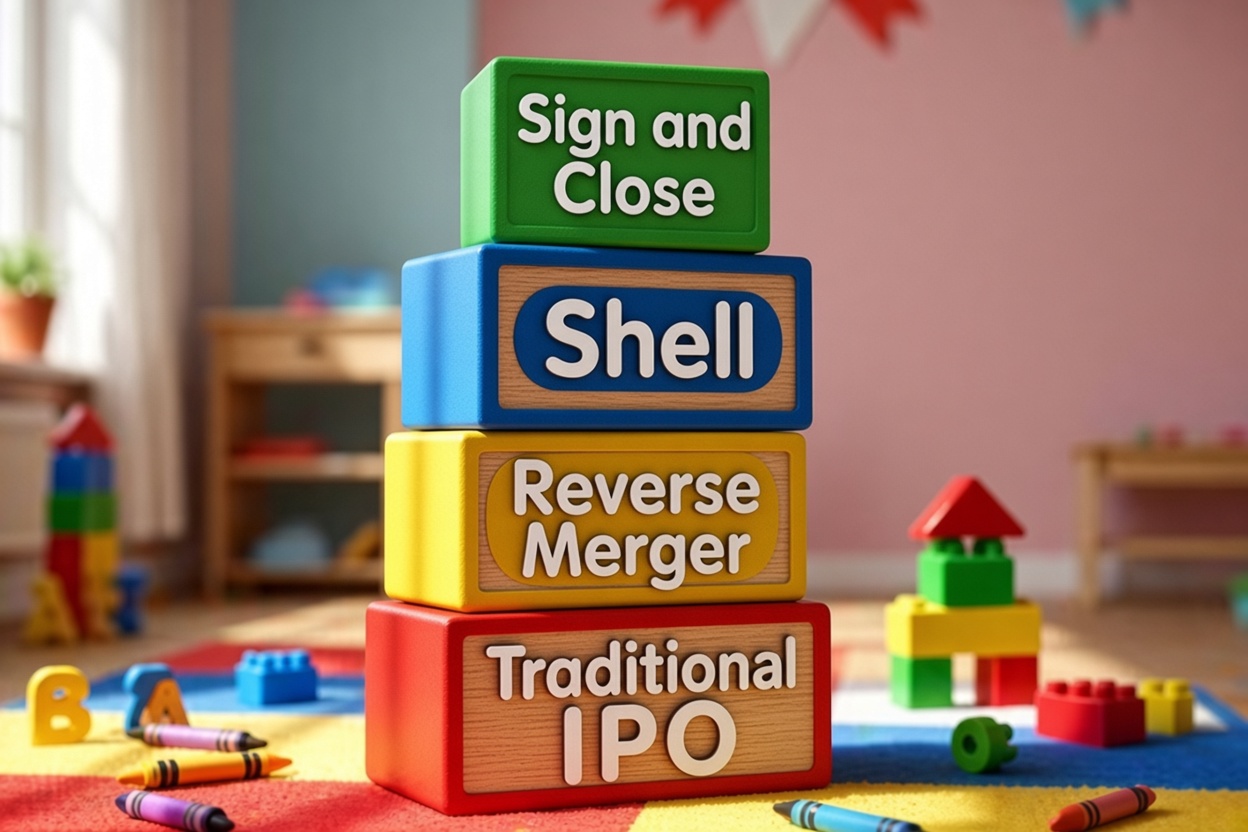
For decades, reverse mergers provided private companies with a relatively predictable backdoor to the public markets. Rather than navigating the lengthy, expensive, and often volatile initial public offering (IPO) process, a private company could combine with a publicly traded entity—frequently a former operating business that had hit a wall but still retained viable structure and exchange listings.
However, recent regulatory shifts from the U.S. Securities and Exchange Commission (SEC) have altered this traditional playbook. Through a combination of new rules and expanding staff interpretations, the regulatory landscape for reverse mergers has become considerably more complex.
Here is a look at how recent SEC actions have changed reverse merger mechanics, what it means for deal structure, and why the strategy remains a compelling option for the right companies.
1. The Death of the “Sign and Close” Model
Historically, public companies that fell on hard times could acquire a private target via a private placement of shares under Section 4(a)(2) of the Securities Act. These deals were known as “sign and close” reverse mergers because they allowed the transaction to close almost immediately without prior SEC registration of the newly issued shares.
That path has largely been closed. Under recent SEC interpretations—specifically expanded under Rule 145a—the SEC views business combinations involving companies deemed to be “shells” as a public offering of the private target’s securities to the public entity’s existing shareholders.
Because a private company cannot practically execute a private placement directed at thousands of unknown public retail investors, registration on Form S-4 is now mandatory for these transactions. As a result, the rapid “sign and close” route is essentially off the table for public companies that trigger shell status.
2. A Harder Look at Who Is (and Isn’t) a “Shell”
Under long-standing rules (like Rule 12b-2), a shell company was strictly defined as an entity with no or nominal assets and no or nominal operations. For years, operating companies that suffered setbacks—such as a biopharmaceutical firm whose lead clinical trial failed—could avoid shell classification as long as they retained non-nominal assets or secondary operational programs.
The SEC’s recent guidance (notably articulated in Footnote 943 of Release No. 33-11265) shifts the focus from simple balance-sheet math to a broader “totality of the circumstances” test.
Under this new posture:
- Asset Dispositions Trigger Scrutiny: If a public company disposes of its legacy operations or assets before, during, or shortly after the transaction, regulators may look past current asset values and treat the entity as a shell.
- Contingent Value Rights (CVRs) under Fire: Issuing CVRs—a common mechanism used to pass the future value of legacy assets back to original shareholders—is now frequently viewed by SEC staff as an indicator that legacy assets are being spun off, potentially triggering shell status.
- Intention Matters: To avoid shell classification, the post-merger entity generally needs a clear, demonstrable intent to continue developing and maintaining at least some of the public company’s legacy programs rather than simply winding them down or liquidating them.
- C staff as an indicator that legacy assets are being spun off, potentially triggering shell status.
- Intention Matters: To avoid shell classification, the post-merger entity generally needs a clear, demonstrable intent to continue developing and maintaining at least some of the public company’s legacy programs rather than simply winding them down or liquidating them.
3. Practical Consequences for Post-Merger Companies
If a public company is classified as a shell during a reverse merger, the downstream regulatory consequences for the combined entity are significant:
- Ineligible Issuer Status: The merged entity is designated as an “ineligible issuer” for three years post-closing, restricting communication flexibility and the use of streamlined shelf registration statements.
- Delayed Form S-3 Access: The combined company must maintain a full 12-month reporting history post-closing before gaining eligibility to use Form S-3 for registered primary or secondary offerings.
- Resale Restrictions on Insiders: Shares issued to affiliates of the private target cannot immediately be registered on a standard resale shelf. Insiders and major stakeholders may face a 12-month lockup or holding period before their shares can be freely traded under standard registration forms.
4. Reverse Mergers vs. Traditional IPOs: Is the Path Still Worth It?
Given the added filing requirements, registration delays, and regulatory friction, is the reverse merger structure still viable?
The short answer is yes, but the value proposition has shifted.
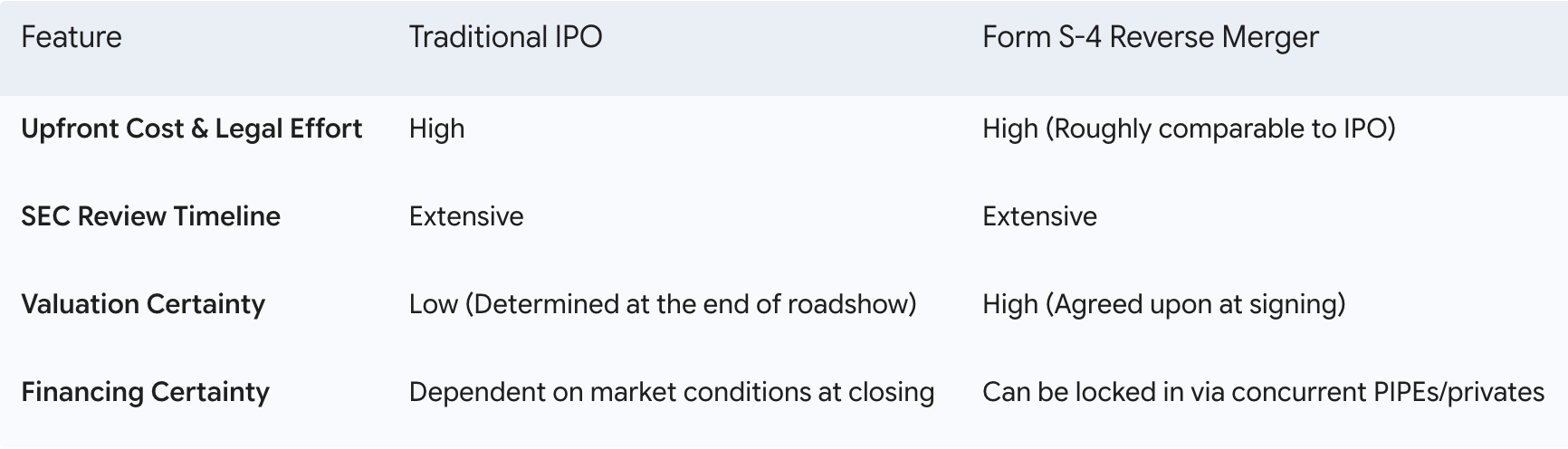
While a reverse merger on Form S-4 no longer offers a shortcut on regulatory review or legal costs compared to an IPO, it still offers superior deal certainty. In an IPO, a company invests substantial capital without knowing its final valuation or whether market conditions will allow the offering to price. In a reverse merger, valuation and accompanying capital commitments are locked in at the time of contract execution, subject only to shareholder approval and SEC registration clearance.
Strategic Takeaways for Executives and Boards
- Audit Legacy Operations Early: If you are a public company considering a pivot, carefully evaluate what legacy assets or active operational programs will be retained post-closing. Wiping the slate clean increases the risk of being classified as a shell.
- Plan for Form S-4 Timelines: Assume the transaction will require full registration on Form S-4. Build the appropriate review and SEC comment periods into the deal timeline.
- Prepare Target Financials Early: Ensure the private target’s financial statements meet public reporting standards early in the process to prevent bottlenecks during S-4 preparation.
While the SEC’s evolving interpretations have eliminated legacy shortcuts, the reverse merger remains a potent strategic tool for private companies seeking public market access with guaranteed valuation parameters.
Disclaimer: This article is provided for informational purposes only and does not constitute legal or tax advice. Securities rules change, so speak with qualified counsel about your specific situation.
To speak with a Securities Attorney, please contact Brenda Hamilton at 200 E Palmetto Rd, Suite 103, Boca Raton, Florida, (561) 416-8956, or by email at [email protected].
Hamilton & Associates | Securities Attorneys
Brenda Hamilton, Securities Attorney
200 E Palmetto Rd, Suite 103
Boca Raton, Florida 33432
Telephone: (561) 416-8956
Facsimile: (561) 416-2855
www.SecuritiesLawyer101.com