
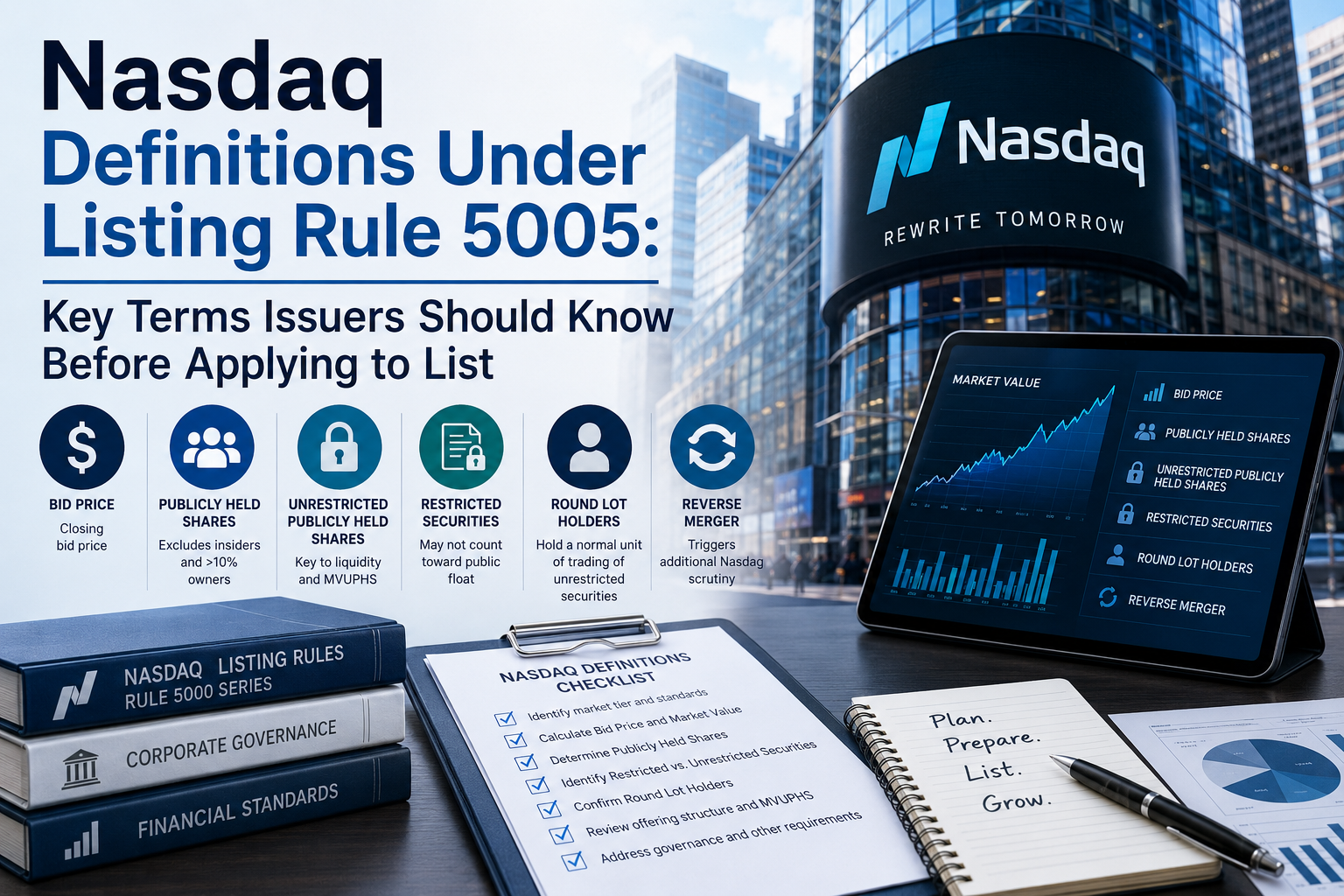
Nasdaq listing analysis often begins with financial standards, bid price, public float, shareholder counts and corporate governance. But those standards cannot be applied correctly unless the issuer first understands Nasdaq-defined terms. Nasdaq Listing Rule 5005 contains definitions used throughout the Nasdaq Listing Rules, and those definitions can determine whether shares, holders, offerings and transactions count for listing purposes.
This article explains the practical meaning of important Nasdaq definitions for issuers preparing for a Nasdaq listing, OTC uplisting, IPO, direct listing, direct public offering, reverse merger analysis or continued listing review. For additional background, see Securities Lawyer 101 Nasdaq Listing, Nasdaq Listing Process and Documentation, and NASDAQ and NYSE Initial Listing Requirements.
Quick Answer: Why Nasdaq Rule 5005 Definitions Matter
Nasdaq definitions matter because they determine how Nasdaq applies listing standards. A company may appear to have enough shareholders, public float or market value, but the result can change when Nasdaq excludes insiders, more-than-10-percent holders, restricted securities or holders who do not own unrestricted round lots.
- Bid Price affects minimum price eligibility and continued listing analysis.
- Market Value determines the value of publicly held shares or other measures used in quantitative standards.
- Publicly Held Shares exclude shares held by officers, directors and more-than-10-percent beneficial owners.
- Unrestricted Publicly Held Shares are central to Nasdaq liquidity analysis and MVUPHS calculations.
- Restricted Securities can reduce the share count available for public float and holder calculations.
- Round Lot Holders must hold a normal unit of trading of unrestricted securities.
- Reverse Merger history can create additional listing review issues.
Companies planning an uplisting from OTC Markets should also review Uplisting After Going Public, Nasdaq Compliance: Capital Market Listing Requirements, and Nasdaq $5 Million Minimum Offering Proceeds Rule.
Nasdaq Market Tiers Referenced in Rule 5005
Nasdaq Rule 5005 defines terms used for the three main Nasdaq tiers: the Nasdaq Capital Market, the Nasdaq Global Market and the Nasdaq Global Select Market. Nasdaq Rule Series 5000 contains rules related to qualification, listing and delisting of companies, and the 5300, 5400 and 5500 Series contain quantitative listing requirements for the Global Select, Global Market and Capital Market. Review the official Nasdaq Rule 5000 Series and Nasdaq initial listing materials before filing a listing application.
- Nasdaq Capital Market – often used by smaller companies that meet applicable financial, liquidity, shareholder and governance standards.
- Nasdaq Global Market – a higher tier with its own financial and liquidity standards.
- Nasdaq Global Select Market – the highest Nasdaq tier, with Global Select inclusion standards.
Nasdaq Rule 5005 Definitions in Plain English
The following glossary summarizes Nasdaq Rule 5005 definitions in practical terms for issuers and advisors. It is not a substitute for the official Nasdaq rule text.
Act
The Securities Exchange Act of 1934.
Why it matters: Many Nasdaq terms cross-reference Exchange Act concepts, SEC reporting duties and Regulation NMS definitions.
Best efforts offering
An offering where selling group members do not commit to buy unsold securities; they sell only what they elect or are able to sell.
Why it matters: This differs from a firm commitment underwriting and can affect Nasdaq liquidity and offering analysis.
Related reading: Guide to Preparing SEC Form S-1, Registration Statements, and Direct Public Offerings.
Bid Price
The closing bid price.
Why it matters: Minimum bid price is a central listing and continued listing concept.
Related reading: Nasdaq Capital Market Initial Listing Guide, Nasdaq Compliance: Capital Market Listing Requirements, and Nasdaq $5 Million Minimum Offering Proceeds Rule.
Cash flows
For the Nasdaq Global Select Market, cash flows are defined in Rule 5310(b).
Why it matters: Relevant when a company relies on cash-flow based Global Select standards.
Commission or SEC
The United States Securities and Exchange Commission.
Why it matters: Nasdaq-listed issuers generally interact with both Nasdaq and the SEC.
Company
The issuer of a security listed on Nasdaq or applying to list, including non-corporate issuers where applicable.
Why it matters: Confirms that Nasdaq rules apply broadly to the listing applicant.
Consolidated Quotation Service or CQS
The quotation collection system for securities listed on an exchange other than Nasdaq under Regulation NMS.
Why it matters: Relevant to market data and quotation infrastructure.
Country of Domicile
The country under whose laws the company is organized or incorporated.
Why it matters: Important for foreign private issuer and home-country practice analysis.
Related reading: Foreign Private Issuer Reporting on Form 20-F and Form 6-K and Foreign Private Issuer Listing and Compliance.
Covered Security
A security described in Section 18(b) of the Securities Act of 1933.
Why it matters: May affect state securities law preemption.
Direct Registration Program
A program allowing shareholders to hold securities in book-entry form directly with the company or transfer agent without physical certificates.
Why it matters: Useful for transfer agent records, shareholder ownership and public holder review.
Dually-Listed Security
A security listed on the Nasdaq Global Market or Global Select Market that is also listed on the New York Stock Exchange.
Why it matters: Relevant for issuers with listings on more than one exchange.
EDGAR System
The SEC electronic filing system.
Why it matters: Nasdaq may treat documents filed on EDGAR as filed with Nasdaq when the rules allow.
Equity Investment Tracking Stock
A class of common equity tracking, on an unleveraged basis, an issuer investment in the common equity of a single other Nasdaq-listed company.
Why it matters: A specialized equity security with listing implications.
ESOP
Employee stock option plan.
Why it matters: Employee equity plans can affect capitalization, dilution and restricted securities review.
Executive Officer
A term defined in Nasdaq Rule 5605(a)(1).
Why it matters: Executive officer status affects governance, independence and public holder exclusions.
Filed with Nasdaq
Submitted directly to Nasdaq or filed with the SEC through EDGAR.
Why it matters: Helps issuers understand filing mechanics during listing and compliance review.
Firm Commitment Offering
An offering in which syndicate participants make a financial commitment to purchase the securities.
Why it matters: Important for IPO and uplisting structures and certain Nasdaq liquidity alternatives.
Related reading: Guide to Preparing SEC Form S-1, Registration Statements, and Direct Public Offerings.
Family Member
A term defined in Nasdaq Rule 5605(a)(2).
Why it matters: Relevant to director independence and governance analysis.
Foreign Private Issuer
A foreign private issuer as defined under Exchange Act Rule 3b-4.
Why it matters: Affects SEC reporting, governance accommodations and Nasdaq listing planning.
Related reading: Foreign Private Issuer Reporting on Form 20-F and Form 6-K and Foreign Private Issuer Listing and Compliance.
Independent Director
A term defined in Nasdaq Rule 5605(a)(2).
Why it matters: Central to Nasdaq board and committee requirements.
Index Warrants
A term defined in Nasdaq Rule 5725(a).
Why it matters: Relevant to specialized warrant listings.
Listed Securities
Securities listed on Nasdaq or another national securities exchange.
Why it matters: Used in several Nasdaq listing and compliance contexts.
Market Value
The consolidated closing bid price multiplied by the measure being valued.
Why it matters: Core to market value of publicly held shares and other quantitative standards.
Related reading: Nasdaq Capital Market Initial Listing Guide, Nasdaq Compliance: Capital Market Listing Requirements, and Nasdaq $5 Million Minimum Offering Proceeds Rule.
Member
A broker or dealer admitted to Nasdaq membership.
Why it matters: Relevant to market participants and Nasdaq trading support.
Market Maker
A dealer registered as a market maker that regularly and continuously quotes a security for its own account.
Why it matters: Market maker participation can matter in listing readiness and liquidity planning.
Nasdaq Global Market or NGM
A Nasdaq tier that includes the Global Market and Global Select Market.
Why it matters: One of the principal Nasdaq market tiers for listed companies.
Nasdaq Global Market Security
A security listed on Nasdaq that satisfies applicable Global Market requirements, or certain related rights, warrants or index warrants.
Why it matters: Determines whether the security belongs in the Global Market category.
Nasdaq Capital Market
A distinct Nasdaq tier for securities meeting the Rule 5100, 5200 and 5500 Series requirements.
Why it matters: Often the target tier for smaller operating companies and OTC uplistings.
Related reading: Nasdaq Capital Market Initial Listing Guide, Nasdaq Compliance: Capital Market Listing Requirements, and Nasdaq $5 Million Minimum Offering Proceeds Rule.
Nasdaq Capital Market Security
A security listed on the Capital Market that satisfies applicable requirements and is not a Global Market security, or certain related rights or warrants.
Why it matters: Defines the securities treated as Capital Market securities.
Related reading: Nasdaq Capital Market Initial Listing Guide, Nasdaq Compliance: Capital Market Listing Requirements, and Nasdaq $5 Million Minimum Offering Proceeds Rule.
Nasdaq Global Select Market or NGSM
The Global Select segment of the Nasdaq Global Market for securities meeting Rule 5100, 5200 and 5300 Series initial inclusion standards.
Why it matters: The highest Nasdaq tier.
Nasdaq Global Select Market Security
A security listed on Nasdaq and included in the Global Select segment.
Why it matters: Identifies securities that have met Global Select criteria.
Other Regulatory Authority
Another agency with authority over certain bank, savings institution or insurance company securities.
Why it matters: Relevant for specialized issuers subject to non-SEC oversight.
Primary Equity Security
The company first class of common stock, ordinary shares, shares or beneficial interests, limited partnership interests, ADRs or ADSs.
Why it matters: Important because many Nasdaq initial listing standards apply to primary equity securities.
Related reading: Guide to Preparing SEC Form S-1, Registration Statements, and Direct Public Offerings.
Private Placement Market
A trading system for unregistered securities operated by a national securities exchange or registered broker-dealer.
Why it matters: Relevant to unregistered securities trading systems.
Publicly Held Shares
Shares not held directly or indirectly by officers, directors or beneficial owners of more than 10 percent of total shares outstanding.
Why it matters: A key public float concept for initial listing and continued listing compliance.
Related reading: Nasdaq Capital Market Initial Listing Guide, Nasdaq Compliance: Capital Market Listing Requirements, and Nasdaq $5 Million Minimum Offering Proceeds Rule.
Public Holders
Beneficial and record holders, excluding executive officers, directors and more-than-10-percent beneficial owners.
Why it matters: Important for shareholder distribution requirements.
Restrictive Market
A jurisdiction that does not provide the PCAOB access to inspect public accounting firms auditing Nasdaq-listed companies, with additional tests for where the business is principally administered.
Why it matters: Important for foreign issuers and auditor inspection risk.
Related reading: Foreign Private Issuer Reporting on Form 20-F and Form 6-K and Foreign Private Issuer Listing and Compliance.
Restricted Securities
Securities subject to resale restrictions, including private placement shares, compensation shares, Regulation S shares, lockup shares and Rule 144 restricted securities.
Why it matters: A critical definition for public float, unrestricted shares and resale analysis.
Related reading: Rule 144 Opinion and Section 4(a)(1) Opinion, Legal Opinion and SEC Resales, and Removing Restrictive Legends From Stock.
Reverse Merger
A transaction where an operating company becomes an Exchange Act reporting company by combining with a public shell company, subject to Nasdaq exclusions for specified transactions.
Why it matters: Reverse merger history can create additional Nasdaq listing issues.
Related reading: Reverse Merger Attorneys, Reverse Mergers 101, Reverse Merger Legal Risks, and Reverse Mergers and OTC Markets Compliance.
Round Lot or Normal Unit of Trading
Defined under Regulation NMS Rule 600(b)(93), with Nasdaq publishing semi-annual updates for Nasdaq-listed securities.
Why it matters: Relevant to round lot holder analysis.
Round Lot Holder
A holder of a normal unit of trading of unrestricted securities; beneficial holders are considered in addition to record holders.
Why it matters: A common issue in Nasdaq shareholder-count reviews.
Related reading: Nasdaq Capital Market Initial Listing Guide, Nasdaq Compliance: Capital Market Listing Requirements, and Nasdaq $5 Million Minimum Offering Proceeds Rule.
Shareholder
A record or beneficial owner of a security listed or applying to list, including comparable owners such as limited partners or depositary receipt holders.
Why it matters: Important for ownership and holder calculations.
Substantial Shareholder
A term defined in Nasdaq Rule 5635(e)(3).
Why it matters: Relevant to shareholder approval and financing rules.
Substitution Listing Event
Certain corporate changes, reorganizations, reclassifications, replacement listings or changes to underlying assets of listed securities.
Why it matters: Can trigger Nasdaq listing review even when the business continuity appears unchanged.
Total Holders
Both beneficial holders and record holders of a security.
Why it matters: A broader holder count than public holders.
Unrestricted Publicly Held Shares
Publicly held shares that are also unrestricted securities.
Why it matters: Central to MVUPHS and public float analysis.
Related reading: Rule 144 Opinion and Section 4(a)(1) Opinion, Legal Opinion and SEC Resales, and Removing Restrictive Legends From Stock.
Unrestricted Securities
Securities that are not restricted securities.
Why it matters: A key filter for Nasdaq liquidity and holder calculations.
Related reading: Rule 144 Opinion and Section 4(a)(1) Opinion, Legal Opinion and SEC Resales, and Removing Restrictive Legends From Stock.
Practical Listing Issues Created by These Definitions
Public float is not the same as total outstanding shares
A company cannot assume that all outstanding shares count toward Nasdaq public float or liquidity standards. Shares held by officers, directors and more-than-10-percent beneficial owners are generally excluded from Publicly Held Shares. Shares that are subject to resale restrictions may also be excluded from unrestricted share calculations.
Before filing a listing application, the company should review its shareholder list, transfer agent records, capitalization table, private placement history, lockup agreements, Rule 144 status and beneficial ownership information. See Rule 144 Opinion and Section 4(a)(1) Opinion and Legal Opinions and Restrictive Legends.
Round lot holder counts require more than a shareholder list
Round Lot Holders must hold a normal unit of trading of unrestricted securities. A record holder list alone may be incomplete because Nasdaq considers beneficial holders in addition to record holders. Issuers should coordinate early with their transfer agent, broker participants and counsel to prepare holder support.
Bid price and market value must be calculated using Nasdaq concepts
Bid Price means the closing bid price, and Market Value uses the consolidated closing bid price multiplied by the relevant measure. These definitions can affect initial listing eligibility, market value of publicly held shares, continued listing compliance and reverse split planning.
Reverse merger history can trigger additional scrutiny
Nasdaq defines Reverse Merger broadly. Companies that became public through a shell company combination should analyze Nasdaq reverse merger rules, seasoning, trading history, public record, DTC status, shareholder base and SEC reporting history. See Reverse Merger Legal Risks and Reverse Mergers and OTC Markets Compliance.
Foreign issuers should analyze domicile, auditor access and FPI status
Foreign issuers should evaluate country of domicile, foreign private issuer status, home-country practices, auditor inspection issues and Restrictive Market concerns before applying to list. See Foreign Private Issuer Listing and Compliance and Foreign Private Issuer Reporting.
Nasdaq Definitions Checklist for Issuers
- Confirm the intended market tier: Nasdaq Capital Market, Nasdaq Global Market or Nasdaq Global Select Market.
- Identify the applicable initial listing standard and each quantitative test.
- Calculate Bid Price and Market Value using Nasdaq definitions.
- Separate total shares from Publicly Held Shares and Unrestricted Publicly Held Shares.
- Identify all officers, directors and more-than-10-percent beneficial owners.
- Review which shares are Restricted Securities and which are Unrestricted Securities.
- Confirm Public Holders, Total Holders and Round Lot Holders with transfer agent and brokerage support.
- Analyze whether a firm commitment offering is required or strategically advisable.
- Review Form S-1 disclosure, offering structure and MVUPHS calculations.
- Analyze reverse merger, shell company, SPAC, foreign issuer or restrictive market issues.
- Confirm independent director, audit committee and other governance requirements before submission.
- Coordinate with Nasdaq listing counsel, auditors, transfer agent, underwriter and market makers early.
For broader transaction planning, review Going Public Services, Guide to Preparing SEC Form S-1, Direct Public Offerings in 2025, and Choosing the Right Path to the Public Markets.
Frequently Asked Questions
What is Nasdaq Rule 5005?
Nasdaq Rule 5005 is the definitions rule used throughout the Nasdaq Listing Rules. It defines or cross-references terms such as Bid Price, Market Value, Publicly Held Shares, Public Holders, Restricted Securities, Unrestricted Securities, Round Lot Holder, Reverse Merger and Nasdaq market tiers.
Why do Publicly Held Shares matter?
Publicly Held Shares matter because Nasdaq listing standards often require a minimum market value or number of shares held by the public. Shares held by officers, directors and more-than-10-percent beneficial owners are generally excluded.
What are Unrestricted Publicly Held Shares?
Unrestricted Publicly Held Shares are publicly held shares that are not restricted securities. This concept is important for Nasdaq liquidity and MVUPHS analysis.
Do restricted shares count toward the Nasdaq public float?
Restricted shares may not count toward unrestricted public float or unrestricted publicly held share calculations. Issuers should review each issuance, exemption, holding period, lockup and resale restriction with securities counsel.
What is a Round Lot Holder?
A Round Lot Holder is a holder of a normal unit of trading of unrestricted securities. Nasdaq considers beneficial holders in addition to record holders.
Why does reverse merger history matter for Nasdaq?
Reverse merger history can affect Nasdaq eligibility because Nasdaq applies additional scrutiny and specific rules to companies that became reporting companies through shell company transactions.
Where can companies find the official Nasdaq definitions?
Companies should review Nasdaq Listing Rule 5005 in the Nasdaq Listing Center Rulebook and confirm the current rule text before relying on a listing analysis.
Related Securities Lawyer 101 Resources
- Nasdaq Listing
- Nasdaq Listing Process and Documentation
- Navigating the Nasdaq Listing Process
- Nasdaq Capital Market Initial Listing Guide
- Nasdaq Compliance: Capital Market Listing Requirements
- Nasdaq $5 Million Minimum Offering Proceeds Rule
- Nasdaq SPAC Listing Rules 2026
- NASDAQ and NYSE Initial Listing Requirements
- Uplisting After Going Public
- Guide to Preparing SEC Form S-1
- Registration Statements
- Direct Public Offerings
- Foreign Private Issuer Reporting
- Rule 144 Opinion and Section 4(a)(1) Opinion
- Reverse Merger Legal Risks
- Securities Lawyer 101 Resources
Conclusion
Nasdaq definitions are not merely technical vocabulary. They shape how Nasdaq evaluates shareholder distribution, public float, bid price, market value, restricted securities, unrestricted securities, governance status, issuer history and listing eligibility. Companies preparing for a Nasdaq application should analyze these definitions before filing a registration statement, launching an offering, completing a reverse split, submitting a Listing Center application or relying on a public float calculation.
Hamilton & Associates Law Group, P.A. represents issuers in securities law, going public, Nasdaq listing, NYSE listing, OTC Markets, Form S-1 registration, SEC reporting, reverse merger, Rule 144 and public company compliance matters. To learn more, visit Securities Lawyer 101.
This securities law blog post is provided as a general informational service. It is not legal advice. Companies considering a Nasdaq listing should consult qualified securities counsel and review the current Nasdaq Listing Rules.