
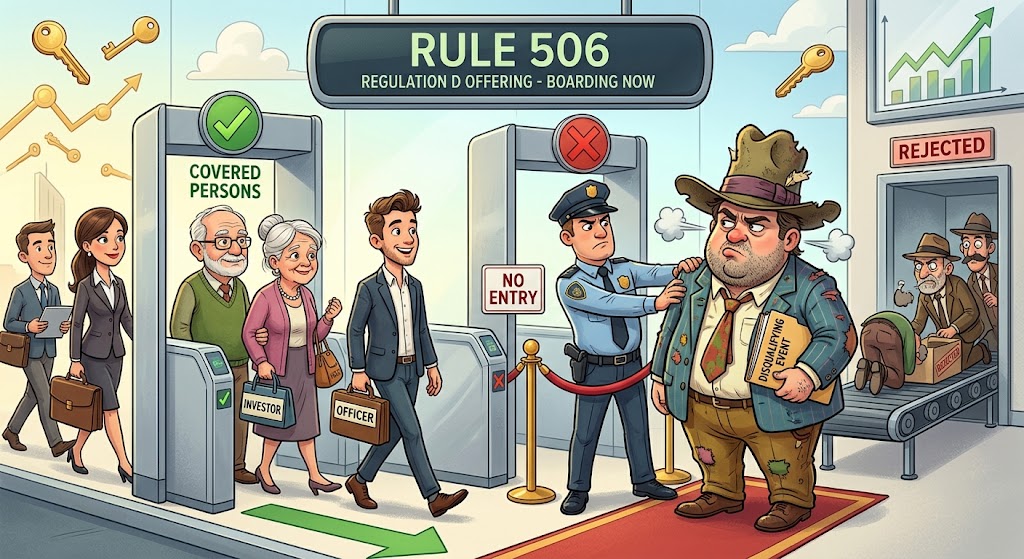
Rule 506 of Regulation D is one of the most widely used exemptions for private securities offerings, but the exemption can be unavailable if the issuer or another covered person has a disqualifying event under Rule 506(d). These provisions are commonly known as the Rule 506 “bad actor” disqualification rules.
The bad actor rules apply to both Rule 506(b) and Rule 506(c) offerings. They reach beyond the issuer itself and can require diligence on directors, executive officers, significant voting owners, promoters, investment managers, placement agents, compensated solicitors and certain personnel associated with those parties.
For issuers, the practical lesson is simple: bad actor diligence should be completed before securities are sold and should be refreshed when an offering is continuous, delayed or long-running. Discovering a disqualifying event after a sale can create a significant exemption issue that may not be cured merely by filing a Form D or revising the offering documents.
Rule 506 Bad Actor Rules at a Glance
- Rule 506(d) applies to offerings relying on both Rule 506(b) and Rule 506(c).
- The rule covers the issuer and several categories of people and entities connected with the issuer or offering.
- Disqualifying events include specified criminal convictions, court orders, regulatory orders, SEC orders, SRO sanctions and certain U.S. Postal Service orders.
- Events occurring on or after September 23, 2013 can disqualify an offering if the rule’s conditions are met.
- Certain events occurring before September 23, 2013 generally do not disqualify the offering but may require written disclosure to purchasers under Rule 506(e).
- The issuer may rely on a reasonable-care exception only if it did not know and, despite exercising reasonable care, could not have known that a disqualification existed.
- Long-running offerings require more than a one-time questionnaire; SEC staff guidance calls for periodic updating of the factual inquiry when circumstances warrant.
- The SEC may grant a waiver for good cause, and in some cases the court or regulator entering an order can provide that Rule 506 disqualification should not arise.
What Is Rule 506(d) Bad Actor Disqualification?
Rule 506(d) is part of Regulation D under the Securities Act of 1933. It prevents an issuer from relying on the Rule 506 exemption for a sale if a covered person is subject to one of the rule’s specified disqualifying events, unless an exception or waiver applies.
Because Rule 506 is frequently used for private placements that raise substantial amounts of capital, loss of the exemption can be serious. Rule 506(d) therefore should be addressed as part of the offering diligence process, not after subscriptions have already been accepted.
The rule applies at the time of each sale. That timing matters in continuing offerings because a new covered person or a new disqualifying event can affect later sales even though earlier sales occurred before the problem arose.
Who Is a Covered Person Under Rule 506(d)?
The SEC identifies the following categories as covered persons for purposes of Rule 506 bad actor disqualification:
- the issuer, including its predecessors and affiliated issuers involved in the same offering;
- directors, general partners and managing members of the issuer;
- executive officers of the issuer and other officers who participate in the offering;
- beneficial owners of 20% or more of the issuer’s outstanding voting equity securities, calculated on the basis of total voting power;
- promoters connected with the issuer;
- for pooled investment fund issuers, the fund’s investment manager and specified principals of the investment manager;
- persons paid, directly or indirectly, to solicit purchasers in the offering; and
- specified directors, general partners, managing members, executive officers and participating officers of compensated solicitors and certain investment managers.
The list is broader than many issuers expect. A private company that checks only its CEO and directors may overlook a 20% voting owner, a promoter, an officer who helped prepare the offering materials, or personnel associated with a placement agent.
Executive Officers and Officers Participating in the Offering
All executive officers are covered persons. Other officers can also be covered if they participate in the offering. SEC guidance explains that participation must be more than transitory or incidental and can include involvement in due diligence, preparation of disclosure documents, structuring or offering advice, or communications with the issuer, prospective investors or other offering participants.
Purely administrative functions, such as routine bookkeeping, wiring funds or opening brokerage accounts, generally do not by themselves constitute participation under the SEC staff interpretation.
20% Beneficial Owners
Rule 506(d) covers beneficial owners of 20% or more of the issuer’s outstanding voting equity securities, calculated on the basis of total voting power. Beneficial ownership is analyzed using principles under Exchange Act Rule 13d-3 and can include both direct and indirect ownership.
Voting agreements and shared voting power can complicate the calculation. Issuers should not assume that the capitalization table alone identifies every 20% beneficial owner for Rule 506(d) purposes.
Timing also matters. SEC staff has explained that an investor who becomes a 20% beneficial owner as a result of a particular sale is not a 20% owner at the time of that sale, but can become a covered person for subsequent sales made while the investor remains a 20% beneficial owner.
Promoters
Promoters connected with the issuer are covered persons. The federal securities-law definition of promoter is broader than a job title and can reach people or entities that took initiative in founding or organizing the business or received specified interests or proceeds in connection with that activity. Issuers should identify promoters based on their actual role and relationship to the issuer rather than relying only on formal titles.
Placement Agents and Other Compensated Solicitors
Persons who are paid, directly or indirectly, to solicit purchasers are covered by Rule 506(d). SEC staff has made clear that the category is not limited to registered broker-dealers. A person can be a compensated solicitor for Rule 506(d) purposes regardless of whether that person is registered, or required to be registered, as a broker-dealer.
The analysis can also extend to specified control persons and participating officers of the solicitor. For this reason, using a placement agent, finder or other compensated intermediary should trigger a separate Rule 506(d) diligence process rather than a simple check of the intermediary’s entity name.
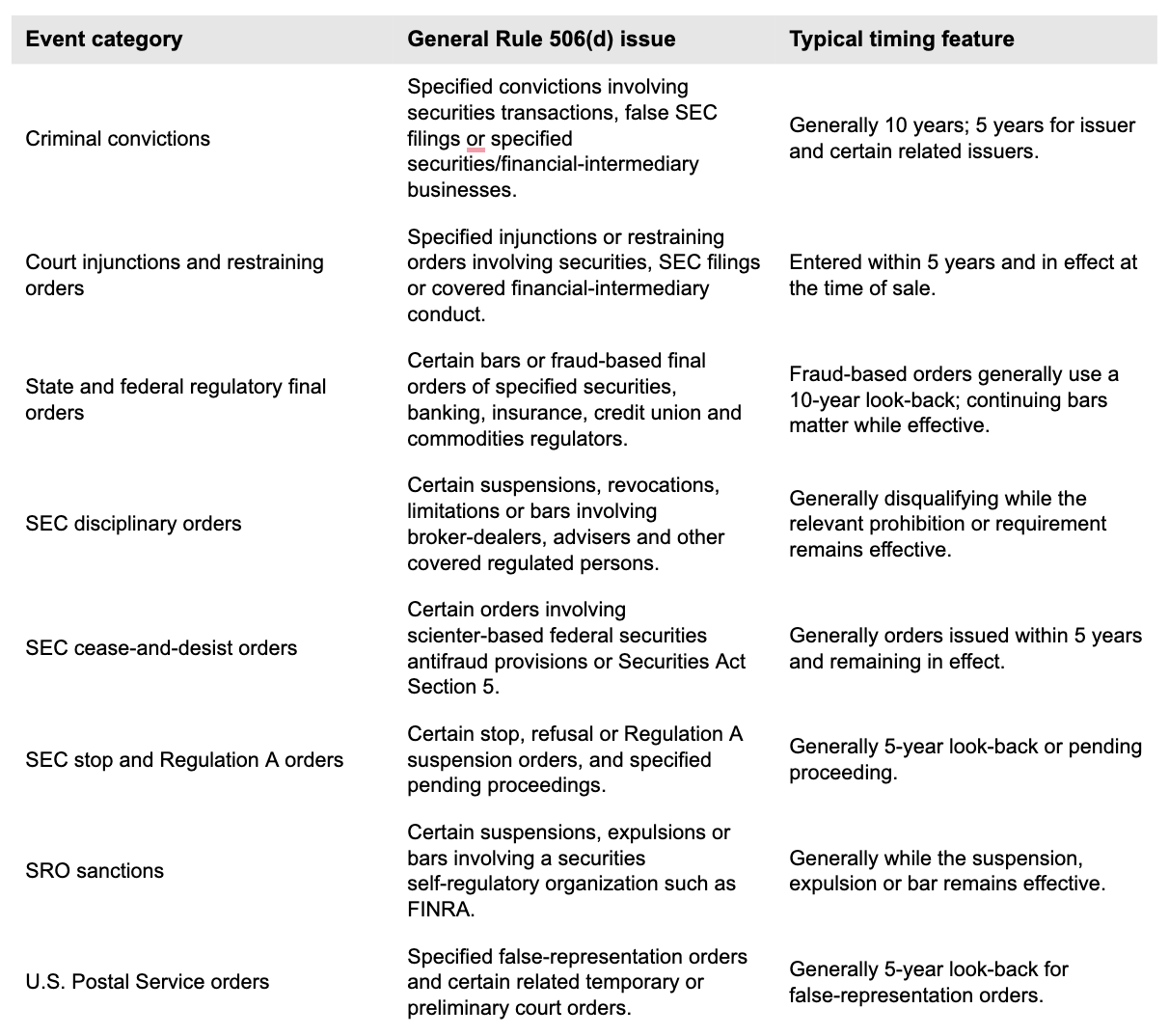
What Events Can Disqualify a Rule 506 Offering?
Rule 506(d) identifies several categories of disqualifying events. The precise language, timing and status of an order matter, so an issuer should analyze the actual document rather than relying on a general description of a person’s disciplinary history.
Why September 23, 2013 Matters
September 23, 2013 is the effective date of the Rule 506 bad actor amendments. The date of the triggering event, rather than merely the date of the underlying misconduct, is critical to the analysis.
A covered disqualifying event occurring on or after September 23, 2013 can make Rule 506 unavailable for a sale unless an exception, removal of the disqualification or waiver applies.
An event occurring before September 23, 2013 generally does not disqualify the offering solely because of Rule 506(d). However, Rule 506(e) can require the issuer to provide purchasers with a written description of a pre-existing event that would otherwise have been disqualifying. The disclosure must be furnished a reasonable time before the Rule 506 sale.
Rule 506(e) does not require disclosure of every old disciplinary matter. SEC staff guidance states that an event outside the applicable look-back period, or an order that would no longer have continuing disqualifying effect, need not be disclosed solely under Rule 506(e).
What Is the Rule 506(d) Reasonable Care Exception?
Rule 506(d) contains a reasonable-care exception for an issuer that can establish that it did not know and, despite exercising reasonable care, could not have known that a covered person with a disqualifying event participated in the offering.
Reasonable care is not a substitute for diligence. The SEC states that an issuer cannot establish reasonable care without making a factual inquiry, in light of the circumstances, into whether a disqualification exists.
There is no single mandatory search procedure for every offering. The scope of the inquiry can depend on factors such as the number and type of covered persons, the issuer’s relationship with them, the jurisdictions involved, publicly available information and the duration of the offering.
How Should an Issuer Conduct a Rule 506 Bad Actor Check?
A practical Rule 506(d) diligence process usually begins by identifying every covered person before attempting to search disciplinary records. The issuer then develops a record showing the inquiry it performed and the responses it received.
1. Build the Covered-Person List
Identify directors, managing members or general partners, executive officers, other participating officers, 20% voting beneficial owners, promoters, investment managers where applicable, compensated solicitors and the relevant personnel associated with those intermediaries.
2. Use Written Questionnaires or Certifications
Obtain written representations addressing the categories of Rule 506(d) disqualifying events. The questionnaire should be tailored to the actual covered-person categories rather than using a generic criminal-history question.
3. Conduct Appropriate Public-Record and Regulatory Checks
Depending on the circumstances, reasonable diligence may include searches of SEC and FINRA records, state regulator records, court records and other databases relevant to the covered person. A questionnaire can be important evidence, but it should not be used to ignore contrary information already known to the issuer.
4. Review the Actual Order or Judgment
A disciplinary event cannot reliably be classified from a search-result headline. The issuer should obtain and analyze the underlying conviction, injunction, administrative order, bar or other document to determine the operative provision, date, look-back period and whether the order remains in effect.
5. Document the Determination
Keep the covered-person list, questionnaires, search results, copies of relevant orders, legal analysis and any disclosure or waiver materials with the offering records. The objective is to be able to demonstrate what the issuer knew and what reasonable steps it took at the relevant time.
Bad Actor Diligence in Continuous and Long-Running Offerings
A one-time bad actor check may not be enough for an offering that remains open for months or years. In its consolidated Corporation Finance interpretations, the SEC staff states that continuous, delayed or long-lived offerings require the issuer to update its factual inquiry periodically.
Depending on the circumstances, updates can include bring-down questionnaires and certifications, negative-consent letters, contractual notice covenants and periodic re-checking of public databases. The appropriate frequency depends on the facts of the offering and the covered persons involved.
Issuers should also require covered persons to notify the company promptly if a potentially disqualifying event occurs during the offering. SEC staff has stated that an issuer may reasonably rely on a covered person’s agreement to provide notice of potential or actual triggering events, although that agreement does not eliminate the need for periodic updates when an offering is long-running.
What Happens if a Disqualifying Event Is Discovered During the Offering?
Rule 506(d) is evaluated at the time of each sale. A disqualifying event arising during an offering generally does not retroactively affect sales completed before the triggering event, but later sales may be unable to rely on Rule 506 unless the problem is addressed.
The response depends on the covered person and the event. Potential steps can include terminating the covered person’s role, obtaining a waiver, determining whether the order itself provides that disqualification should not arise, making required Rule 506(e) disclosure for a pre-September 23, 2013 event, or restructuring the offering relationship where legally appropriate.
SEC staff has specifically addressed an ongoing offering in which a placement agent or one of its covered control persons becomes disqualified. Future sales may continue to rely on Rule 506 in certain circumstances if the placement-agent engagement is terminated and the agent receives no compensation for future sales, or if the affected control person is removed from the role that made the person covered.
Can the SEC Waive Rule 506 Bad Actor Disqualification?
Yes. Rule 506 provides a mechanism for the Commission to waive disqualification upon a showing of good cause that disqualification is not necessary under the circumstances.
There is also a separate route involving the authority that entered the relevant judgment or order. If, before the sale, the court or regulatory authority advises in writing in the manner contemplated by Rule 506(d)(2)(iii) that Rule 506 disqualification should not arise as a consequence of its order, SEC staff guidance states that this provision is self-executing and a separate Commission waiver is not required for that event.
Waiver analysis is highly fact-specific. An issuer that discovers a potentially disqualifying event should address it before continuing to sell securities rather than assuming that a waiver will be available later.
Common Rule 506 Bad Actor Compliance Mistakes
1. Checking Only the Issuer’s Founders
Rule 506(d) reaches a much broader group than founders and senior management. Significant voting owners, promoters, placement agents, compensated solicitors and participating personnel can all matter.
2. Treating a Background Check as the Entire Analysis
A generic criminal-background search may not capture SEC orders, state regulatory orders, SRO sanctions, injunctions or other triggering events.
3. Ignoring Indirect 20% Beneficial Ownership
The 20% threshold is based on beneficial ownership and total voting power. Indirect ownership, voting arrangements and shared voting power can affect who must be screened.
4. Screening the Placement Agent but Not Its Covered Personnel
The diligence analysis can extend beyond the intermediary entity to specified directors, managing members, executive officers and participating officers.
5. Assuming Every Regulatory Matter Is Disqualifying
Rule 506(d) is specific. The type of regulator, statutory basis, form of order, timing and continuing effect can determine whether an event actually triggers disqualification.
6. Assuming an Old Event Can Be Ignored
A pre-September 23, 2013 event may require Rule 506(e) disclosure even though it does not disqualify the offering.
7. Failing to Refresh Diligence During an Ongoing Offering
SEC staff specifically expects periodic updating when an offering is continuous, delayed or long-lived.
8. Discovering a Problem and Continuing Sales Without Analysis
Because Rule 506(d) applies at the time of each sale, a newly discovered issue should be evaluated before additional subscriptions are accepted or closed.
Practical Rule 506 Bad Actor Checklist
- Confirm that the offering will rely on Rule 506(b) or Rule 506(c).
- Identify all issuer directors, general partners, managing members and executive officers.
- Identify other officers who will participate in the offering.
- Determine all 20% beneficial owners based on total voting power, including relevant indirect ownership.
- Identify promoters connected with the issuer.
- For pooled investment funds, identify the investment manager and applicable covered principals.
- Identify every placement agent, finder or other person receiving direct or indirect compensation for solicitation.
- Identify the covered personnel associated with compensated solicitors.
- Obtain appropriately tailored bad actor questionnaires or certifications.
- Conduct public-record and regulatory searches appropriate to the facts and circumstances.
- Review the actual text and effective dates of any potentially relevant order, conviction, injunction or sanction.
- Determine whether any event occurred before September 23, 2013 and requires Rule 506(e) disclosure.
- Document any reasonable-care analysis, waiver or determination that an event is outside Rule 506(d).
- Require covered persons to provide notice of new disciplinary events during the offering.
- Calendar periodic bring-down diligence for continuous or long-running offerings.
- Recheck the covered-person list whenever ownership, management, promoters or selling arrangements change.
Frequently Asked Questions About Rule 506 Bad Actor Disqualification
Do the bad actor rules apply to both Rule 506(b) and Rule 506(c)?
Yes. Rule 506(d) can disqualify offerings relying on either Rule 506(b) or Rule 506(c).
Does a criminal record automatically disqualify someone under Rule 506?
No. Rule 506(d) covers specified criminal convictions and includes defined subject matter and look-back periods. The actual conviction and its date must be analyzed.
Are 20% owners covered persons?
Yes, if they are beneficial owners of 20% or more of the issuer’s outstanding voting equity securities based on total voting power. Direct and indirect beneficial ownership can matter.
Are placement agents covered by Rule 506(d)?
Yes, persons paid directly or indirectly to solicit purchasers are covered, and specified personnel associated with the compensated solicitor can also be covered.
Does a compensated solicitor have to be a registered broker-dealer to be covered?
No. SEC staff has expressly stated that compensated solicitors are not limited to registered brokers.
What if a bad actor event happened before September 23, 2013?
The event generally does not create Rule 506(d) disqualification solely because it predates the rule’s effective date, but Rule 506(e) may require written disclosure to purchasers if the event would otherwise have been disqualifying.
Is there a reasonable-care exception?
Yes, but the issuer must be able to show that it did not know and, despite exercising reasonable care, could not have known of the disqualification. The SEC requires a factual inquiry appropriate to the circumstances.
How often should bad actor questionnaires be updated?
There is no universal interval in the rule. SEC staff states that continuous, delayed or long-lived offerings require periodic updates through methods appropriate to the circumstances.
Can the SEC waive a Rule 506 disqualification?
Yes. A waiver may be available for good cause. In addition, certain written determinations by the authority entering an order can prevent disqualification from arising under Rule 506(d)(2)(iii).
Do foreign convictions or foreign regulatory orders trigger Rule 506(d)?
SEC staff has stated that Rule 506(d) disqualification is not triggered by actions taken in foreign jurisdictions such as foreign convictions, court orders or foreign regulatory orders. Other disclosure or legal issues may still require separate analysis.
Can an issuer continue an offering if a placement agent becomes disqualified?
Potentially, but the issue must be addressed before later sales. SEC staff has described circumstances in which future Rule 506 sales could continue after the placement-agent engagement or the affected covered person’s role is terminated.
Rule 506 Bad Actor Diligence Should Begin Before the First Sale
Rule 506(d) is not merely a disclosure item for the private placement memorandum. It is a condition that can affect whether the Rule 506 exemption is available for a particular sale.
A defensible process begins with identifying every covered person, obtaining targeted representations, conducting reasonable factual inquiry, analyzing any disciplinary events under the specific provisions of Rule 506(d), and documenting the determination. For offerings that remain open, the process should continue through periodic bring-downs and monitoring for changes in management, ownership and selling arrangements.
Addressing these issues before investors are admitted can help prevent a disciplinary event involving one participant from becoming an exemption problem for the entire offering.
Need Assistance With a Rule 506 Offering or Bad Actor Review?
SecuritiesLawyer101 assists issuers with Rule 506(b) and Rule 506(c) offerings, Rule 506(d) bad actor diligence, private placement memoranda, subscription agreements, investor questionnaires, Form D filings, accredited investor issues and state blue sky compliance.
Reviewing covered persons and potential disqualifying events before securities are sold can help issuers identify disclosure, waiver and offering-structure issues while there is still time to address them.
This article is provided for informational purposes only and does not constitute legal advice. Federal and state securities laws, SEC rules and staff interpretations can change and should be evaluated based on the particular facts and circumstances of each offering.
To speak with a Securities Attorney, please contact Brenda Hamilton at 200 E Palmetto Rd, Suite 103, Boca Raton, Florida, (561) 416-8956, or by email at [email protected].
Hamilton & Associates | Securities Attorneys
Brenda Hamilton, Securities Attorney
200 E Palmetto Rd, Suite 103
Boca Raton, Florida 33432
Telephone: (561) 416-8956
Facsimile: (561) 416-2855
www.SecuritiesLawyer101.com